
THEMIS Mission Design THEMIS Mission Ops Peer Review
![Maneuver Planning Schedule P 1 Through 1 st Tail Saeson ID UT d. V[km/s]](https://slidetodoc.com/presentation_image_h2/00c4065ff72d9be0c0bced1eb63bdf0a/image-24.jpg "Maneuver Planning Schedule P 1 Through 1 st Tail Saeson ID UT d. V[km/s]")
- Slides: 47
THEMIS Mission Design THEMIS Mission Ops Peer Review Mission Design − 1 November 4 2003
Mission Design Overview − − − − Mission Requirements Mission Orbits Orbit Placement Maneuver Planning Delta V Budget Shadow Analysis Conjunction Analysis Status and Next Steps THEMIS Mission Ops Peer Review Mission Design − 2 November 4 2003
Mission Requirements 1 Five probes in 1 -, 2 -, and 4 -day orbits at strategically-selected apogee distances to act as timing monitors and in situ platforms for diagnostic plasma and fields measurements. − Space segment coordinated in space and time with GBO’s to form a constellation capable of determining the order of events within a substorm. − Probes are placed in science orbits prior to first tail observation season, and orbital phases are adjusted periodically (period tweaks) to optimize amount and quality of conjunction time. − Inclination of outer probes (P 1 -2) is restored prior to second-year tail observation season to counteract drift due to orbital perturbations. − THEMIS Mission Ops Peer Review Mission Design − 3 November 4 2003
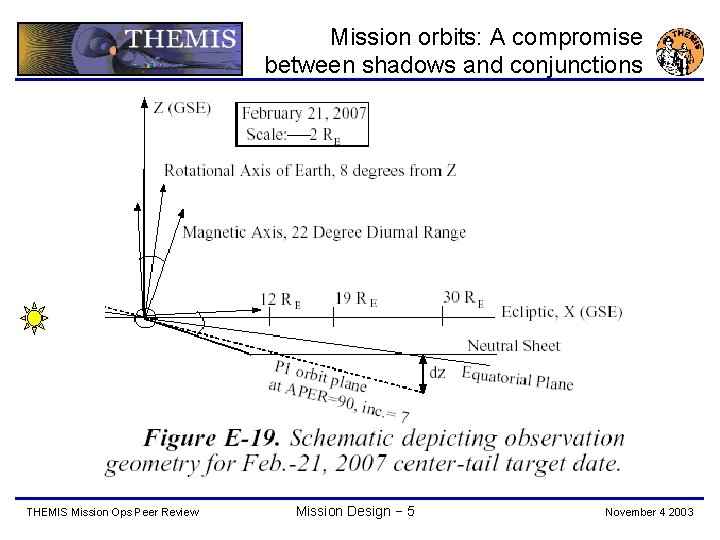
Mission Requirements 2 Mission Requirements (in addition to the L 1 requirements discussed) − M-2 The THEMIS project shall develop a plan to meet the NASA orbital debris guidelines of re-entry in NASA Safety Standard (NSS) 1740. 14 − − M-25 Each Probe shall be designed to achieve electrical energy balance over an orbit assuming a 30 minute transmitter power on time and a 180 min eclipse. − − Compliance: Already accounted for in nominal DV budget Compliance: Orbit design avoids orbit elements with long shadows M-44 Within the schedule cap (<March 2007), the THEMIS launch date shall not be restricted [Restating a L 1 requirement]. − Compliance: Bus and orbit design are independent of launch date Main drivers for orbit design to meet science requirements Shadows < 180 min [pick appropriate RAP and inclination] Conjunctions with. Mission Canada [Pick sidereal day period THEMIS Mission Ops Peer Review Design − 4 November 4 2003 multiples] Conjunctions with plasma sheet [pick
Mission orbits: A compromise between shadows and conjunctions THEMIS Mission Ops Peer Review Mission Design − 5 November 4 2003
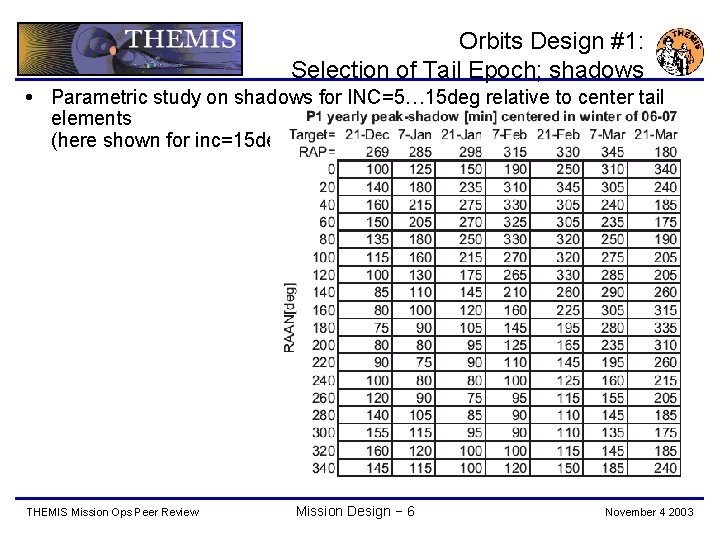
Orbits Design #1: Selection of Tail Epoch; shadows Parametric study on shadows for INC=5… 15 deg relative to center tail elements (here shown for inc=15 deg): THEMIS Mission Ops Peer Review Mission Design − 6 November 4 2003
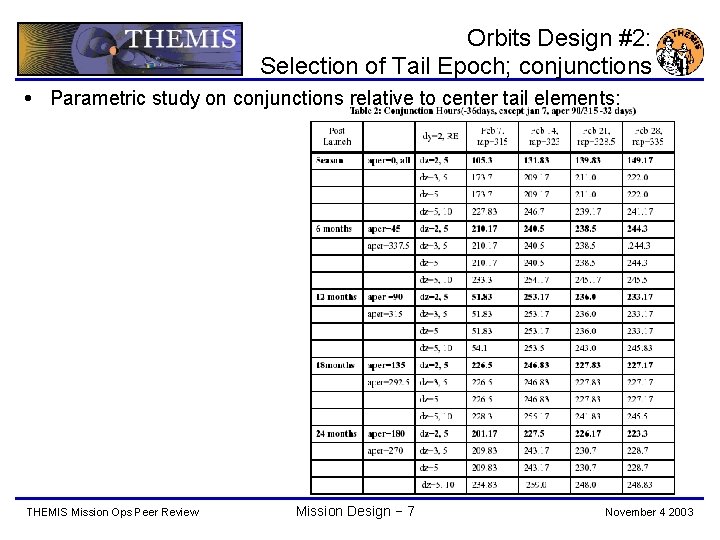
Orbits Design #2: Selection of Tail Epoch; conjunctions Parametric study on conjunctions relative to center tail elements: THEMIS Mission Ops Peer Review Mission Design − 7 November 4 2003
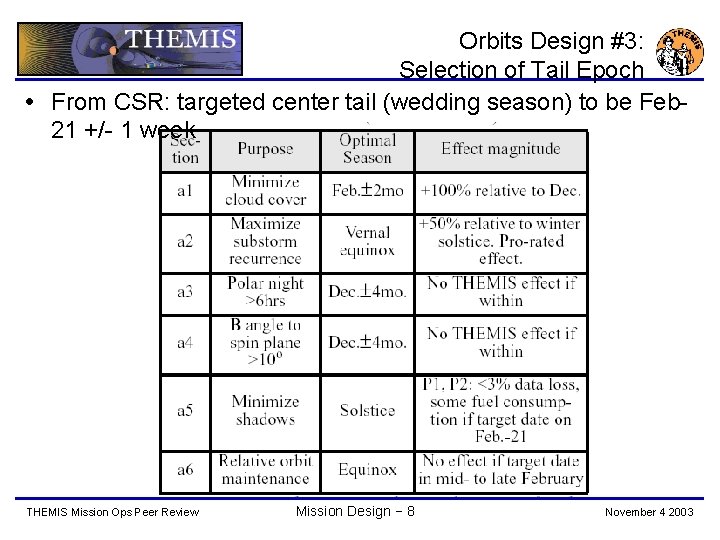
Orbits Design #3: Selection of Tail Epoch From CSR: targeted center tail (wedding season) to be Feb 21 +/- 1 week THEMIS Mission Ops Peer Review Mission Design − 8 November 4 2003
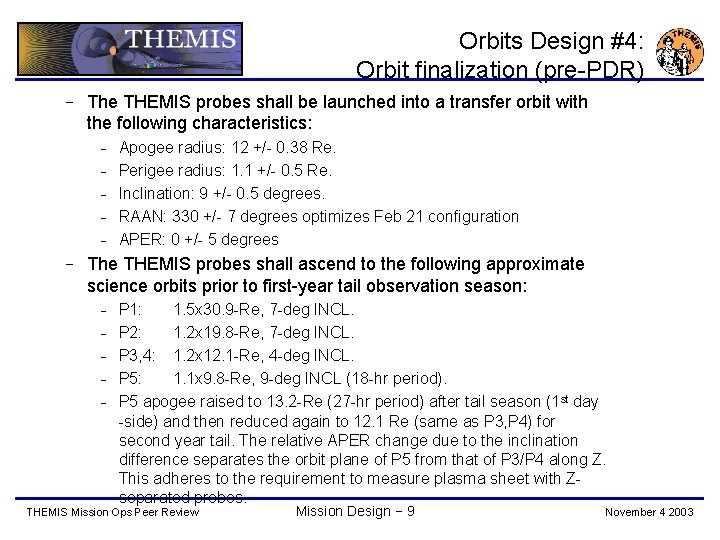
Orbits Design #4: Orbit finalization (pre-PDR) − The THEMIS probes shall be launched into a transfer orbit with the following characteristics: − − − Apogee radius: 12 +/- 0. 38 Re. Perigee radius: 1. 1 +/- 0. 5 Re. Inclination: 9 +/- 0. 5 degrees. RAAN: 330 +/- 7 degrees optimizes Feb 21 configuration APER: 0 +/- 5 degrees The THEMIS probes shall ascend to the following approximate science orbits prior to first-year tail observation season: − − − P 1: 1. 5 x 30. 9 -Re, 7 -deg INCL. P 2: 1. 2 x 19. 8 -Re, 7 -deg INCL. P 3, 4: 1. 2 x 12. 1 -Re, 4 -deg INCL. P 5: 1. 1 x 9. 8 -Re, 9 -deg INCL (18 -hr period). P 5 apogee raised to 13. 2 -Re (27 -hr period) after tail season (1 st day -side) and then reduced again to 12. 1 Re (same as P 3, P 4) for second year tail. The relative APER change due to the inclination difference separates the orbit plane of P 5 from that of P 3/P 4 along Z. This adheres to the requirement to measure plasma sheet with Zseparated probes. THEMIS Mission Ops Peer Review Mission Design − 9 November 4 2003
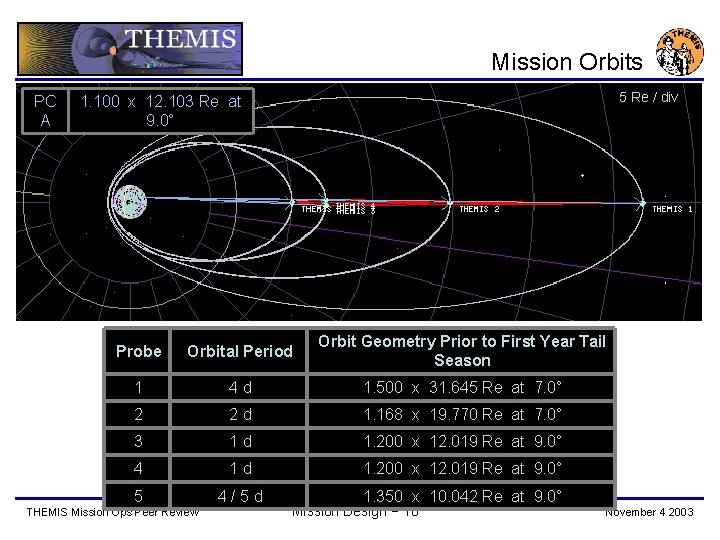
Mission Orbits PC A 5 Re / div 1. 100 x 12. 103 Re at 9. 0° Probe Orbital Period Orbit Geometry Prior to First Year Tail Season 1 4 d 1. 500 x 31. 645 Re at 7. 0° 2 2 d 1. 168 x 19. 770 Re at 7. 0° 3 1 d 1. 200 x 12. 019 Re at 9. 0° 4 1 d 1. 200 x 12. 019 Re at 9. 0° 5 4/5 d 1. 350 x 10. 042 Re at 9. 0° THEMIS Mission Ops Peer Review Mission Design − 10 November 4 2003
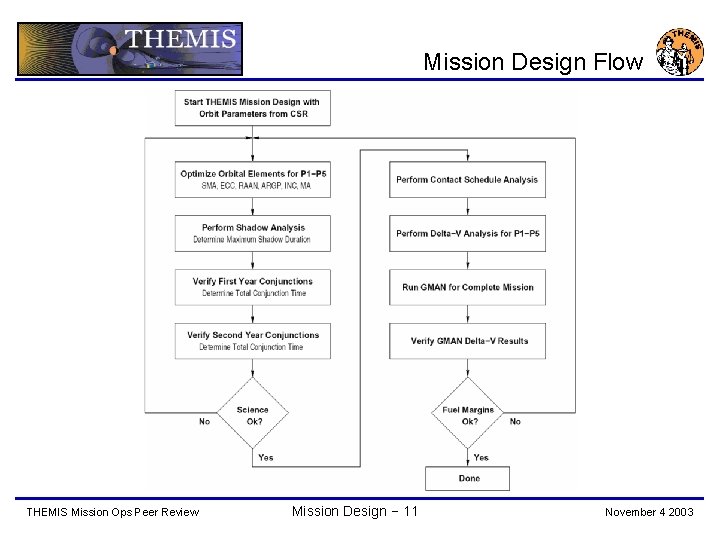
Mission Design Flow THEMIS Mission Ops Peer Review Mission Design − 11 November 4 2003
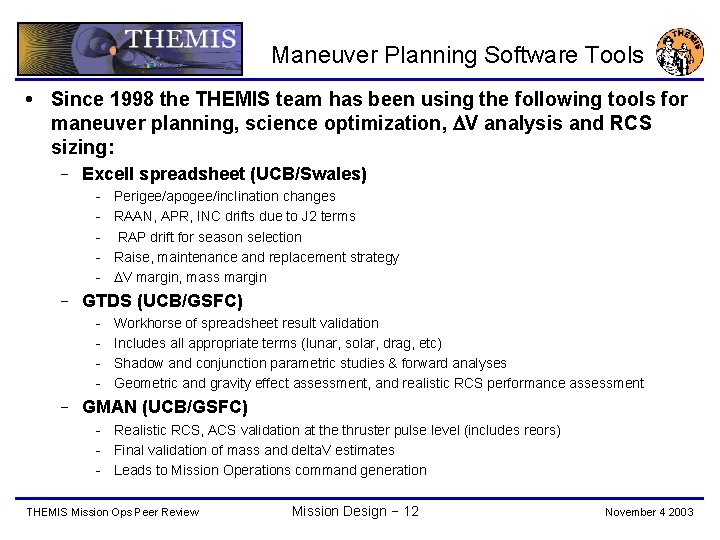
Maneuver Planning Software Tools Since 1998 the THEMIS team has been using the following tools for maneuver planning, science optimization, DV analysis and RCS sizing: − Excell spreadsheet (UCB/Swales) − − − GTDS (UCB/GSFC) − − − Perigee/apogee/inclination changes RAAN, APR, INC drifts due to J 2 terms RAP drift for season selection Raise, maintenance and replacement strategy DV margin, mass margin Workhorse of spreadsheet result validation Includes all appropriate terms (lunar, solar, drag, etc) Shadow and conjunction parametric studies & forward analyses Geometric and gravity effect assessment, and realistic RCS performance assessment GMAN (UCB/GSFC) − − − Realistic RCS, ACS validation at the thruster pulse level (includes reors) Final validation of mass and delta. V estimates Leads to Mission Operations command generation THEMIS Mission Ops Peer Review Mission Design − 12 November 4 2003
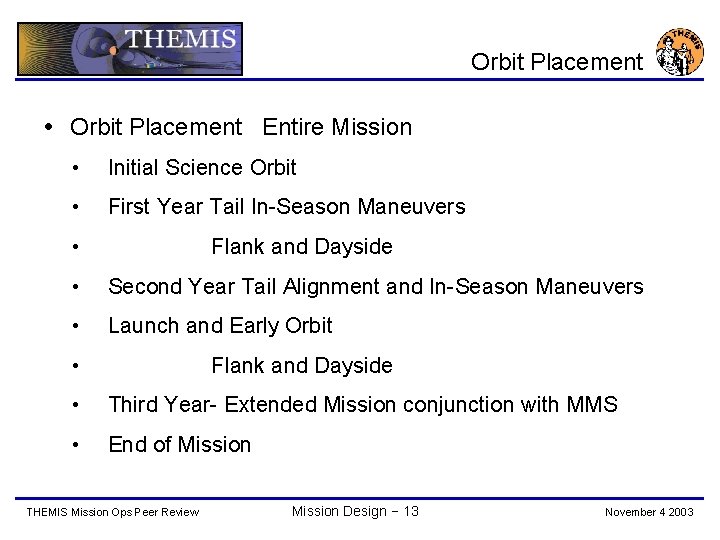
Orbit Placement Entire Mission • Initial Science Orbit • First Year Tail In-Season Maneuvers • Flank and Dayside • Second Year Tail Alignment and In-Season Maneuvers • Launch and Early Orbit • Flank and Dayside • Third Year- Extended Mission conjunction with MMS • End of Mission THEMIS Mission Ops Peer Review Mission Design − 13 November 4 2003
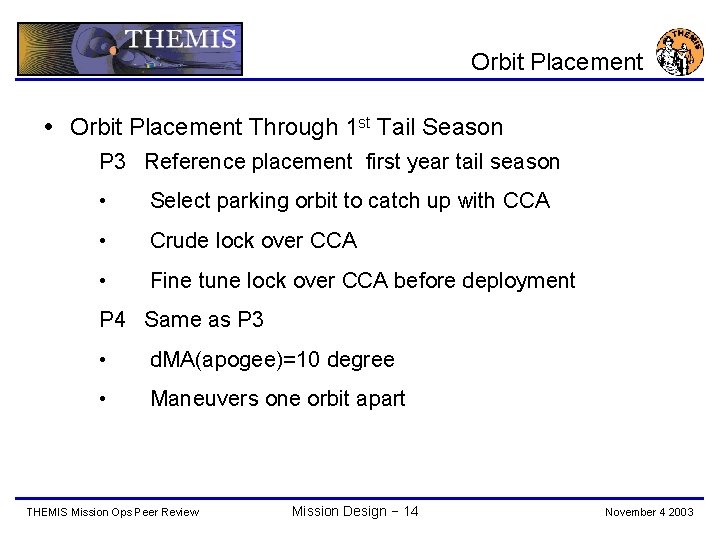
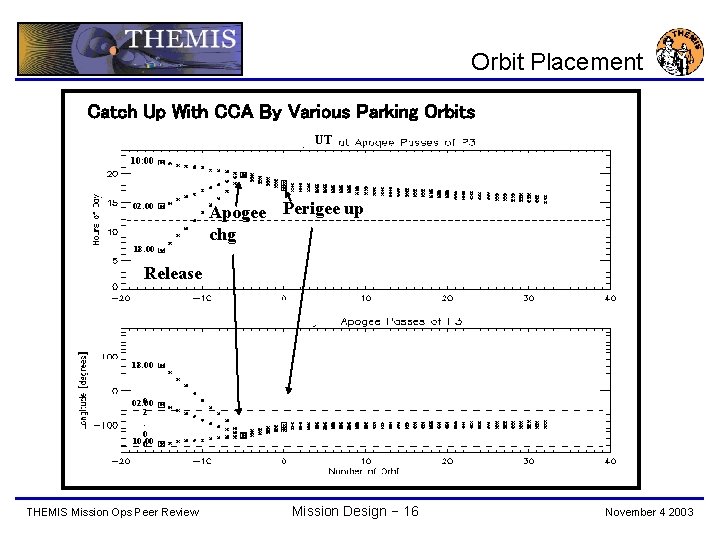
Orbit Placement Through 1 st Tail Season P 3 Reference placement first year tail season • Select parking orbit to catch up with CCA • Crude lock over CCA • Fine tune lock over CCA before deployment P 4 Same as P 3 • d. MA(apogee)=10 degree • Maneuvers one orbit apart THEMIS Mission Ops Peer Review Mission Design − 14 November 4 2003
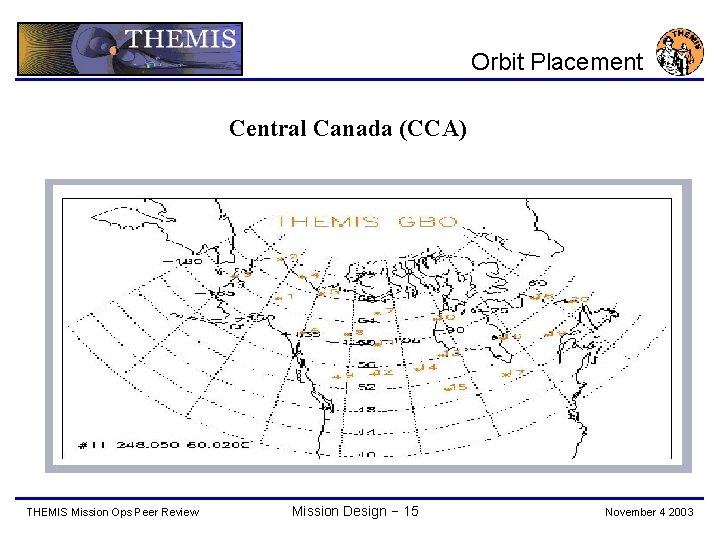
Orbit Placement Central Canada (CCA) THEMIS Mission Ops Peer Review Mission Design − 15 November 4 2003
Orbit Placement Catch Up With CCA By Various Parking Orbits UT 10: 00 02: 00 Apogee Perigee up chg 18: 00 Release 18: 00 0 02: 00 2 : 0 10: 00 0 THEMIS Mission Ops Peer Review Mission Design − 16 November 4 2003
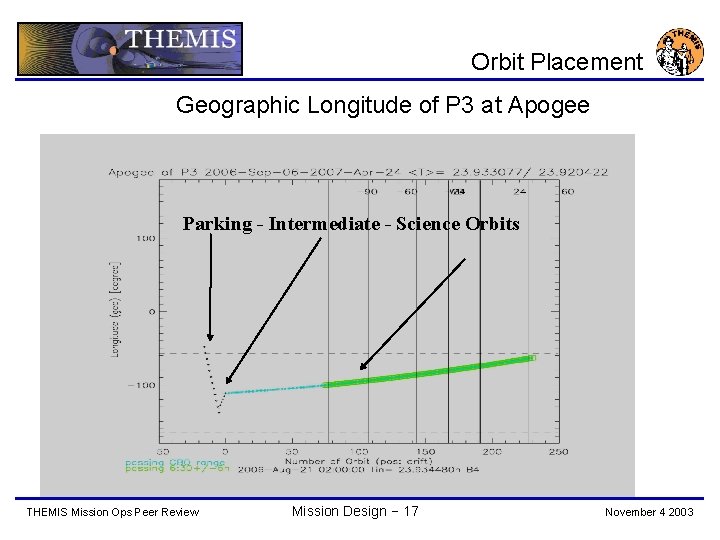
Orbit Placement Geographic Longitude of P 3 at Apogee Parking - Intermediate - Science Orbits THEMIS Mission Ops Peer Review Mission Design − 17 November 4 2003
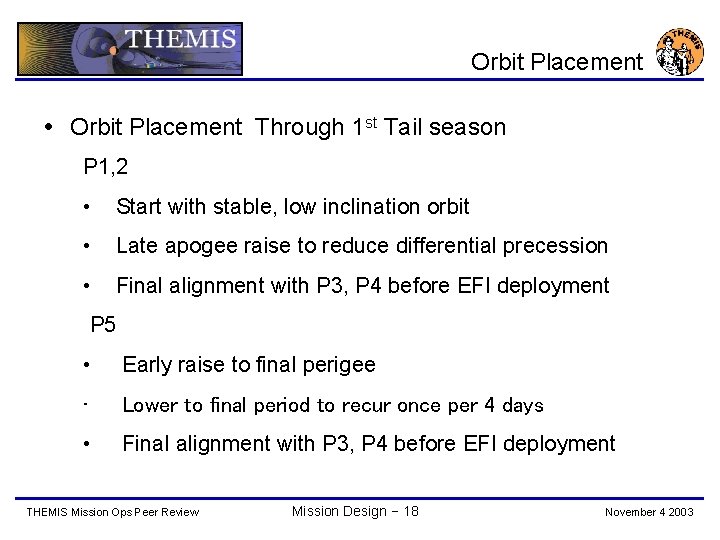
Orbit Placement Through 1 st Tail season P 1, 2 • Start with stable, low inclination orbit • Late apogee raise to reduce differential precession • Final alignment with P 3, P 4 before EFI deployment P 5 • Early raise to final perigee • Lower to final period to recur once per 4 days • Final alignment with P 3, P 4 before EFI deployment THEMIS Mission Ops Peer Review Mission Design − 18 November 4 2003
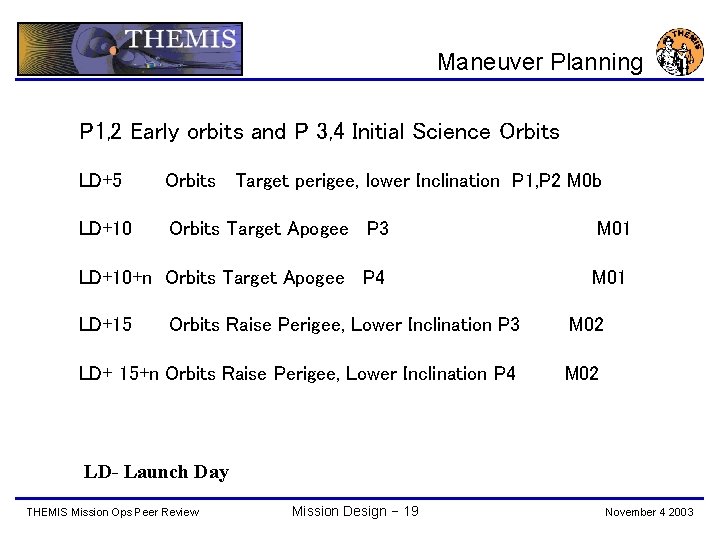
Maneuver Planning P 1, 2 Early orbits and P 3, 4 Initial Science Orbits LD+5 Orbits Target perigee, lower Inclination P 1, P 2 M 0 b LD+10 Orbits Target Apogee P 3 M 01 LD+10+n Orbits Target Apogee P 4 M 01 LD+15 Orbits Raise Perigee, Lower Inclination P 3 M 02 LD+ 15+n Orbits Raise Perigee, Lower Inclination P 4 M 02 LD- Launch Day THEMIS Mission Ops Peer Review Mission Design − 19 November 4 2003
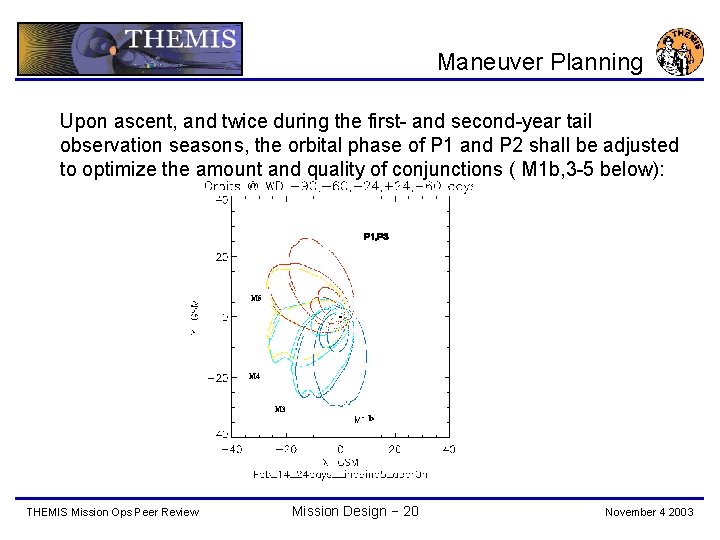
Maneuver Planning Upon ascent, and twice during the first- and second-year tail observation seasons, the orbital phase of P 1 and P 2 shall be adjusted to optimize the amount and quality of conjunctions ( M 1 b, 3 -5 below): P 1, P 3 M 5 M 4 M 3 THEMIS Mission Ops Peer Review b Mission Design − 20 November 4 2003
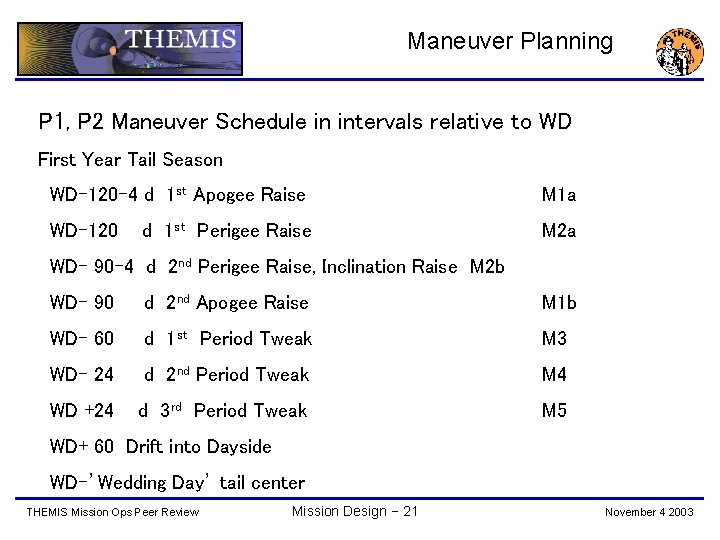
Maneuver Planning P 1, P 2 Maneuver Schedule in intervals relative to WD First Year Tail Season WD-120 -4 d 1 st Apogee Raise M 1 a d 1 st Perigee Raise M 2 a WD-120 WD- 90 -4 d 2 nd Perigee Raise, Inclination Raise M 2 b WD- 90 d 2 nd Apogee Raise M 1 b WD- 60 d 1 st Period Tweak M 3 WD- 24 d 2 nd Period Tweak M 4 WD +24 d 3 rd Period Tweak M 5 WD+ 60 Drift into Dayside WD-’Wedding Day’ tail center THEMIS Mission Ops Peer Review Mission Design − 21 November 4 2003
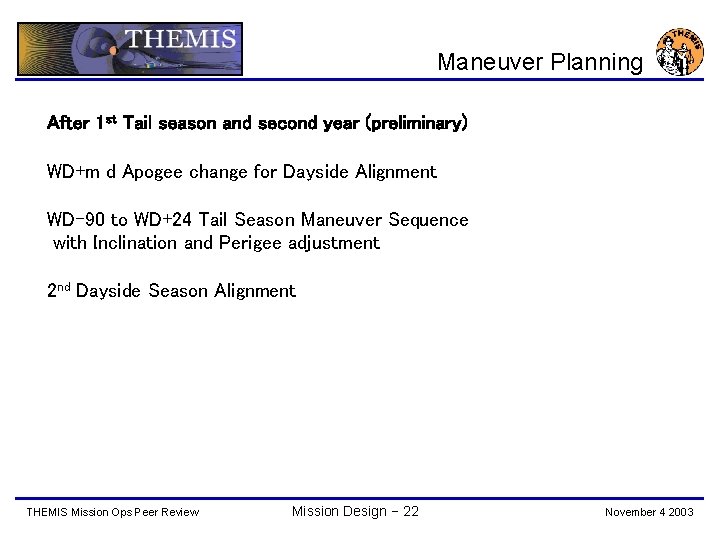
Maneuver Planning After 1 st Tail season and second year (preliminary) WD+m d Apogee change for Dayside Alignment WD-90 to WD+24 Tail Season Maneuver Sequence with Inclination and Perigee adjustment 2 nd Dayside Season Alignment THEMIS Mission Ops Peer Review Mission Design − 22 November 4 2003
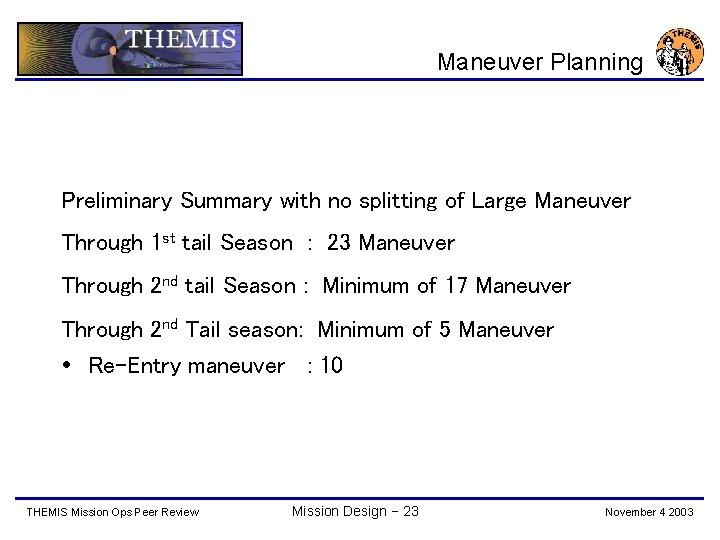
Maneuver Planning Preliminary Summary with no splitting of Large Maneuver Through 1 st tail Season : 23 Maneuver Through 2 nd tail Season : Minimum of 17 Maneuver Through 2 nd Tail season: Minimum of 5 Maneuver Re-Entry maneuver : 10 THEMIS Mission Ops Peer Review Mission Design − 23 November 4 2003
Maneuver Planning Schedule P 1 Through 1 st Tail Saeson ID UT d. V[km/s] ; ; ; ; M 0 b_P 1 2006 -Aug-26 16: 40: 34. 31 0. 03009 M 1 a_P 1 2006 -Oct-21 06: 24: 34. 31 0. 08156 M 2 a_P 1 2006 -Oct-24 15: 02: 34. 31 0. 00386 M 2 b_P 1 2006 -Nov-19 04: 42: 04. 31 0. 13107 M 1 b_P 1 2006 -Nov-24 01: 16: 34. 31 0. 20310 M 03_P 1 2006 -Dec-22 20: 17: 34. 31 0. 00363 M 04_P 1 2007 -Jan-30 13: 07: 34. 31 0. 00154 M 05_P 1 2007 -Mar-17 18: 47: 04. 31 0. 00104 P 1 total d. V= 0. 45589349 MC estimate of d. V= 0. 41100000 Projected mission total d. V= 0. 61089349 last maneuver) MC mission total d. V= 0. 56600000 THEMIS Mission Ops Peer Review Mission Design − 24 LD) n 1 005 059 061 080 083 091 101 113 n 2 005 054 002 019 003 008 011 013 (n 2 - orbits after (n 1 -orbits after November 4 2003
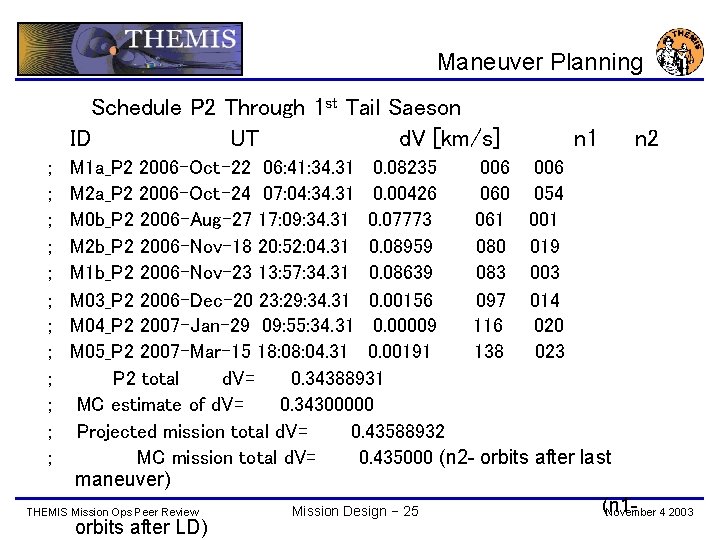
Maneuver Planning Schedule P 2 Through 1 st Tail Saeson ID UT d. V [km/s] ; ; ; n 1 n 2 M 1 a_P 2 2006 -Oct-22 06: 41: 34. 31 0. 08235 006 M 2 a_P 2 2006 -Oct-24 07: 04: 34. 31 0. 00426 060 054 M 0 b_P 2 2006 -Aug-27 17: 09: 34. 31 0. 07773 061 001 M 2 b_P 2 2006 -Nov-18 20: 52: 04. 31 0. 08959 080 019 M 1 b_P 2 2006 -Nov-23 13: 57: 34. 31 0. 08639 083 003 M 03_P 2 2006 -Dec-20 23: 29: 34. 31 0. 00156 097 014 M 04_P 2 2007 -Jan-29 09: 55: 34. 31 0. 00009 116 020 M 05_P 2 2007 -Mar-15 18: 04. 31 0. 00191 138 023 P 2 total d. V= 0. 34388931 MC estimate of d. V= 0. 34300000 Projected mission total d. V= 0. 43588932 MC mission total d. V= 0. 435000 (n 2 - orbits after last maneuver) (n 1 THEMIS Mission Ops Peer Review Mission Design − 25 November 4 2003 orbits after LD)
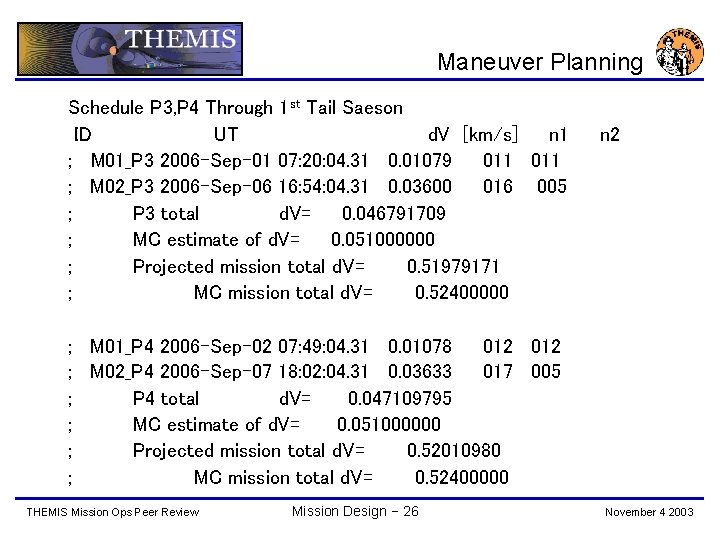
Maneuver Planning Schedule P 3, P 4 Through 1 st Tail Saeson ID UT d. V [km/s] n 1 ; M 01_P 3 2006 -Sep-01 07: 20: 04. 31 0. 01079 011 ; M 02_P 3 2006 -Sep-06 16: 54: 04. 31 0. 03600 016 005 ; P 3 total d. V= 0. 046791709 ; MC estimate of d. V= 0. 051000000 ; Projected mission total d. V= 0. 51979171 ; MC mission total d. V= 0. 52400000 n 2 ; M 01_P 4 2006 -Sep-02 07: 49: 04. 31 0. 01078 012 ; M 02_P 4 2006 -Sep-07 18: 02: 04. 31 0. 03633 017 005 ; P 4 total d. V= 0. 047109795 ; MC estimate of d. V= 0. 051000000 ; Projected mission total d. V= 0. 52010980 ; MC mission total d. V= 0. 52400000 THEMIS Mission Ops Peer Review Mission Design − 26 November 4 2003
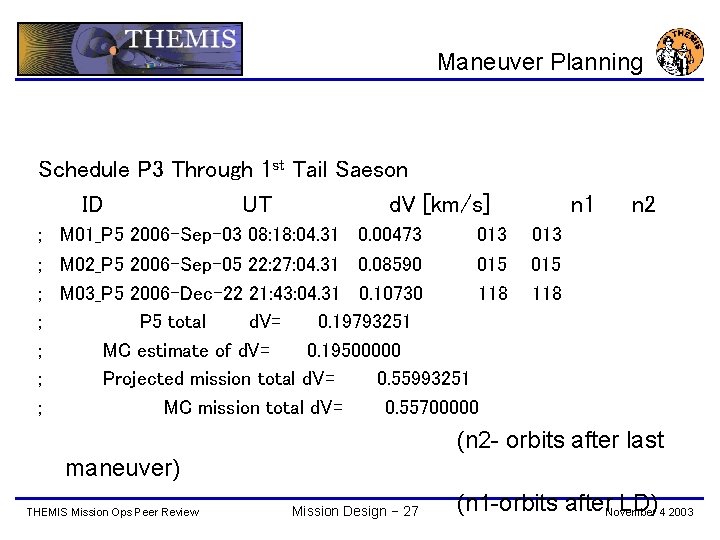
Maneuver Planning Schedule P 3 Through 1 st Tail Saeson ID UT d. V [km/s] ; M 01_P 5 2006 -Sep-03 08: 18: 04. 31 0. 00473 013 ; M 02_P 5 2006 -Sep-05 22: 27: 04. 31 0. 08590 015 ; M 03_P 5 2006 -Dec-22 21: 43: 04. 31 0. 10730 118 ; P 5 total d. V= 0. 19793251 ; MC estimate of d. V= 0. 19500000 ; Projected mission total d. V= 0. 55993251 ; MC mission total d. V= 0. 55700000 n 1 n 2 013 015 118 (n 2 - orbits after last maneuver) THEMIS Mission Ops Peer Review Mission Design − 27 (n 1 -orbits after. November LD) 4 2003
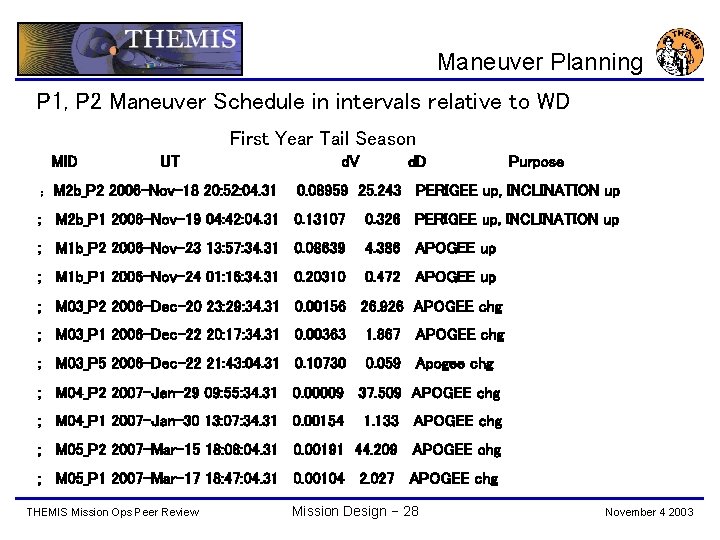
Maneuver Planning P 1, P 2 Maneuver Schedule in intervals relative to WD First Year Tail Season MID ; UT M 2 b_P 2 2006 -Nov-18 20: 52: 04. 31 d. V d. D Purpose 0. 08959 25. 243 PERIGEE up, INCLINATION up ; M 2 b_P 1 2006 -Nov-19 04: 42: 04. 31 0. 13107 0. 326 PERIGEE up, INCLINATION up ; M 1 b_P 2 2006 -Nov-23 13: 57: 34. 31 0. 08639 4. 386 APOGEE up ; M 1 b_P 1 2006 -Nov-24 01: 16: 34. 31 0. 20310 0. 472 APOGEE up ; M 03_P 2 2006 -Dec-20 23: 29: 34. 31 0. 00156 26. 926 APOGEE chg ; M 03_P 1 2006 -Dec-22 20: 17: 34. 31 0. 00363 1. 867 APOGEE chg ; M 03_P 5 2006 -Dec-22 21: 43: 04. 31 0. 10730 0. 059 Apogee chg ; M 04_P 2 2007 -Jan-29 09: 55: 34. 31 0. 00009 37. 509 APOGEE chg ; M 04_P 1 2007 -Jan-30 13: 07: 34. 31 0. 00154 1. 133 APOGEE chg ; M 05_P 2 2007 -Mar-15 18: 04. 31 0. 00191 44. 209 APOGEE chg ; M 05_P 1 2007 -Mar-17 18: 47: 04. 31 0. 00104 2. 027 APOGEE chg THEMIS Mission Ops Peer Review Mission Design − 28 November 4 2003
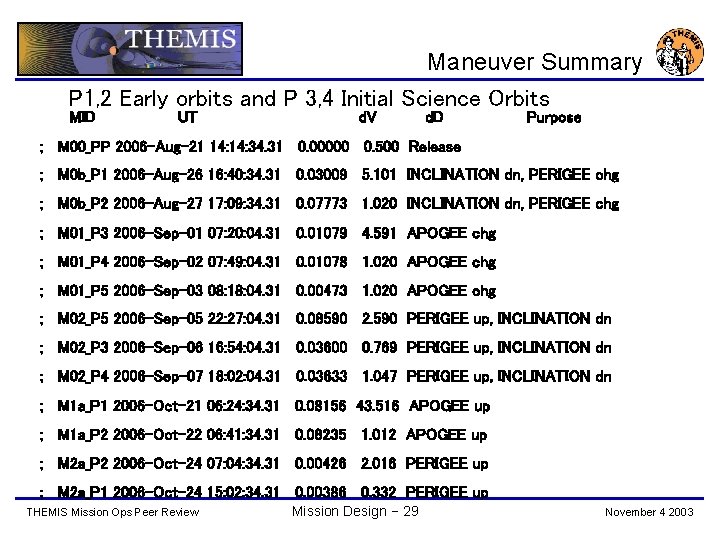
Maneuver Summary P 1, 2 Early orbits and P 3, 4 Initial Science Orbits MID UT d. V d. D Purpose ; M 00_PP 2006 -Aug-21 14: 34. 31 0. 00000 0. 500 Release ; M 0 b_P 1 2006 -Aug-26 16: 40: 34. 31 0. 03009 5. 101 INCLINATION dn, PERIGEE chg ; M 0 b_P 2 2006 -Aug-27 17: 09: 34. 31 0. 07773 1. 020 INCLINATION dn, PERIGEE chg ; M 01_P 3 2006 -Sep-01 07: 20: 04. 31 0. 01079 4. 591 APOGEE chg ; M 01_P 4 2006 -Sep-02 07: 49: 04. 31 0. 01078 1. 020 APOGEE chg ; M 01_P 5 2006 -Sep-03 08: 18: 04. 31 0. 00473 1. 020 APOGEE chg ; M 02_P 5 2006 -Sep-05 22: 27: 04. 31 0. 08590 2. 590 PERIGEE up, INCLINATION dn ; M 02_P 3 2006 -Sep-06 16: 54: 04. 31 0. 03600 0. 769 PERIGEE up, INCLINATION dn ; M 02_P 4 2006 -Sep-07 18: 02: 04. 31 0. 03633 1. 047 PERIGEE up, INCLINATION dn ; M 1 a_P 1 2006 -Oct-21 06: 24: 34. 31 0. 08156 43. 516 APOGEE up ; M 1 a_P 2 2006 -Oct-22 06: 41: 34. 31 0. 08235 1. 012 APOGEE up ; M 2 a_P 2 2006 -Oct-24 07: 04: 34. 31 0. 00426 2. 016 PERIGEE up ; M 2 a_P 1 2006 -Oct-24 15: 02: 34. 31 0. 00386 0. 332 PERIGEE up THEMIS Mission Ops Peer Review Mission Design − 29 November 4 2003
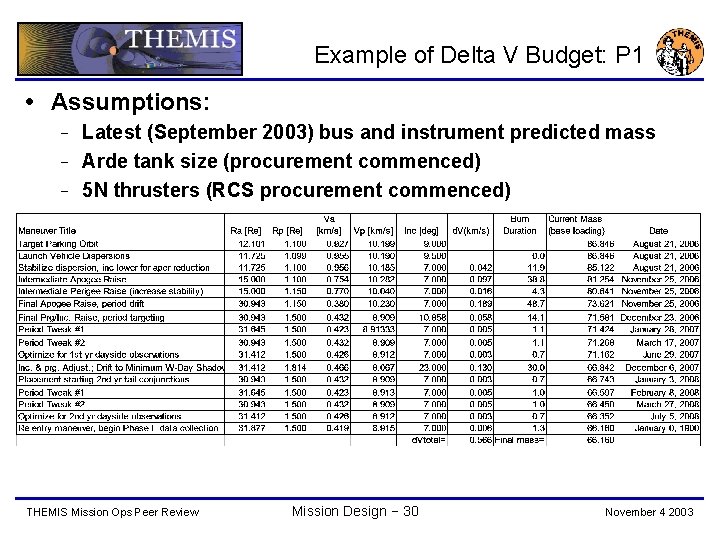
Example of Delta V Budget: P 1 Assumptions: Latest (September 2003) bus and instrument predicted mass − Arde tank size (procurement commenced) − 5 N thrusters (RCS procurement commenced) − THEMIS Mission Ops Peer Review Mission Design − 30 November 4 2003
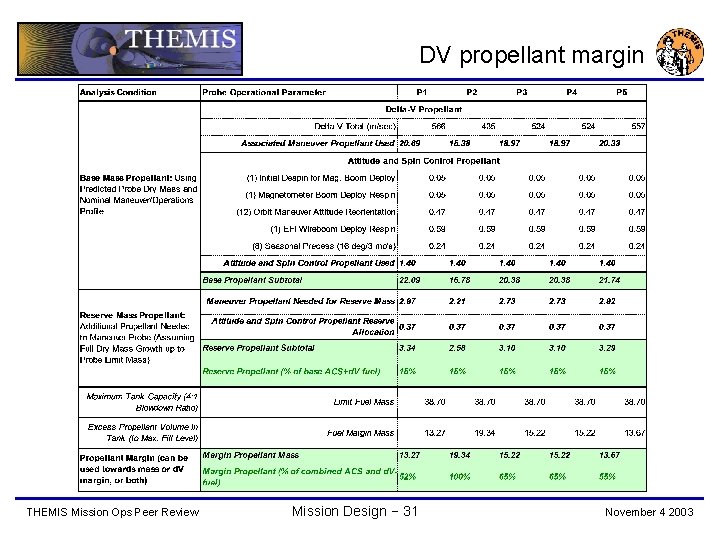
DV propellant margin THEMIS Mission Ops Peer Review Mission Design − 31 November 4 2003
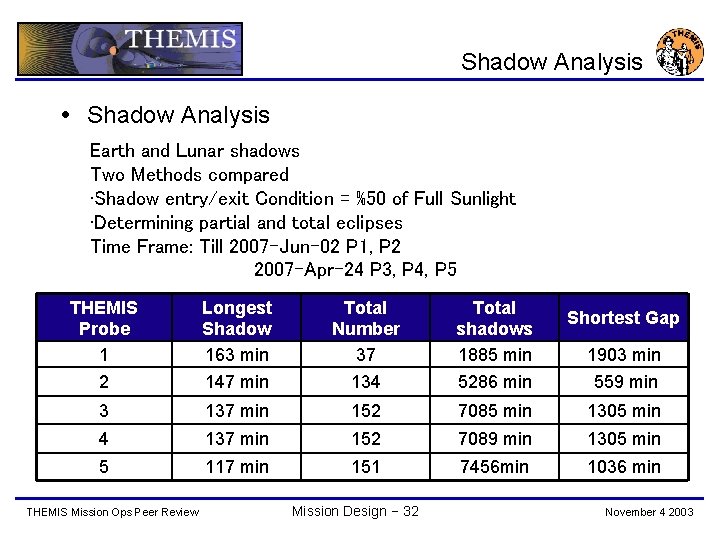
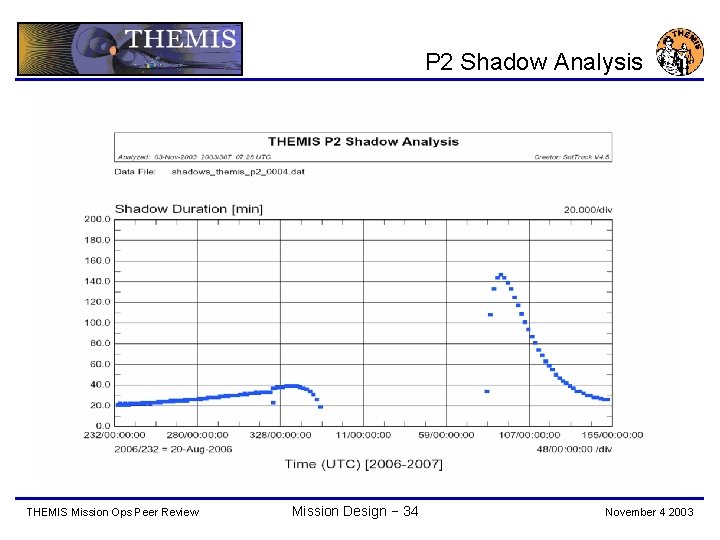
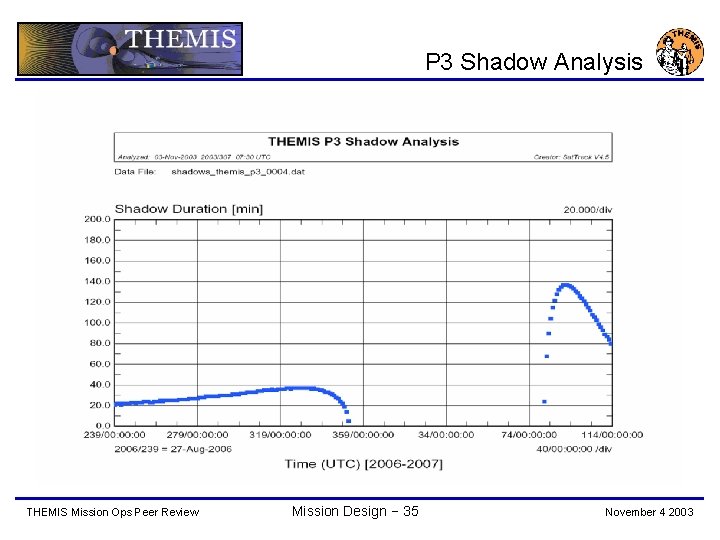
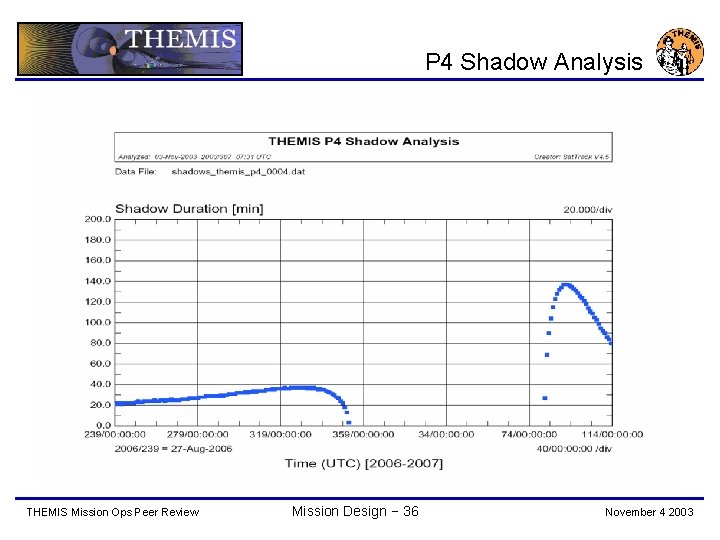
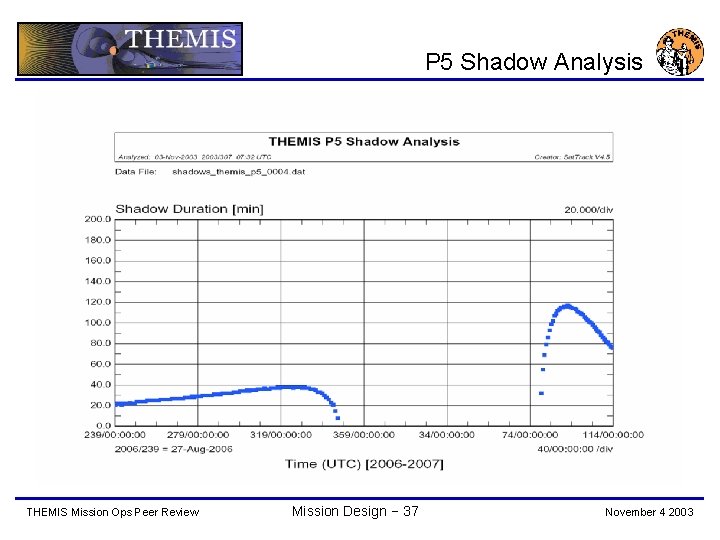
Shadow Analysis Earth and Lunar shadows Two Methods compared • Shadow entry/exit Condition = %50 of Full Sunlight • Determining partial and total eclipses Time Frame: Till 2007 -Jun-02 P 1, P 2 2007 -Apr-24 P 3, P 4, P 5 THEMIS Probe 1 Longest Shadow 163 min Total Number 37 Total shadows 1885 min 2 147 min 134 5286 min 559 min 3 137 min 152 7085 min 1305 min 4 137 min 152 7089 min 1305 min 5 117 min 151 7456 min 1036 min THEMIS Mission Ops Peer Review Mission Design − 32 Shortest Gap 1903 min November 4 2003
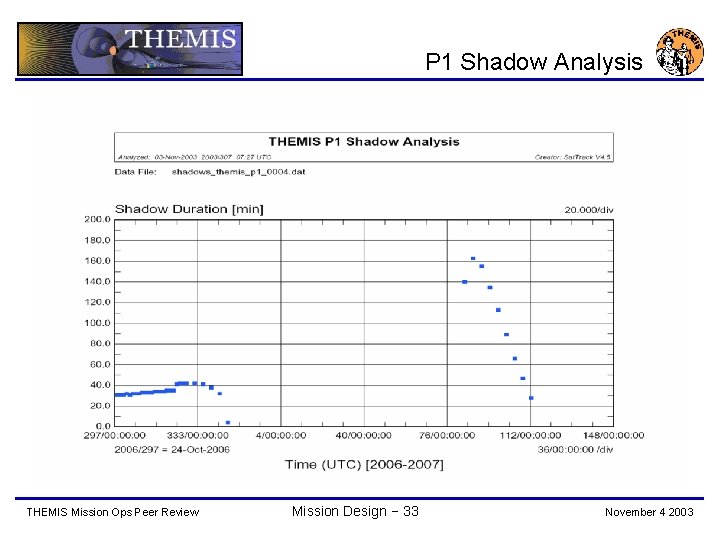
P 1 Shadow Analysis THEMIS Mission Ops Peer Review Mission Design − 33 November 4 2003
P 2 Shadow Analysis THEMIS Mission Ops Peer Review Mission Design − 34 November 4 2003
P 3 Shadow Analysis THEMIS Mission Ops Peer Review Mission Design − 35 November 4 2003
P 4 Shadow Analysis THEMIS Mission Ops Peer Review Mission Design − 36 November 4 2003
P 5 Shadow Analysis THEMIS Mission Ops Peer Review Mission Design − 37 November 4 2003
Conjunction Analysis • The selected orbital plan shall achieve greater than 188 hours of four-probe conjunctions during the prime tail observation season (September to April). –The number of hours of conjunctions required to satisfy the L 1 requirements takes into account the typical spatial extent and location of the substorm event, proximity required to detect the event, and the average rate of substorm occurrence. –Satisfaction of the conjunction requirement is established via orbit simulation using GTDS and a neutral sheet model. –A Conjunction satisfies the following criteria: –Four probes within 2 Re in Ygsm. –Inner probes within 2 Re of model neutral sheet. –Outer probes within 5 Re of model neutral sheet. THEMIS Mission Ops Peer Review Mission Design − 38 November 4 2003
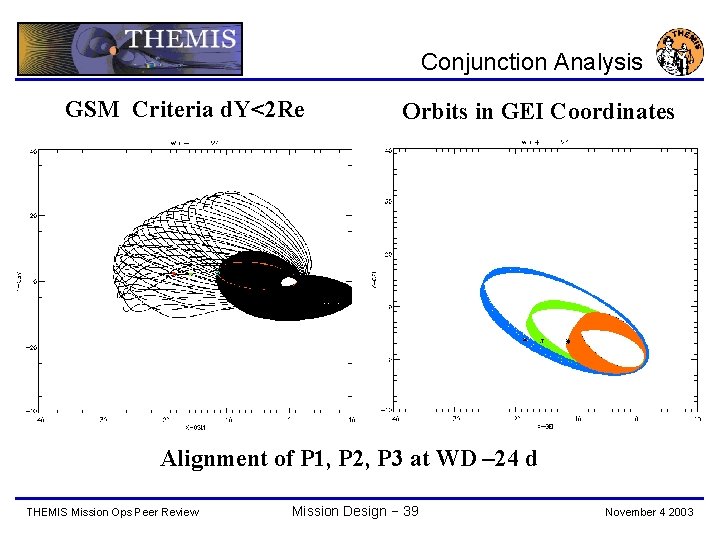
Conjunction Analysis GSM Criteria d. Y<2 Re Orbits in GEI Coordinates Alignment of P 1, P 2, P 3 at WD – 24 d THEMIS Mission Ops Peer Review Mission Design − 39 November 4 2003
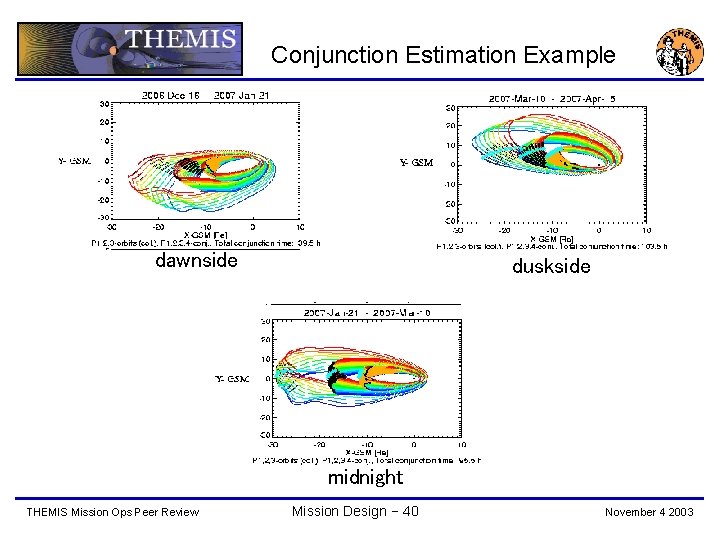
Conjunction Estimation Example dawnside duskside midnight THEMIS Mission Ops Peer Review Mission Design − 40 November 4 2003
Status and Next Steps Status Simulation of Orbit Placements for P 1, P 2, P 3, P 4, P 5 through first Tail Season In high precision Mode to accomplish Shadows < 180 min Conjunctions with Canada Maneuver separation Verify d. V Budget for perturbation included Next Steps Improve Conjunctions with plasma sheet in progress Finish Dayside and 2 nd Year Mission Verify maneuver Scenarios with GMAN in progress Implementing Maneuver simulation Replacement Scenarios Re-Iterate to optimize according to Mission Design Flow Chart Ground Contact analysis and maneuver Schedule d. V Budget with attitude Maneuver THEMIS Mission Ops Peer Review Mission Design − 41 November 4 2003
Backup slides on P 2, 3, 4, 5 and replacement strategy…. . THEMIS Mission Ops Peer Review Mission Design − 42 November 4 2003
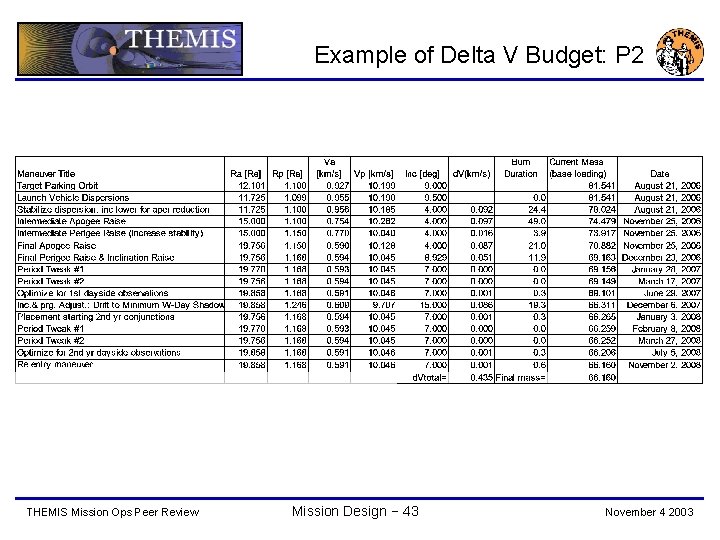
Example of Delta V Budget: P 2 THEMIS Mission Ops Peer Review Mission Design − 43 November 4 2003
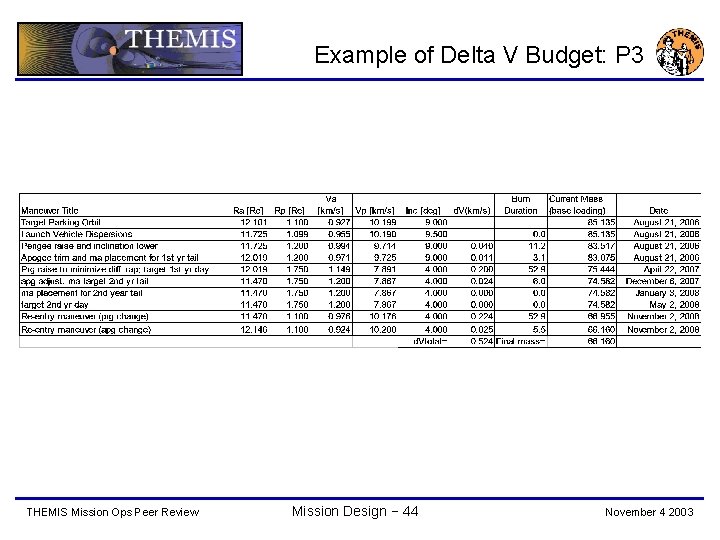
Example of Delta V Budget: P 3 THEMIS Mission Ops Peer Review Mission Design − 44 November 4 2003
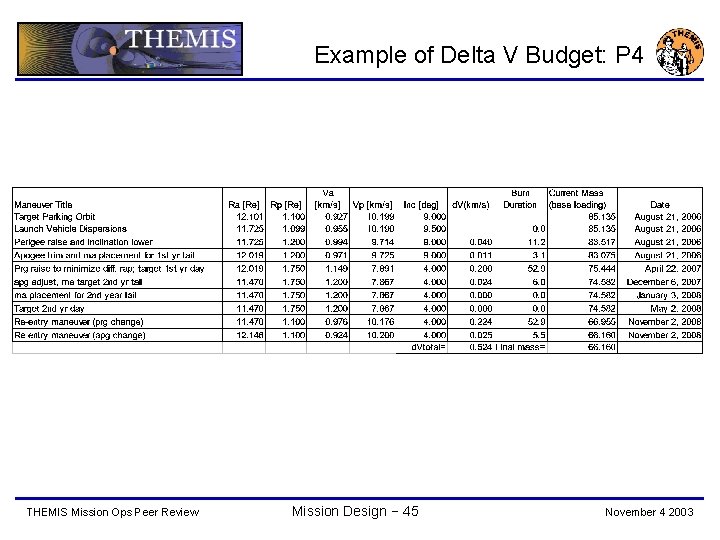
Example of Delta V Budget: P 4 THEMIS Mission Ops Peer Review Mission Design − 45 November 4 2003
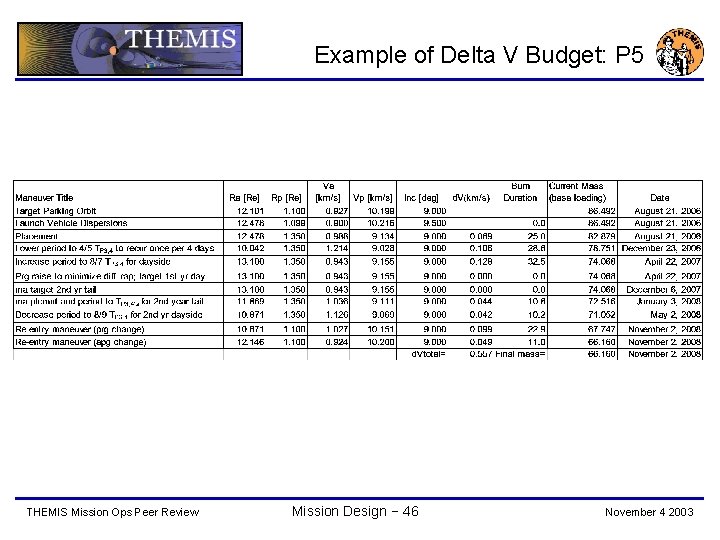
Example of Delta V Budget: P 5 THEMIS Mission Ops Peer Review Mission Design − 46 November 4 2003
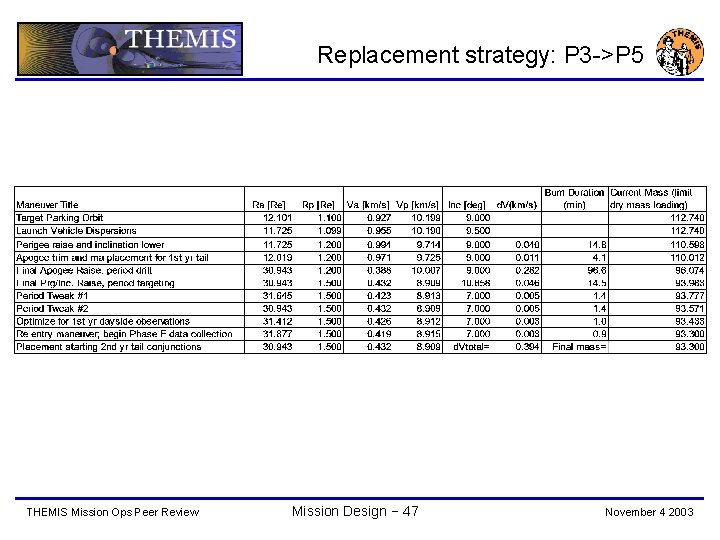
Replacement strategy: P 3 ->P 5 THEMIS Mission Ops Peer Review Mission Design − 47 November 4 2003