
Themis Burst Modes How much burst data can
Themis Burst Modes • How much burst data can be transmitted • What phenomena do we want to catch • A burst trigger algorithm and applications
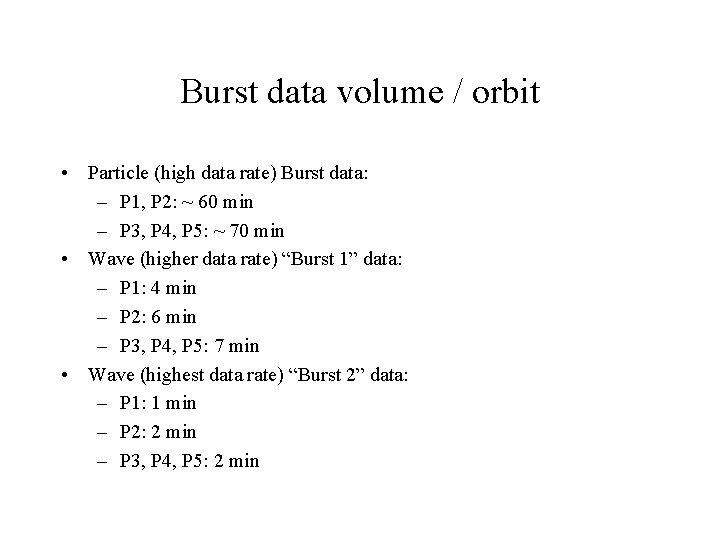
Burst data volume / orbit • Particle (high data rate) Burst data: – P 1, P 2: ~ 60 min – P 3, P 4, P 5: ~ 70 min • Wave (higher data rate) “Burst 1” data: – P 1: 4 min – P 2: 6 min – P 3, P 4, P 5: 7 min • Wave (highest data rate) “Burst 2” data: – P 1: 1 min – P 2: 2 min – P 3, P 4, P 5: 2 min
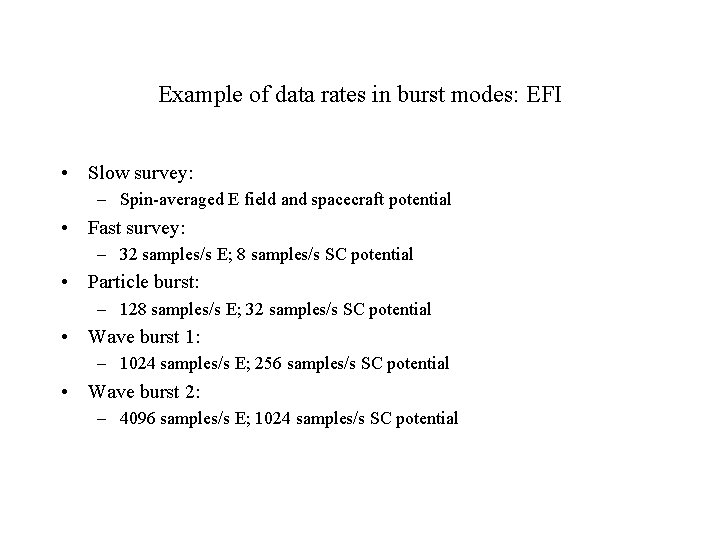
Example of data rates in burst modes: EFI • Slow survey: – Spin-averaged E field and spacecraft potential • Fast survey: – 32 samples/s E; 8 samples/s SC potential • Particle burst: – 128 samples/s E; 32 samples/s SC potential • Wave burst 1: – 1024 samples/s E; 256 samples/s SC potential • Wave burst 2: – 4096 samples/s E; 1024 samples/s SC potential
Relationship between particle and wave bursts • Two options: – Wave bursts occur only within particle bursts – Wave bursts independent of particle bursts
What do we want to catch? • Tail: Current disruption, BBF, PSBL • Flanks: Magnetopause/bow shock/foreshock • Dayside: – Magnetopause/boundary layer – Bow shock – Foreshock magnetic cavities and hot flow anomalies

Burst trigger algorithm: Basic concept (modeled after FAST) • Onboard selection of best data intervals during each orbit • Each data segment has a quality factor Q • Q computed from combination of particles and fields data Q = Q 1 Density + Q 2 Velocity + Q 3 BRMS + Q 4 E +…
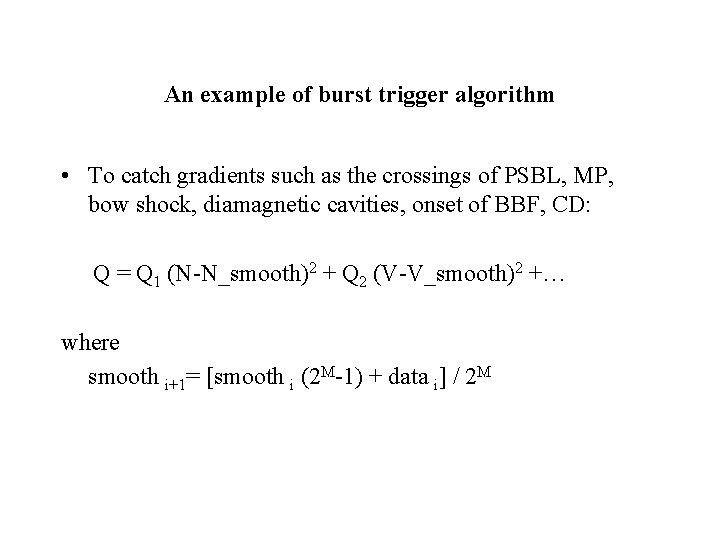
An example of burst trigger algorithm • To catch gradients such as the crossings of PSBL, MP, bow shock, diamagnetic cavities, onset of BBF, CD: Q = Q 1 (N-N_smooth)2 + Q 2 (V-V_smooth)2 +… where smooth i+1= [smooth i (2 M-1) + data i] / 2 M
- Slides: 7