
Themes And Symbols The Coexistence of Good and
Themes And Symbols The Coexistence of Good and Evil Atticus is the Law Southern Life and Racial Injustice The Importance of a Moral Education/Class Structure Courage and Compassion Gender Roles Mockingbirds as the Innocents
Themes: Coexistence of Good & Evil • Explore the moral nature of human beings--Are people essentially good or essentially evil? • Scout and Jem assume that people are good because they have never seen evil. • Develop this throughout the novel in order to understand their world. • The Threat that Prejudice and Ignorance pose to the Innocent • Tom and Boo are not prepared for the evil they encounter and, as a result, are destroyed. • Jem is victimized to an extent by his discovery of the evil of racism during and after the trial • Scout maintains her basic faith in human nature despite the outcome of Tom’s trial, but Jem’s faith in justice is badly damaged
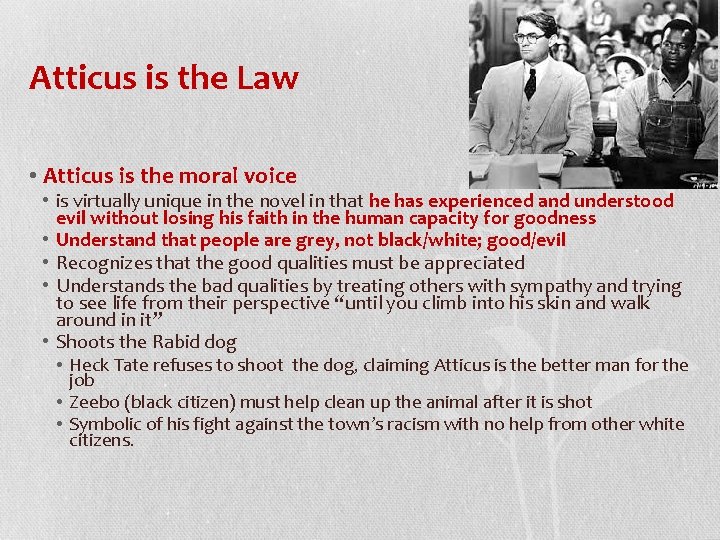
Atticus is the Law • Atticus is the moral voice • is virtually unique in the novel in that he has experienced and understood evil without losing his faith in the human capacity for goodness • Understand that people are grey, not black/white; good/evil • Recognizes that the good qualities must be appreciated • Understands the bad qualities by treating others with sympathy and trying to see life from their perspective “until you climb into his skin and walk around in it” • Shoots the Rabid dog • Heck Tate refuses to shoot the dog, claiming Atticus is the better man for the job • Zeebo (black citizen) must help clean up the animal after it is shot • Symbolic of his fight against the town’s racism with no help from other white citizens.
Southern Life and Racial Injustice • Part One focuses on: • the children’s fascination with Boo Radley • the comfort/safety of their neighborhood • Alexandra awards a caste system to the neighborhood • Geneology determines the neighbors’ habits and personalities (drinking habits, gambling problems, walking with a hunch) • The South itself, with its traditions and taboos, drives the novel • Part Two focuses on: • “the spirit-corodding shame of the civilized white Southerner in the treatment of the Negro” says book reviewer Harding Le. May • Centers around race relations- the reactions of races to issues involved • Shaped by : • Rosa Parks (1955) • Autherine Lucy and Polly Myers Univ. of Alabama admittance in 1956(possibly the two most significant and conflict-ridden social change in the South since the Civil War and Reconstruction)
The Importance of Moral Education • In a sense, the plot of the story charts Scout’s moral education and theme of how children are educated– how they are taught to move from innocence to understanding • Atticus plays a key role in this development • Devotes himself to instilling a social conscience in Jem and Scout • School scenes provide a contrast to Atticus’s effective education • Scout is frequently confronted with teachers who are either frustratingly unsympathetic to children’s need or morally hypocritical • Sympathy and Understanding are the most important lesson • Atticus’s methods vs. Miss Caroline’s rigidity
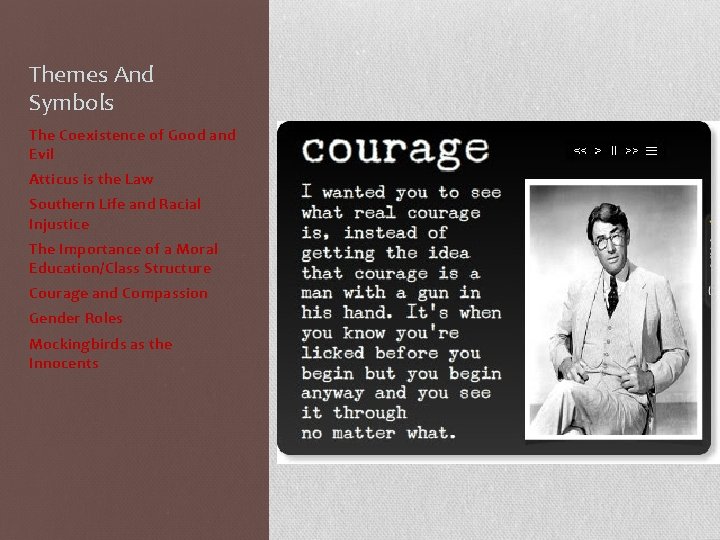
Courage and Compassion • The novel has been noted for its poignant exploration of different forms of courage. • Compassion • Scout’s impulsive inclination to fight students who insult Atticus • Scout ponders the implication of loneliness when she hears Mayella’s testimony, who believes Atticus is making fun of her when he asked who her friends are. • At the end of the novel, Scout considers the events of the novel from Boo’s persepctive • Courage/Respect for Others • “…when you’re licked before you begin but you being anyway and you see it through no matter what…”- Atticus • Helping Mrs. Dubose break her morphine addiction • Defending Tom Robinson
Gender Roles • Throughout the novel, Scout begins to realize what being a female really means by observing and comparing females she encounters. • Positive Influences: • Calpurnia and Miss Maudie: both are independent, strong-willed, and protective • Alexandra: Although wildly prejudiced and very outspoken, conducts herself appropriately according to “Southern Etiquette” • Negative influences: • Alexandra: criticizes Scout for her “boyish” attitude and rude tongue • Mrs. Dubose: chastises her for not wearing a dress, implicating she is “ruining the family name” • Mayella Ewell: destroys and innocent man just to hide her own desire for him • Absent mother and abusive fathers • Moms: Scout and Jem’s (dead), Mayella’s (dead), and Mrs. Radley (silent on Boo’s confinement) • Dads: Bob Ewell (abuser/molester), Mr. Radley (imprisons his son in the house)
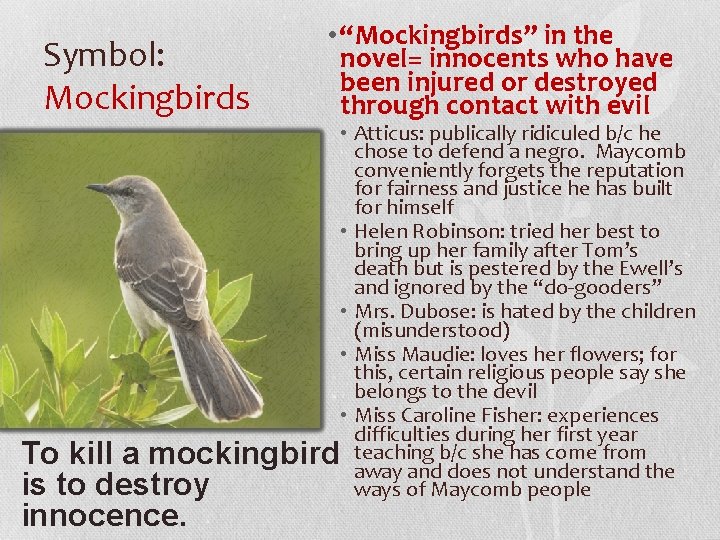
Symbol: Mockingbirds • “Mockingbirds” in the novel= innocents who have been injured or destroyed through contact with evil • Atticus: publically ridiculed b/c he chose to defend a negro. Maycomb conveniently forgets the reputation for fairness and justice he has built for himself • Helen Robinson: tried her best to bring up her family after Tom’s death but is pestered by the Ewell’s and ignored by the “do-gooders” • Mrs. Dubose: is hated by the children (misunderstood) • Miss Maudie: loves her flowers; for this, certain religious people say she belongs to the devil • Miss Caroline Fisher: experiences difficulties during her first year b/c she has come from To kill a mockingbird teaching away and does not understand the is to destroy ways of Maycomb people innocence.
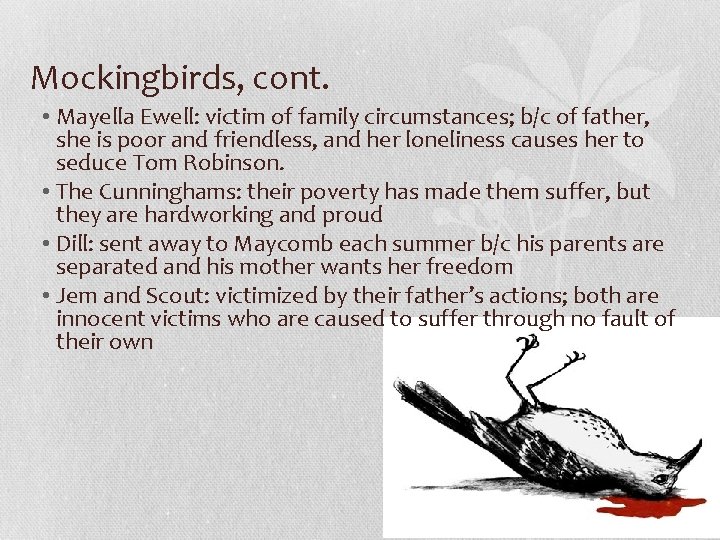
Mockingbirds, cont. • Mayella Ewell: victim of family circumstances; b/c of father, she is poor and friendless, and her loneliness causes her to seduce Tom Robinson. • The Cunninghams: their poverty has made them suffer, but they are hardworking and proud • Dill: sent away to Maycomb each summer b/c his parents are separated and his mother wants her freedom • Jem and Scout: victimized by their father’s actions; both are innocent victims who are caused to suffer through no fault of their own
- Slides: 9