
THEME THESIS EVIDENCE ANALYSIS Reteach Review Issues with
- Slides: 20
THEME& THESIS EVIDENCE & ANALYSIS (Reteach & Review)
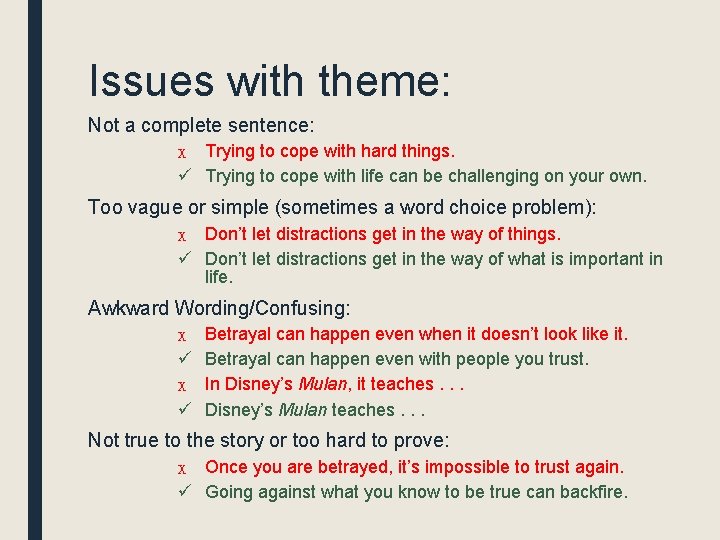
Issues with theme: Not a complete sentence: x Trying to cope with hard things. ü Trying to cope with life can be challenging on your own. Too vague or simple (sometimes a word choice problem): x Don’t let distractions get in the way of things. ü Don’t let distractions get in the way of what is important in life. Awkward Wording/Confusing: x ü Betrayal can happen even when it doesn’t look like it. Betrayal can happen even with people you trust. In Disney’s Mulan, it teaches. . . Disney’s Mulan teaches. . . Not true to the story or too hard to prove: x Once you are betrayed, it’s impossible to trust again. ü Going against what you know to be true can backfire.
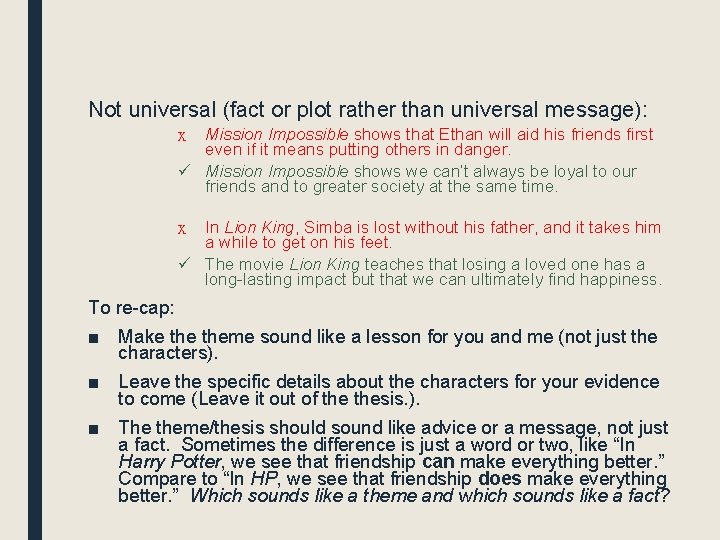
Not universal (fact or plot rather than universal message): Mission Impossible shows that Ethan will aid his friends first even if it means putting others in danger. ü Mission Impossible shows we can’t always be loyal to our friends and to greater society at the same time. x In Lion King, Simba is lost without his father, and it takes him a while to get on his feet. ü The movie Lion King teaches that losing a loved one has a long-lasting impact but that we can ultimately find happiness. x To re-cap: ■ Make theme sound like a lesson for you and me (not just the characters). ■ Leave the specific details about the characters for your evidence to come (Leave it out of thesis. ). ■ The theme/thesis should sound like advice or a message, not just a fact. Sometimes the difference is just a word or two, like “In Harry Potter, we see that friendship can make everything better. ” Compare to “In HP, we see that friendship does make everything better. ” Which sounds like a theme and which sounds like a fact?
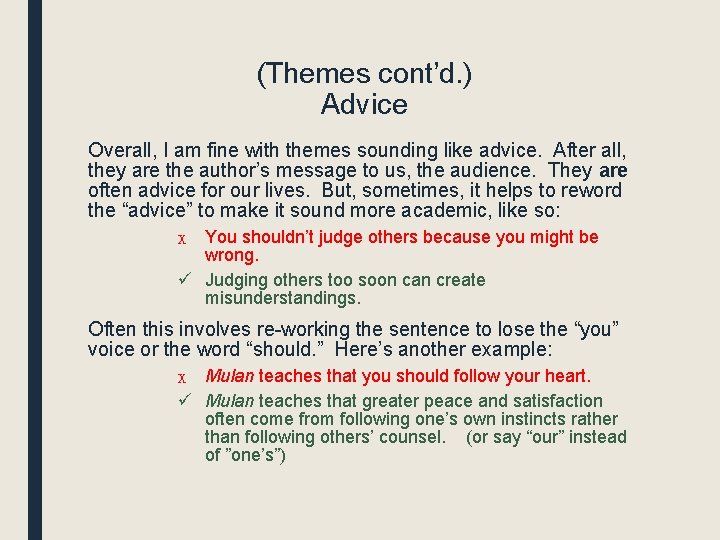
(Themes cont’d. ) Advice Overall, I am fine with themes sounding like advice. After all, they are the author’s message to us, the audience. They are often advice for our lives. But, sometimes, it helps to reword the “advice” to make it sound more academic, like so: x You shouldn’t judge others because you might be wrong. ü Judging others too soon can create misunderstandings. Often this involves re-working the sentence to lose the “you” voice or the word “should. ” Here’s another example: x Mulan teaches that you should follow your heart. ü Mulan teaches that greater peace and satisfaction often come from following one’s own instincts rather than following others’ counsel. (or say “our” instead of ”one’s”)
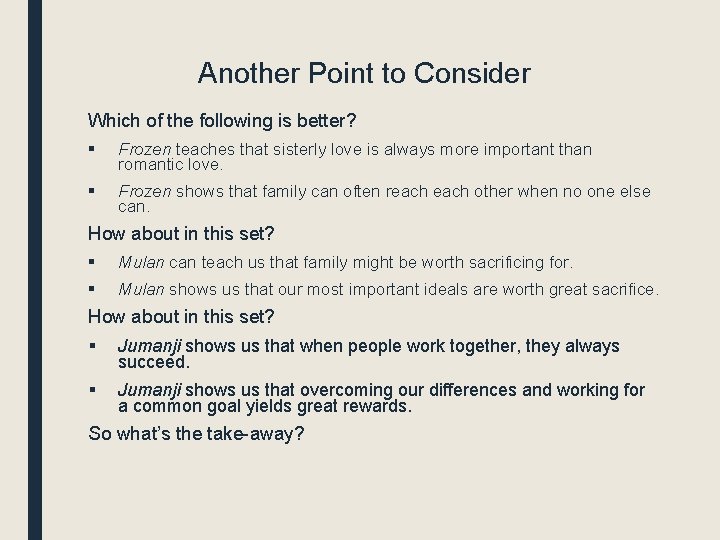
Another Point to Consider Which of the following is better? § Frozen teaches that sisterly love is always more important than romantic love. § Frozen shows that family can often reach other when no one else can. How about in this set? § Mulan can teach us that family might be worth sacrificing for. § Mulan shows us that our most important ideals are worth great sacrifice. How about in this set? § Jumanji shows us that when people work together, they always succeed. § Jumanji shows us that overcoming our differences and working for a common goal yields great rewards. So what’s the take-away?
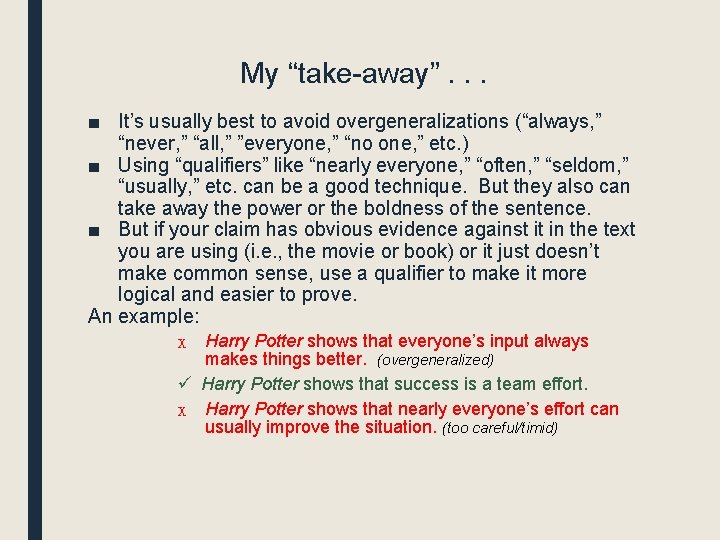
My “take-away”. . . ■ It’s usually best to avoid overgeneralizations (“always, ” “never, ” “all, ” ”everyone, ” “no one, ” etc. ) ■ Using “qualifiers” like “nearly everyone, ” “often, ” “seldom, ” “usually, ” etc. can be a good technique. But they also can take away the power or the boldness of the sentence. ■ But if your claim has obvious evidence against it in the text you are using (i. e. , the movie or book) or it just doesn’t make common sense, use a qualifier to make it more logical and easier to prove. An example: x Harry Potter shows that everyone’s input always makes things better. (overgeneralized) ü Harry Potter shows that success is a team effort. x Harry Potter shows that nearly everyone’s effort can usually improve the situation. (too careful/timid)
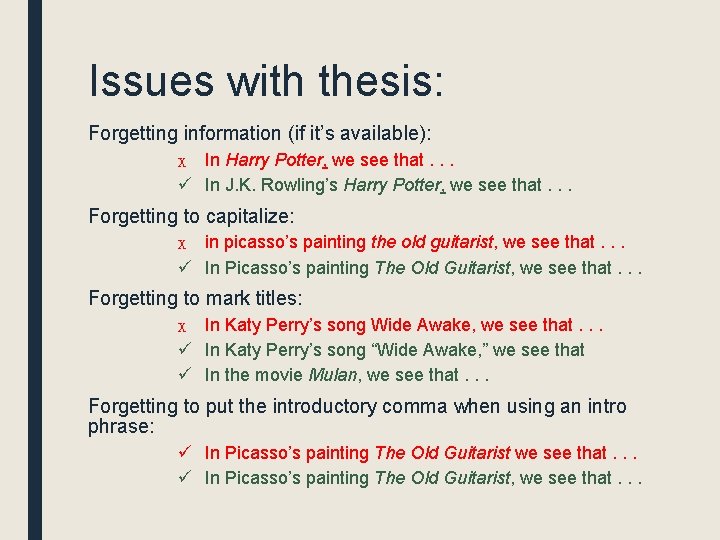
Issues with thesis: Forgetting information (if it’s available): x In Harry Potter, we see that. . . ü In J. K. Rowling’s Harry Potter, we see that. . . Forgetting to capitalize: x in picasso’s painting the old guitarist, we see that. . . ü In Picasso’s painting The Old Guitarist, we see that. . . Forgetting to mark titles: x In Katy Perry’s song Wide Awake, we see that. . . ü In Katy Perry’s song “Wide Awake, ” we see that ü In the movie Mulan, we see that. . . Forgetting to put the introductory comma when using an intro phrase: ü In Picasso’s painting The Old Guitarist we see that. . . ü In Picasso’s painting The Old Guitarist, we see that. . .
Now that you have a thesis…you need evidence to support your claim/theme.
What is Evidence? ■ From the text (quoted or paraphrased) ■ Supports your claim ■ You need at least 2 (convincing pieces) for each claim! ■ If a claim has two parts to it, you likely need at least two examples for each part. For example, if someone claims “the harder the challenge, the sweeter the reward, ” I want to see two times where the reward was sweeter because of the hard challenge. ■ Note: In future papers this year and academia in general, it is usually expected that you have 3 pieces of evidence for each claim, such as 3 examples within a paragraph to prove that topic sentence. (Or 3 paragraphs to prove your overall thesis. )
What counts as 2 separate pieces of evidence? ■ Two different things you can point to that prove your claim in different ways, such as two different characters’ actions in a story or one character’s experience at two different times. In a painting, you might discuss the color used in the piece as well as the form (or the expression) of the person painted. ■ By the way, the most important thing is to be convincing, to fully prove your point. If you wouldn’t be convinced by only two pieces of evidence, then find three.
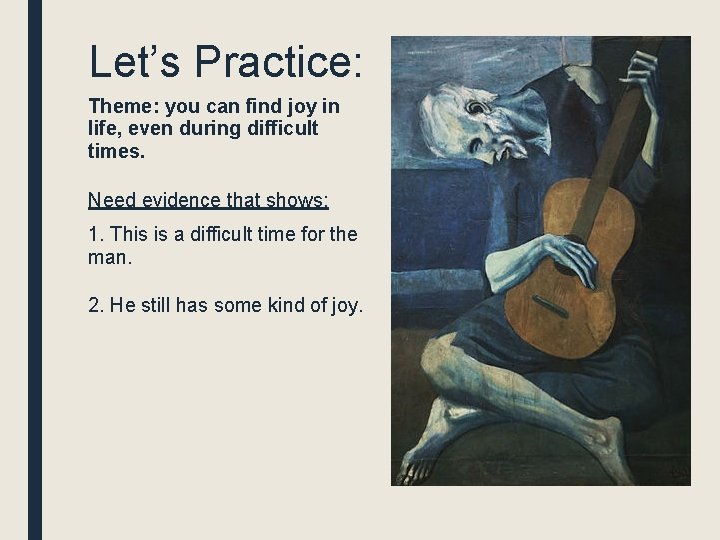
Let’s Practice: Theme: you can find joy in life, even during difficult times. Need evidence that shows: 1. This is a difficult time for the man. 2. He still has some kind of joy.
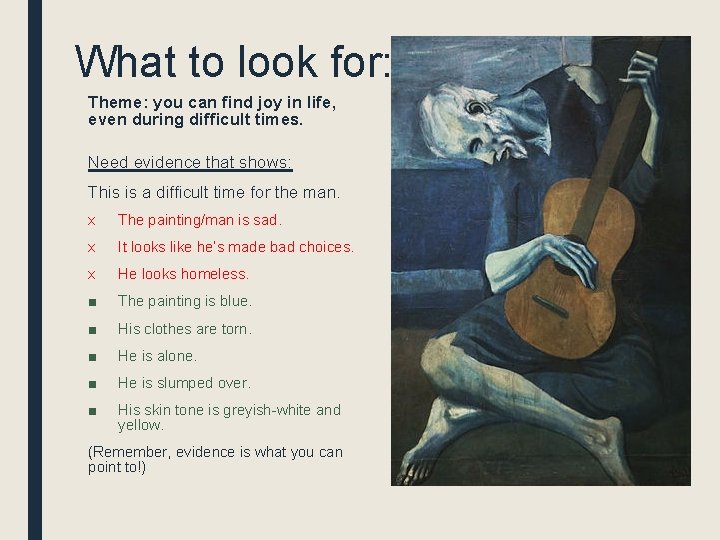
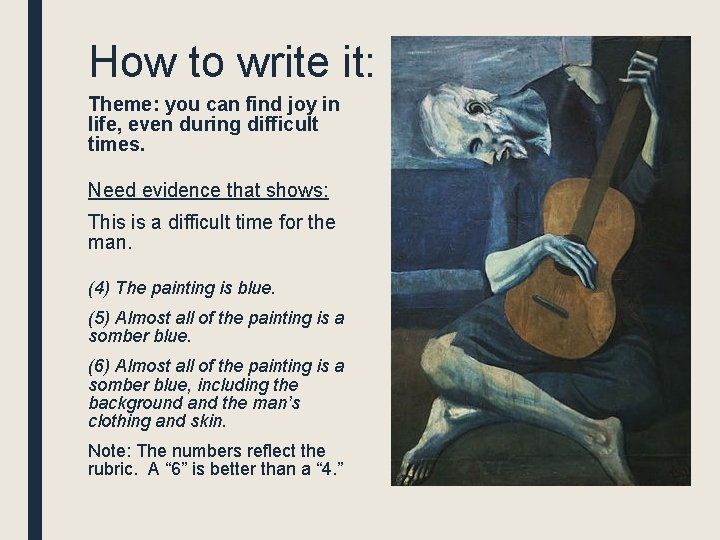
What to look for: Theme: you can find joy in life, even during difficult times. Need evidence that shows: This is a difficult time for the man. x The painting/man is sad. x It looks like he’s made bad choices. x He looks homeless. ■ The painting is blue. ■ His clothes are torn. ■ He is alone. ■ He is slumped over. ■ His skin tone is greyish-white and yellow. (Remember, evidence is what you can point to!)
How to write it: Theme: you can find joy in life, even during difficult times. Need evidence that shows: This is a difficult time for the man. (4) The painting is blue. (5) Almost all of the painting is a somber blue. (6) Almost all of the painting is a somber blue, including the background and the man’s clothing and skin. Note: The numbers reflect the rubric. A “ 6” is better than a “ 4. ”
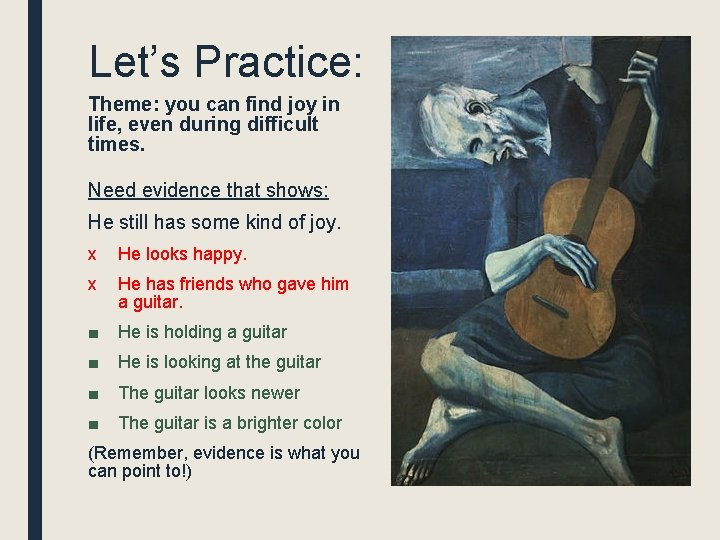
Let’s Practice: Theme: you can find joy in life, even during difficult times. Need evidence that shows: He still has some kind of joy. x He looks happy. x He has friends who gave him a guitar. ■ He is holding a guitar ■ He is looking at the guitar ■ The guitar looks newer ■ The guitar is a brighter color (Remember, evidence is what you can point to!)
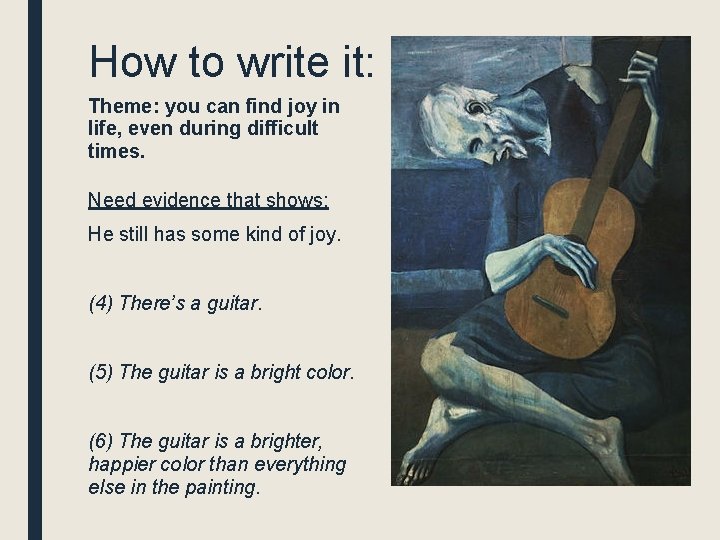
How to write it: Theme: you can find joy in life, even during difficult times. Need evidence that shows: He still has some kind of joy. (4) There’s a guitar. (5) The guitar is a bright color. (6) The guitar is a brighter, happier color than everything else in the painting.
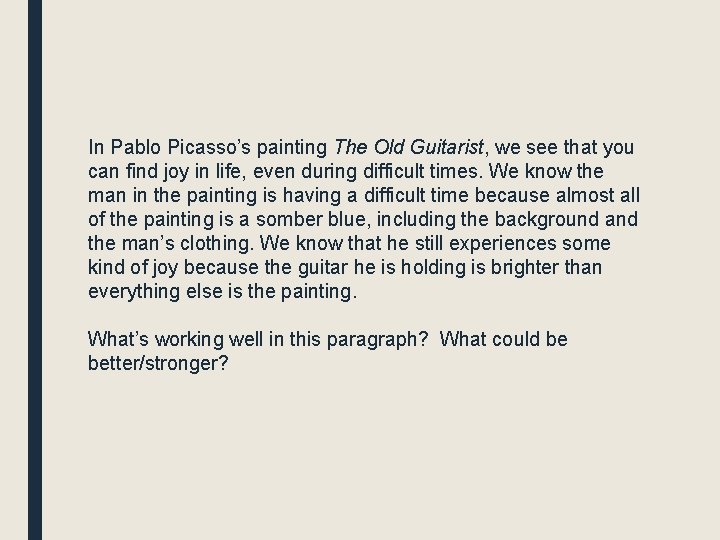
In Pablo Picasso’s painting The Old Guitarist, we see that you can find joy in life, even during difficult times. We know the man in the painting is having a difficult time because almost all of the painting is a somber blue, including the background and the man’s clothing. We know that he still experiences some kind of joy because the guitar he is holding is brighter than everything else is the painting. What’s working well in this paragraph? What could be better/stronger?
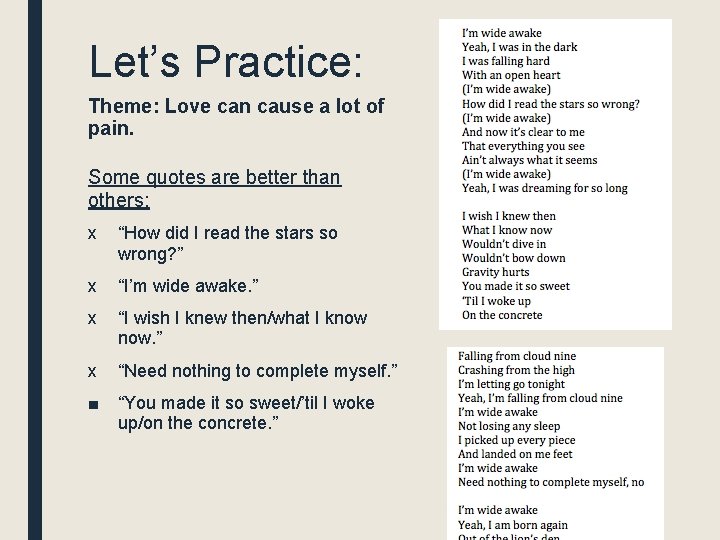
Let’s Practice: Theme: Love can cause a lot of pain. Some quotes are better than others: x “How did I read the stars so wrong? ” x “I’m wide awake. ” x “I wish I knew then/what I know now. ” x “Need nothing to complete myself. ” ■ “You made it so sweet/’til I woke up/on the concrete. ”
What is Analysis? ■ Your own thoughts and words about how the evidence supports your theme/claim. ■ Interprets the material--talks about something only hinted at in the text. (Why a character did what they did or what the color blue represents. ) ■ Hypothetical situations in a text to make your point. ■ Analogies to make your point (“This would be like. . . ”). ■ How something could have played out differently. ■ Often the hardest part—we’ll practice.
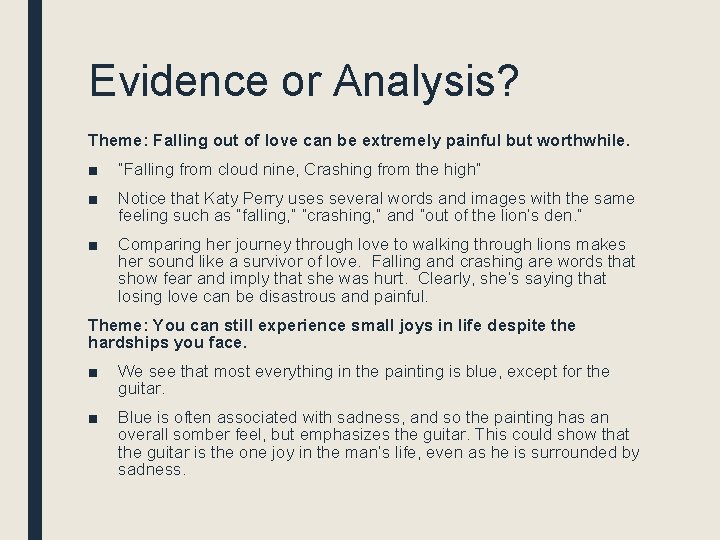
Evidence or Analysis? Theme: Falling out of love can be extremely painful but worthwhile. ■ “Falling from cloud nine, Crashing from the high” ■ Notice that Katy Perry uses several words and images with the same feeling such as “falling, ” “crashing, ” and “out of the lion’s den. ” ■ Comparing her journey through love to walking through lions makes her sound like a survivor of love. Falling and crashing are words that show fear and imply that she was hurt. Clearly, she’s saying that losing love can be disastrous and painful. Theme: You can still experience small joys in life despite the hardships you face. ■ We see that most everything in the painting is blue, except for the guitar. ■ Blue is often associated with sadness, and so the painting has an overall somber feel, but emphasizes the guitar. This could show that the guitar is the one joy in the man’s life, even as he is surrounded by sadness.
Your Assignment: ■ (Do a pre-write before writing your essay/paragraph. ) ■ Write a short essay (good-sized paragraph) about theme for the camel or mouse fable. You may do this on your own or with a partner. ■ Make sure your paragraph follows ICEEEET (intro/claim, then 2 pieces of evidence with 2 explanations, then a tieback). You may want more than 2, esp. if your claim has two parts to it. Make sure it sounds convincing. ■ Make sure your paragraph is legible (You may type it if computers are available. ). ■ Color-code and label your paragraph.