
Theme 3 4 Breach of Contract Forms of
Theme 3: 4 Breach of Contract
Forms of Breach of Contract � Party fails to honour his contractual obligations in the form of: ◦ ◦ ◦ Mora debitoris Mora creditoris Positive malperformance Repudiation Prevention of performance
Mora debitoris (delay by debtor) �Debtor does not perform timeously in terms of the contract. � Requirements: ◦ Performance must still be possible �If performance is impossible due to late performance it would not be breach in terms of mora debitoris, but prevention of performance. ◦ Debtor fails to perform timeously �If date and time of performance is stipulated, debtor is automatically in mora if he does not perform on time. �in mora ex re : no request for performance by creditor required �If date and time of performance is not stipulated, the creditor must request performance, by delivering a notice of demand, to place the debtor in mora. �in mora persona: Time set must be reasonable. If the debtor fails to perform he is set in mora. ◦ Performance already due and enforceable �If performance is impossible due to late performance it would not be breach in terms of mora debitoris, but prevention of performance. ◦ Delay due to the debtor’s fault �Failure to perform must be intentional or negligent. Not performing due to circumstances beyond his control will not be breach of contract.
� Consequences of mora debitoris: ◦ Legal obligation between the parties perpetuates. ◦ Legal tie is not terminated unless performance becomes impossible without the fault of the parties. ◦ The debtor bears the risk that the performance could become impossible while he is in mora and will not be excused for that.
Mora creditoris (delay by creditor) �Creditor fails to accept proper performance by the debtor or does not co-operate in order to enable debtor to perform. � Requirements: ◦ Performance must still be possible �If performance is impossible due failure to co-operate it would not be breach in terms of mora creditoris, but prevention of performance. �Impossibility without fault is not breach of contract. ◦ Creditor delays performance �Only possible where co-operation of the creditor is required. ◦ Performance due and enforceable �No obligation exists to accept performance prior to arranged date and time. �Performance can be rejected if it is subject to a suspensive condition. ◦ Proper performance offered by debtor �Refusal to accept performance substantially defective does not constitute mora creditoris. ◦ Delay due to creditor’s fault �Defective performance my be rejected. Intentional or negligent failure to accept performance will result in breach of contract.
� Consequences of mora creditoris: ◦ Debtor not excused from performing �Debtor still has to perform unless performance becomes impossible without fault of the debtor. ◦ Mora debitoris cancelled �Mora debitoris and mora creditoris cannot exist simultaneously. ◦ Debtor’s duty to take care of the object diminished �Debtor now only liable for damage caused intentionally or by gross negligence. ◦ Obligation perpetuated �The creditor bears the risk that the performance could become impossible while he is in mora and will not be excused for that.
Positive Malperformance � Refers to the contents or the quality of the performance. � Requirements: ◦ Positive duty �If defective performance is delivered the debtor is guilty of positive malperformance. ◦ Negative duty �Person must refrain from doing something, dut does it anyway. ◦ Fault �Fault is not required. Liability can be avoided eg. Act of God � Consequences of positive malperformance ◦ Creditor can rely on contractual remedies: �Cancellation �Specific performance �Damages
Repudiation �A party to the contract communicates his intention to no longer be bound to his obligations in terms of the contract, without lawful justification. � Requirements: ◦ An act �Words or conduct / Expressly or tacitly �Notice of cancellation / malperformance / no performance / etc. ◦ Intention to repudiate �Objective test is applied: Would the reasonable man have come to the conclusion that the contract is repudiated? � Consequences of repudiation ◦ Acceptance of repudiation is not required to constitute breach of contract. ◦ Contract is not automatically terminated, the prejudiced party has the choice to accept or reject the repudiation.
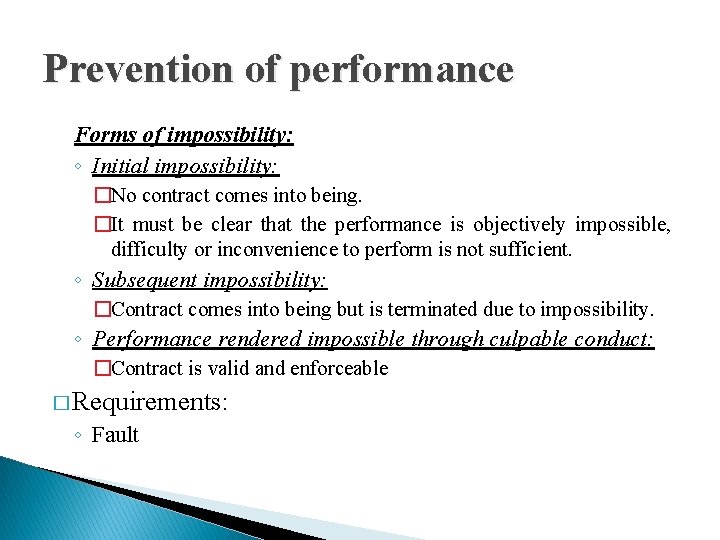
Prevention of performance Forms of impossibility: ◦ Initial impossibility: �No contract comes into being. �It must be clear that the performance is objectively impossible, difficulty or inconvenience to perform is not sufficient. ◦ Subsequent impossibility: �Contract comes into being but is terminated due to impossibility. ◦ Performance rendered impossible through culpable conduct: �Contract is valid and enforceable � Requirements: ◦ Fault
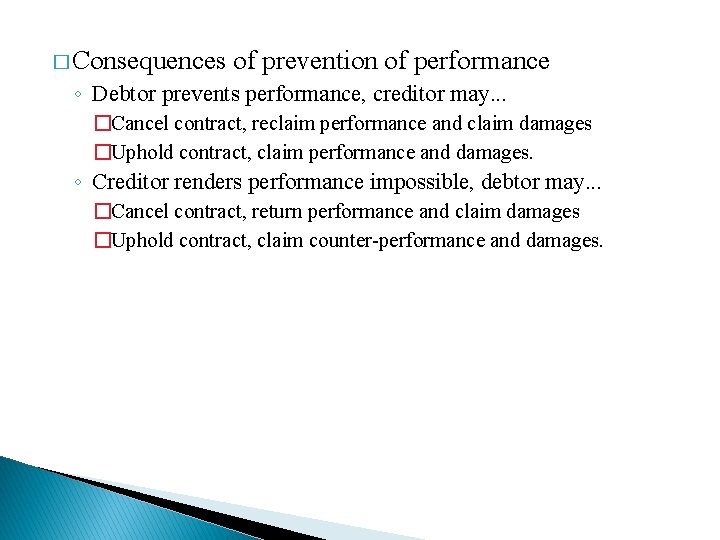
� Consequences of prevention of performance ◦ Debtor prevents performance, creditor may. . . �Cancel contract, reclaim performance and claim damages �Uphold contract, claim performance and damages. ◦ Creditor renders performance impossible, debtor may. . . �Cancel contract, return performance and claim damages �Uphold contract, claim counter-performance and damages.

END
- Slides: 11