
THEME 1 Improving the Experimentation and Discovery Process
- Slides: 6
THEME 1: Improving the Experimentation and Discovery Process Unprecedented complexity of scientific enterprise Is science stymied by the human bottleneck?
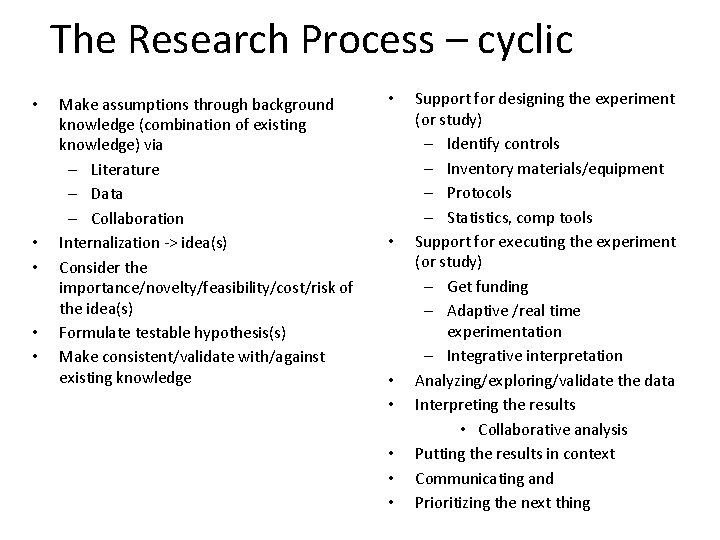
The Research Process – cyclic • • • Make assumptions through background knowledge (combination of existing knowledge) via – Literature – Data – Collaboration Internalization -> idea(s) Consider the importance/novelty/feasibility/cost/risk of the idea(s) Formulate testable hypothesis(s) Make consistent/validate with/against existing knowledge • • Support for designing the experiment (or study) – Identify controls – Inventory materials/equipment – Protocols – Statistics, comp tools Support for executing the experiment (or study) – Get funding – Adaptive /real time experimentation – Integrative interpretation Analyzing/exploring/validate the data Interpreting the results • Collaborative analysis Putting the results in context Communicating and Prioritizing the next thing
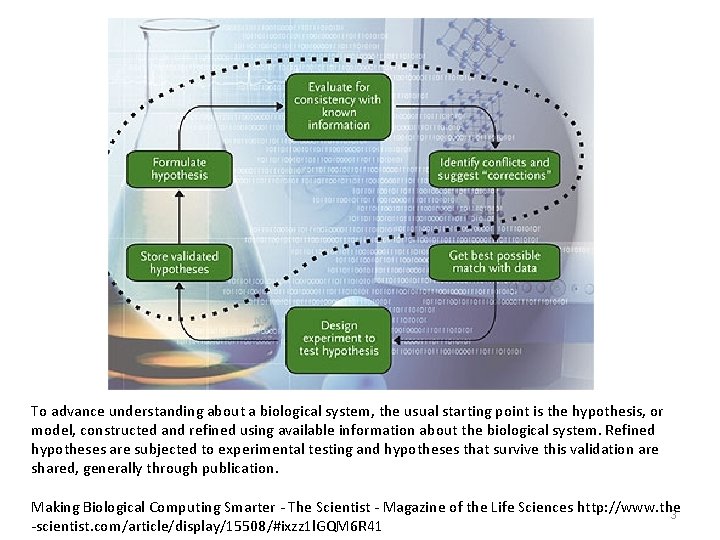
To advance understanding about a biological system, the usual starting point is the hypothesis, or model, constructed and refined using available information about the biological system. Refined hypotheses are subjected to experimental testing and hypotheses that survive this validation are shared, generally through publication. Making Biological Computing Smarter - The Scientist - Magazine of the Life Sciences http: //www. the 3 -scientist. com/article/display/15508/#ixzz 1 l. GQM 6 R 41
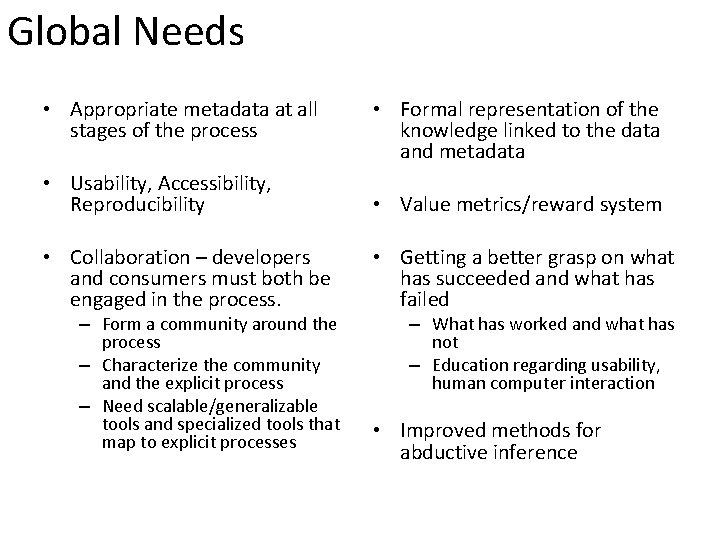
Global Needs • Appropriate metadata at all stages of the process • Formal representation of the knowledge linked to the data and metadata • Usability, Accessibility, Reproducibility • Value metrics/reward system • Collaboration – developers and consumers must both be engaged in the process. • Getting a better grasp on what has succeeded and what has failed – Form a community around the process – Characterize the community and the explicit process – Need scalable/generalizable tools and specialized tools that map to explicit processes – What has worked and what has not – Education regarding usability, human computer interaction • Improved methods for abductive inference
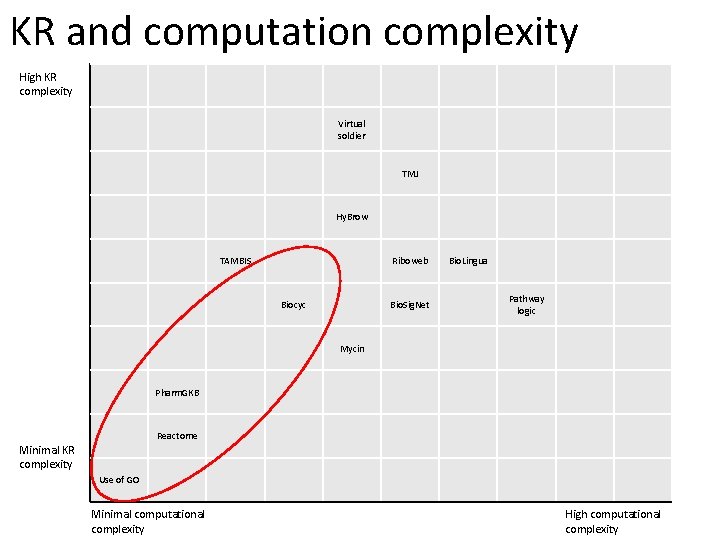
KR and computation complexity High KR complexity Virtual soldier TMJ Hy. Brow TAMBIS Riboweb Biocyc Bio. Sig. Net Bio. Lingua Pathway logic Mycin Pharm. GKB Reactome Minimal KR complexity Use of GO Minimal computational complexity High computational complexity
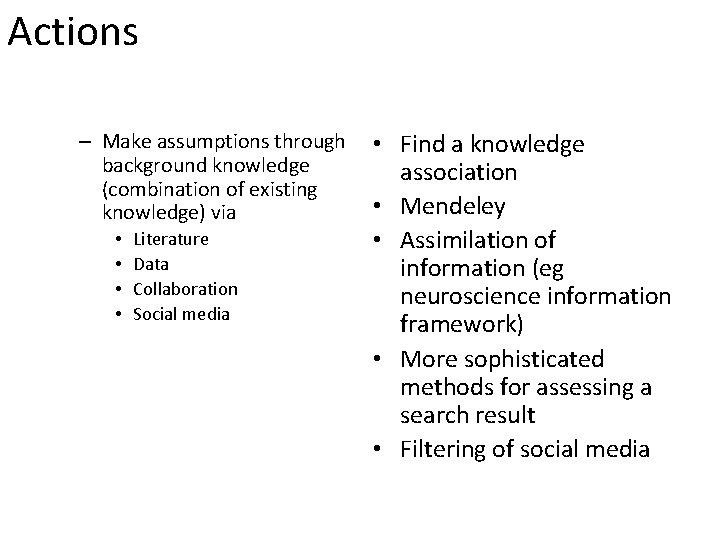
Actions – Make assumptions through background knowledge (combination of existing knowledge) via • • Literature Data Collaboration Social media • Find a knowledge association • Mendeley • Assimilation of information (eg neuroscience information framework) • More sophisticated methods for assessing a search result • Filtering of social media