
THEMATIC AND INFORMATION STRUCTURES MOTIVATION FOR THE USE






- Slides: 30
THEMATIC AND INFORMATION STRUCTURES MOTIVATION FOR THE USE OF THEMATIC SYSTEMS OF THE CLAUSE
• Information in senteces can be reorganized, changed • Marked and unmarked pattern of English sentences • Different communicative motivation • Certain rules apply: (end focus, topic preservation, end weight)
THE GIVEN-NEW PRINCIPLE (´END FOCUS´) • Message • Given information and New information • The Given element: • The known information, or recoverable by the hearer • It has already been mentioned in previous discourse • Is ´psychologically given´ (assumed to be in hearer´s background knowledge)
• The New element • New information for the hearer (not recoverable from the context)
GENERAL PRINCIPLES • We usually start our message with what we think our hearer knows • Then we progress to what he does not know • The priciple of communicative dynamism • We start with the ´given´and progress towards ´new´ • The principle of ´end focus´
• New information – the most important in the message • Usually placed towards the end of the clause • Given infos – the point from which the new information is developed • We proceed from known to the unknown • We put given before new • Given information often coincides with theme
• A: Who makes these chairs? • B: Ikea makes them. • B: They are made by Ikea. • Second option is preferred • Respecting the Given-New Principle
THE PRINCIPLE OF CLAUSEINITIAL TOPIC PRESERVATION • The importance of topic • In written language we often like sentences to have a similar theme • The initial item in a sentence has a topic preservation function
READ THE EXAMPLE: • The PM stepped off the plane. She was immediately surrounded by journalists. (´end focus´ principle) • The passive enables (through pronoun ´she´) to preserve the topic
THE PRINCIPLE OF ENDWEIGHT • Preference for placing long, complex, ´heavy´ constituents towards the end of the clause • The reason: they seem easier to understand or process • A. It is annoying that he changed the time of the meeting without telling us. • B. That he changed the time of the meeting without telling us is annyoing. • Sentence A would be preferred to B sentence
• The sentence B has got a very long, complex noun clause in subject position and a very short predicate after the verb • extraposition construction allows us to move the long complex, noun clause to the end of the sentence • Making the whole sentence easier to process
EXTRAPOSITION • It – dummy operator/anticipatory it • Subject is extraposed/postponed – moved to the end of the sentence • It – stands for the postponed subject
SOME EXAMPLES OF EXTRAPOSITION • It is necessary that you sign the paper. • (That you sign the paper is necessary. ) • It is obvious that you have been misled. • It's a shame what happened to you and your sister.
MOTIVATION FOR THE SELECTION OF PARTICULAR THEMATIC CONSTRUCTIONS • Thematic re-ordering • Any other element (but the expected one) is brought to initial position • The theme is marked • Thematic fronting: Very angry it made him. • Postponement of subject: At no time was she really happy.
FRONTING • Emphasis • Accompanied by inversion
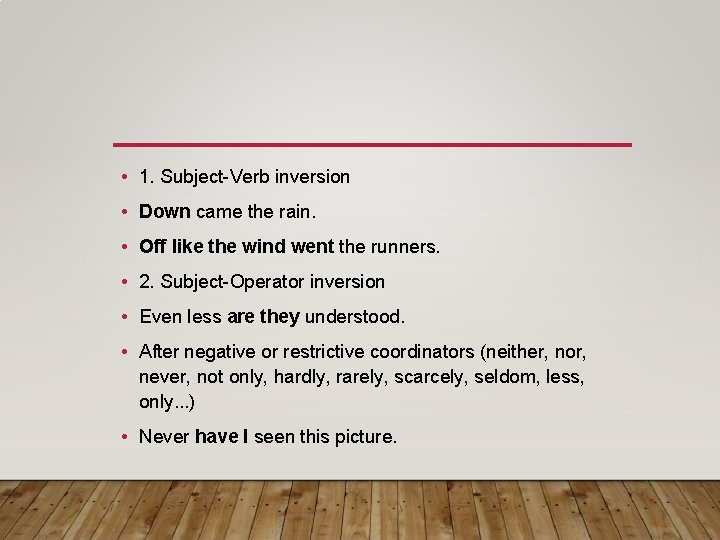
• 1. Subject-Verb inversion • Down came the rain. • Off like the wind went the runners. • 2. Subject-Operator inversion • Even less are they understood. • After negative or restrictive coordinators (neither, nor, never, not only, hardly, rarely, scarcely, seldom, less, only. . . ) • Never have I seen this picture.
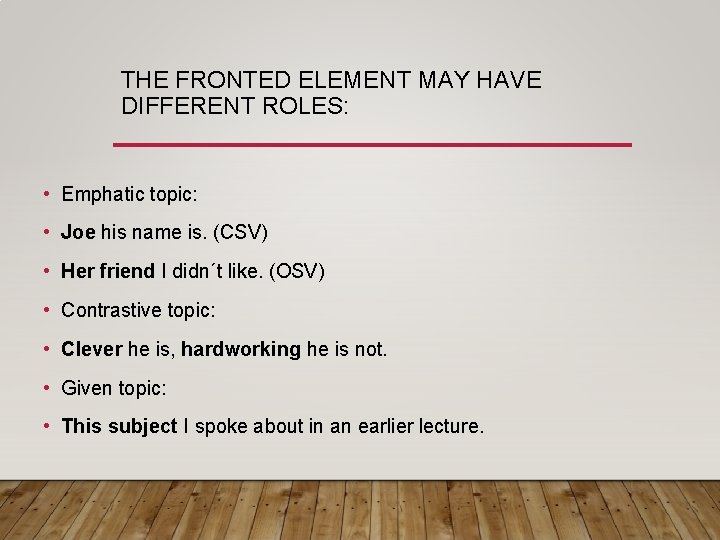
THE FRONTED ELEMENT MAY HAVE DIFFERENT ROLES: • Emphatic topic: • Joe his name is. (CSV) • Her friend I didn´t like. (OSV) • Contrastive topic: • Clever he is, hardworking he is not. • Given topic: • This subject I spoke about in an earlier lecture.
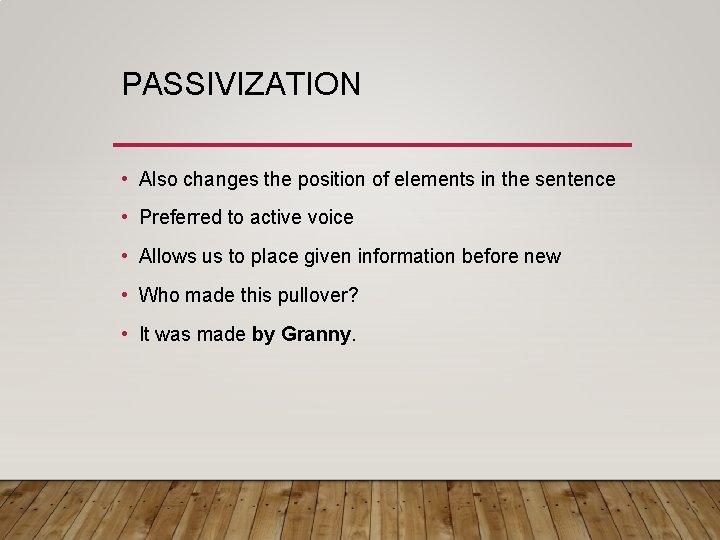
PASSIVIZATION • Also changes the position of elements in the sentence • Preferred to active voice • Allows us to place given information before new • Who made this pullover? • It was made by Granny.
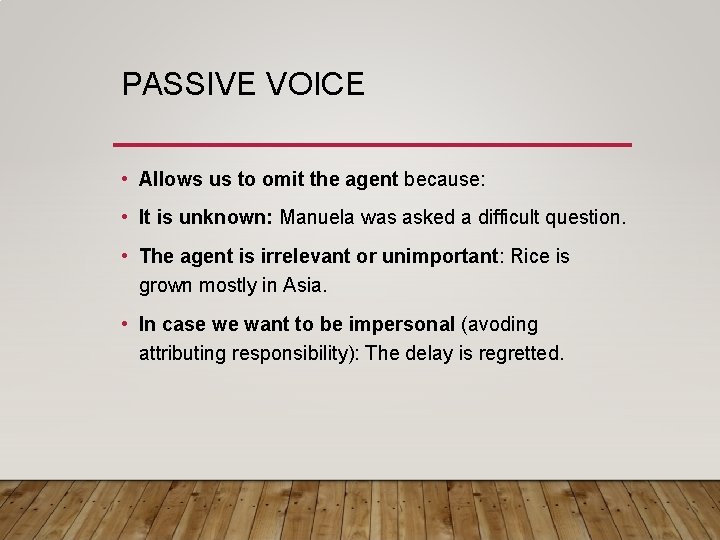
PASSIVE VOICE • Allows us to omit the agent because: • It is unknown: Manuela was asked a difficult question. • The agent is irrelevant or unimportant: Rice is grown mostly in Asia. • In case we want to be impersonal (avoding attributing responsibility): The delay is regretted.
EXTRAPOSITION • A kind of postponement • Allows us to move long, subordinate clauses (acting as subject) into final position • Keeping faithful to the principle of end-weight • Structure: • Subject moved to the end • Normal subject position – filled by IT • Sentence – 2 subjects (anticipatory pronoun IT, and real subject (postponed subject)
• It surprised me to hear him say that. • It was obvious that we had lost the way.
ONLY A PART OF AN ELEMENT CAN BE POSTPONED: • A rumour circulated widely that whe was engaged to the President´s son. • The time had come to decorate the house for Christmas.
EXISTENTIAL ´THERE´ • There are some friends of ours waiting outside. • There is a policeman regulating the traffic. • ´there´ enables to move new information out of subject position, nearer to the end of the clause • Usually used with indefinite expression
EXISTENTIAL SENTENCES WITH RELATIVE CLAUSES • There are two students (that/who) would like to see you. • There are some planets that were discovered by the ancients. (different tenses) • There´s nothing (that) I can do about it.
CLEFT SENTENCES • Emphasizing a particular part of the sentence • Drawing special attention to the complement of the verb ´be´ • Two sentences emerge • Both sentences have got their own verb
IT-CLEFTS • It + be + that • The specially focused element can be – NP, PP, Adv. P, adverbial clause: • It was his voice that held me. • It was only for his help that they won. • It is here that we should stay. • It was because they were frightened that they had left the house quickly.
WH- CLEFTS • Pseudo-cleft • Wh- clause – as a subject • Wh-word+be+the focused element (NP, inf. cl, finite nominal cl. ) • What I really need is another credit card. • What he did was to go to Holy Trinity Church. • What they will be hoping for is that they can get a few weeks of holiday.
WH-CLEFTS WITH´BE´ • What he wanted was exercise. • Exercise is what he wanted.
EMPHASIZED ELEMENT IN CLEFT SENTENCES CAN BE: • Prepositional phrase: It was on foot that he went there. • Adverbial phrase: It was greedily and speedily that Homer Simpson drank his beer. • Non-finite clause: It is to address a far-reaching problem that Oxfam is launching this campaign. • Gerund: It could be going home early or slacking off work that the boss reacted to. • Adverbial clause: It was because she was so lonely all the time that she decided to move out.
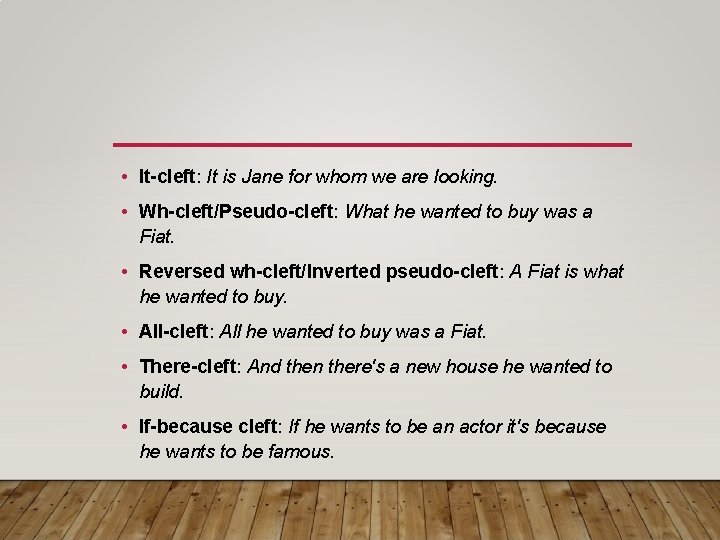
• It-cleft: It is Jane for whom we are looking. • Wh-cleft/Pseudo-cleft: What he wanted to buy was a Fiat. • Reversed wh-cleft/Inverted pseudo-cleft: A Fiat is what he wanted to buy. • All-cleft: All he wanted to buy was a Fiat. • There-cleft: And then there's a new house he wanted to build. • If-because cleft: If he wants to be an actor it's because he wants to be famous.