
TheKiet Lu KokLim Low Jianmin Zheng Graphics Interface

- Slides: 19
The-Kiet Lu Kok-Lim Low Jianmin Zheng Graphics Interface 2009 1
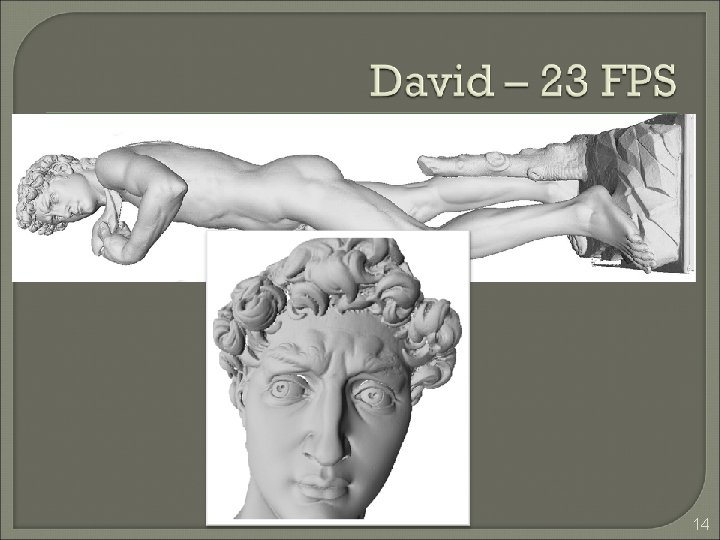
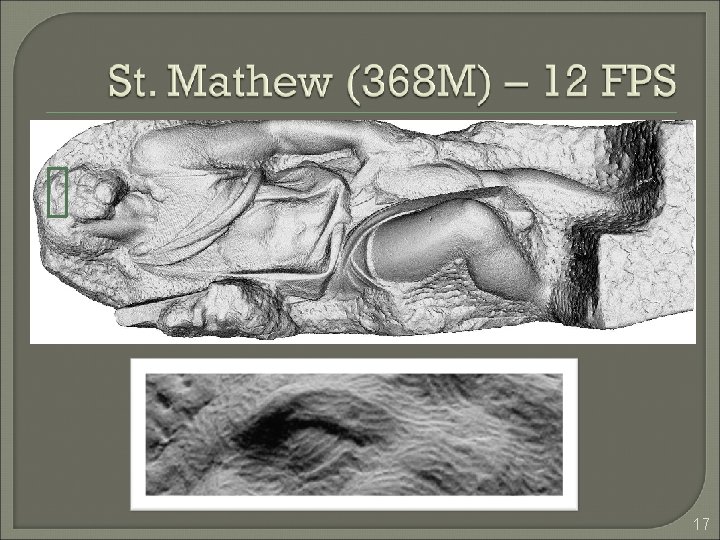
� Rendering high-detail surface (>100 M points) is inefficient when vertices are independently processed one-by-one in real-time • Redundant processing �Occlusion �LOD �# of pixels vs. # of vertices � 1024 x 1024 pixels vs. 368 millions points �Memory size � 1 vertex requires > 6 bytes (un-compressed) �St. Mathew (368 M) > 2 Gbs � Simplification – slow • Requires surface reconstruction first 2
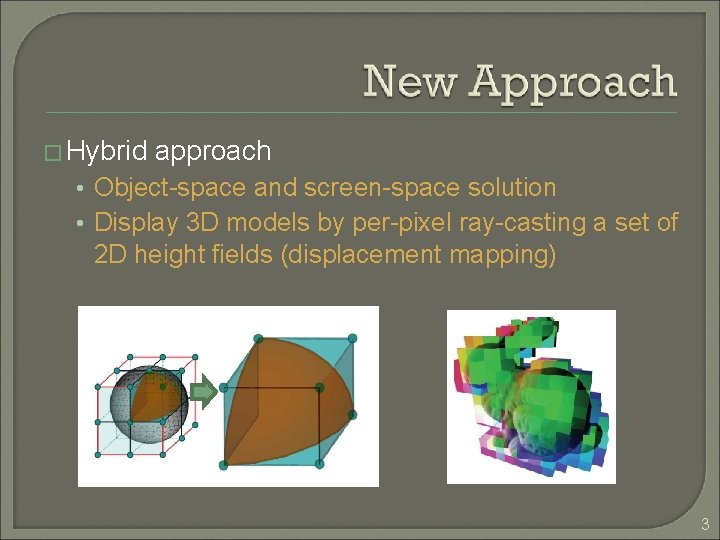
� Hybrid approach • Object-space and screen-space solution • Display 3 D models by per-pixel ray-casting a set of 2 D height fields (displacement mapping) 3
4
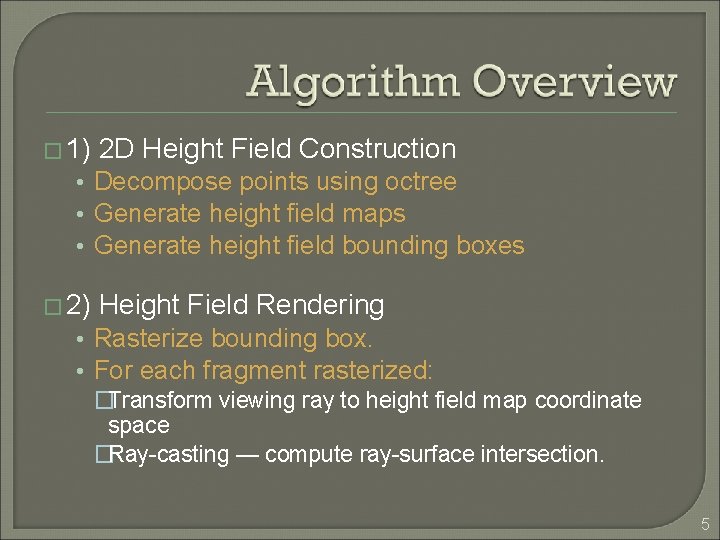
� 1) 2 D Height Field Construction • Decompose points using octree • Generate height field maps • Generate height field bounding boxes � 2) Height Field Rendering • Rasterize bounding box. • For each fragment rasterized: �Transform viewing ray to height field map coordinate space �Ray-casting — compute ray-surface intersection. 5
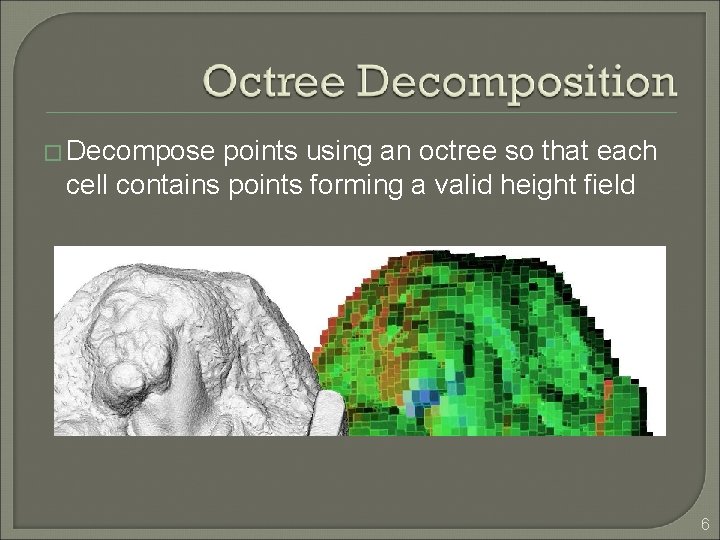
� Decompose points using an octree so that each cell contains points forming a valid height field 6
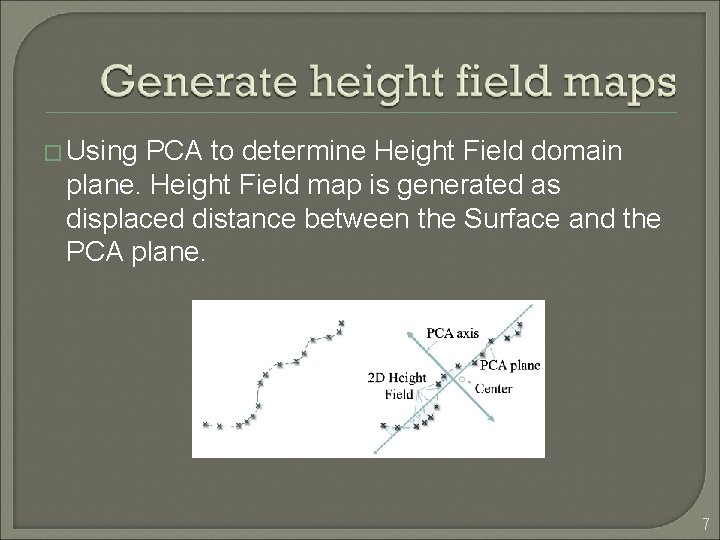
� Using PCA to determine Height Field domain plane. Height Field map is generated as displaced distance between the Surface and the PCA plane. 7
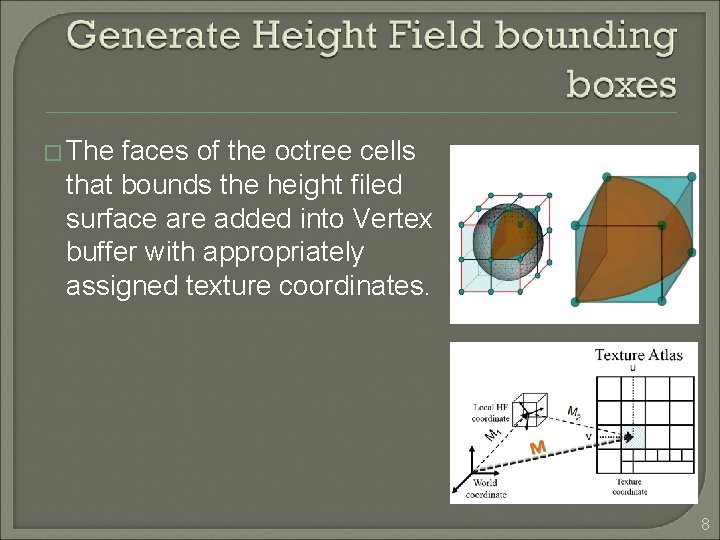
� The faces of the octree cells that bounds the height filed surface are added into Vertex buffer with appropriately assigned texture coordinates. 8
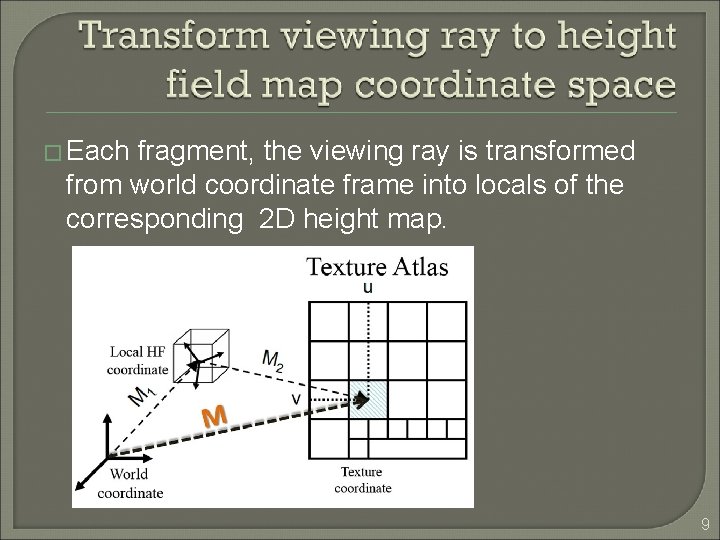
� Each fragment, the viewing ray is transformed from world coordinate frame into locals of the corresponding 2 D height map. 9
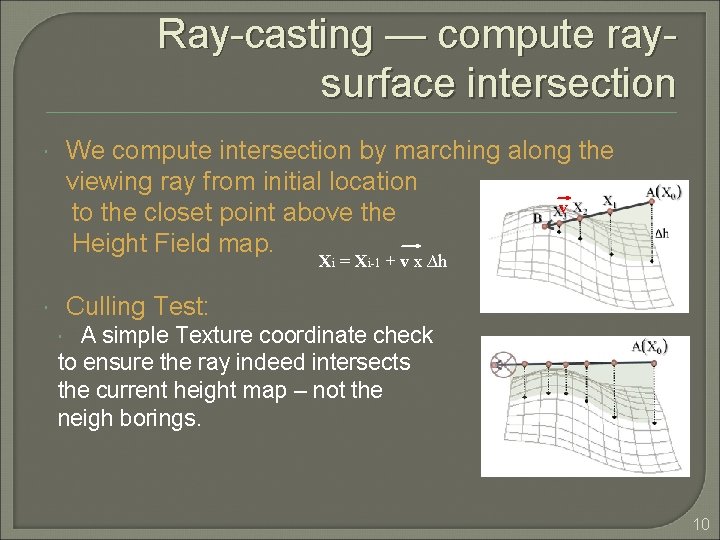
Ray-casting — compute raysurface intersection We compute intersection by marching along the viewing ray from initial location v to the closet point above the Height Field map. Xi = Xi-1 + v x ∆h Culling Test: A simple Texture coordinate check to ensure the ray indeed intersects the current height map – not the neigh borings. 10
Advantage of our approach � Hybrid approach • Optimize �Automatic Screen-space occlusion culling �Back Face culling �Early Z-culling �Memory consumption � 6 bytes vertex vs. 8 -bit depth buffer �Texture compression • Limitation �Performance subjects to screen resolution 11
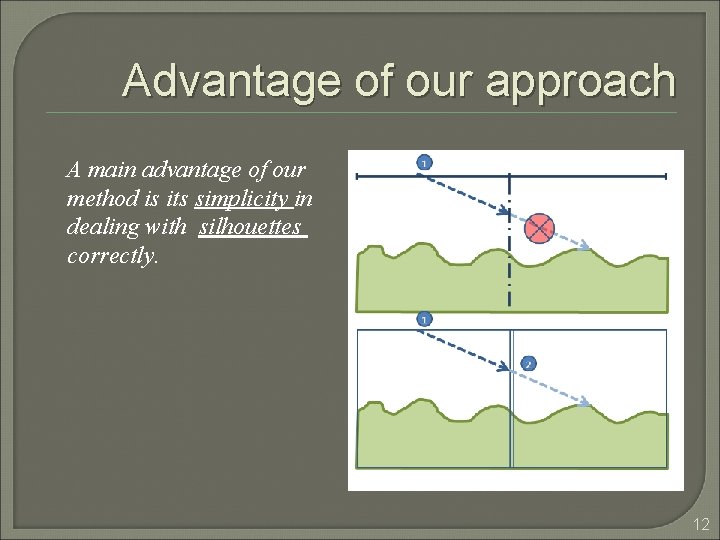
Advantage of our approach A main advantage of our method is its simplicity in dealing with silhouettes correctly. 12
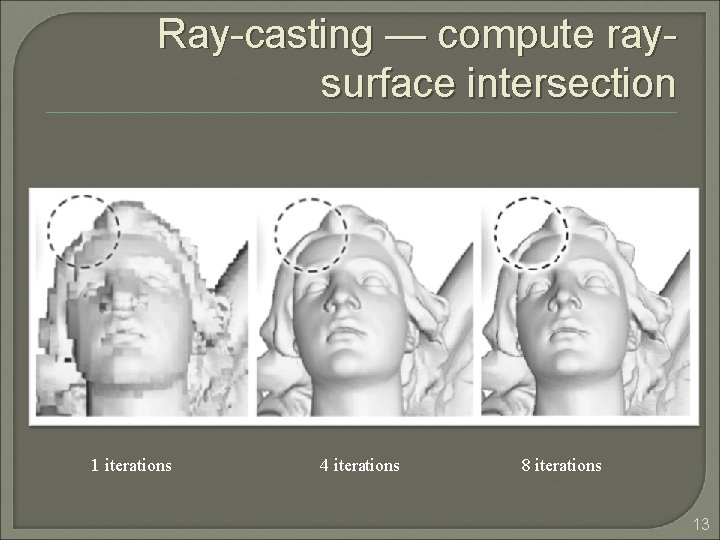
Ray-casting — compute raysurface intersection 1 iterations 4 iterations 8 iterations 13
14
15
16
17
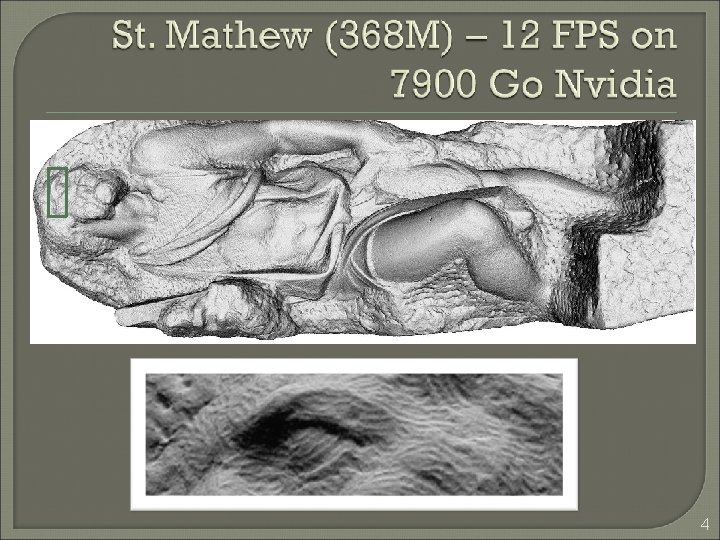
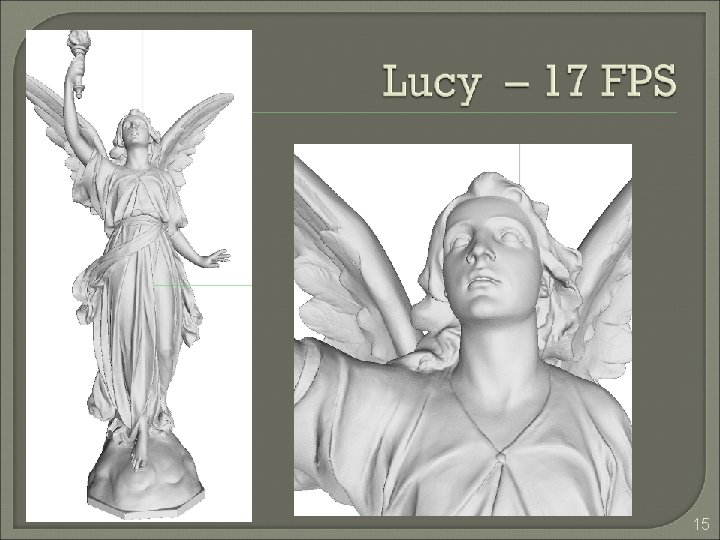
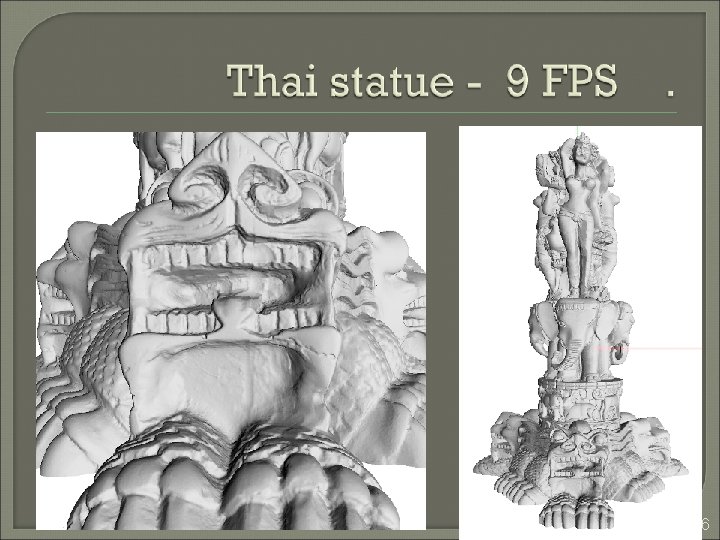
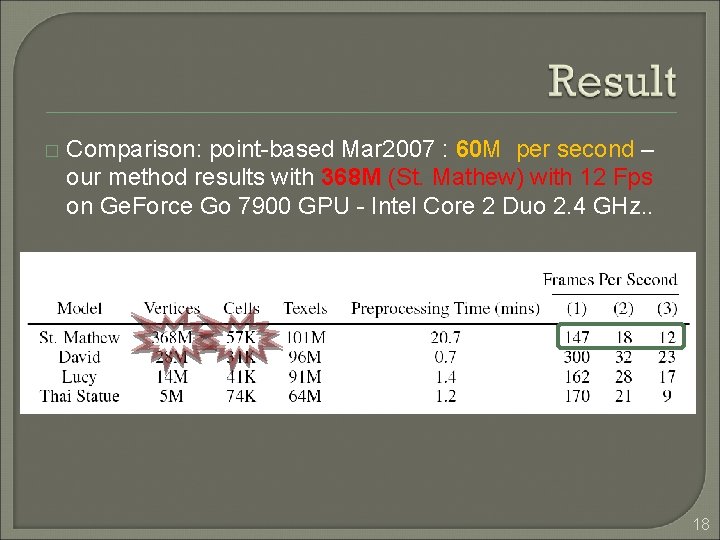
� Comparison: point-based Mar 2007 : 60 M 60 per second – our method results with 368 M (St. Mathew) with 12 Fps on Ge. Force Go 7900 GPU - Intel Core 2 Duo 2. 4 GHz. . 18
� We have presented a new approach for fast visualization of highly detail 3 D models by decomposition 3 D model into Height Fields and render these Height Fields using image-space raycasting algorithm that offers significant performance improvement compared to previous point-based approach. � Our current limitation is that it is not efficient for flat and smooth surfaces as well as not applicable for dynamic or deformable surfaces – our current research topic. 19