
Their Eyes Were Watching God Chapter 6 By
Their Eyes Were Watching God Chapter 6 By Kilie Morgan, Katie Wadkovsky, Jillian Warren
Plot Line ● ● ● Janie is at the store watching people on the porch pass around pictures Sam and Lige tease Matt Bonner about his mule ○ They tease him because he allows his mule to starve and Matt says he’s just thin because he’s mean, removing the blame from himself and placing it on the mule Joe does not let Janie join the mule-banter because she is “too good” for that despite laughing at it himself Janie is aggravated at Joe forcing her to wear a head-rag ○ Joe is jealous of other men looking at her because she is his sole possession, not anyone else’s. Once he caught Walter touching her hair, it was never seen again in the store Matt lost his mule and asked the people at the store if they had seen him ○ Matt needs him to plow a field, says he just does not cooperate when Lige asks if the mule is up to it
● ● ● Porch sees mule at the edge of the woods ○ Lum jumps on mule when it gets in front of the store and it attacks him, making Lum run away ○ Six men from the porch antagonize the mule to make him angry, soon exhausting him ○ Janie scorns the men for their bullying under her breath, Joe hears her and makes them stop before he calls for Matt Joe tells Janie to go get him another pair of shoes ○ Janie wants to refuse but she does not to avoid confrontation, yet takes her time to get the shoes Joe buys the mule from Matt ○ He negotiates a price much lower than Matt’s offer ○ Matt accused Joe of robbing him but went through with it anyway, feeling like it’s a steal because he thinks the mule will die soon
● ● Joe reveals he bought the mule to allow him to recover ○ Gets the town’s praise and Janie’s praise ○ Hambo compliments Janie’s speech skills, directly contradicting Joe when he said she did not know anything about speech-making ○ Joe ignores him Town feeds mule ○ Town makes up stories about him Mule dies ○ Found on his back with legs straight up ○ Town members took off work to talk about it ○ Dragged out to the edge of town Whole town goes to the mule’s “funeral” ○ Joe does not allow Janie to go because it is too “common” for her as the mayor’s wife despite going himself ○ Janie left in town by herself
● ● ● There’s a ceremony in the swamp for the mule ○ Joe gives a speech about the mule, describing it as a citizen and teacher, then talks about mule heaven Buzzards come inspect the corpse ○ They report back to their leader ○ The leader examines the body to make sure it’s truly dead ○ They have a chant and then feast Joe returns to the store, hiding his good humor from Janie because she’s still upset about having to stay at the store ○ He feels like Janie is ungrateful of his efforts to put her in a high position Joe ridicules the town for making such a big deal about the mule ○ Janie disagrees, saying not everyone can be like him ○ Joe defends himself Sam and Lige arguing on the porch ○ Sam asks if it’s caution or nature that prevents a man from burning his hand on a stove ○ Joe joins the porch ○ Joe tells a story
● ● Three girls walk down the street ○ The men fall over themselves trying to impress the women ○ Daisy takes the center stage ■ Her hair is described to have the flavor of white people hair, like a string that’s been around ham long enough to absorb the flavor, implying that Daisy has been around white people enough to rise to their status in a way and is viewed as somehow “above” the rest of the town ■ The men try to one-up each other with their “love” for Daisy ● They do not actually love her--they are using her to boost their own egos and standing among the town Mrs. Bogle approaches the shop ○ Joe sends Janie to see what she wants, Janie is visibly upset ○ Lum says there are not any pigs feet left but Joe disagrees ■ Joe gets mad at Janie for misplacing the receipt ■ Janie says she did not lose it and accuses Joe of not looking for it. Joe claims that she needs to be told what to do because she cannot think for herself
● ● ● Janie reflects on her and Joe’s marriage ○ She realizes their marriage is loveless and the “love” there is just for show and she stops trying to argue with Joe and assert herself because she feels it is more work than it is worth Joe slapped Janie because he was not satisfied with her cooking ○ Janie hides her personal feelings from Joe and puts on an act. She realizes Joe’s talk that whisked her away from her town was always just talk--there was never any substance behind it. When Janie returns to the store, Joe is bullying Mrs. Robbins which entertains the porch ○ Mrs. Robbins showers Joe with praise when he lets her in the store to buy food, claims husband does not feed her or her children ■ Joe gives her a small corner of meat even though she asked for a much larger piece, ignoring her when she protests ■ No one on the porch believes her when she says her husband doesn’t feed her family ○ The men get into a conversation of how they would beat and even kill their wives for acting the way Mrs. Robbins did toward Tony, endorsing domestic violence as a way to fix their problems ■ Janie tells them all off, saying that women know more than the men make them out to know and how their attitude closes women off ■ Janie is ignored. Joe tells her to go get the checkerboard
Extended Metaphors Mule=African-American women Page 56, “Everybody was having fun at the mule-baiting. All but Janie. ” Page 52, "Yuh know yuh don't feed de mule. How he gointuh get fat? " Page 53, ". . . Ah'd have mah picture took and give it the dat mule so's he could learn better. Ah ain't gointuh 'low 'im tuh hold nothin' lak dat against me. " Page 53, "There would be more stories about how poor the brute was; his age; his evil disposition and his latest caper. " Page 56, "'They oughta be shamed uh theyselves! Teasin' dat poor brute lak they is! Done been worked tuh death; done had his disposition ruint wid mistreatment…"
Animals = Women Page 75, “ “He says beatin’ women is just like steppin’ on baby chickens. ” “ Page 75, “ ““It’s so easy to make yo’self out God Almighty when you ain’t got nothin’ tuh strain against but women and chickens. ” Page 71, "Somebody got to think for women and chillun and chickens and cows. " Women=possessions that boost men's egoes (pg 68) Page 67, "Heah come mah order right now" Page 68, "The boys had to act out their rivalry too… 'Ah'll beg de Judge tuh hang me, and wouldn't take nothin' less than life. ' There was a big long laugh from the porch. Then Jim had to demand a test…'Is dat all? Ah'd buy her uh steamship and then Ah'd hire some mens tuh run it fur her. '" Hair = Power Page 55, “But Jody was set on it. Her hair was NOT going to show in the store. ” Page 55, “She was in the store for him to look at, not those others. But he never said things like that. It just wasn’t in him. ” Page 67, “She’s got those big black eyes with plenty shiny white in them that makes them shine like brand new money and she knows what God gave women eyelashes for, too. ”
Store = Janie’s trophy shelf Page 54, “She went through so many silent rebellions like that. Such a waste of time and life. But Joe kept saying that she could do it if she wanted to and he wanted her to use her privileges. ” Page 55, "She was there in the store for him to look at, not those others. " Janie = Trophy Page 60, “Dat’s right, but Ah’m uh man even if Ah is de Mayor. But de mayor’s wife is somethin’ different again. ” Page 62, “She wasn’t appreciative of his efforts and she had plenty cause to be. Here he was just pouring honor all over her; building a high chair for her to sit in and overlook the world and she here pouting over it!” “”Ah knows uh few things, and womenfolks thinks sometimes too!” “Aw naw they don’t. They just think they’s thinkin’. ”
Joe = Superiority Page 58, “Jody, dat wuz uh mighty fine thing fuh you tuh do. ‘Taint everybody would have thought of it, ‘cause it ain’t no everyday thought. Freein’ dat mule makes uh mighty big man outa you. Something like George Washington and Lincoln. Abraham Lincoln, he had de whole United States tuh rule so he freed de Negroes. You got tuh town so you freed uh mule. You have tuh power tuh free things and dat makes you lak uh king uh something. ” Page 70, ““I god, Janie, ” Starks said impatiently. ” Page 75, “ “It’s so easy to make yo’self out God Almighty when you ain’t got nothin’ tuh strain against but women and chickens. ” Page 71, "I god, they sho don't think none theirselves. " Page 54, "They's jus' some puny humans playin' round de toes uh Time. " Marriage = Flower Page 71, “She wasn’t a petal-open anymore with him. She was a twenty-four and seven years married when she knew. ” Page 72, “She had no more blossomy openings dusting pollen over her man, neither any glistening young fruit where the petals used to be. ”
Stove = Human nature Page 64, “Whut is it dat keeps uh man from gettin’ burnt on uh red-hot stove-caution or nature? ” Buzzards = Town Page 61, “Everybody enjoyed themselves to the highest and then finally the mule was left to the already impatient buzzards. They were holding a great flying-meet way up over the heads of the mourners and some of the nearby trees were already peopled with the stoop-shouldered forms. ” Page 74, “Mrs. Tony swooped like lightening and seized it, and started towards the door. ” Page 61, "The flock had to wait the white-headed leader, but it was hard. They jostled each other and pecked at heads in hungry irritation. Some walked up and down the beast from head to tail, tail to head. The Parson sat motionless. . . decorum demanded that he sit oblivious until he was notified. . . the others danced in joy and hunger at his approach. " The porch = Judgement Page 72, “Jody was on the porch and the porch was full of Eatonville as usual at this time of day. ” Page 73, “This was what the porch was waiting for. They burst into a laugh. ”
Describing Maps
Hair Metaphor, Diction “The business of the head-rag irked her endlessly. But Jody was set on it. Her hair was NOT going to show in the store. She was in the store for him to look at, not those others. ”(55) Power: the capacity or ability to direct or influence the behavior of others or the course of events. Jody makes Janie cover hair because it represents her freedom and femininity, seeing these traits as a threat to himself since they carry influence. The italics of “him” and negative connotations of “those others” make it seem that Joe is removing or separating himself from the town population, looking down on them as lesser people. It also demonstrates the control and authority that Joe has over Janie. Later on, Joe grows older and uglier, trying to degrade Janie to his level but she’s still too beautiful. Her beauty makes him feel threatened, as it hurts his tiny little male ego. That’s why he makes her cover hair up, because he doesn’t want anyone else in the town to look at her the same way he does, since she’s his. It’s clear that he carries power, due to the all capitalized “not”, using force to make her do what he wants.
Mrs. Starks Diction, Irony Repressed: restrained, inhibited, or oppressed. “‘Janie, Ah reckon you better go fetch me dem old black gaiters…’ She got up without a word and went off for the shoes. A little war of defense for helpless things was going on inside her. She wanted to fight about it. ‘But Ah hates disagreement and confusion, so Ah better not talk. It makes it hard tuh git along. ” She didn’t hurry back. She fumbled around long enough to get her face straight. ” (57) Janie lets Joe order her around and obeys him without ever speaking her mind and making her true feelings known. Mrs. Starks sacrifices her self-expression for the sake of short-term peace but ends up sinking into a long term dissatisfaction because of it. This is ironic because Joe promised her a life beyond her wildest dreams, which in a way he did provide her; the riches that come with being the mayor’s wife is no small thing, but he was oppressive and possessive in her treatment of her, so much so that her value was boiled down to that of an object. Her identity revolved completely around Joe. Her existence as perceived by others and herself was solely based on being the “Mayor’s wife”.
Mule Metaphor Mistreated: treat (a person or animal) badly, cruelly, or unfairly. “They oughta be shamed uh theyselves! Teasin’ dat poor brute lak they is! Done been worked tuh death; done had his disposition ruint wid mistreatment…” (56) The mule was expected to carry all the burdens expected of him and work until his owner saw fit, despite being in poor condition and experiencing regular abuse. Throughout the book, the mule represents society’s treatment of black women. Mules are work animals; their entire purpose to humans is to serve them. Women in this book are presented in much of the same way. The men in the book view women as objects whose sole purpose for existence is to serve, whether it be their dinner, their egos, or their social status. Women have been so mistreated by society, by their family, by their husbands, and by other women that their outlook on the world turns bitter and cynical, like how the mule “had his disposition ruint wid mistreatment”.
Buzzards Personification, Diction, Imagery Greedy: 1: having or showing an intense and selfish desire for something, especially wealth or power. 2: having an excessive desire or appetite for food. "The flock had to wait for the white -headed leader, but it was hard. They jostled each other and pecked at heads in hungry irritation. Some walked up and down the beast from head to tail, tail to head. The Parson sat motionless. . . decorum demanded that he sit oblivious until he was notified. . . the others danced in joy and hunger at his approach. " (61) The town revels in others’ pain and humiliation and bask in it as their main source of entertainment. The buzzards represent the town. By using the word “flock”, it shows how they were all the same and followed a “leader, ” a higher power which is a representation of Jody. Personifying the buzzards shows how Jody was the “leader” and the town were the followers. The illustration of the buzzards and the “peck[ing] at heads in hungry irritation” reveals the vile behavior that the town expressed, that they were impatient and acted out of “hunger, ” which is greed. When on the porch, they are also hungry for gossip and ready to pick apart whoever walks by, similar to how they start gossiping about Janie as soon as she walks by at the beginning of the book.
Janie Irony, characterization Assertive Janie is constantly walked on by Jody and conditioned to be an inferior woman, but she’s had enough and snaps to stand up for herself and other women. “Janie did what she had never done before, that is, thrust herself into the conversation. ‘Sometimes God gits familiar wid us womenfolks too and talks His inside business. He told me how surprised He was ‘bout y’all turning out so smart after Him makin’ yuh different; and how surprised y’all is goin’ tuh be if you ever find out you don’t know half as much ‘bout us as you think you do. It’s so easy to make yo’ self out God Almighty when you ain’t got nothin’ tuh strain against but women and chickens. ’” (75) Men, especially Joe, elevate themselves to being a higher authority than women, and Janie is discussing how God “talks His inside business” with women. God is considered the ultimate highest authority and women (at the time) were the lowest, so it is ironic that God chooses to speak to women over men about his “inside business”. Janie asserting herself into the conversation is representative of the growth she is experiencing as a person and how she has realized and accepted the good parts of her marriage with Joe are over. Janie knows that chapter of her life with him is coming to a close and that there are new and better things on the horizon. She’s unafraid to speak her mind because she knows that listening to Joe is not the top priority in her life anymore--she is.
Literary Analysis
Jody=Superiority “Jody, dat wuz uh mighty fine thing fuh you tuh do. ‘Taint everybody would have thought of it, ‘cause it ain’t no everyday thought. Freein’ dat mule makes uh mighty big man outa you. Something like George Washington and Lincoln. Abraham Lincoln, he had de whole United States tuh rule so he freed de Negroes. You got tuh town so you freed uh mule. You have tuh power tuh free things and dat makes you lak uh king uh something. ” (58) Jody is superiority, he holds the “power t[o] free things, ” which holds him at a higher position than the rest of the town. He has the “power” to free a “mule, ” which symbolizes African American woman, mules suffered harsh treatment as a lower class, as African American women were treated as the bottom of society. They were both forced to carry the burdens of society. Through the allusion of “Abraham Lincoln, [who] had de whole United States to rule, ” he pushed for freedom for all slaves, demonstrating he had the “power [to] free things, ” the comparison illustrates how Jody was a-higher power and worshipped through the town as a “king uh something. ”
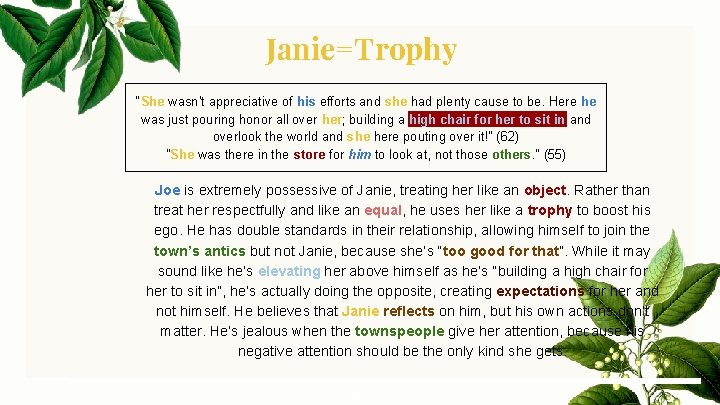
Janie=Trophy “She wasn’t appreciative of his efforts and she had plenty cause to be. Here he was just pouring honor all over her; building a high chair for her to sit in and overlook the world and she here pouting over it!” (62) "She was there in the store for him to look at, not those others. " (55) Joe is extremely possessive of Janie, treating her like an object. Rather than treat her respectfully and like an equal, he uses her like a trophy to boost his ego. He has double standards in their relationship, allowing himself to join the town’s antics but not Janie, because she’s “too good for that”. While it may sound like he’s elevating her above himself as he’s “building a high chair for her to sit in”, he’s actually doing the opposite, creating expectations for her and not himself. He believes that Janie reflects on him, but his own actions don’t matter. He’s jealous when the townspeople give her attention, because his negative attention should be the only kind she gets. 21
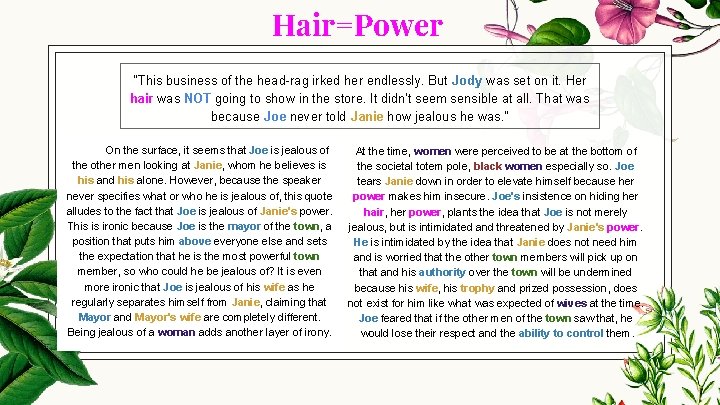
Hair=Power "This business of the head-rag irked her endlessly. But Jody was set on it. Her hair was NOT going to show in the store. It didn't seem sensible at all. That was because Joe never told Janie how jealous he was. " On the surface, it seems that Joe is jealous of the other men looking at Janie, whom he believes is his and his alone. However, because the speaker never specifies what or who he is jealous of, this quote alludes to the fact that Joe is jealous of Janie's power. This is ironic because Joe is the mayor of the town, a position that puts him above everyone else and sets the expectation that he is the most powerful town member, so who could he be jealous of? It is even more ironic that Joe is jealous of his wife as he regularly separates himself from Janie, claiming that Mayor and Mayor's wife are completely different. Being jealous of a woman adds another layer of irony. At the time, women were perceived to be at the bottom of the societal totem pole, black women especially so. Joe tears Janie down in order to elevate himself because her power makes him insecure. Joe's insistence on hiding her hair, her power, plants the idea that Joe is not merely jealous, but is intimidated and threatened by Janie's power. He is intimidated by the idea that Janie does not need him and is worried that the other town members will pick up on that and his authority over the town will be undermined because his wife, his trophy and prized possession, does not exist for him like what was expected of wives at the time. Joe feared that if the other men of the town saw that, he would lose their respect and the ability to control them.
- Slides: 22