
THEATRICAL SCENIC DESIGN CREATING AND PRESENTING A PROFESSIONAL
- Slides: 1
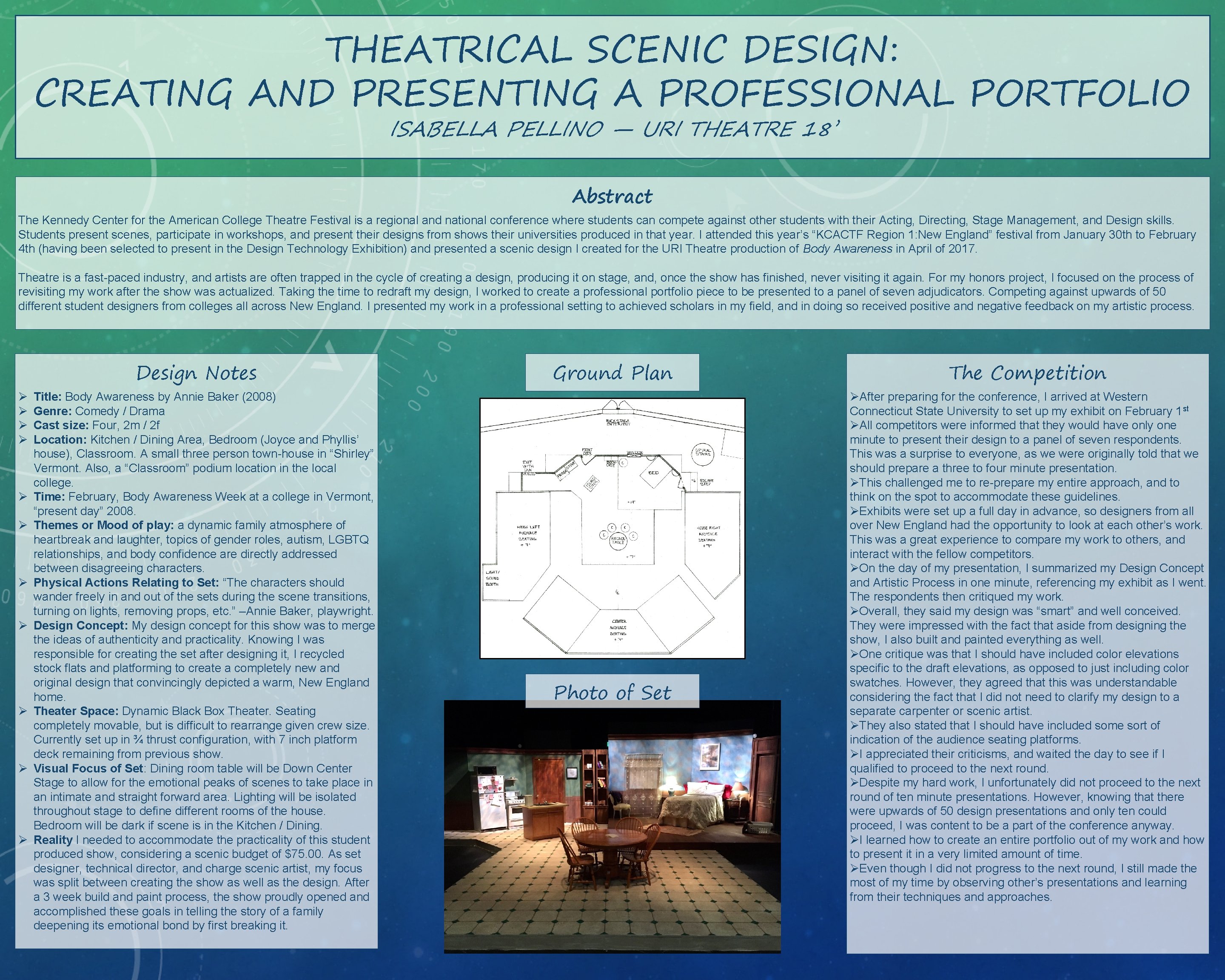
THEATRICAL SCENIC DESIGN: CREATING AND PRESENTING A PROFESSIONAL PORTFOLIO ISABELLA PELLINO — URI THEATRE 18’ Abstract The Kennedy Center for the American College Theatre Festival is a regional and national conference where students can compete against other students with their Acting, Directing, Stage Management, and Design skills. Students present scenes, participate in workshops, and present their designs from shows their universities produced in that year. I attended this year’s “KCACTF Region 1: New England” festival from January 30 th to February 4 th (having been selected to present in the Design Technology Exhibition) and presented a scenic design I created for the URI Theatre production of Body Awareness in April of 2017. Theatre is a fast-paced industry, and artists are often trapped in the cycle of creating a design, producing it on stage, and, once the show has finished, never visiting it again. For my honors project, I focused on the process of revisiting my work after the show was actualized. Taking the time to redraft my design, I worked to create a professional portfolio piece to be presented to a panel of seven adjudicators. Competing against upwards of 50 different student designers from colleges all across New England. I presented my work in a professional setting to achieved scholars in my field, and in doing so received positive and negative feedback on my artistic process. Design Notes Ø Ø Ø Title: Body Awareness by Annie Baker (2008) Genre: Comedy / Drama Cast size: Four, 2 m / 2 f Location: Kitchen / Dining Area, Bedroom (Joyce and Phyllis’ house), Classroom. A small three person town-house in “Shirley” Vermont. Also, a “Classroom” podium location in the local college. Time: February, Body Awareness Week at a college in Vermont, “present day” 2008. Themes or Mood of play: a dynamic family atmosphere of heartbreak and laughter, topics of gender roles, autism, LGBTQ relationships, and body confidence are directly addressed between disagreeing characters. Physical Actions Relating to Set: “The characters should wander freely in and out of the sets during the scene transitions, turning on lights, removing props, etc. ” –Annie Baker, playwright. Design Concept: My design concept for this show was to merge the ideas of authenticity and practicality. Knowing I was responsible for creating the set after designing it, I recycled stock flats and platforming to create a completely new and original design that convincingly depicted a warm, New England home. Theater Space: Dynamic Black Box Theater. Seating completely movable, but is difficult to rearrange given crew size. Currently set up in ¾ thrust configuration, with 7 inch platform deck remaining from previous show. Visual Focus of Set: Dining room table will be Down Center Stage to allow for the emotional peaks of scenes to take place in an intimate and straight forward area. Lighting will be isolated throughout stage to define different rooms of the house. Bedroom will be dark if scene is in the Kitchen / Dining. Reality I needed to accommodate the practicality of this student produced show, considering a scenic budget of $75. 00. As set designer, technical director, and charge scenic artist, my focus was split between creating the show as well as the design. After a 3 week build and paint process, the show proudly opened and accomplished these goals in telling the story of a family deepening its emotional bond by first breaking it. Ground Plan Photo of Set The Competition ØAfter preparing for the conference, I arrived at Western Connecticut State University to set up my exhibit on February 1 st ØAll competitors were informed that they would have only one minute to present their design to a panel of seven respondents. This was a surprise to everyone, as we were originally told that we should prepare a three to four minute presentation. ØThis challenged me to re-prepare my entire approach, and to think on the spot to accommodate these guidelines. ØExhibits were set up a full day in advance, so designers from all over New England had the opportunity to look at each other’s work. This was a great experience to compare my work to others, and interact with the fellow competitors. ØOn the day of my presentation, I summarized my Design Concept and Artistic Process in one minute, referencing my exhibit as I went. The respondents then critiqued my work. ØOverall, they said my design was “smart” and well conceived. They were impressed with the fact that aside from designing the show, I also built and painted everything as well. ØOne critique was that I should have included color elevations specific to the draft elevations, as opposed to just including color swatches. However, they agreed that this was understandable considering the fact that I did not need to clarify my design to a separate carpenter or scenic artist. ØThey also stated that I should have included some sort of indication of the audience seating platforms. ØI appreciated their criticisms, and waited the day to see if I qualified to proceed to the next round. ØDespite my hard work, I unfortunately did not proceed to the next round of ten minute presentations. However, knowing that there were upwards of 50 design presentations and only ten could proceed, I was content to be a part of the conference anyway. ØI learned how to create an entire portfolio out of my work and how to present it in a very limited amount of time. ØEven though I did not progress to the next round, I still made the most of my time by observing other’s presentations and learning from their techniques and approaches.