
THEATRE HISTORY PART 2 THE MIDDLE AGES TO
- Slides: 30
THEATRE HISTORY PART 2: THE MIDDLE AGES TO 1800
Medieval Theatre ■ The Middle Ages in Europe was a period often called the Dark Ages because there was little to no cultural activity. ■ The Middle Ages began with the fall of Rome in 476 A. D. and continued until the 15 th century. ■ Feudalism, in which peasants worked land paid rent to landowning lords, was the political system of the time.
Medieval Theatre ■ Poverty and illiteracy among the masses was common. ■ Travel and the exchange of ideas all but vanished. ■ For approximately, 400 years there was no theatre. ■ Some exceptions included sparse folk festivals and a few wandering jugglers and minstrels. ■ The lack of theatre during this time is a result of staunch opposition from the church.
Medieval Theatre ■ The church, despite burying drama in the 5 th century, resurrected it during the 9 th century when it introduced the trope—short dramatized scenes. ■ At first, brief Easter and Nativity tableaus (representations of a scene performed by motionless people in costume) were given to help the illiterate congregation understand the service. ■ Pantomime developed from this, and dialogue soon followed.
Medieval Theatre ■ This religious drama was acted out by priests and choirboys. ■ The scenes became so popular that whole stories began to be enacted. ■ Small platforms called mansions, or stations, were placed within the cathedral. ■ Separate scenes were performed on these with the crowd moving from one mansion to another until they had seen the whole story.
Medieval Theatre ■ Three types of plays were presented in the Middle Ages: 1. Mystery Plays – Bible stories re-enacted 2. Miracle Plays – Enacting the lives of the saints 3. Morality Plays – Stories teaching right from wrong in which characters personified abstract qualities
Medieval Theatre ■ An excellent example of a morality play is Everyman, which is still performed today. ■ As Everyman journeys to Death, his Friends, Worldly Goods, and so on all leave him. Only Good Deeds accompanies him to the grave.
Medieval Theatre ■ In the 10 th century, a nun, Hrosvitha, wrote religious comedy that was performed on the cathedral mansions. ■ Drama in the church became boisterous when comedy was added. ■ The crowds became so large that in the 13 th or 14 th century, the mansions were moved outside to the marketplace.
Medieval Theatre ■ Elaborate staging devices were contrived, such as Hell’s Mouth, which would open and close amid smoke and flames, as well as a rack that exhibited tortured souls, complete with realistic screams. ■ Eventually the trade guilds (unions) sponsored the plays, with each guild representing an applicable episode. – Shipbuilders staged Noah’s Ark – Cooks handled Hell’s Mouth since they were used to smoke and flames
Medieval Theatre ■ Each scene was prepared in great detail and was carefully rehearsed. ■ The productions, which were often quite spectacular, were presented to throngs of people on festival days in an atmosphere of fun.
Medieval Theatre ■ In England, France, and the Netherlands, pageant wagons were often used instead of stationary mansions. ■ These were double-decker wagons. ■ The lower story was curtained off and served as a changing room. ■ The play’s action was staged on the upper level and sometimes on the street around the wagon. ■ Audience members would be stationary, and the wagons would be brought to them episode by episode— something like our parade floats today.
Medieval Theatre ■ The passion play evolved during the late Middle Ages. It depicted scenes from Christ’s life, particularly the last days of his suffering and resurrection.
Medieval Theatre ■ The effects of medieval theatre was felt in later drama. ■ Because audience members were brought close to the performers and the playing area provided increased freedom, the art of acting became as important as the dialogue. ■ Medieval drama also brought a mixture of the comic and the serious. This combination would be imitated by both the improvisational players in Italy and the Elizabethan writers in England.
Renaissance Theatre ■ The Renaissance, which means “rebirth” in French, took place largely in the 15 th and 16 th centuries, and was an exciting time for theatre. ■ The Renaissance started in Italy, and men such as Petrarch, Leonardo da Vinci, Michelangelo, and Machiavelli contributed to a great flowering of knowledge and ideas.
Renaissance Theatre - Italy ■ The most important form of theatre that originated in Italy at this time was commedia dell’arte. ■ Commedia dell’arte was professional improvised comedy performed in the streets for the masses.
Renaissance Theatre - Italy ■ A company consisting usually of seven men and three women, would ad lib action, dialogue, song, and dance around a scenario usually involving love and intrigue. ■ The cast of commedia dell’arte, which included the first women on stage since Indian drama, wore half masks. ■ The popularity of this art form spread throughout Europe.
Renaissance Theatre - France ■ Due to France’s many wars and one theatre group having exclusive rights to the public playhouse, the Renaissance came late to French theatre, reaching its height in the 17 th century. ■ At that time the increased theatre activity gave rise to neoclassicism, a form in which dramatists follow the classic unities and write in a restricted verse form. ■ This French drama developed into entertainment for royalty.
Renaissance Theatre - France ■ Molière (1622 -1673) represents the high point of French Renaissance drama. ■ He wrote such witty satire that his plays continue to entertain around the world. ■ Some of his plays include: The Doctor in Spite of Himself, Tartuffe, and The Imaginary Invalid.
Elizabethan Theatre ■ When Elizabeth I became queen of England, theatre gained a friend. Elizabeth loved theatre. ■ She commanded many court performances, protected groups of players through court sponsorship, and looked upon London’s feverish dramatic activity with approval.
Elizabethan Theatre ■ The Elizabethan period was an age of literary enlightenment. ■ There were many brilliant playwrights, and most of them wrote with great freedom, disregarding the classic unities of the time and place, and the rule—left over from the ancient Greeks---that violence should not be seen on stage. ■ They also mixed poetry with prose and interspersed comedy with tragedy.
Elizabethan Theatre ■ Christopher Marlowe (1564 -1593) – Next to Shakespeare, Marlowe is considered the greatest dramatists of tragedy in England, even though he only lived to the age of 29. – In his short life, he wrote 7 plays including his best known, Dr. Faustus.
Elizabethan Theatre ■ Ben Jonson (1572 -1637) – Jonson was a classic writer, always correct, always abiding by the Aristotelian unities. – Much of his work is biting, humorous satire. – His work includes: Volpone and The Alchemist
Elizabethan Theatre ■ William Shakespeare (1564 -1616) – Considered the greatest of all English dramatists – Born in Stratford-upon-Avon – Shakespeare attended grammar school, his only formal education – At 18, he married Ann Hathaway, who was 8 years older than him
Elizabethan Theatre ■ William Shakespeare (1564 -1616) – Although the exact reason isn’t known, he left his wife and three children and went to London – He began working as an actor, manager, and writer – By 1596, he was well established and in royal favor
Elizabethan Theatre ■ William Shakespeare (1564 -1616) – In the 38 plays attributed to him, Shakespeare created histories, comedies, tragedies, and fantasies. – His plays combined skillful plot and character development with majestic use of language. – Some of his famous characters include: ■ ■ ■ Hamlet Falstaff Puck Othello Romeo and Juliet Macbeth and Lady Macbeth
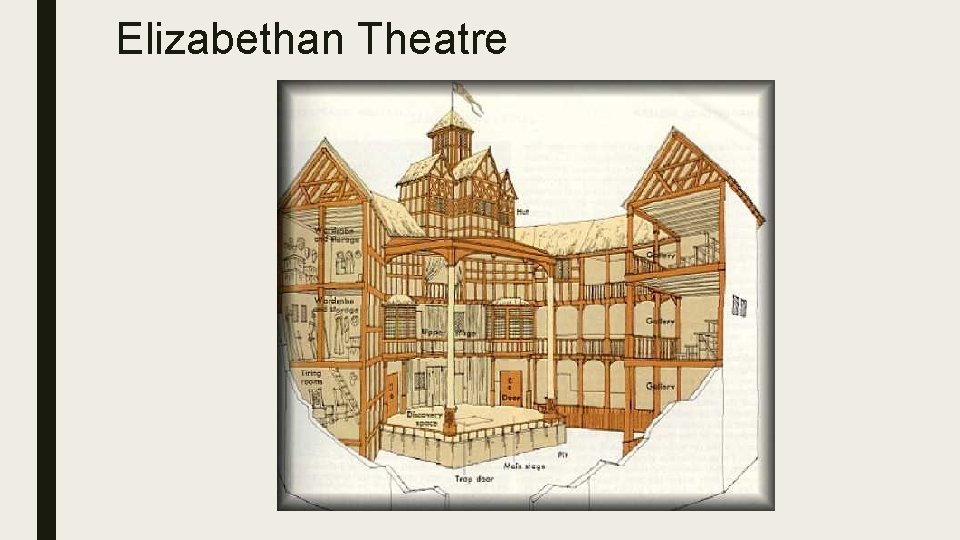
Elizabethan Theatre ■ The first public playhouse was called Theatre and was built in 1576. It held about 1, 500 people. ■ Other theatres built during this time included The Rose, The Swan, and The Globe. ■ The theatres were called Wooden O’s because they were usually round or octagonal with two or three tiers of thatched roof galleries surrounding an open court on three sides.
Elizabethan Theatre
Elizabethan Theatre ■ Plays were held in the afternoon (with daylight serving as the lighting system). ■ To announce performances, flags were used (white flag for comedy, black flag for tragedy). ■ All classes of people attended. ■ The groundlings (usually tradespeople, soldiers, apprentices, and servants) paid a penny and stood in the pit around the acting platform. ■ Lords and ladies paid more and had seats in the gallery.
Elizabethan Theatre ■ There was no scenery. The spectators had to use their imagination as they listened to the playwright’s descriptions and the character’s dialogue. ■ Some props were used, and so were certain sound effects. ■ In fact, the burning of The Globe Theatre in 1613 was the result of the thatch roof catching fire from the cannon shots that announced the king’s entrance in Shakespeare’s Henry VIII. ■ Costumes were usually styles of the day donated by patrons, so little attempt at historical accuracy was made. ■ Only a few stylized costumes were used such as witches and fairies.
Restoration and 18 th Century Theatre ■ The Restoration came about with the establishing of the monarchy in England in 1660 under Charles II. ■ When Charles returned from France and was restored to the English throne, he started a new era of drama that was fashioned after theatre he had seen in Paris. ■ Since the Elizabethan playhouses had been torn down by the Puritans, new indoor theatres were built with a deep apron on which to act and with a proscenium arch. ■ The audience was sophisticated aristocracy. ■ The plays staged at this time were comedies of manners that satirized the artificiality of the day, and so they were witty and concerned with foolish pleasures.