
Theater Background What does the development of theater

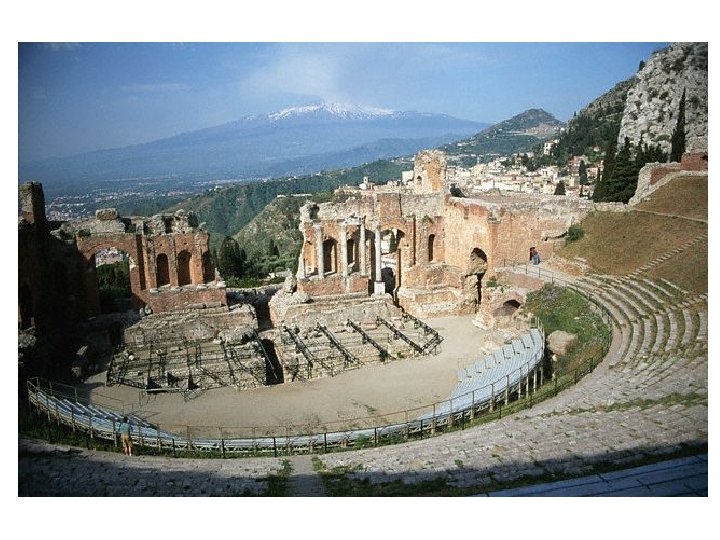
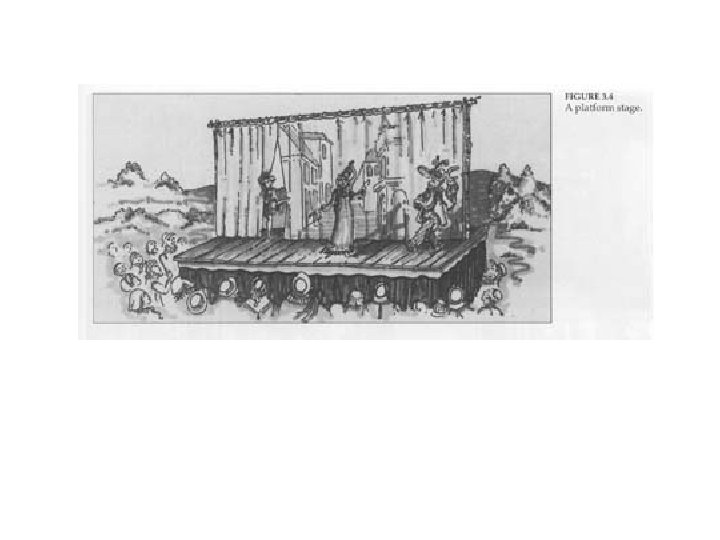
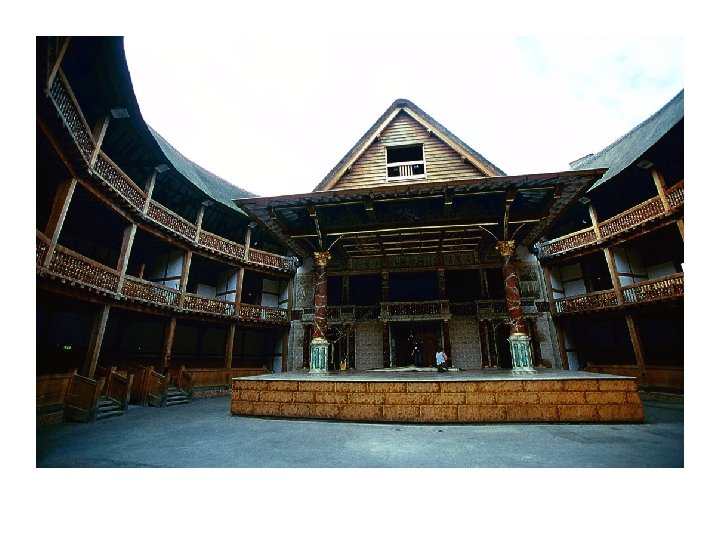
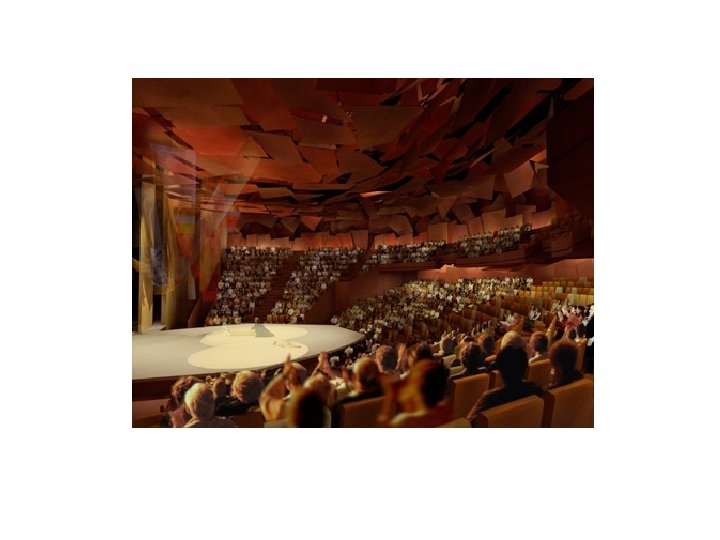
Theater Background • What does the development of theater and the physical theater space imply about Greek and Roman civilization? • Why did theater disappear for such a long time in the West? • What were some factors in its revival? • What are some types of stage spaces?

Freytag • Who was Freytag and when did he write? • What are some distinctions Freytag made between the Ancients and the Moderns? • Is Freytag still applicable to contemporary drama?

Freytag’s “well-made” Play • Freytag found recurring patterns which he idealized into a general structure consisting of four basic parts: – Exposition – Rising action – Climax – Falling action
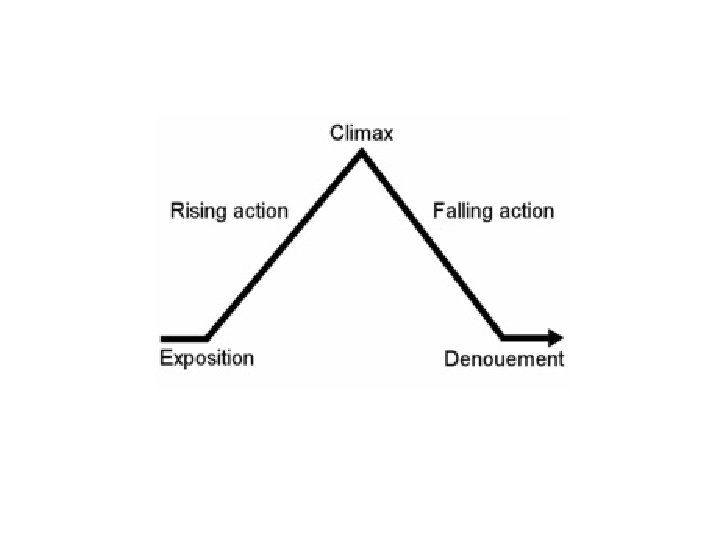
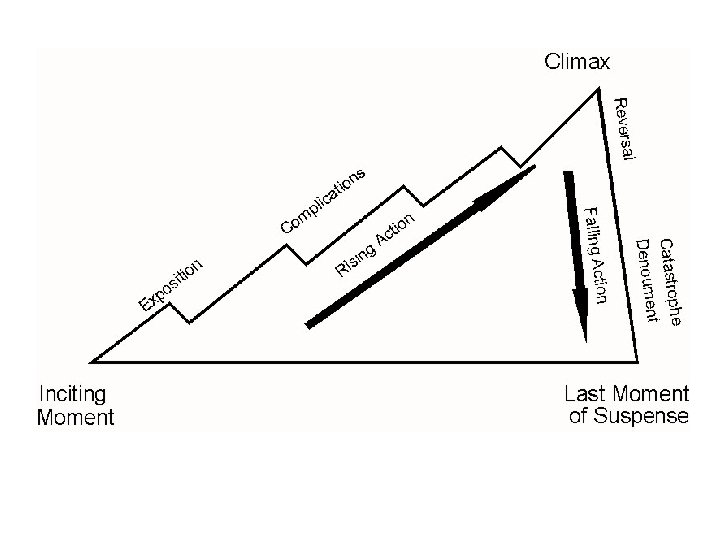
Other Applications • Consider Freytag’s structure in respect to other, non-dramatic narratives that we have read. • Does this structure apply to many narratives generally? • Are there any stories we have read which do not follow this structure?
Review of Characters • • Valère Elise Cléante Harpagon La Flêche Mariane Jacques

New Characters • Anselme • Frosine

Plot and Form of Act I • • What is the goal of scene 1? What is the goal of scene 2? What is the goal of scene 3? How does scene 4 bring all of these problems together?

Terms • • • closure denouement deus ex machina period piece recognition scene voice of reason

Content 1. Why is Mariane upset? (176) 2. Why does Frosine criticize young lovers? (176 -7) 3. What does Frosine encourage Mariane to do? (177) 4. What does Mariane discover at Harpagon’s house? (178) 5. Why is Harpagon upset with Cléante when he meets Mariane? (179 -80)

Content 6. What does Cléante reveal about his relationship with Mariane? (189) 7. What does La Flêche reveal to Cléante? (194) 8. How do the officer’s and Harpagon’s plans for an investigation differ? (196 -7) 9. Whom does Jacques accuse of theft? (198) 10. Why do Harpagon and Valère misunderstand each other? (200 -3)?
Content 11. Why does Anselme urge Valère to be careful about what he says? (206) 12. What story does Valère tell about his origins? (207) 13. What proof can Valère provide that his story is true? (207) 14. What is Anselme’s relation to Valère and Mariane? (207) 15. What does Cléante offer his father? What must Harpagon give him for it? (209)

Act III: Conflict and Climax • What new conflicts are introduced in Act III? • Where is the highpoint of this act?

Tentative Answers • Mariane’s knowledge of Cléante’s feelings and situation add an element to the conflict. • Mariane’s realization that Cléante is Harpagon’s son is a highpoint of this act.
Gender and Gender Roles • Generally, how do the female characters differ from the male characters? • Why does Mariane agree to the marriage? • What assumptions must be made about family relations and especially women’s roles for the play to be believable?

Departures from Freytag • asides • monologue

Use of Asides • How are asides used in the play so far (especially III. vi) and what is their function? [passages: 178, 180, 181 -2] • What would Molière have had to do to get rid of the asides (and still give us the same information)? • What happens to drama when asides are no longer possible?

Harpagon’s Monologue • Note the artificiality of the monologue • Note the effect of speaking directly to an audience • Think about how this would differ if the play were serious • passage: 195 • segment: 1: 28
Vignettes • Much of Acts II and III contain subplots. • Act I, however, cannot be cut very much. • What is the difference between the functions of these acts for the play overall? • Which parts could be removed and why? • Why would Molière write a play containing “unnecessary” parts? • What does it suggest about his audience?

Protagonist/Antagonist • We have used the word protagonist in our other reading. What is a protagonist and what is this person’s role in a narrative? • What is our typical relation to a protagonist? • Who is the protagonist of this play, and how do we know? • Are our expectations fulfilled of this protagonist? • Is there an antagonist?

Related Terms • protagonist-antagonist • foil • villain

Changes in the Comic Protagonist • In many comedies the main character undergoes a transformation. Often, he or she starts out as a bad person, but ends up learning something or experiencing something which changes his or her behavior or attitude towards life. • Does Harpagon really change at the end of the play? Does he end up as a different person?
Abnormal to Normal • Sometimes a comedy involves replacing an “abnormal” relationship or situation with a “normal” or “natural” or “correct” situation. How does this idea work in this play? • Consider the marriages. Compare the final results to the proposed marriages or marriage situations we start out with in Act I. • Do we still understand normality in this way?
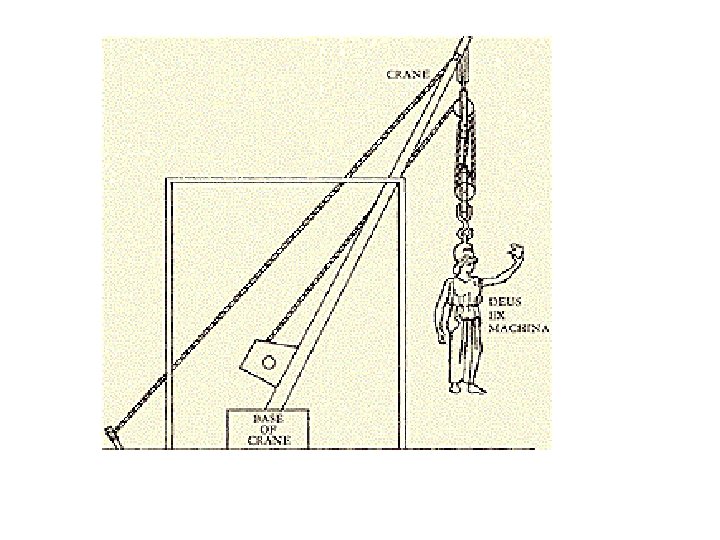
The Deus ex Machina • What do you think of the ending and the way that Molière tries not to leave loose ends? • A deus [god] ex [from, out of] machina [machine, mechanical process] was a feature of some Greek tragedy, particularly that of Euripides. Humans are unable to solve their problems and so a god descends at the end of the play to sort out the mess. • If we think of the device metaphorically, what might that mean? • Is it frustrating to have a deus ex machina in a play?
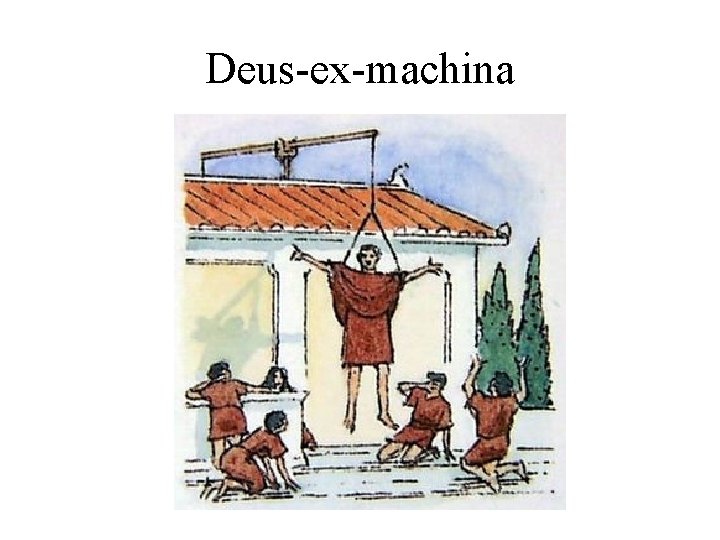
Deus-ex-machina
Voice of Reason • Many of Molière’s plays contain abnormal characters; many also contain a level-headed, rational character who speaks thoughtfully about the play’s conflict—the voice of reason. • Who represents the voice of reason in the play? • passages: 205, 206
Recognition Scene/Closure • Comic plots sometimes do end with the complicated “recognition scene” at the end, which gives closure to the play. • How might the audience react to a lack of clear closure? • passage: 206 -208

Happy/Comic Ending • • Does this play have a happy ending? Does the play have closure? Does the play depict justice? Does the play in fact fulfill expectations for comedy, especially for the comic protagonist?

Climax and Anti-climax • The climax of the play is where all the obstacles are overcome and the conflict is solved. • Where would you place the climax of the play? • Is there an anti-climax?

Period Piece • A period piece is a work whose concerns are related to a specific society at a certain time, and which has lost its relevance today. • Why might we read something that most consider a period piece? • Is Molière’s play topical for us, or is it just a period piece?

Universality in Molière • This play first appeared 450 years ago (and obviously in a different culture, socio-political context, and language). • Is it legible to us? If so, why? • Is it applicable to us? If so, why? • Does the play qualify as a universal work? • For whom would it not qualify? What is required for it to work universally?
Topic #1 • With reference to specific symbols in the stories, develop a comprehensive allegorical reading of either “An Old Manuscript” or “Before the Law. ” Do not write about both. Keep in mind that multiple interpretations are possible, so avoid overstatement and unsupported generalization.
Topic #2 • Argue for or against this statement: In the excerpt that we read, Richard, protagonist of Black Boy, is a tragic hero. You must take a position for or against—do not argue both sides. Keep in mind that tragic means tragedy in its literary sense. It’s a good idea to use your knowledge of literary tragic heroes to establish your criteria for judgment.
Topic #3 • Discuss the knife given to Richard by Mr. Olin as a symbol. Interpret the movement of the knife, both for the white and the black characters, in the context of the excerpt.

Topic #4 • Explain how Molière provides us with the necessary expository elements in Act I by which we can understand the major conflict of the play (that is, preceding the point of attack, which you should identify). You will have to sort these elements out systematically for several characters, using the ideas of character motive and conflict. This topic only concerns Act I.

Topic #5 • Discuss how The Miser is a “universal” play (or whether in fact it is). What makes it meaningful in different times and in different cultures (or what blocks this, if you disagree)? I urge creating a clear, concrete main point structure if you choose this topic. You must avoid unsupported generalizations, and you must approach this topic by either agreeing that it is or disagreeing that it is not—don’t argue both positions.

For Next Time • Read: Act without Words II and the remaining poetry • Response #3 is due May 26.
- Slides: 45