
THE ZUNI PEOPLE BY Introduction The Zuni are

THE ZUNI PEOPLE BY:
Introduction �The Zuni are one of the nineteen Pueblo Indian tribes who are descendants of the Ancient Puebloans. �Their tribal name is A'shiwi (Shi'wi), meaning "the flesh. ” �Zuni history is believed to be dated back before 2500 B. C. when they moved to the Southwest � It was during this time that they made their first attempts at agriculture and game hunting. �Around 1500 B. C. their agriculture thrived enabling them to grow many more crops such maize and wheat.
Zuni Politics �The Zuni men played the dominant role in Zuni village life and were the spiritual leaders in charge of religious ceremonies and rituals. �The Zuni men were also the political leaders of the tribe. �The role of the women was concentrated on the home. �The Zuni tribe became noted as excellent agriculturalists, stockbreeders and skilled weavers, potters, and silversmiths.
Religion �A feature of every Zuni village is the underground chamber used for tribal ceremonies and rituals called a Kiva �The principal figure in the Zuni creation myth is "Awonawilona, the maker of all" in which the origin of the sun, the earth and the sky, men and all creatures are explained. �The Zuni tribes are strongly associated with Kahuna dolls. The Kachinas represent the powerful spirits of deities, animals or natural elements who can use their magical powers for the good and well-being of the Zuni tribe, bringing rain, fertility, healing and protection to the people. �The Summer Solstices Ceremony is a major Zuni ceremony which is celebrated over a period of 16 days. The Zuni believed in Achiyalatopa a bird monster with magic powers that possessed feathers made of stone knives, which it threw at objects.
Language �The Zuni tribe spoke in the Zuni language as well. The Zuni language has been around for more than 7, 000 years. �The Zuni language is different but later on they adopt words from Hopi and Pima tribes. �The Zuni believe that without a language they wouldn’t be able to communicate with their ancestors.
Art/Architecture � The ancestors of the Zuni Pueblo Indians first lived in Cliff Houses. � They were excellent stone masons who moved from these dwellings and began to build their houses beneath the overhanging cliffs �The Zuni homes were made of adobe from a mixture of clay and straw baked into hard bricks. �Each adobe was the home of one family and often contained several rooms.
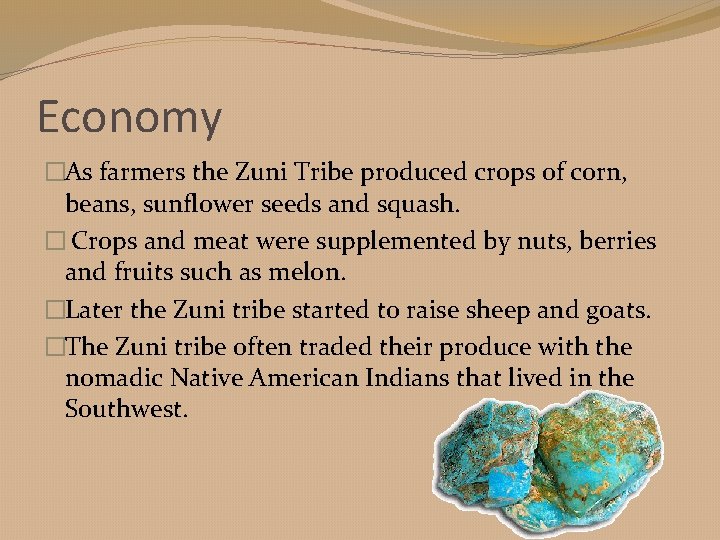
Economy �As farmers the Zuni Tribe produced crops of corn, beans, sunflower seeds and squash. � Crops and meat were supplemented by nuts, berries and fruits such as melon. �Later the Zuni tribe started to raise sheep and goats. �The Zuni tribe often traded their produce with the nomadic Native American Indians that lived in the Southwest.
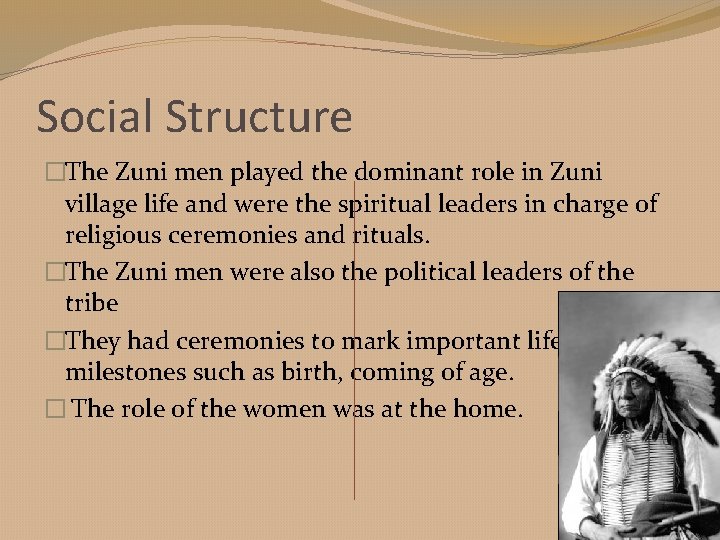
Social Structure �The Zuni men played the dominant role in Zuni village life and were the spiritual leaders in charge of religious ceremonies and rituals. �The Zuni men were also the political leaders of the tribe �They had ceremonies to mark important life milestones such as birth, coming of age. � The role of the women was at the home.

The Zuni buffalo dance
Bibliography (n. d. ). Retrieved October 3, 2015, from http: //en. wikipedia. org/zuni__people (n. d. ). Retrieved October 3, 2015, from http: //www. ashivwi. org/zuni_people The Pueblo of Zuni. (n. d. ). Retrieved October 4, 2015, from http: //www. ashiwi. org/ (n. d. ). Retrieved October 5, 2015, from https: //en. wikipedia. org/wiki/Zuni_Indian_Reservation (n. d. ). Retrieved October 5, 2015, fromhttps: //en. wikipedia. org/wiki/Zuni_Pueblo, _New_Mexico

The End Thank you for watching
- Slides: 11