
The Zarit Burden Inventory ZBI for Caregivers of
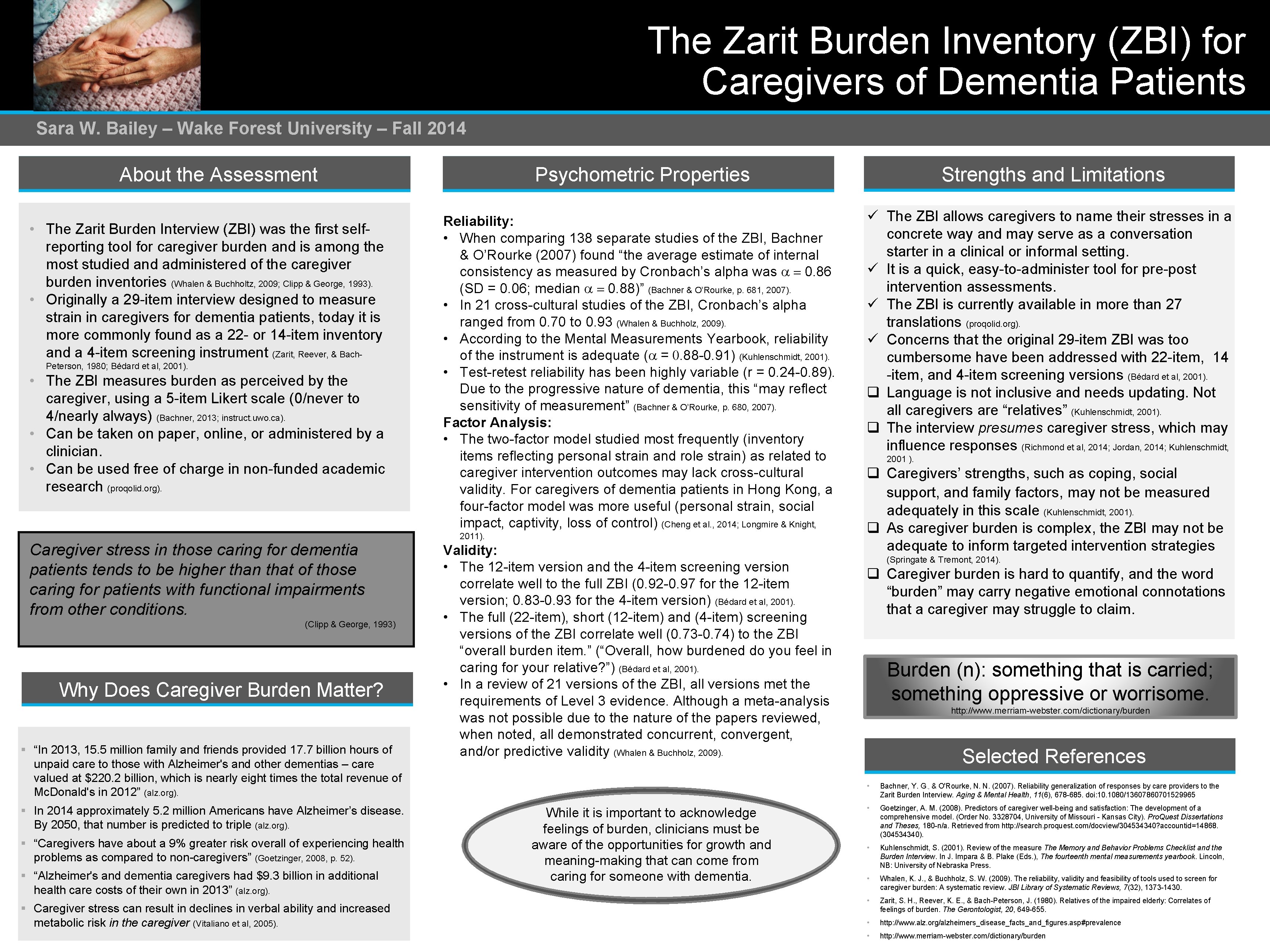
The Zarit Burden Inventory (ZBI) for Caregivers of Dementia Patients Sara W. Bailey – Wake Forest University – Fall 2014 About the Assessment • The Zarit Burden Interview (ZBI) was the first selfreporting tool for caregiver burden and is among the most studied and administered of the caregiver burden inventories (Whalen & Buchholtz, 2009; Clipp & George, 1993). • Originally a 29 -item interview designed to measure strain in caregivers for dementia patients, today it is more commonly found as a 22 - or 14 -item inventory and a 4 -item screening instrument (Zarit, Reever, & Bach. Peterson, 1980; Bédard et al, 2001). • The ZBI measures burden as perceived by the caregiver, using a 5 -item Likert scale (0/never to 4/nearly always) (Bachner, 2013; instruct. uwo. ca). • Can be taken on paper, online, or administered by a clinician. • Can be used free of charge in non-funded academic research (proqolid. org). Caregiver stress in those caring for dementia patients tends to be higher than that of those caring for patients with functional impairments from other conditions. (Clipp & George, 1993) Why Does Caregiver Burden Matter? § “In 2013, 15. 5 million family and friends provided 17. 7 billion hours of unpaid care to those with Alzheimer's and other dementias – care valued at $220. 2 billion, which is nearly eight times the total revenue of Mc. Donald's in 2012” (alz. org). § In 2014 approximately 5. 2 million Americans have Alzheimer’s disease. By 2050, that number is predicted to triple (alz. org). § “Caregivers have about a 9% greater risk overall of experiencing health problems as compared to non-caregivers” (Goetzinger, 2008, p. 52). § “Alzheimer's and dementia caregivers had $9. 3 billion in additional health care costs of their own in 2013” (alz. org). § Caregiver stress can result in declines in verbal ability and increased metabolic risk in the caregiver (Vitaliano et al, 2005). Psychometric Properties Strengths and Limitations Reliability: • When comparing 138 separate studies of the ZBI, Bachner & O’Rourke (2007) found “the average estimate of internal consistency as measured by Cronbach’s alpha was a = 0. 86 (SD = 0. 06; median a = 0. 88)” (Bachner & O’Rourke, p. 681, 2007). • In 21 cross-cultural studies of the ZBI, Cronbach’s alpha ranged from 0. 70 to 0. 93 (Whalen & Buchholz, 2009). • According to the Mental Measurements Yearbook, reliability of the instrument is adequate (a = 0. 88 -0. 91) (Kuhlenschmidt, 2001). • Test-retest reliability has been highly variable (r = 0. 24 -0. 89). Due to the progressive nature of dementia, this “may reflect sensitivity of measurement” (Bachner & O’Rourke, p. 680, 2007). Factor Analysis: • The two-factor model studied most frequently (inventory items reflecting personal strain and role strain) as related to caregiver intervention outcomes may lack cross-cultural validity. For caregivers of dementia patients in Hong Kong, a four-factor model was more useful (personal strain, social impact, captivity, loss of control) (Cheng et al. , 2014; Longmire & Knight, ü The ZBI allows caregivers to name their stresses in a concrete way and may serve as a conversation starter in a clinical or informal setting. ü It is a quick, easy-to-administer tool for pre-post intervention assessments. ü The ZBI is currently available in more than 27 translations (proqolid. org). ü Concerns that the original 29 -item ZBI was too cumbersome have been addressed with 22 -item, 14 -item, and 4 -item screening versions (Bédard et al, 2001). q Language is not inclusive and needs updating. Not all caregivers are “relatives” (Kuhlenschmidt, 2001). q The interview presumes caregiver stress, which may influence responses (Richmond et al, 2014; Jordan, 2014; Kuhlenschmidt, 2011). Validity: • The 12 -item version and the 4 -item screening version correlate well to the full ZBI (0. 92 -0. 97 for the 12 -item version; 0. 83 -0. 93 for the 4 -item version) (Bédard et al, 2001). • The full (22 -item), short (12 -item) and (4 -item) screening versions of the ZBI correlate well (0. 73 -0. 74) to the ZBI “overall burden item. ” (“Overall, how burdened do you feel in caring for your relative? ”) (Bédard et al, 2001). • In a review of 21 versions of the ZBI, all versions met the requirements of Level 3 evidence. Although a meta-analysis was not possible due to the nature of the papers reviewed, when noted, all demonstrated concurrent, convergent, and/or predictive validity (Whalen & Buchholz, 2009). While it is important to acknowledge feelings of burden, clinicians must be aware of the opportunities for growth and meaning-making that can come from caring for someone with dementia. 2001 ). q Caregivers’ strengths, such as coping, social support, and family factors, may not be measured adequately in this scale (Kuhlenschmidt, 2001). q As caregiver burden is complex, the ZBI may not be adequate to inform targeted intervention strategies (Springate & Tremont, 2014). q Caregiver burden is hard to quantify, and the word “burden” may carry negative emotional connotations that a caregiver may struggle to claim. Burden (n): something that is carried; something oppressive or worrisome. http: //www. merriam-webster. com/dictionary/burden Selected References • Bachner, Y. G. , & O'Rourke, N. N. (2007). Reliability generalization of responses by care providers to the Zarit Burden Interview. Aging & Mental Health, 11(6), 678 -685. doi: 10. 1080/13607860701529965 • Goetzinger, A. M. (2008). Predictors of caregiver well-being and satisfaction: The development of a comprehensive model. (Order No. 3328704, University of Missouri - Kansas City). Pro. Quest Dissertations and Theses, 180 -n/a. Retrieved from http: //search. proquest. com/docview/304534340? accountid=14868. (304534340). • Kuhlenschmidt, S. (2001). Review of the measure The Memory and Behavior Problems Checklist and the Burden Interview. In J. Impara & B. Plake (Eds. ), The fourteenth mental measurements yearbook. Lincoln, NB: University of Nebraska Press. • Whalen, K. J. , & Buchholz, S. W. (2009). The reliability, validity and feasibility of tools used to screen for caregiver burden: A systematic review. JBI Library of Systematic Reviews, 7(32), 1373 -1430. • Zarit, S. H. , Reever, K. E. , & Bach-Peterson, J. (1980). Relatives of the impaired elderly: Correlates of feelings of burden. The Gerontologist, 20, 649 -655. • http: //www. alz. org/alzheimers_disease_facts_and_figures. asp#prevalence • http: //www. merriam-webster. com/dictionary/burden
- Slides: 1