
The Youth Risk Behavior Surveillance System YRBSS 2013
The Youth Risk Behavior Surveillance System (YRBSS): 2013 National, State, and Local Data National Center for HIV/AIDS, Viral Hepatitis, STD, and TB Prevention Division of Adolescent and School Health
Purposes of the YRBSS • Focus the nation on behaviors among youth causing the most important health problems • • Assess how risk behaviors change over time Provide comparable data
Priority Health-Risk Behaviors and Health Outcomes Monitored by YRBSS • Behaviors that contribute to the leading causes of mortality and morbidity • • Unintentional injuries and violence Sexual behaviors Alcohol and other drug use Tobacco use Unhealthy dietary behaviors Inadequate physical activity Obesity Asthma

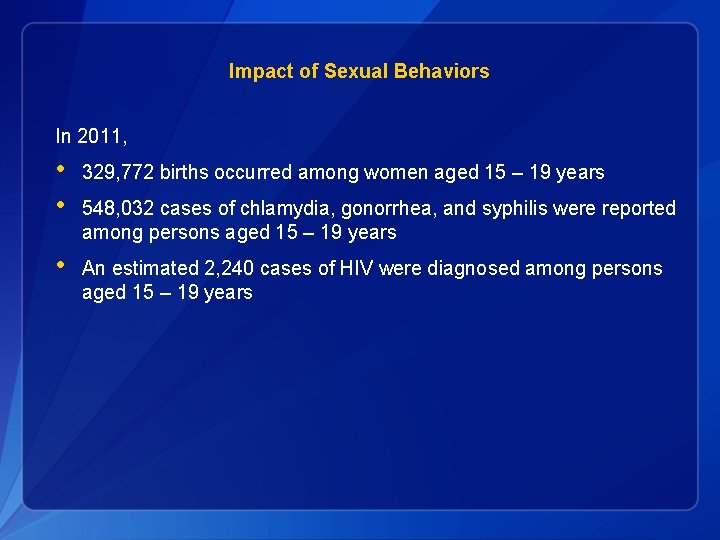
Impact of Sexual Behaviors In 2011, • • 329, 772 births occurred among women aged 15 – 19 years • An estimated 2, 240 cases of HIV were diagnosed among persons aged 15 – 19 years 548, 032 cases of chlamydia, gonorrhea, and syphilis were reported among persons aged 15 – 19 years
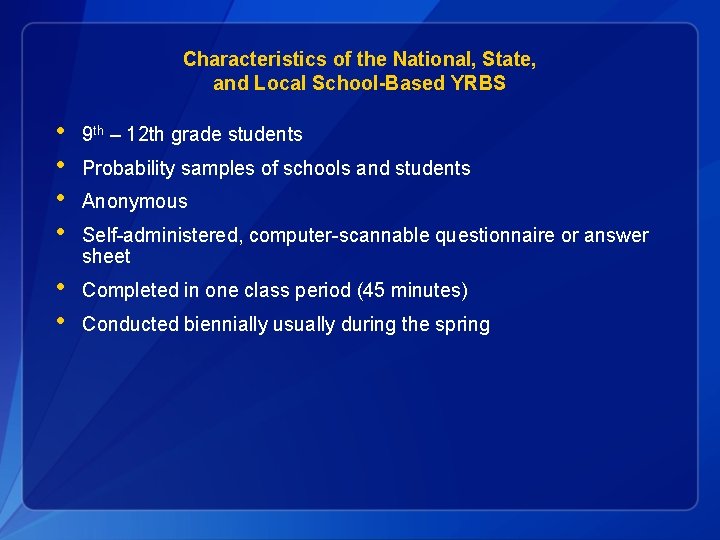
Characteristics of the National, State, and Local School-Based YRBS • • 9 th – 12 th grade students • • Completed in one class period (45 minutes) Probability samples of schools and students Anonymous Self-administered, computer-scannable questionnaire or answer sheet Conducted biennially usually during the spring
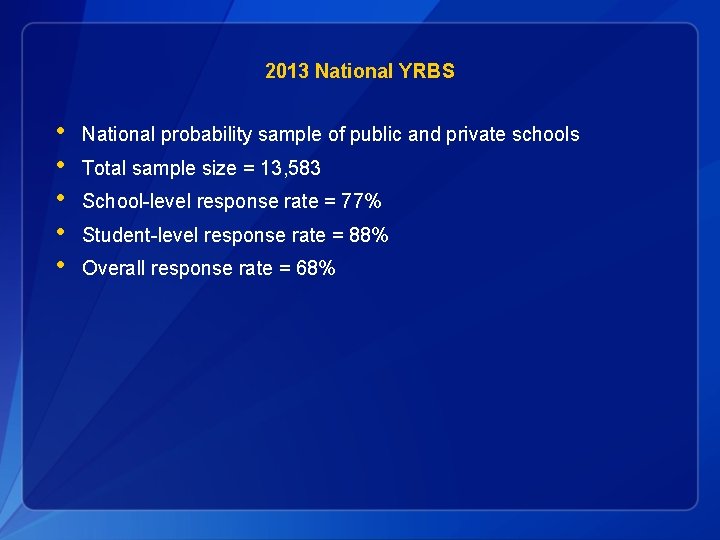
2013 National YRBS • • • National probability sample of public and private schools Total sample size = 13, 583 School-level response rate = 77% Student-level response rate = 88% Overall response rate = 68%
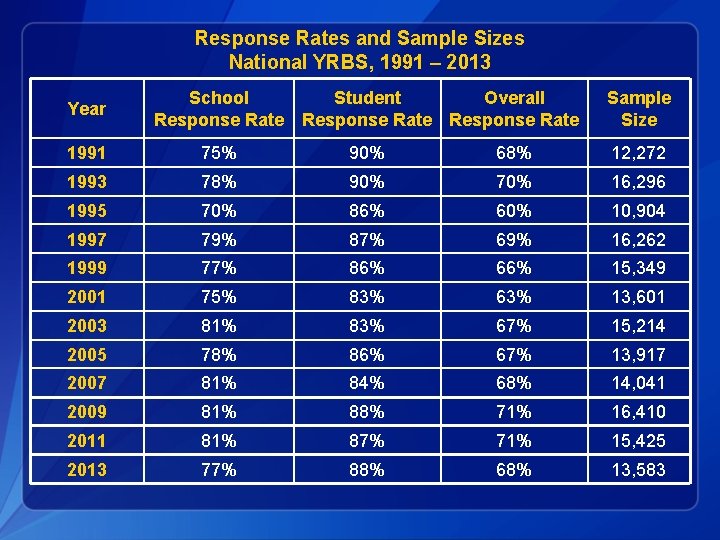
Response Rates and Sample Sizes National YRBS, 1991 – 2013 Year School Response Rate Student Overall Response Rate Sample Size 1991 75% 90% 68% 12, 272 1993 78% 90% 70% 16, 296 1995 70% 86% 60% 10, 904 1997 79% 87% 69% 16, 262 1999 77% 86% 66% 15, 349 2001 75% 83% 63% 13, 601 2003 81% 83% 67% 15, 214 2005 78% 86% 67% 13, 917 2007 81% 84% 68% 14, 041 2009 81% 88% 71% 16, 410 2011 81% 87% 71% 15, 425 2013 77% 88% 68% 13, 583
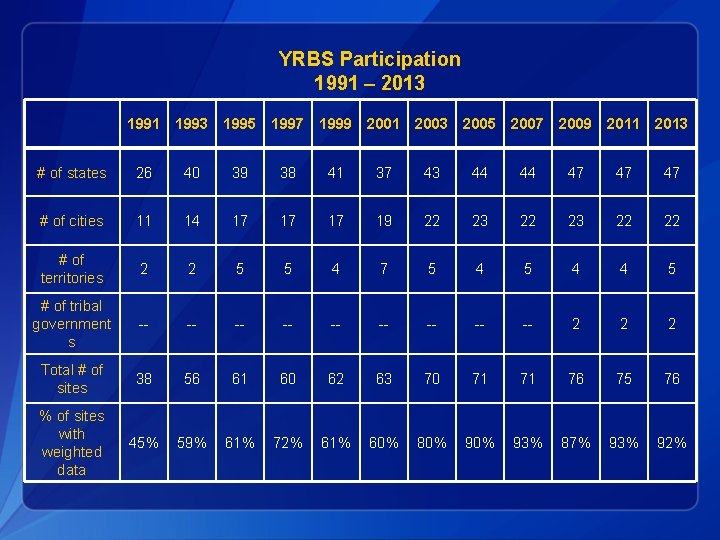
YRBS Participation 1991 – 2013 1991 1993 1995 1997 1999 2001 2003 2005 2007 2009 2011 2013 # of states 26 40 39 38 41 37 43 44 44 47 47 47 # of cities 11 14 17 17 17 19 22 23 22 22 # of territories 2 2 5 5 4 7 5 4 4 5 # of tribal government s -- -- -- 2 2 2 Total # of sites 38 56 61 60 62 63 70 71 71 76 75 76 % of sites with weighted data 45% 59% 61% 72% 61% 60% 80% 93% 87% 93% 92%
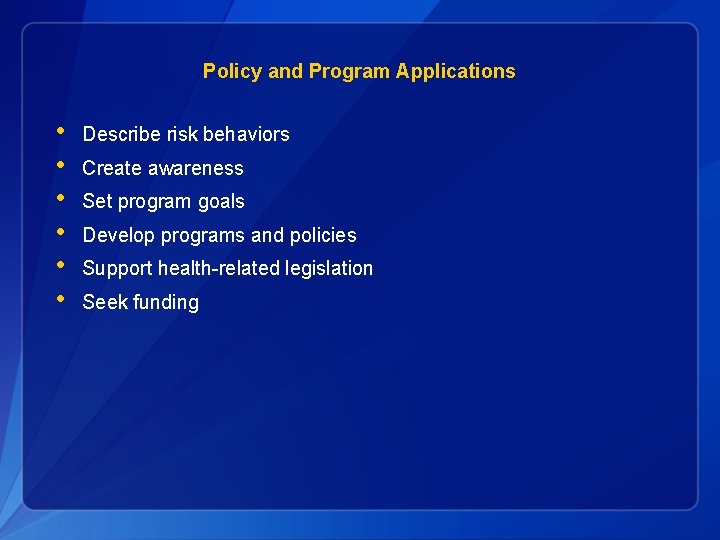
Policy and Program Applications • • • Describe risk behaviors Create awareness Set program goals Develop programs and policies Support health-related legislation Seek funding
Describe Risk Behaviors • • Overall and among subgroups of youth How risk behaviors are interrelated
Create Awareness Among: • Legislators, boards of education, and school administrators • • • Parents Community members School staff Students Media
Set Program Goals • • • Strategic plans for school health programs Healthy People 2020 objectives CDC Cooperative Agreement Performance Measures
Develop Programs and Policies • • School health programs and policies Programs and policies for youth in high risk situations Instructional guides and materials Professional development programs for teachers
Support Health-Related Legislation • • • School health program requirements School health council requirements Drug-free or weapon-free school zone laws Minors’ access laws Drinking and driving laws Bans on billboards and other advertising Competitive food policies School health services policies Anti-bullying legislation School environment policies
Seek Funding • Support funding requests to federal, state, and private agencies and foundations
YRBSS Information • www. cdc. gov/yrbss • • • Youth Online Questionnaire and item rationale Morbidity and Mortality Weekly Report Surveillance Summaries Data and codebooks for the national YRBS Publications, journal articles, and fact sheets
- Slides: 18