
The Young Child Development from Prebirth Through Age
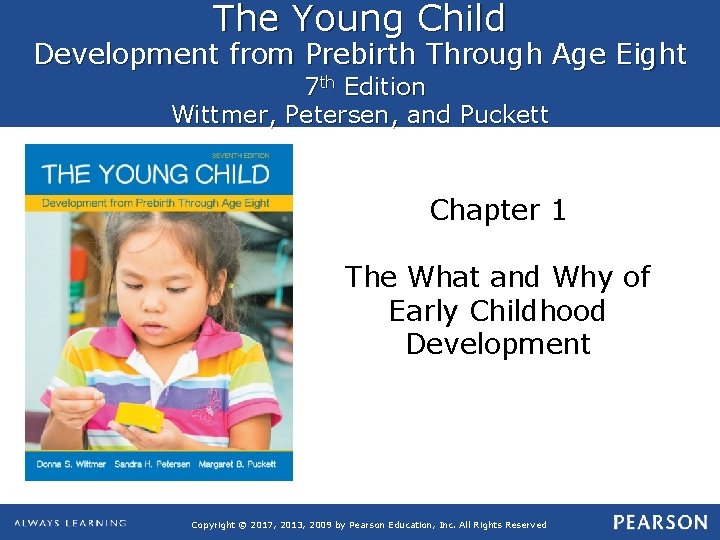
The Young Child Development from Prebirth Through Age Eight 7 th Edition Wittmer, Petersen, and Puckett Chapter 1 The What and Why of Early Childhood Development Copyright © 2017, 2013, 2009 by Pearson Education, Inc. All Rights Reserved
Essential Features of Early Learning and Development • Learning is active, foundational, continuous. § Learning begins as fetus begins to perceive sounds and light, rhythms, and flavors. § Learning is cumulative. • Learning is a continuous, dynamic interaction among experiences, gene expression, and brain development. § Human genome has ~20, 000 genes that carry inherited information. • Experiences may trigger a gene to express or stop a gene from expressing. The Young Child, 7 th Edition Wittmer, Petersen, and Puckett Copyright © 2017, 2013, 2009 by Pearson Education, Inc. All Rights Reserved

Essential Features of Early Learning and Development • Experience causes change in brain structure. • Each domain is crucial to early learning, and each has specific developmental paths. § Each domain has its own developmental path. § Each domain is dependent on the others. • Stress and adversity can undermine learning and impair well-being. § These effects may be moderated with the support of a responsive, nurturing adult. The Young Child, 7 th Edition Wittmer, Petersen, and Puckett Copyright © 2017, 2013, 2009 by Pearson Education, Inc. All Rights Reserved

Essential Features of Early Learning and Development • Secure and responsive relationships, coupled with high-quality, positive learning interactions and environments, are foundational for healthy development. § Early childhood professionals must be capable of having warm, responsive, nurturing relationships with children. • All learning is based in culture. § From birth, children learn the rules, values, and beliefs of their culture. § Culture becomes a filter for what children are directed to learn. The Young Child, 7 th Edition Wittmer, Petersen, and Puckett Copyright © 2017, 2013, 2009 by Pearson Education, Inc. All Rights Reserved

Early Learning Guidelines and Outcome Standards • The No Child Left Behind Act (NCLB) of 2001 § Accountability: Each state develops content and academic achievement standards • What children in kindergarten-12 th grade should know in English/language arts, math, science • Common Core of State Standards (CCSS) developed in 2010 The Young Child, 7 th Edition Wittmer, Petersen, and Puckett Copyright © 2017, 2013, 2009 by Pearson Education, Inc. All Rights Reserved
Early Learning Guidelines and Outcome Standards • Good Start, Grow Smart (GSGS) — passed by Congress in 2002 § Early childhood version of NCLB § What children should know and be able to do when entering kindergarten § Voluntary • Head Start Early Learning Outcomes Framework(2015) § Children from birth to five The Young Child, 7 th Edition Wittmer, Petersen, and Puckett Copyright © 2017, 2013, 2009 by Pearson Education, Inc. All Rights Reserved
Early Childhood as an Interdisciplinary Field • Early childhood development draws knowledge from research and practice in: § § § § § biology neurology medicine psychology sociology anthropology education political science + The Young Child, 7 th Edition Wittmer, Petersen, and Puckett Copyright © 2017, 2013, 2009 by Pearson Education, Inc. All Rights Reserved
The Early Childhood Development Profession • Beginning in the late 1700 s • Focus on developmental appropriateness § age-appropriate § individually appropriate § appropriate for culture and background The Young Child, 7 th Edition Wittmer, Petersen, and Puckett Copyright © 2017, 2013, 2009 by Pearson Education, Inc. All Rights Reserved
The Early Childhood Development Profession • Most states require teachers to have specialized training § National Association for the Education of Young Children (NAEYC) standards for professional development § Child Development Associate (CDA) National Credentialing Program § Requirements in Head Start (HS) and Early Head Start (EHS) programs The Young Child, 7 th Edition Wittmer, Petersen, and Puckett Copyright © 2017, 2013, 2009 by Pearson Education, Inc. All Rights Reserved
The Early Childhood Development Profession • Professional development guidelines — early childhood & elementary education personnel should: § have knowledge of and respect for wide variations in children and the uniqueness of each § understand the importance of full inclusion of children with special needs and developmental challenges § relate appropriately to individuals and their families The Young Child, 7 th Edition Wittmer, Petersen, and Puckett Copyright © 2017, 2013, 2009 by Pearson Education, Inc. All Rights Reserved
The Early Childhood Development Profession • Professional development guidelines — early childhood & elementary education personnel should: § provide developmentally appropriate experiences and set challenging yet achievable goals for individual children § apply sound and ethical principles in screening, diagnosis, and ongoing assessments of all children § learn about and access appropriate resources to facilitate and enhance the developmental outcomes for each child The Young Child, 7 th Edition Wittmer, Petersen, and Puckett Copyright © 2017, 2013, 2009 by Pearson Education, Inc. All Rights Reserved
Inclusion of Children with Disabilities • Inclusion: procedures and curricular means for ensuring that all children are fully accepted members of the programs and communities in which they participate. • Many benefits for both children with special learning needs and their typically developing peers The Young Child, 7 th Edition Wittmer, Petersen, and Puckett Copyright © 2017, 2013, 2009 by Pearson Education, Inc. All Rights Reserved
Inclusion of Children with Disabilities • Federally mandated § Individuals with Disabilities Education Act (IDEA) • passed in 1991, reauthorized in 2004 § Americans with Disabilities Act (ADA) • passed in 1992 • Standards for early childhood special education/early intervention professionals § Division for Early Childhood (DEC), Council for Exceptional Children (CEC) The Young Child, 7 th Edition Wittmer, Petersen, and Puckett Copyright © 2017, 2013, 2009 by Pearson Education, Inc. All Rights Reserved
Evolution of Child Study • John Locke § newborn’s mind is tabula rasa • Jean Jacques Rousseau § children born inherently good § development unfolds on a set schedule • Johann Pestalozzi, Charles Darwin § published studies of their own sons § Darwin’s conceptualization of a dynamic, living world set the stage for the scientific study of children The Young Child, 7 th Edition Wittmer, Petersen, and Puckett Copyright © 2017, 2013, 2009 by Pearson Education, Inc. All Rights Reserved

Evolution of Child Study • G. Stanley Hall § scientific method to study change and development in children § first child development research journal, the Journal of Genetic Psychology • Lawrence K. Frank § Society for Research in Child Development The Young Child, 7 th Edition Wittmer, Petersen, and Puckett Copyright © 2017, 2013, 2009 by Pearson Education, Inc. All Rights Reserved
Theories of Early Childhood Development and Learning • Attempt to explain how children develop and learn as well as what is important for them to learn • Many different theories, with overlap § Review Table 1. 1 • these theories are discussed in detail throughout the text The Young Child, 7 th Edition Wittmer, Petersen, and Puckett Copyright © 2017, 2013, 2009 by Pearson Education, Inc. All Rights Reserved
- Slides: 16