
The Yer Ph I Polarization LIDAR System Be
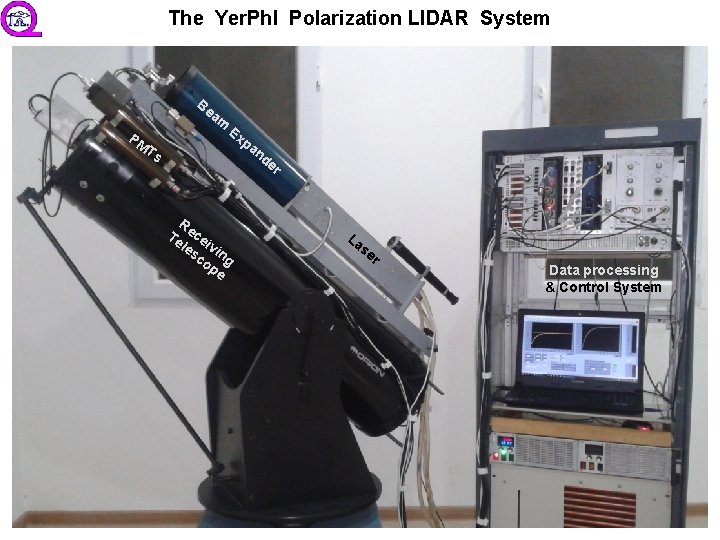
The Yer. Ph. I Polarization LIDAR System Be am PM Ts Ex pa nd er R Te ece le ivi sc ng op e La se r Data processing & Control System
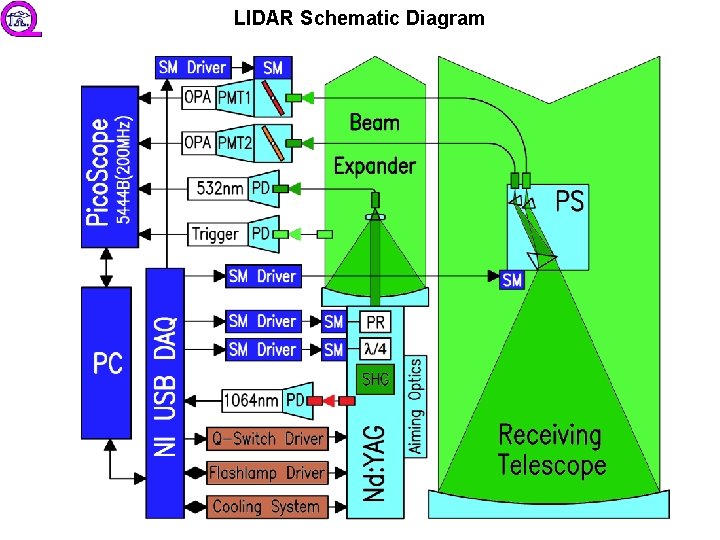
LIDAR Schematic Diagram

The LIDAR Laser Emitter and Receiving System Registration System Triggering Fiber Receiving Telescope Polarization Separator Optical Signal Transportation Fibers to PMTs Optical Signal Outputs Play-free Gear Stepper Motor Registration System Triggering PD Laser Beam Expander The Laser Emitter Alignment Rail Stepper Driven Tunable Narrow Band Filter PMTs Narrow Band Filter Receiving Mirror Focus Finder
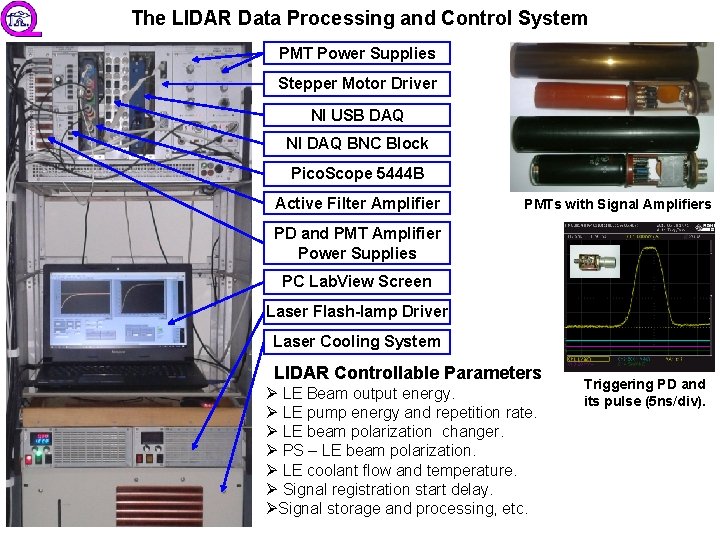
The LIDAR Data Processing and Control System PMT Power Supplies Stepper Motor Driver NI USB DAQ NI DAQ BNC Block Pico. Scope 5444 B Active Filter Amplifier PMTs with Signal Amplifiers PD and PMT Amplifier Power Supplies PC Lab. View Screen Laser Flash-lamp Driver Laser Cooling System LIDAR Controllable Parameters Ø LE Beam output energy. Ø LE pump energy and repetition rate. Ø LE beam polarization changer. Ø PS – LE beam polarization. Ø LE coolant flow and temperature. Ø Signal registration start delay. ØSignal storage and processing, etc. Triggering PD and its pulse (5 ns/div).

LIDAR Controls and Lab. View Screens Real Time Laser Output and Received Signals Pico. Scope Controls Reading, Processing and Saving Controls Depolarized by Electric Field Processed Data Continuous Reading Processed Polarization Separated Data Polarization Rotator and Separator Steppers Controls Spectrum Analyzer Stepper Motor Controls Spectrum Analyzer Processed Data
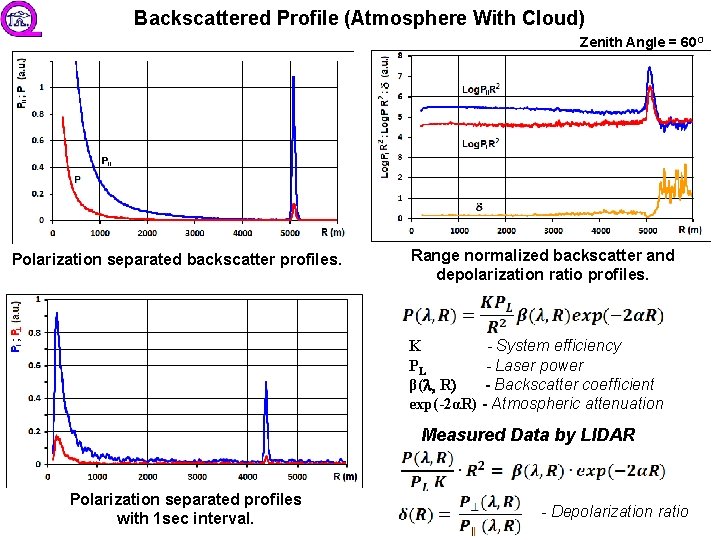
Backscattered Profile (Atmosphere With Cloud) Zenith Angle = 60 O Polarization separated backscatter profiles. Range normalized backscatter and depolarization ratio profiles. K - System efficiency PL - Laser power β(l, R) - Backscatter coefficient exp(-2αR) - Atmospheric attenuation Measured Data by LIDAR Polarization separated profiles with 1 sec interval. - Depolarization ratio
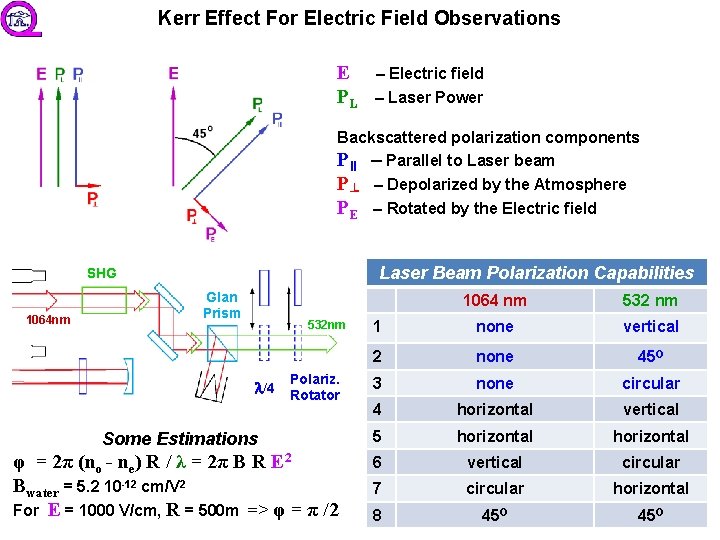
Kerr Effect For Electric Field Observations E PL – Electric field – Laser Power Backscattered polarization components PII – Parallel to Laser beam P┴ – Depolarized by the Atmosphere PE – Rotated by the Electric field Laser Beam Polarization Capabilities SHG Glan Prism 1064 nm 532 nm 1 none vertical 2 none 45 O 3 none circular 4 horizontal vertical Some Estimations 5 horizontal φ = 2π (no - ne) R / λ = 2π B R E 2 Bwater = 5. 2 10 -12 cm/V 2 For E = 1000 V/cm, R = 500 m => φ = π /2 6 vertical circular 7 circular horizontal 8 45 O 1064 nm 532 nm Polariz. l/4 Rotator
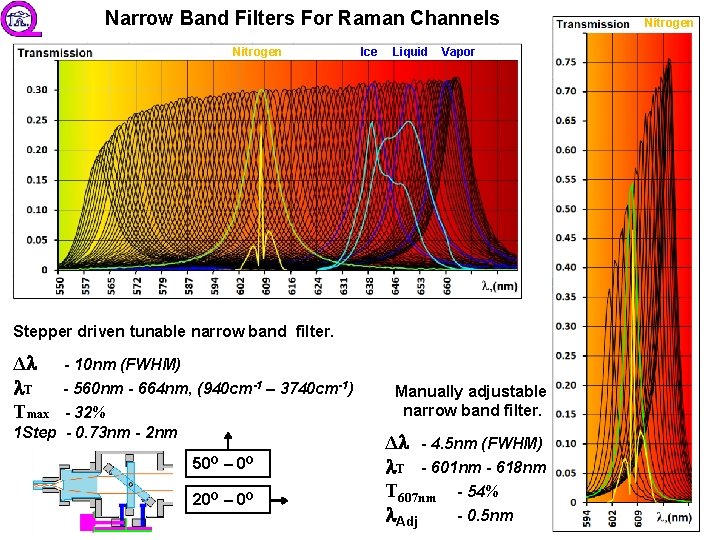
Narrow Band Filters For Raman Channels Nitrogen Ice Liquid Vapor Stepper driven tunable narrow band filter. Δl l. T Tmax - 10 nm (FWHM) - 560 nm - 664 nm, (940 cm-1 – 3740 cm-1) - 32% 1 Step - 0. 73 nm - 2 nm 50 O – 0 O 20 O – 0 O Manually adjustable narrow band filter. Δl - 4. 5 nm (FWHM) l. T - 601 nm - 618 nm T 607 nm - 54% l. Adj - 0. 5 nm Nitrogen
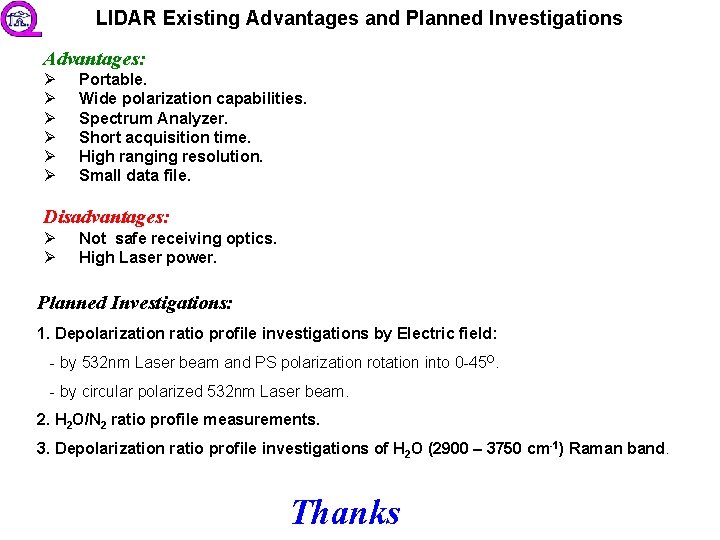
LIDAR Existing Advantages and Planned Investigations Advantages: Ø Ø Ø Portable. Wide polarization capabilities. Spectrum Analyzer. Short acquisition time. High ranging resolution. Small data file. Disadvantages: Ø Ø Not safe receiving optics. High Laser power. Planned Investigations: 1. Depolarization ratio profile investigations by Electric field: - by 532 nm Laser beam and PS polarization rotation into 0 -45 O. - by circular polarized 532 nm Laser beam. 2. H 2 O/N 2 ratio profile measurements. 3. Depolarization ratio profile investigations of H 2 O (2900 – 3750 cm-1) Raman band. Thanks

LIDAR System Specifications Laser Emitter Laser source Nd: YAG: Nd 3+ Custom made Wavelength 1064 nm and/or 532 nm Pulse energy Beam Expander Beam divergence Pulse width Repetition rate Polarization linearity Receiving Telescope Diameter Field of view Polarization Separator Optical fiber bundle aperture PMT Range Signal and data processing Oscilloscope DAQ Software interface 300 – 700 m. J (@ 1064 nm) 100 – 250 m. J (@ 532 nm) 14 X <0. 1 mrad (after beam expander) 10 ns 10 – 20 Hz <10 -3 250 mm 1. 6 mrad Custom made 3 mm FEU-100 and FEU-83 (Russia) 0. 15 – 15 km Pico. Scope 5444 B NI DAQ USB-6341 NI Lab. VIEW
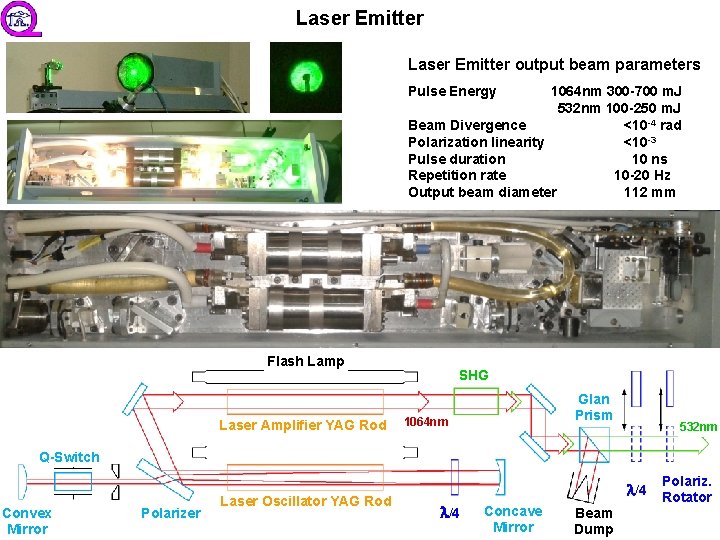
Laser Emitter output beam parameters Pulse Energy 1064 nm 300 -700 m. J 532 nm 100 -250 m. J Beam Divergence <10 -4 rad Polarization linearity <10 -3 Pulse duration 10 ns Repetition rate 10 -20 Hz Output beam diameter 112 mm Flash Lamp Laser Amplifier YAG Rod SHG Glan Prism 1064 nm 532 nm Q-Switch Polariz. Convex Mirror Polarizer Laser Oscillator YAG Rod l/4 Concave Mirror Beam Dump l/4 Rotator
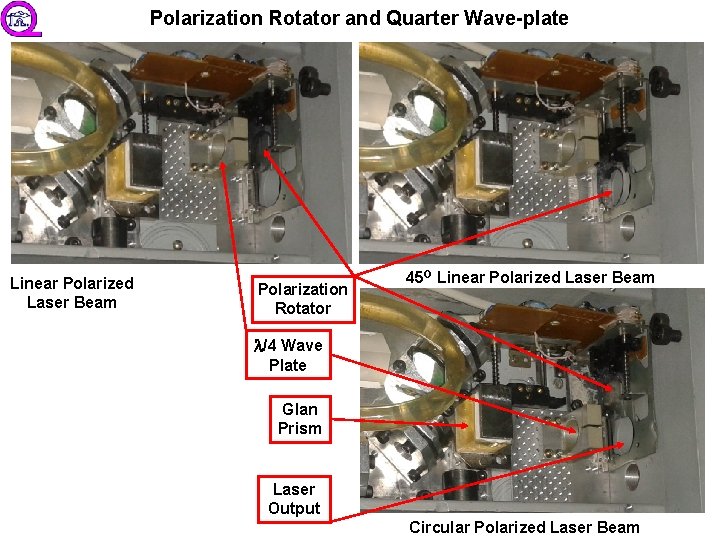
Polarization Rotator and Quarter Wave-plate Linear Polarized Laser Beam Polarization Rotator 45 O Linear Polarized Laser Beam l/4 Wave Plate Glan Prism Laser Output Circular Polarized Laser Beam
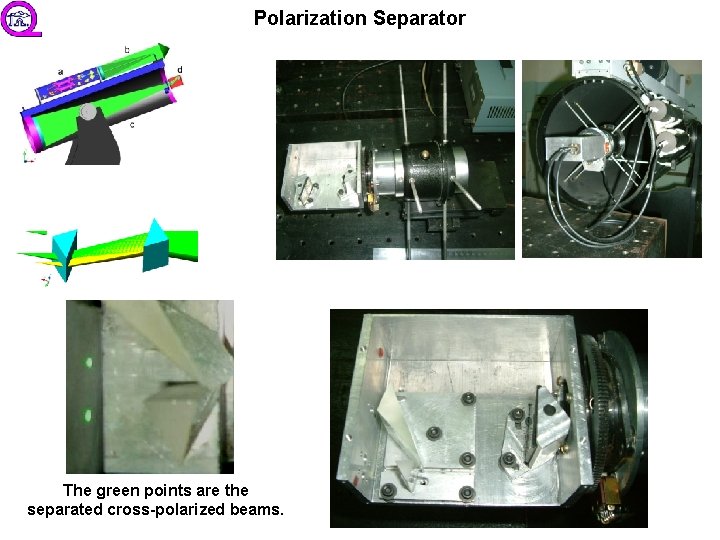
Polarization Separator The green points are the separated cross-polarized beams.
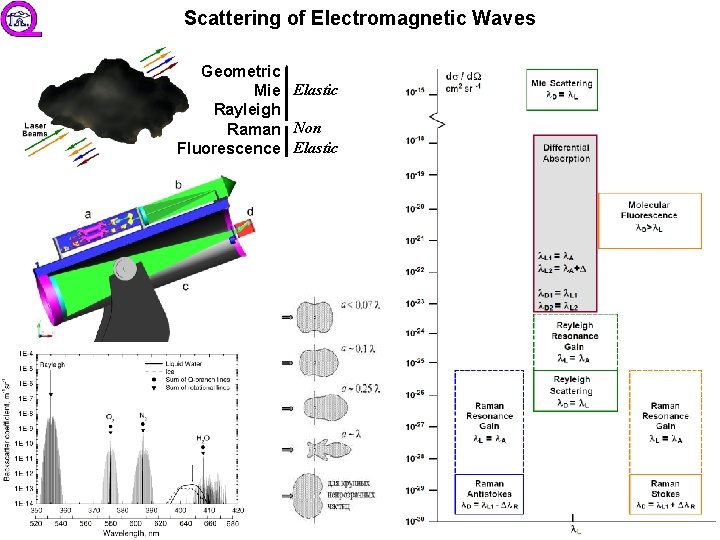
Scattering of Electromagnetic Waves Geometric Mie Elastic Rayleigh Raman Non Fluorescence Elastic
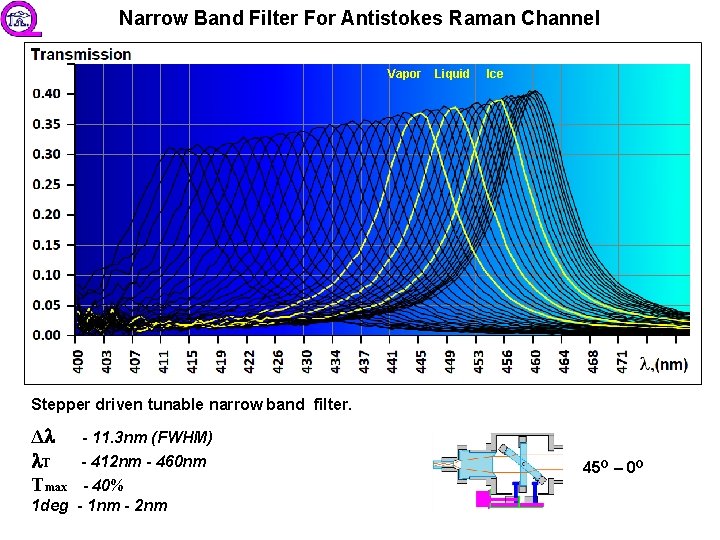
Narrow Band Filter For Antistokes Raman Channel Vapor Liquid Ice Stepper driven tunable narrow band filter. Δl l. T Tmax - 11. 3 nm (FWHM) - 412 nm - 460 nm - 40% 1 deg - 1 nm - 2 nm 45 O – 0 O
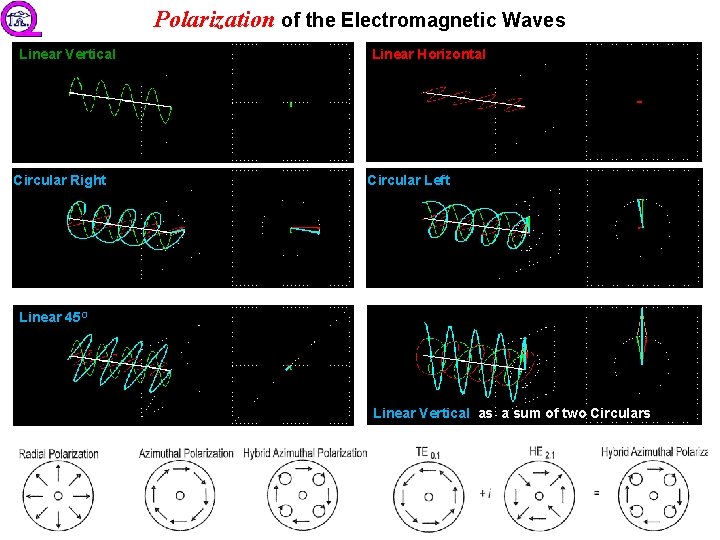
Polarization of the Electromagnetic Waves Linear Vertical Circular Right Linear Horizontal Circular Left Linear 45 O Linear Vertical as a sum of two Circulars
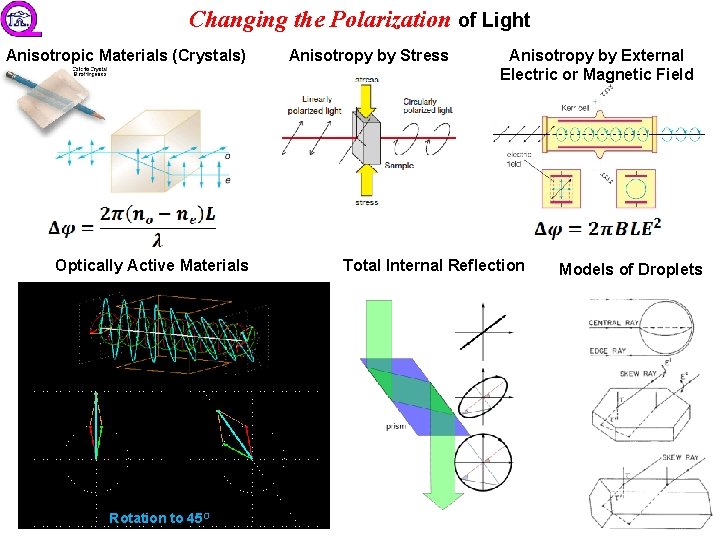
Changing the Polarization of Light Anisotropic Materials (Crystals) Optically Active Materials Rotation to 45 O Anisotropy by Stress Anisotropy by External Electric or Magnetic Field Total Internal Reflection Models of Droplets
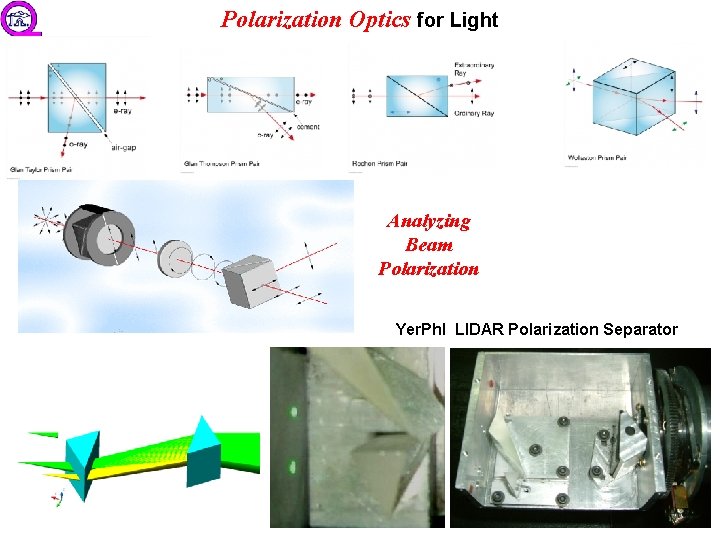
Polarization Optics for Light Analyzing Beam Polarization Yer. Ph. I LIDAR Polarization Separator
- Slides: 18