
The Yellow Card Scheme Reporting Adverse Drug Reactions
- Slides: 31
The Yellow Card Scheme: Reporting Adverse Drug Reactions www. yellowcardwales. org
What is an adverse drug reaction? An adverse drug reaction (ADR) is an unwanted or harmful reaction experienced following the administration of a drug or combination of drugs under normal conditions of use and is suspected to be related to the drug. www. yellowcardwales. org
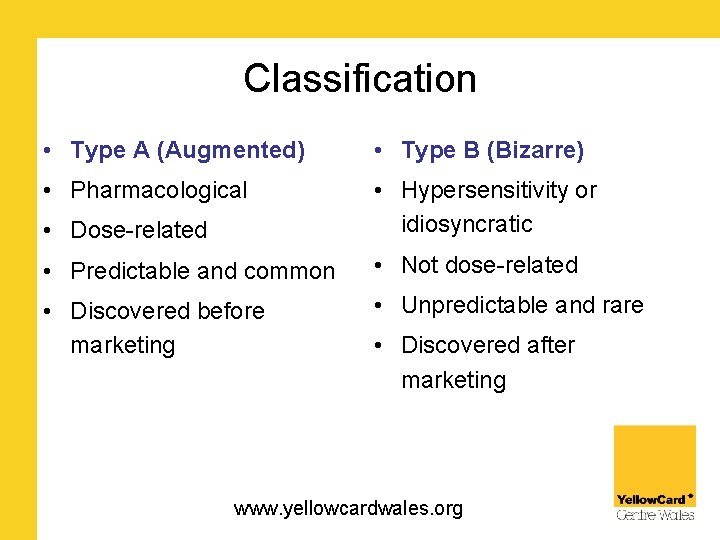
Classification • Type A (Augmented) • Type B (Bizarre) • Pharmacological • Dose-related • Hypersensitivity or idiosyncratic • Predictable and common • Not dose-related • Discovered before marketing • Unpredictable and rare • Discovered after marketing www. yellowcardwales. org
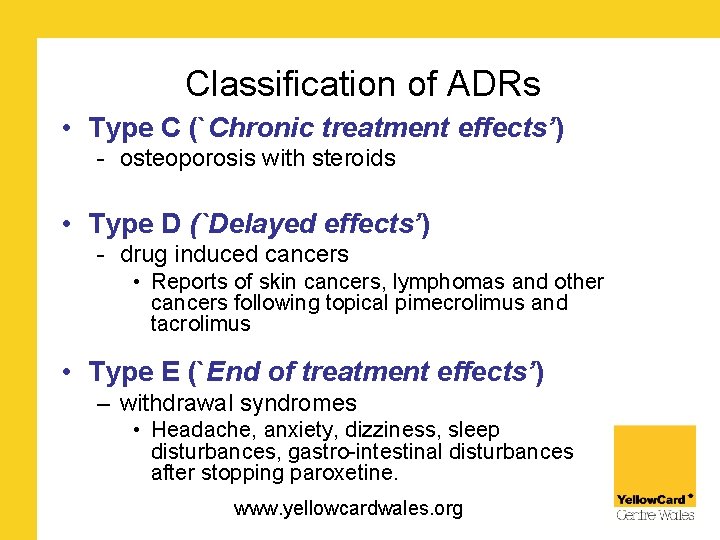
Classification of ADRs • Type C (`Chronic treatment effects’) - osteoporosis with steroids • Type D (`Delayed effects’) - drug induced cancers • Reports of skin cancers, lymphomas and other cancers following topical pimecrolimus and tacrolimus • Type E (`End of treatment effects’) – withdrawal syndromes • Headache, anxiety, dizziness, sleep disturbances, gastro-intestinal disturbances after stopping paroxetine. www. yellowcardwales. org
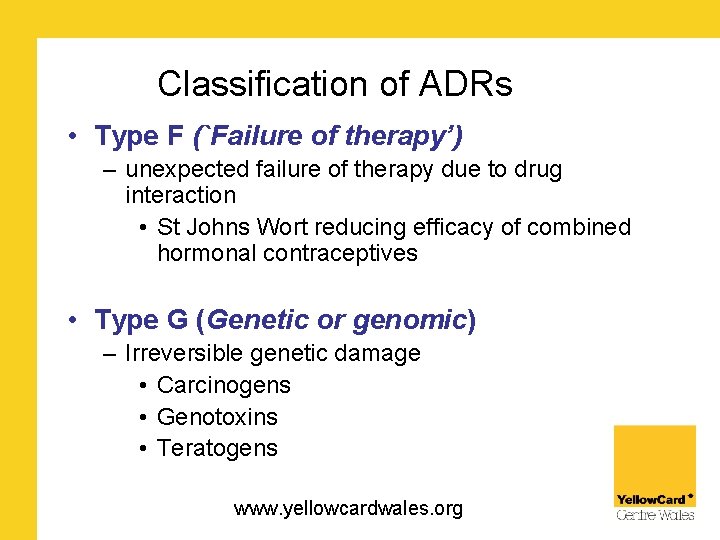
Classification of ADRs • Type F (`Failure of therapy’) – unexpected failure of therapy due to drug interaction • St Johns Wort reducing efficacy of combined hormonal contraceptives • Type G (Genetic or genomic) – Irreversible genetic damage • Carcinogens • Genotoxins • Teratogens www. yellowcardwales. org
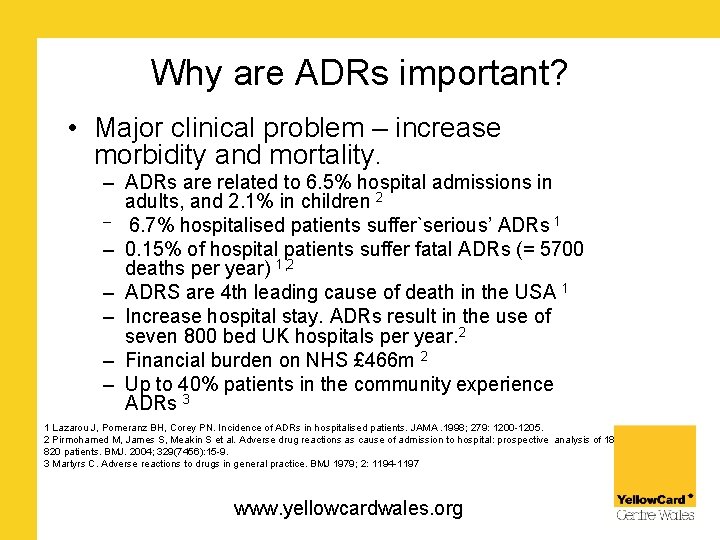
Why are ADRs important? • Major clinical problem – increase morbidity and mortality. – ADRs are related to 6. 5% hospital admissions in adults, and 2. 1% in children 2 – 6. 7% hospitalised patients suffer`serious’ ADRs 1 – 0. 15% of hospital patients suffer fatal ADRs (= 5700 deaths per year) 1, 2 – ADRS are 4 th leading cause of death in the USA 1 – Increase hospital stay. ADRs result in the use of seven 800 bed UK hospitals per year. 2 – Financial burden on NHS £ 466 m 2 – Up to 40% patients in the community experience ADRs 3 1 Lazarou J, Pomeranz BH, Corey PN. Incidence of ADRs in hospitalised patients. JAMA. 1998; 279: 1200 -1205. 2 Pirmohamed M, James S, Meakin S et al. Adverse drug reactions as cause of admission to hospital: prospective analysis of 18 820 patients. BMJ. 2004; 329(7456): 15 -9. 3 Martyrs C. Adverse reactions to drugs in general practice. BMJ 1979; 2: 1194 -1197 www. yellowcardwales. org
ADRs can also… • Adversely affect patient compliance • Reduce available choice of drug treatment • Reduce potential efficacy of drug treatment • Reduce quality of life • Cause diagnostic confusion • Reduce a patient’s confidence in their healthcare professional(s) www. yellowcardwales. org
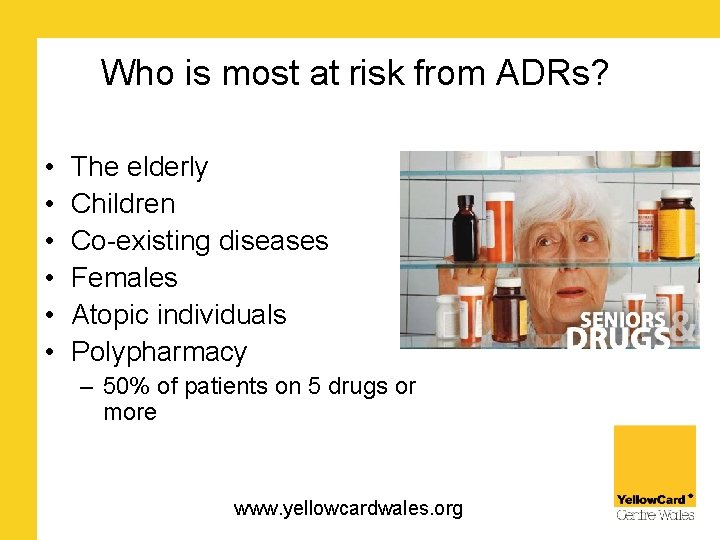
Who is most at risk from ADRs? • • • The elderly Children Co-existing diseases Females Atopic individuals Polypharmacy – 50% of patients on 5 drugs or more www. yellowcardwales. org
What should raise your suspicion? • Timing with drug treatment. • Abnormal clinical measurements while on drug therapy e. g. B. P, temp, pulse, blood glucose and weight • Abnormal laboratory results while on drug therapy. Could be biochemical or haematological • New therapy started which could be used to treat ADR • Patient risk factors • Listen to patients own concerns www. yellowcardwales. org
Assessing causality • • Nature of the reaction Timing Relationship to dose Other possible causes for the symptoms Improvement when drug(s) stopped Has reaction been reported before Dechallenge/Rechallenge www. yellowcardwales. org
The Yellow Card Scheme • Introduced in 1964 after thalidomide tragedy • Spontaneous reports of suspected adverse drug reactions. • Acts as an early warning system to identify ADRs and risk factors • Over 600, 000 confidential reports have been received in UK • MHRA can detect duplicate reports www. yellowcardwales. org
Why report ADRs? • Important role in patient safety • Allows continual safety monitoring of drugs – old & new • New drugs - lack of experience on adverse effects – Exposure in about 1500 people only – Short duration – Unlikely to detect ADRs • Less frequent than 1/1500 • With long latency – Lack of experience in special patient groups • Elderly, children, pregnancy, multiple disease, polypharmacy • To detect rare adverse effects www. yellowcardwales. org
Strengths of Yellow Card Scheme • Acts as ‘early warning system’ for identification of previously unrecognised reactions • Provides information about factors which predispose patients to ADRs • Allows comparisons of ADR ‘profiles’ between products within same therapeutic class • Continual safety monitoring of a product throughout its life span as a therapeutic agent www. yellowcardwales. org
Weaknesses of Yellow Card Scheme • Cannot provide estimates of risk as – true number of cases is underestimated – total number of patients exposed is unknown • Relies on ADR being recognised • Not all ADRs are reported – Only 10% serious reactions reported • May be stimulated by promotion and publicity • Reporting high for newly marketed drugs and falls off over time • Reports do not imply causality www. yellowcardwales. org
Why are reporting rates low? • • • Too busy Not sure what to report Uncertain of the threshold for a serious reaction Not easy to find a Yellow Card Not my responsibility It takes too long to complete a card Reporting generates too much extra work Duplication Belief that serious ADRs will be identified in clinical trials • Confidentiality www. yellowcardwales. org
Completing a Yellow Card www. yellowcardwales. org
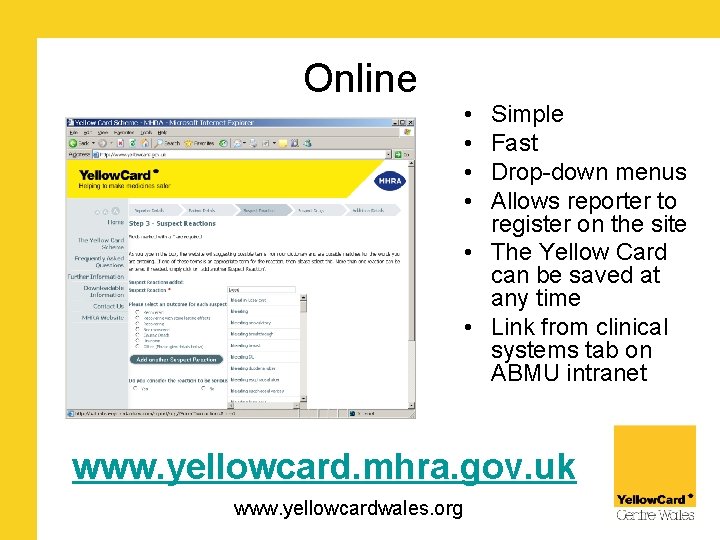
Online • • Simple Fast Drop-down menus Allows reporter to register on the site • The Yellow Card can be saved at any time • Link from clinical systems tab on ABMU intranet www. yellowcard. mhra. gov. uk www. yellowcardwales. org
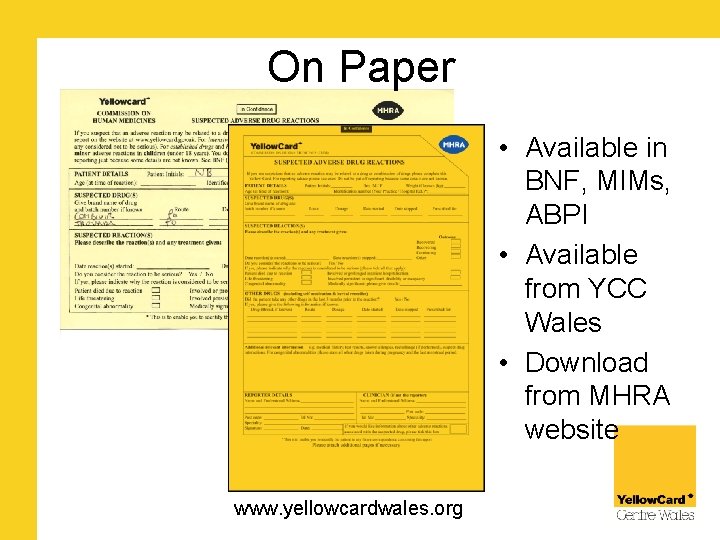
On Paper • Available in BNF, MIMs, ABPI • Available from YCC Wales • Download from MHRA website www. yellowcardwales. org
What to report • Report all suspected adverse drug reactions for – new drugs (marked ▼) - even if mild – established drugs that are serious - even if well recognised • Serious reactions include those which are fatal, life-threatening, disabling or incapacitating, result in or prolong hospitalisation, congenital abnormalities or medically significant • Vaccines • Unlicensed medication • Herbal medicines Causality does not need to be established www. yellowcardwales. org
Black triangle drugs▼ • ▼indicates that the CHM/MHRA are intensively monitoring that product • ▼will be assigned to a product because: • the drug is new to the UK market • the drug is being administered to the patient either by a new route of administration or a new formulation which is considered may have an impact on the already established risk/benefit profile of that drug • the drug is being administered for a new indication www. yellowcardwales. org
If you suspect an ADR… § Do not assume someone else will report it • Only 2 -4% of all ADRs are reported • Only 10% of serious suspected ADRs are reported • Do you have to be completely certain that what you have seen is an ADR? No www. yellowcardwales. org
Information to include on a Yellow Card • 4 critical pieces of information that must be included on the report : s s Suspected drug(s) Suspect reaction(s) Patient details Reporter details www. yellowcardwales. org
Patient Details • • Sex of the patient Age at time of reaction Weight if known Do not need to know name or DOB as this could identify patient and break patient confidentiality • Patients initials and local identification number (hospital or practice number) which will identify patient to you in the event of future correspondence www. yellowcardwales. org
Reporter details • Must be completed in all cases • Name and full address – Need to acknowledge receipt of report and follow up further information if necessary. • Profession – Specify “hospital pharmacist” www. yellowcardwales. org
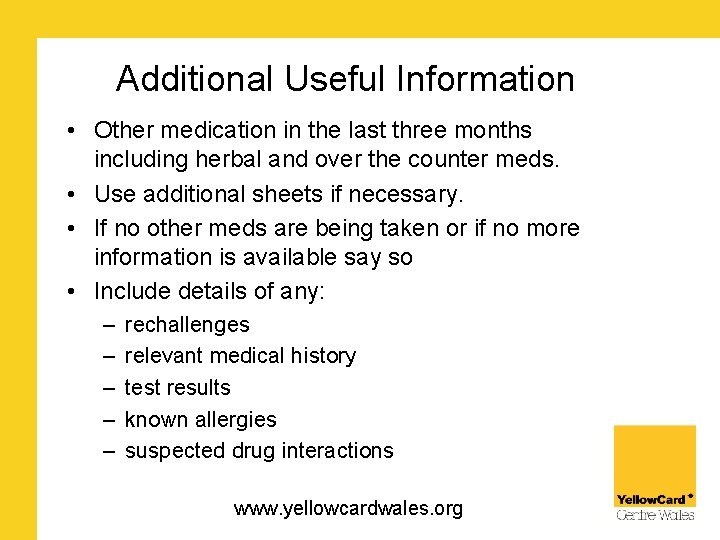
Additional Useful Information • Other medication in the last three months including herbal and over the counter meds. • Use additional sheets if necessary. • If no other meds are being taken or if no more information is available say so • Include details of any: – – – rechallenges relevant medical history test results known allergies suspected drug interactions www. yellowcardwales. org
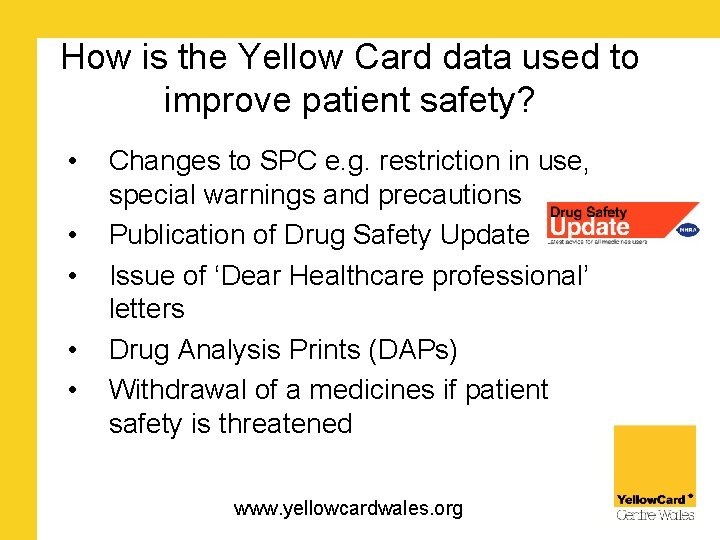
How is the Yellow Card data used to improve patient safety? • • • Changes to SPC e. g. restriction in use, special warnings and precautions Publication of Drug Safety Update Issue of ‘Dear Healthcare professional’ letters Drug Analysis Prints (DAPs) Withdrawal of a medicines if patient safety is threatened www. yellowcardwales. org
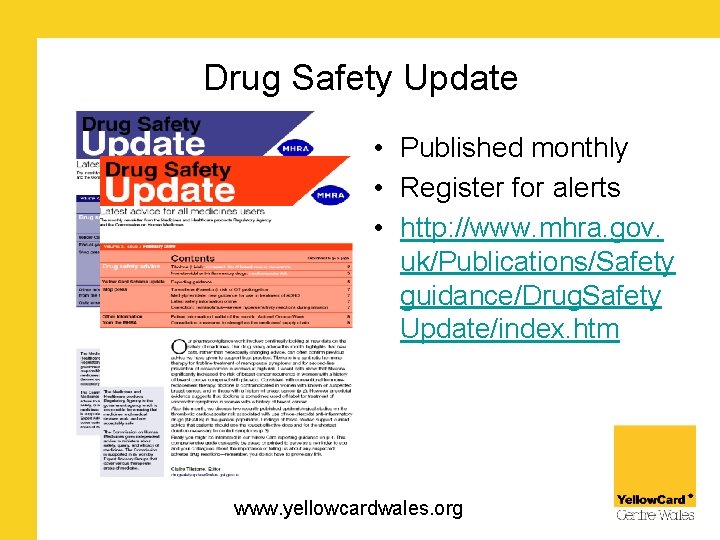
Drug Safety Update • Published monthly • Register for alerts • http: //www. mhra. gov. uk/Publications/Safety guidance/Drug. Safety Update/index. htm www. yellowcardwales. org
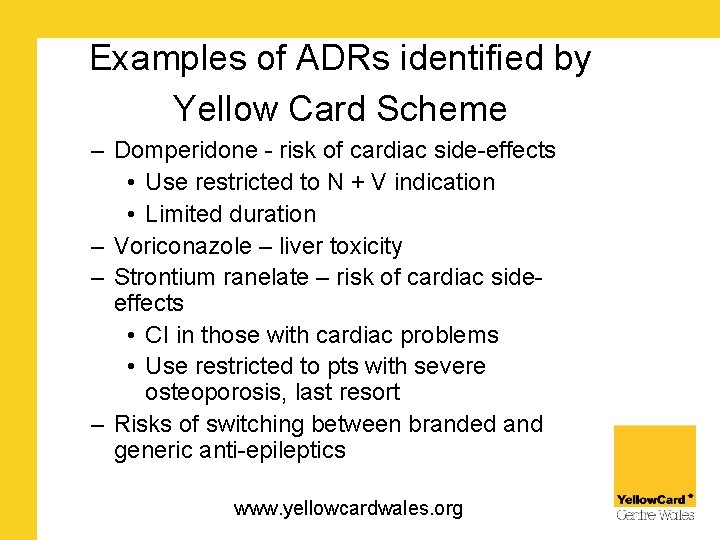
Examples of ADRs identified by Yellow Card Scheme – Domperidone - risk of cardiac side-effects • Use restricted to N + V indication • Limited duration – Voriconazole – liver toxicity – Strontium ranelate – risk of cardiac sideeffects • CI in those with cardiac problems • Use restricted to pts with severe osteoporosis, last resort – Risks of switching between branded and generic anti-epileptics www. yellowcardwales. org
Where to find ADR information • Reference texts – British National Formulary (BNF) – Summary of Product Characteristics (SPC) – Martindale – Lee’s textbook Adverse Drug Reactions • Journals – Adverse Drug Reaction Bulletin – Drug Safety Update – Medline/Embase/Pharmline search • Electronic sources – Micromedex – www. mhra. gov. uk – Meyler’s 'The Side effects of drugs www. yellowcardwales. org
“All health-care professionals have a responsibility to inform colleagues about clinically important adverse drug reactions that they detect, even if a wellrecognised or causal link is uncertain. ” • Document in notes if yellow card completed • Edwards IR and Aronson JK. Adverse drug reactions: definitions, diagnosis, and management. Lancet 2000; 356: 1255 -59 www. yellowcardwales. org
If you suspect an ADR…. do not assume someone else will report it! www. yellowcard. mhra. gov. uk www. yellowcardwales. org