
The Xikrin Mebengokre Indigenous People from the North
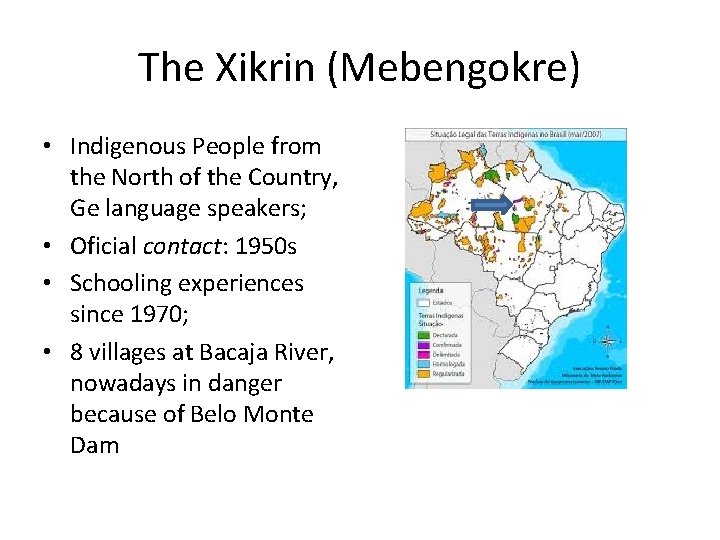
The Xikrin (Mebengokre) • Indigenous People from the North of the Country, Ge language speakers; • Oficial contact: 1950 s • Schooling experiences since 1970; • 8 villages at Bacaja River, nowadays in danger because of Belo Monte Dam

BELO MONTE DAM PROJECT
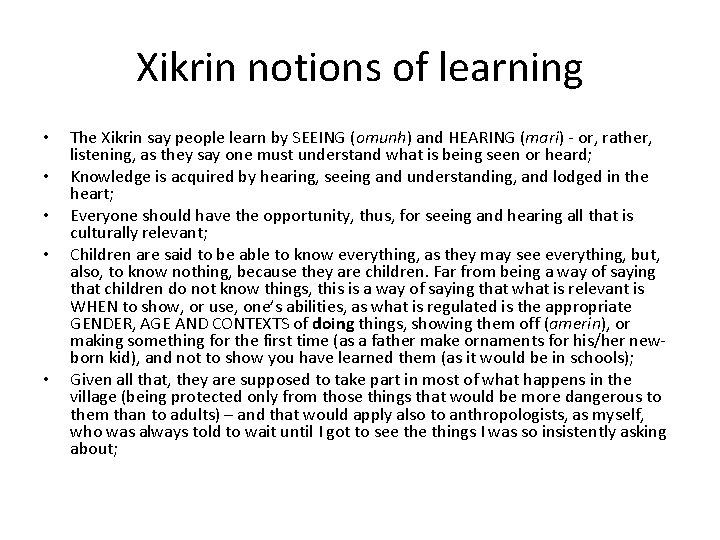
Xikrin notions of learning • • • The Xikrin say people learn by SEEING (omunh) and HEARING (mari) - or, rather, listening, as they say one must understand what is being seen or heard; Knowledge is acquired by hearing, seeing and understanding, and lodged in the heart; Everyone should have the opportunity, thus, for seeing and hearing all that is culturally relevant; Children are said to be able to know everything, as they may see everything, but, also, to know nothing, because they are children. Far from being a way of saying that children do not know things, this is a way of saying that what is relevant is WHEN to show, or use, one’s abilities, as what is regulated is the appropriate GENDER, AGE AND CONTEXTS of doing things, showing them off (amerin), or making something for the first time (as a father make ornaments for his/her newborn kid), and not to show you have learned them (as it would be in schools); Given all that, they are supposed to take part in most of what happens in the village (being protected only from those things that would be more dangerous to them than to adults) – and that would apply also to anthropologists, as myself, who was always told to wait until I got to see things I was so insistently asking about;
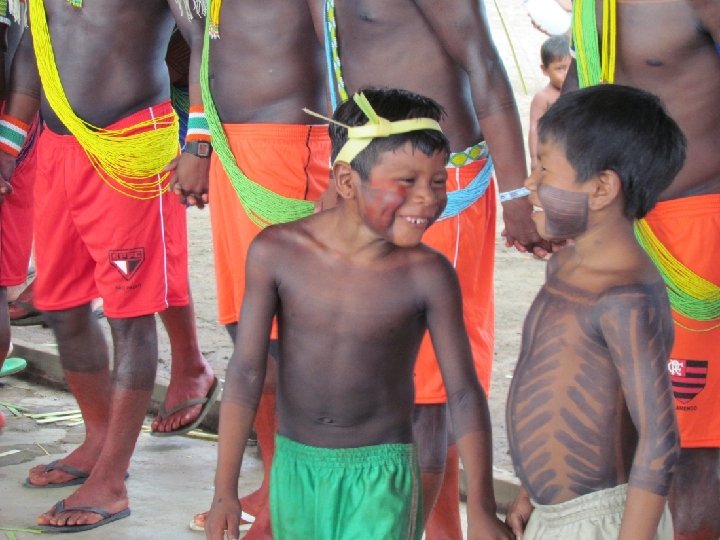
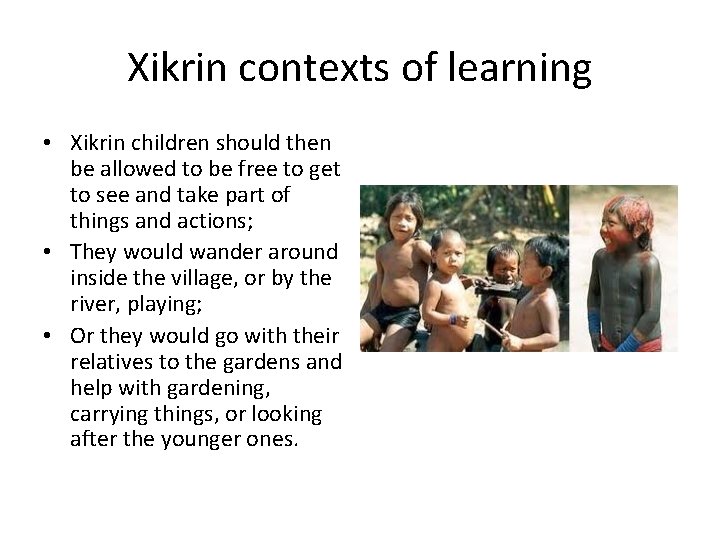
Xikrin contexts of learning • Xikrin children should then be allowed to be free to get to see and take part of things and actions; • They would wander around inside the village, or by the river, playing; • Or they would go with their relatives to the gardens and help with gardening, carrying things, or looking after the younger ones.
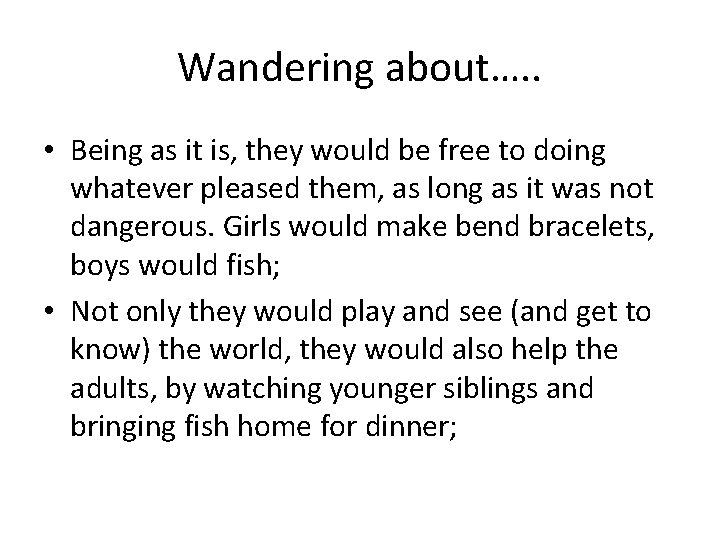
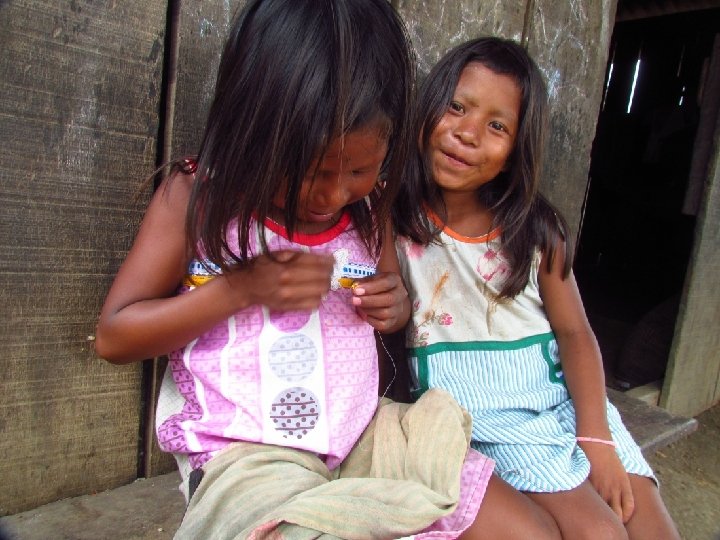
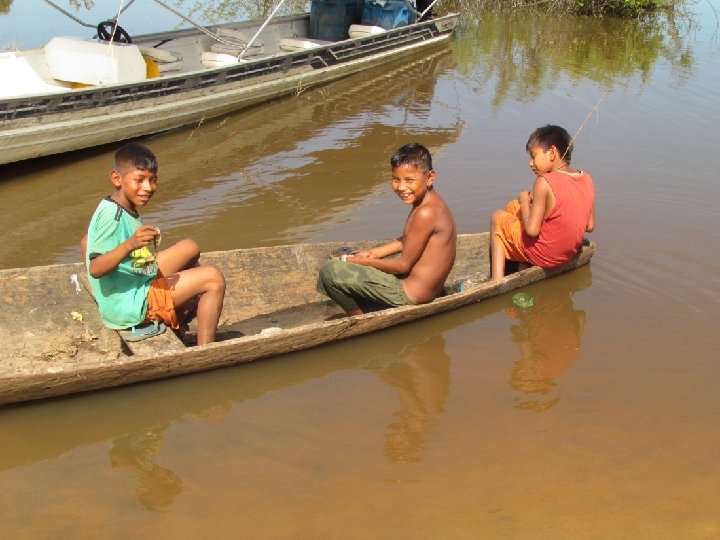
Wandering about…. . • Being as it is, they would be free to doing whatever pleased them, as long as it was not dangerous. Girls would make bend bracelets, boys would fish; • Not only they would play and see (and get to know) the world, they would also help the adults, by watching younger siblings and bringing fish home for dinner;

Schools • Xikrin have experienced schooling since they were first contacted, or pacified (which are the ways Brazilian State policy would call those actions viewed as protecting Brazilian Indigenous populations), and settled in a single village controlled by Brazilian State (as someone working for FUNAI would be sent to live with them); • Although most current generations had one way or the other experienced schooling, until recently there were no literate people in the villages; • Nevertheless, they put a great deal of value into having a school in the village for their children to attend it.
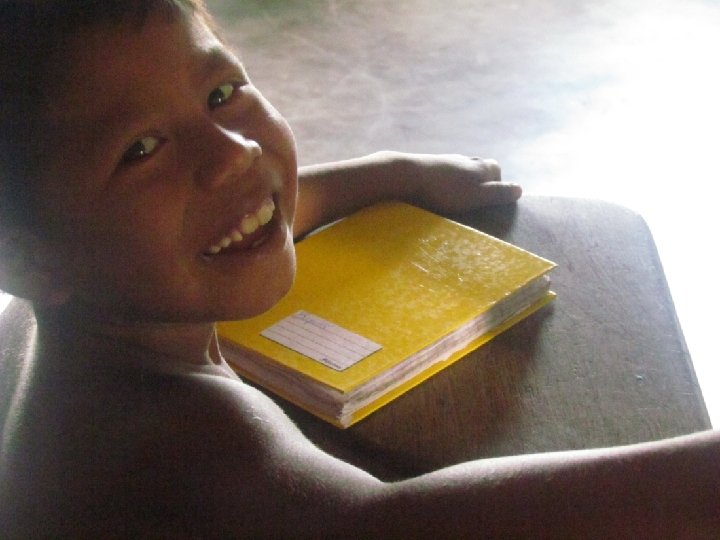
The school • Built in the same way as non-indigenous schools in the region, they are dark and oppressive to my eyes – but it was their choice to build them this way; • Teachers are mostly non-indigenous, and it was just on the past year that the first Xikrin teacher was allowed to act as a teacher at school by local government; • So, children would do exactly the opposite as they do outside the school: there they respond to a nonindigenous teacher, who does not speak their language, and have to stay seated and silent while making their tasks, which seems to be meaningless to them;
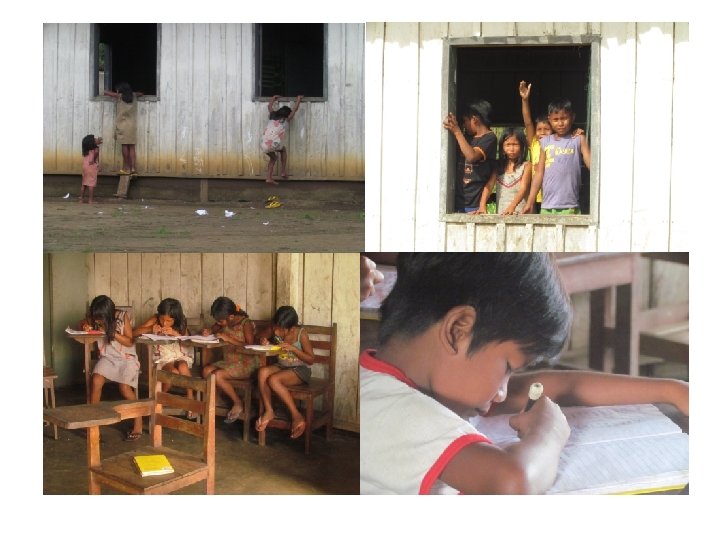
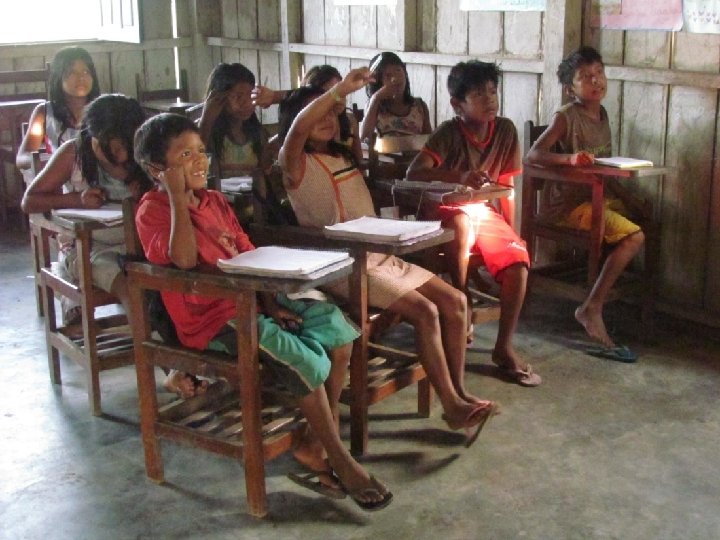
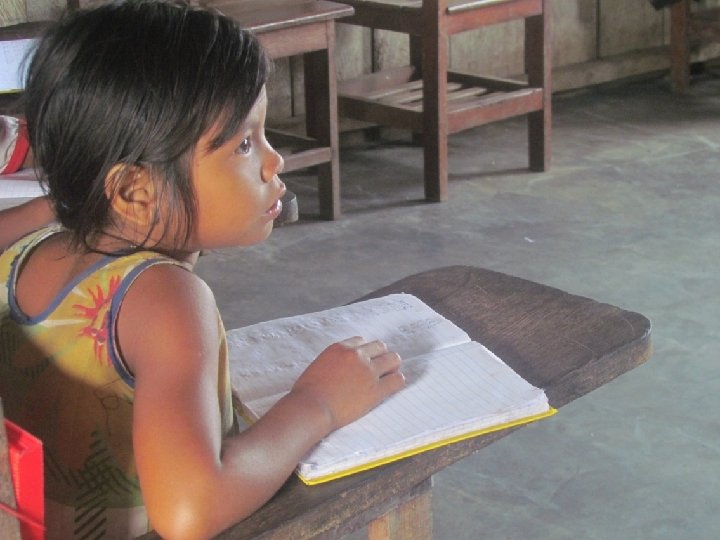
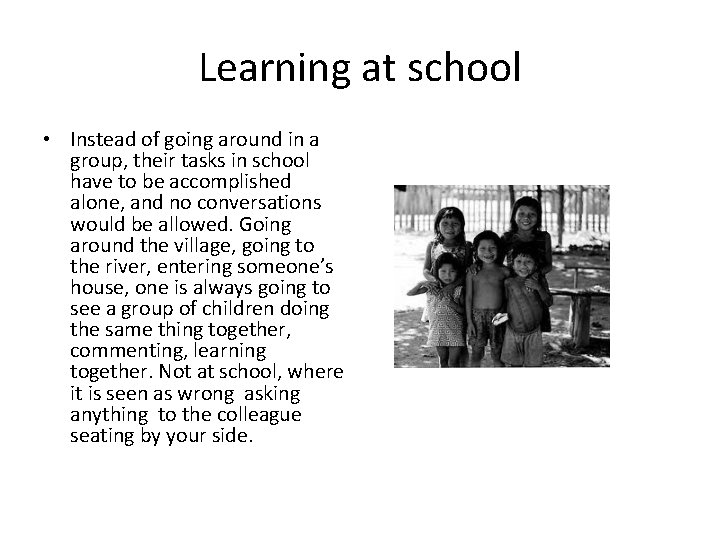
Learning at school • Instead of going around in a group, their tasks in school have to be accomplished alone, and no conversations would be allowed. Going around the village, going to the river, entering someone’s house, one is always going to see a group of children doing the same thing together, commenting, learning together. Not at school, where it is seen as wrong asking anything to the colleague seating by your side.
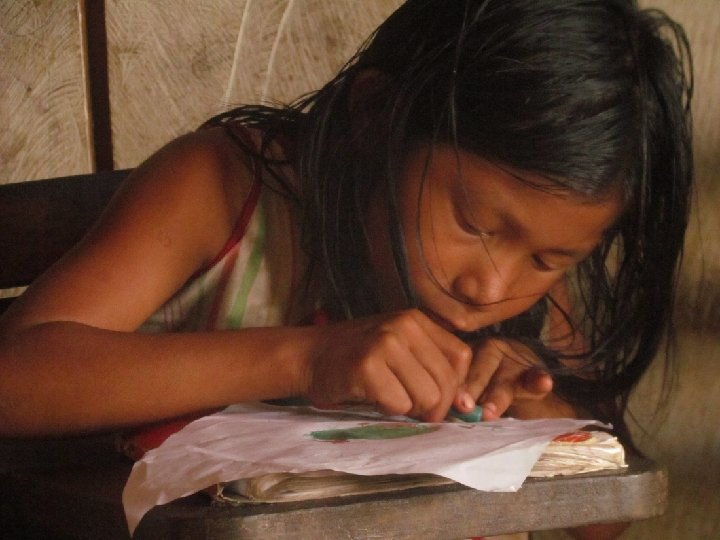
The valuable school • Nevertheless, they love that school. They love everything about it: the tasks, drawing…. • And they love COPYING from the board; they do not really write, but more likely copy what is written in the board, as if it were a graphic pattern; • Parents and adults do not get much involved at school; teachers and the children do all that is needed for it to work, even getting it cleaned and cooking; all that adults care about is that classes are given each day, and that their children write a lot – copying …. .
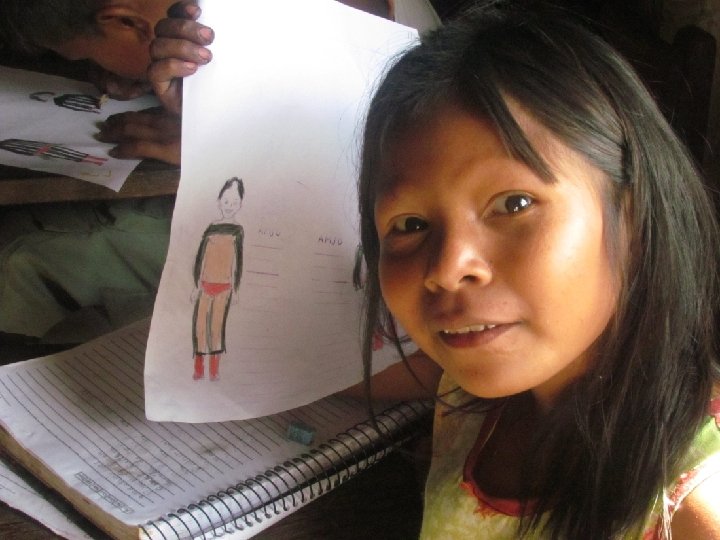
Xikrin expectations • All the Xikrin expect from the school is that it teaches their children to be able to cope with non-indigenous world. For that, they figure, no one better then the “whites” would know how to teach it. So, they allow them to take care of their children for 4 hours each day, and do not control what they are teaching their children; • In fact, going to school is all about coping with this other world: in an inside-outside spatial position, just outside the village circle, keeping the children silently doing their own tasks by themselves, in a “real” school building (because similar to the non-indigenous schools they got to know), engaging them in different tasks they would assume in the village’s everyday life – like cleaning up, making body paintings on paper regardless if they are boys or girls (women only are allowed to make them on bodies) - school is really a place to get in touch with alterity and getting to know how to deal with it.
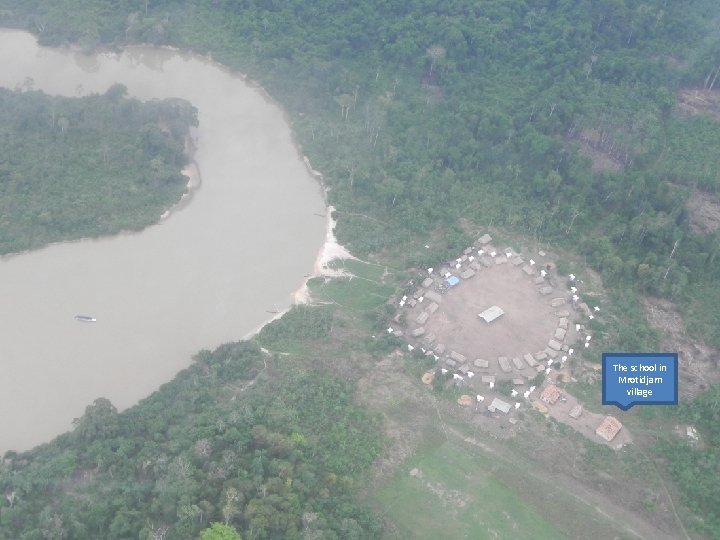
The school in Mrotidjam village
School is children’s business • More than that, as research done with my student Camila Beltrame showed, what is learnt in school is done only inside the school walls, and only by children; • If Xikrin children have to wait until they are the appropriate age to show what they know concerning their own knowledge -mebengokre-xikrin knowledge -, being the adults’ business, what is learnt at school is forgotten by the children when they grow up. It seems there is never going to be a literate generation among the Xikrin……because that is not what Xikrin really seek in schooling. • What they are looking for is a place where children go to interact with Others, in an inside-outside place, in order to learn about Otherness and how to deal with it.
References • PHOTOS: Clarice Cohn & Camila B. Beltrame • BIBLIOGRAPHY: BELTRAME, Camila B. 2013. Etnografia de uma escola xikrin. Ms Dissertation, Federal University of São Carlos; COHN, Clarice. 2000. A criança indígena: concepção xikrin de infância e aprendizado. Ms. Dissertation, São Paulo University. www. ced. ufsc. br/~nee 0 a 6/clarice. html COHN, Clarice. 2005. Educação escolar indígena: para uma discussão de cultura, criança e cidadania ativa. Perspectiva (Florianópolis), Florianópolis/SC, v. 1, n. 1, p. 485 -515, 2005. http: //www. perspectiva. ufsc. br/perspectiva_2005_02/14_artigo_clarice_cohn. pdf COHN, Clarice. Children, death, and the dead: the Mebengokré-Xikrin case. Horizontes Antropológicos (UFRGS), v. 5, p. 4, 2012. http: //socialsciences. scielo. org/scielo. php? pid=S 0104718320100005&script=sci_arttext SZULC, Andrea; COHN, Clarice. 2012. Anthropology and Childhood in South America: Perspectives from Brazil and Argentina. Anthropochildren, n 1, http: //popups. ulg. ac. be/Anthropo. Children/document. php? id=427 TASSINARI, A. M. I. ; COHN, Clarice. 2009. Opening to the Other : Schooling among the Karipuna and Mebengokré-Xikrin of Brazil. Anthropology & Education Quarterly, v. 40, p. 150 -169, 2009.
- Slides: 24