
The x 86 Architecture Lecture 16 Wed Mar
- Slides: 21
The x 86 Architecture Lecture 16 Wed, Mar 17, 2004
Overview l See the reference “IA-32 Intel® Architecture Software Developer's Manual Volume 1: Basic Architecture” at ftp: //download. intel. com/design/Pentium 4/manual s/25366513. pdf
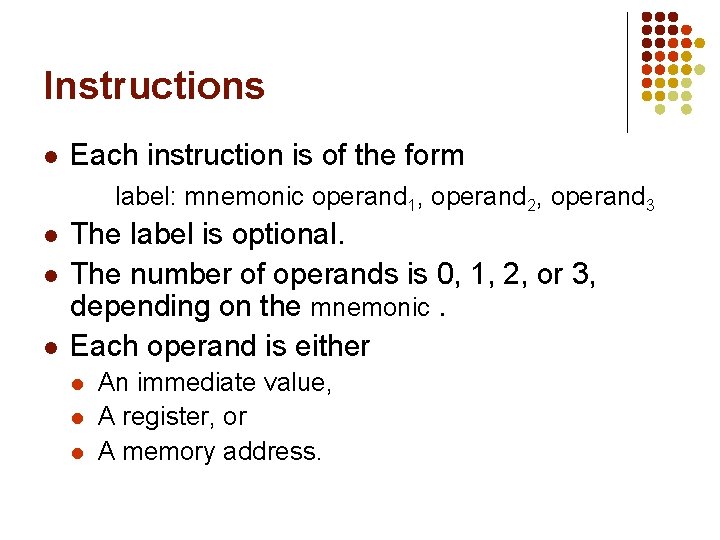
Instructions l Each instruction is of the form label: mnemonic operand 1, operand 2, operand 3 l l l The label is optional. The number of operands is 0, 1, 2, or 3, depending on the mnemonic. Each operand is either l l l An immediate value, A register, or A memory address.
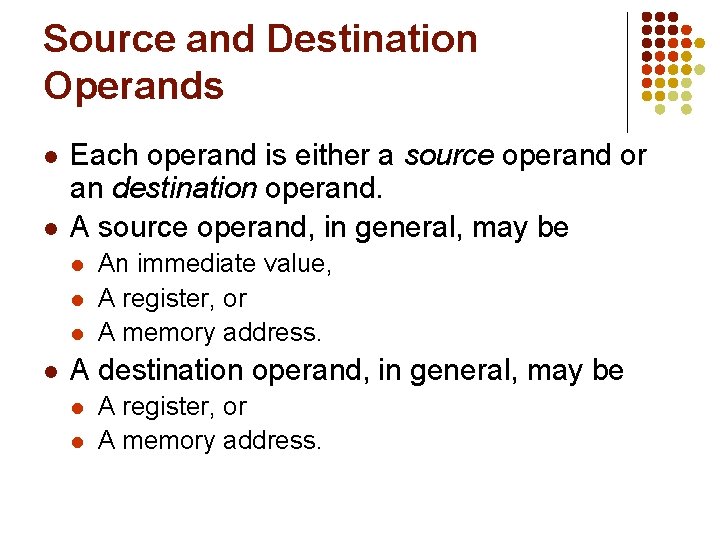
Source and Destination Operands l l Each operand is either a source operand or an destination operand. A source operand, in general, may be l l An immediate value, A register, or A memory address. A destination operand, in general, may be l l A register, or A memory address.
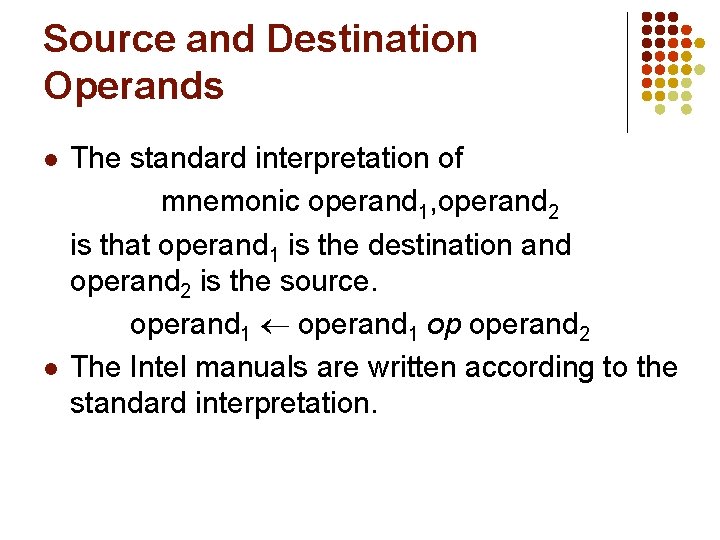
Source and Destination Operands l l The standard interpretation of mnemonic operand 1, operand 2 is that operand 1 is the destination and operand 2 is the source. operand 1 op operand 2 The Intel manuals are written according to the standard interpretation.
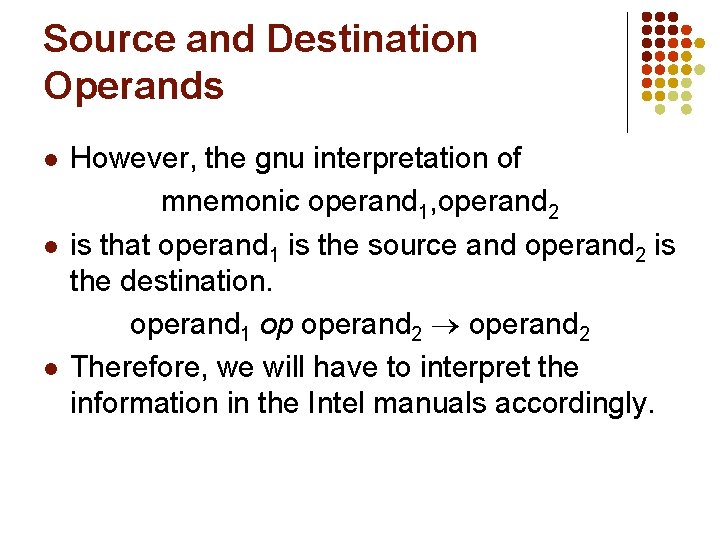
Source and Destination Operands l l l However, the gnu interpretation of mnemonic operand 1, operand 2 is that operand 1 is the source and operand 2 is the destination. operand 1 op operand 2 Therefore, we will have to interpret the information in the Intel manuals accordingly.
Instructions l l Not every logical combination of operands is permitted in every instruction. See the reference “IA-32 Intel® Architecture Software Developer’s Manual Volume 2 A: Instruction Set Reference, AM” at ftp: //download. intel. com/design/Pentium 4/manual s/25366613. pdf
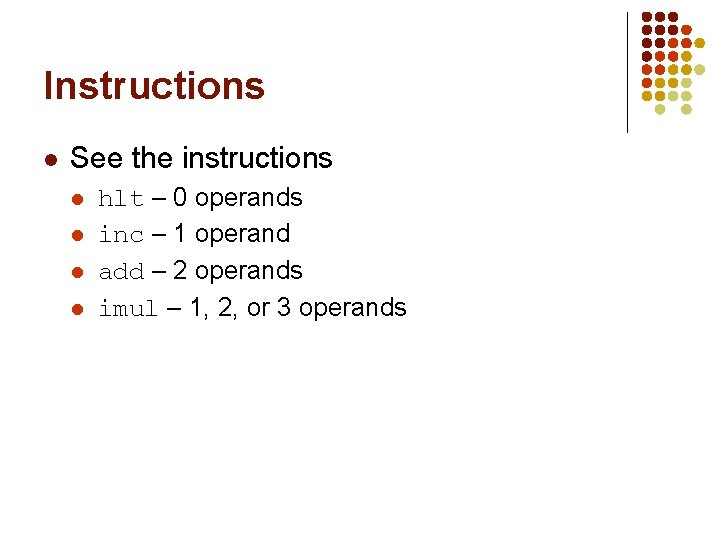
Instructions l See the instructions l l hlt – 0 operands inc – 1 operand add – 2 operands imul – 1, 2, or 3 operands
Address Space l l l The memory addresses are 32 bits, so they can access up to 4 GB of memory. A global variable or function is referenced by its name, which is a label representing its address. Local variables are referenced by an offset from the base pointer, which holds the base address of the activation record on the stack.
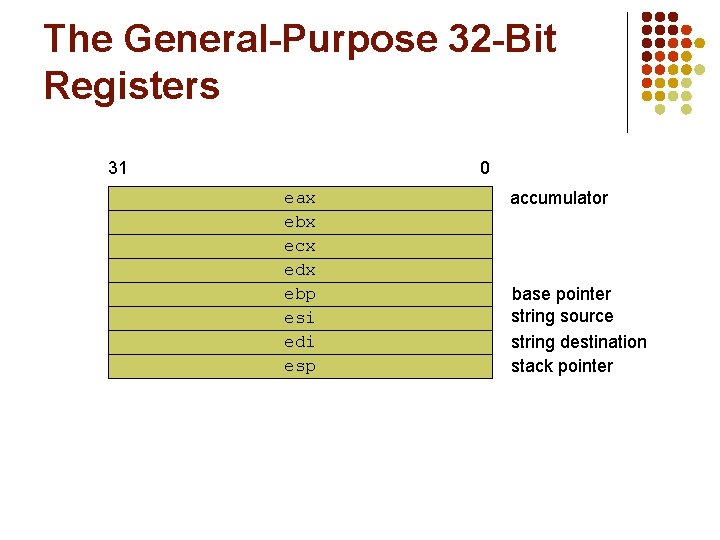
Basic Registers l There are l Eight 32 -bit “general-purpose” registers, One 32 -bit EFLAGS register, One 32 -bit instruction pointer register (eip), and l Other special-purpose registers. l l
The General-Purpose Registers l l l The eight 32 -bit general-purpose registers are eax, ebx, ecx, edx, esi, edi, ebp, and esp. For calculations, we will use eax, ebx, ecx, and edx. Register esp is the stack pointer. Register ebp is the base pointer. Registers esi and edi are source and destination index registers for array and string operations.
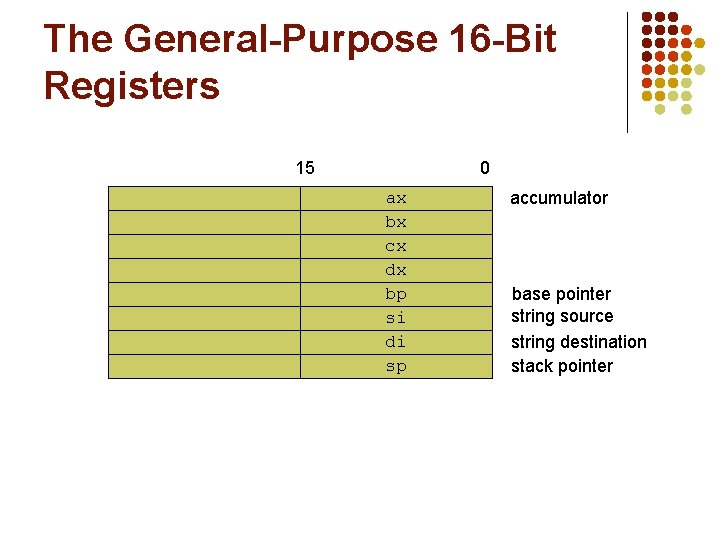
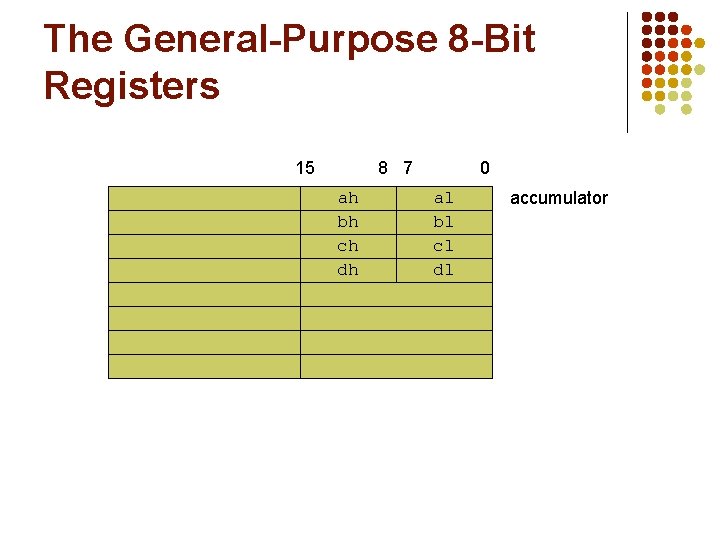
The General-Purpose Registers l l l The registers eax, ebx, ecx, and edx may be accessed as 32 -bit, 16 -bit, or 8 -bit registers. The other four registers can be accessed as 32 -bit or 16 -bit. For example, l l Register eax represents a 32 -bit quantity. The two low-order bytes of eax may be accessed through the name ax. The high-order byte of ax is named ah. The low-order byte of ax is named al.
The General-Purpose 32 -Bit Registers 31 0 eax ebx ecx edx ebp esi edi esp accumulator base pointer string source string destination stack pointer
The General-Purpose 16 -Bit Registers 15 0 ax bx cx dx bp si di sp accumulator base pointer string source string destination stack pointer
The General-Purpose 8 -Bit Registers 15 8 7 ah bh ch dh 0 al bl cl dl accumulator
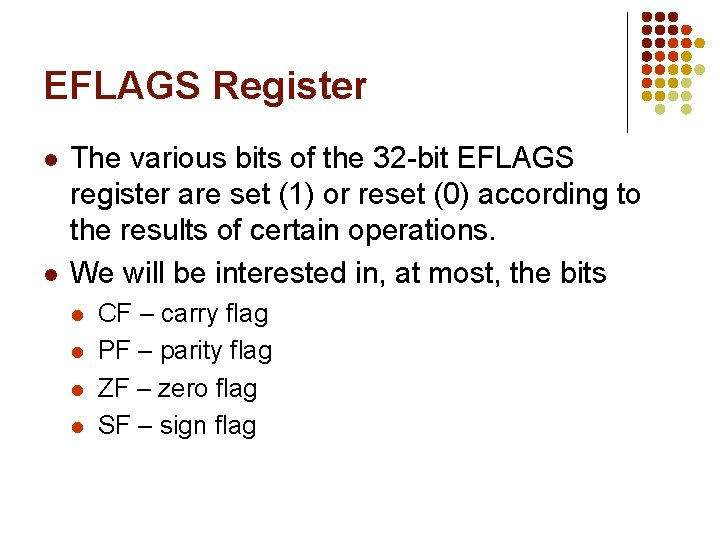
EFLAGS Register l l The various bits of the 32 -bit EFLAGS register are set (1) or reset (0) according to the results of certain operations. We will be interested in, at most, the bits l l CF – carry flag PF – parity flag ZF – zero flag SF – sign flag
Instruction Pointer l l l Finally, there is the eip register, which is the instruction pointer. Register eip holds the address of the next instruction to be executed. We should never use eip or change its value.
Data Types l There are 5 integer data types. l l l Byte – 8 bits. Word – 16 bits. Doubleword – 32 bits. Quadword – 64 bits. Double quadword – 128 bits. We will use doublewords unless we have a specific need for one of the other types.
The Run-time Stack l l l The run-time stack supports procedure calls and the passing of parameters between procedures. The stack is located in memory. The stack grows towards low memory. l l When we push a value, esp is decremented. When we pop a value, esp is incremented.
Using the Run-time Stack l l l Typically, if an operation produces a result, we will push that result onto the stack. The next operation, if it expects a previous result, will pop it off the stack. The alternative is to use the registers to pass results, but that is more complicated since we would have to keep track of which registers were free.
Function Calls and the Base Pointer l When we make a function call, we use the base pointer to store where the top of the stack was before the function call. esp ebp l l Then we push the parameters and local variables of the function onto the stack. When we return from the function, we use the base pointer to restore the stack to its previous state. ebp esp