
The Written and Oral Torah Prepared by Matt
The Written and Oral Torah Prepared by Matt Pham & Felix Just, SJ for SCTR 19 – “Religions of the Book”
Meaning of “Torah” l Hebrew word “Torah” is not really “Law” – l Limited sense: – l First section of the Tanak: Five Books of Moses Broader sense: – l Better translated “teachings & instructions” Entire Tanak: 24 books of the Hebrew Bible Broadest sense: – Whole body of Jewish laws, teachings, and traditions
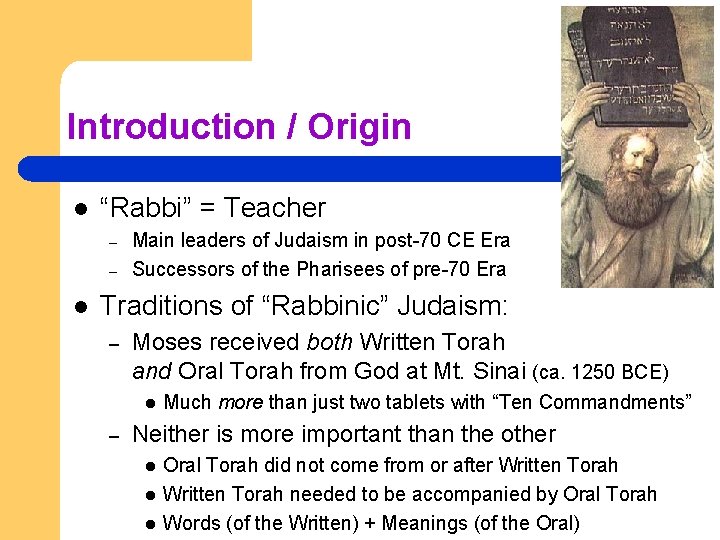
Introduction / Origin l “Rabbi” = Teacher – – l Main leaders of Judaism in post-70 CE Era Successors of the Pharisees of pre-70 Era Traditions of “Rabbinic” Judaism: – Moses received both Written Torah and Oral Torah from God at Mt. Sinai (ca. 1250 BCE) l – Much more than just two tablets with “Ten Commandments” Neither is more important than the other l l l Oral Torah did not come from or after Written Torah needed to be accompanied by Oral Torah Words (of the Written) + Meanings (of the Oral)
Written Torah l Tanakh / Hebrew Bible / Mikra – – l Writing/editing process lasted 1000+ years HB canon limited to 24 books, ca. 90 CE Three Sections: – – – Torah = 5 Books of Moses (a. k. a. Pentateuch) Nevi’im = Prophets (4 Former & 4 Latter Prophets) Khetuvim = Writings (11 Poetic & Wisdom Books)
Oral Torah (acc. to Rabbinic Judaism) l God gave it to Moses at Mt. Sinai – l Passed down orally till 2 nd century CE – l Thus of divine origin, just like the written Torah Finally written down in Mishnah and later Talmuds Why was “Oral” Torah eventually written down? – – Destruction of the Second Temple/Jerusalem Jewish learning threatened by wartime deaths Traditions better preserved if written Rise and importance of Rabbinic Judaism
Mishnah l Earliest written compilation of Oral Torah – – – l Legal opinions & debates about life without the Temple – l “Mishnah” = “teaching” or “repetition” Compiled 200 CE by Rabbi Judah ha-Nasi (“Judah the Prince”) Oldest text of Rabbinic Judaism, recording their traditions How to live/apply/adapt the mitzvot (God’s commandments) Six Sections or “Orders”: – – – Seeds Appointed Times Women Damages Holy Things Purities agricultural laws and prayers laws of the Sabbath and Festivals marriage and divorce civil and criminal law sacrificial rites, the Temple, dietary laws purity and impurity rules (unclean things)
Gemara and Talmud l Gemara = additional commentary on the Mishnah – l Mishnah + Gemara = Talmud – – l Mishnah = core of the Oral Torah Gemara = further discussion of ideas in the Mishnah Talmud = explanation, interpretation, application – l “Gemara” = “learning” or “completion” Jewish law, ethics, customs, history Two versions of the Talmud: – – Two centers of Rabbinic scholarship: Palestine & Babylonia So: Jerusalem Talmud & Babylonian Talmud
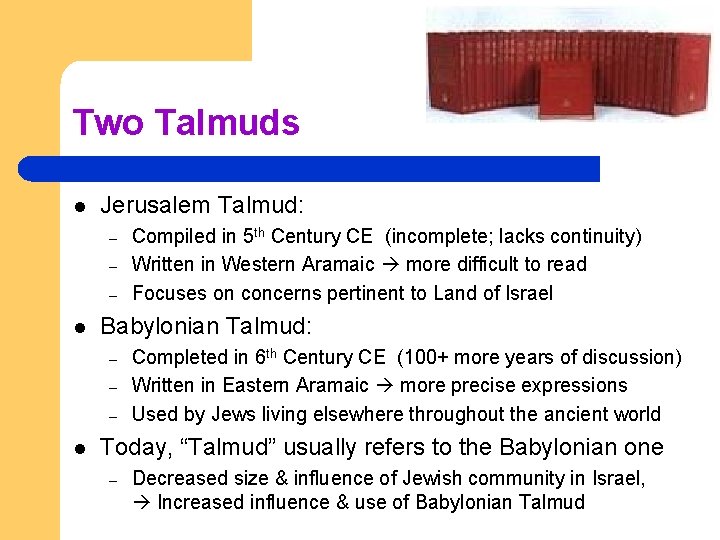
Two Talmuds l Jerusalem Talmud: – – – l Babylonian Talmud: – – – l Compiled in 5 th Century CE (incomplete; lacks continuity) Written in Western Aramaic more difficult to read Focuses on concerns pertinent to Land of Israel Completed in 6 th Century CE (100+ more years of discussion) Written in Eastern Aramaic more precise expressions Used by Jews living elsewhere throughout the ancient world Today, “Talmud” usually refers to the Babylonian one – Decreased size & influence of Jewish community in Israel, Increased influence & use of Babylonian Talmud
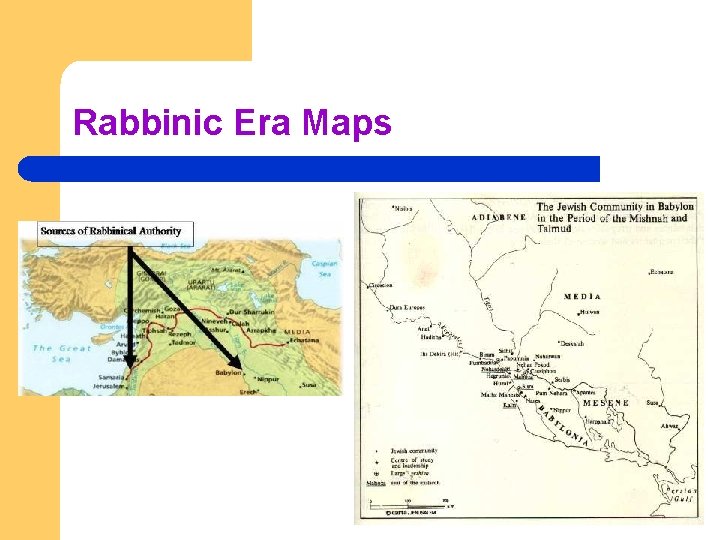
Rabbinic Era Maps
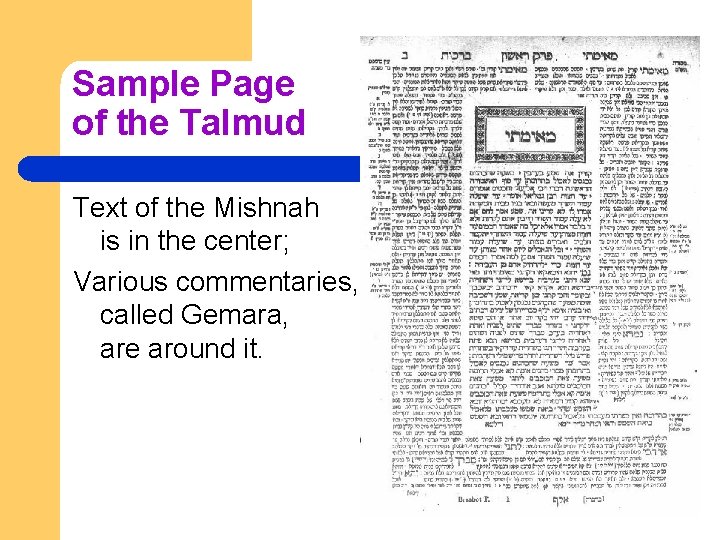
Sample Page of the Talmud Text of the Mishnah is in the center; Various commentaries, called Gemara, are around it.
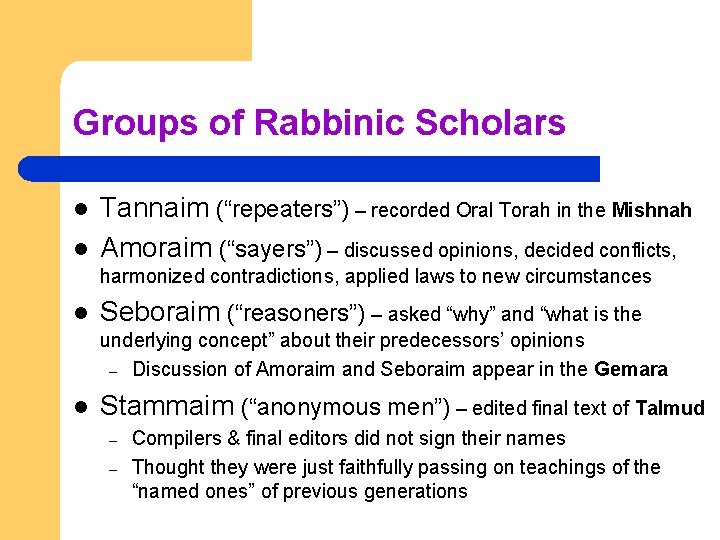
Groups of Rabbinic Scholars l l Tannaim (“repeaters”) – recorded Oral Torah in the Mishnah Amoraim (“sayers”) – discussed opinions, decided conflicts, harmonized contradictions, applied laws to new circumstances l Seboraim (“reasoners”) – asked “why” and “what is the underlying concept” about their predecessors’ opinions – Discussion of Amoraim and Seboraim appear in the Gemara l Stammaim (“anonymous men”) – edited final text of Talmud – – Compilers & final editors did not sign their names Thought they were just faithfully passing on teachings of the “named ones” of previous generations
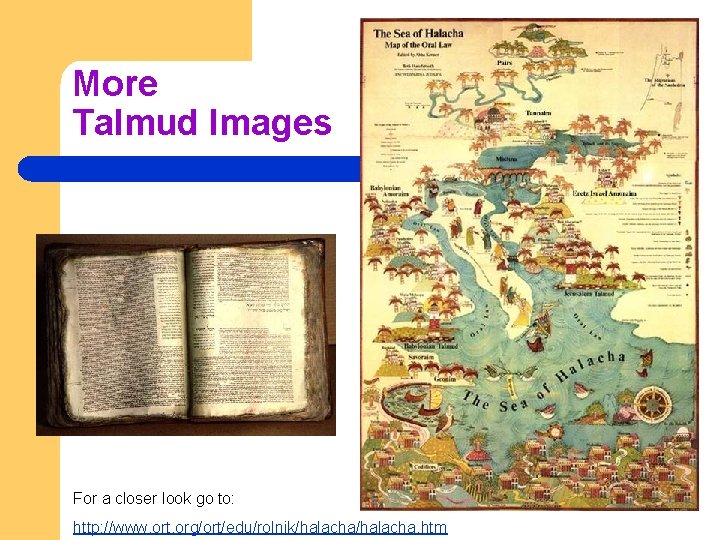
More Talmud Images For a closer look go to: http: //www. ort. org/ort/edu/rolnik/halacha. htm
Midrash l Exegesis = interpretation of biblical texts – l Four Ways of Understanding HB texts: – – l Analyzing the narratives of the HB to derive laws, principles, or moral lessons for Jewish life Simple meaning; hints/clues; interpretation; “secret” Midrash focuses on hints/clues and interpretations Two Types of Subject Matter: – – Halakhic (legal, how to “walk/conduct” one’s life well) Aggadic (non-legal, mainly homiletic / inspirational)
Other Rabbinic Literature l Books of the Tannaitic Rabbinic Era: – – – l Tosefta = another compilation of oral traditions – l Mekilta on Genesis Sifra on Leviticus Sifre on Numbers and Deuteronomy “supplement” to the Mishnah Targumim = Aramaic translations of HB books – often reflects interpretations of later rabbis
Recap (main points to know) l Oral Torah – passed down orally through many generations along with the Written Torah – l Belief of Rabbinic Judaism (from after 70 CE to today) Two main categories: narrative and legal – Midrash deals with biblical stories l – Mishnah & Talmuds deal with legal materials l l Interpretation of HB narratives Application of the mitzvot/commandments Focus of Rabbinic Literature: – More on Mishnah and Talmuds, less on Midrash
- Slides: 15