
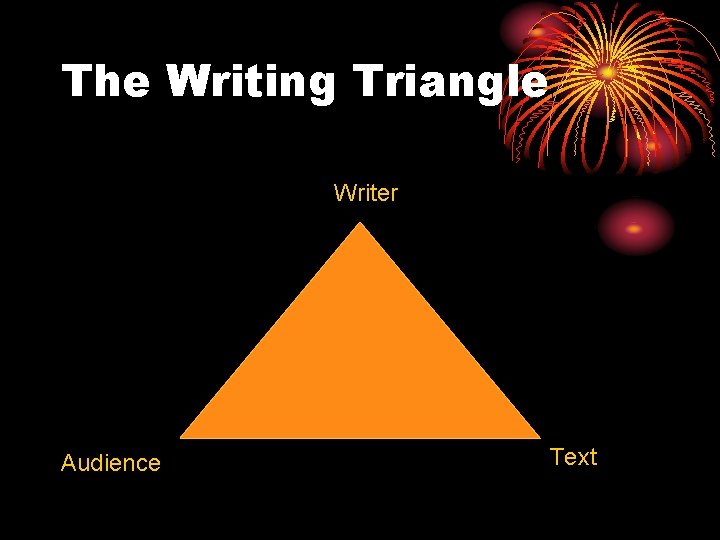
The Writing Triangle Writer Audience Text Writing Context
- Slides: 20
The Writing Triangle Writer Audience Text
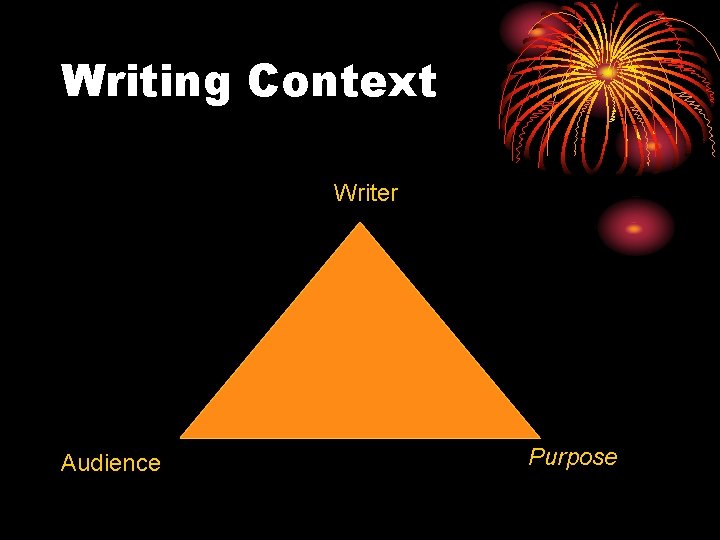
Writing Context Writer Audience Purpose
Who is the writer? How is he/she related to his/her subject? • Does the author have a reputation for honesty, thoroughness, fairness and knowledge? • Is the author an expert? • Is the author associated with any group, organization or belief system?
Who is the author’s audience (how does he/she understand them? )? • • Popular audience General, but well educated Specialized Others: culture, belief/religion, membership in an organization, etc. • How does the author expect his/her audience to react?
What is his/her purpose in writing? • • To Inform To Persuade To Entertain Combination of these
Group work: Exercises 1 on page 34, Seyler.
The Elements of Style
Word choice • Level of diction (formal or informal) • Connotative/denotative meanings • Jargon/Doublespeak
How does the author’s language affect how you read the article? Is it appropriate for the author’s audience and purpose in writing?
Group work: Exercises 1 and 2 on page 37, Seyler.
Attitude/Tone • What does the author’s word choice tell you about his/her attitude towards the subject (positive, negative, neutral)? • What is the writer’s Tone (how does his/her voice come across in the piece of writing?
Group work: Collaborative Exercise on Tone, page 38).
Sentence Structure • Simple • Expanded simple sentence • Compound (two or more independent clauses) • Complex (at least one independent and one dependent clause) • Fragments • Parallelism • Antithesis
What does the sentence structure tell you about the formality/informality of the document? Is it appropriate? What techniques does the author use for emphasis?
Metaphorical Language What comparisons and specific images does the author use? What is their effect on the reader – what seems to be the reason behind them?
Together: Exercise on Style, page 44
Organization • In what order are ideas introduced? • Which subjects are discussed at length? • How does the writer lead us through the organization (transitions, headings, subheadings)?
What techniques does the author use to guide your reading of the document? Is the organization Direct or Indirect?
Examples (Content) What kind of evidence does the author use to clarify and support his/her ideas? Is it solid? Is it appropriate to the author’s purpose and audience? Is it valid?
Others: • Repetition • Hyperbole, Understatement, Irony • Formatting – Quotation Marks, Italics, Capital Letters