
THE WRITING PROCESS STAGE 2 STAGE 2 DRAFTING











![EXAMPLES 1. I recently visited Boston, Massachusetts. [one independent clause] = I is the](https://slidetodoc.com/presentation_image_h2/3beb51d47bc9fb7a309c8294ea45b26b/image-40.jpg "EXAMPLES 1. I recently visited Boston, Massachusetts. [one independent clause] = I is the")





- Slides: 53
THE WRITING PROCESS STAGE 2
STAGE 2: DRAFTING • Drafting: process in which you turn your prewriting plan into complete sentences and paragraphs • Note: GUESS WHAT!! You just did that today for your journal! • A few guidelines: (jot down 2) • Cross out ideas you do not like • Be open to making changes to the plan you created • Don’t expect the draft to be perfect • Don’t feel like you must stick with EVERY detail.
REVIEW • What is a verb? • Verbs are words that express an action or a state of being. • The EASISEST action verbs to identify show an action you want to see. • Ex: kick, throw, skate, dance, climb, pounce, etc. • Other action verbs show an action that takes place in your mind. • Ex: think, like, enjoy, wonder, etc. • Action verbs (V) OFTEN take a direct object (DO). • Ex: The skater won (V) the gold medal (DO).
SURPRISE!!!! • Clear your desk; all you need is a pencil. • You are about to take a practice test for me to see what you know about subject verb agreement. • NO TALKING. Talk = 0 • No cheating. Eyes on your own paper. • Do your best. When you finish, put your head down.
COMPLETE SENTENCES – STAND & CHANT WITH ME! • Subject + Verb = Agreement • The singular subject takes a singular verb; the singular verb is the “s” form verb. • Ex: The dog eats early in the morning. • The dog (singular subject) eats (singular verb is the “s” form verb) early in the morning. • The plural subject takes a plural verb; the plural verb is the “base” form verb. • The dogs chase rabbits often. • The dogs (plural subject) chase (base form verb) rabbits often.
SUBJECTS & PREDICATES • Complete sentences = 2 essential parts, which are: • SUBJECT : tells what the sentence is about • Carla loves to walk along the beach. “Carla” is the subject of the sentence; the sentence is about HER. • PREDICATE : tells what the subject does, is, has, or feels • Carla loves to walk along the beach. “loves to walk…” is the predicate of the sentence; it’s telling what Carla likes to do.
SUBJECTS & PREDICATES • A Complete Subject : ALL the words in a sentence that describe the person or thing that performs the action of the sentence • Example: The history of China is fascinating. • A Simple Subject : main word or words in the complete subject. • Example: The history of China is fascinating. • Question: Why is “of China” not included? • ANSWER: “of” is a preposition, making “of China” a prepositional phrase… we will tackle that later.
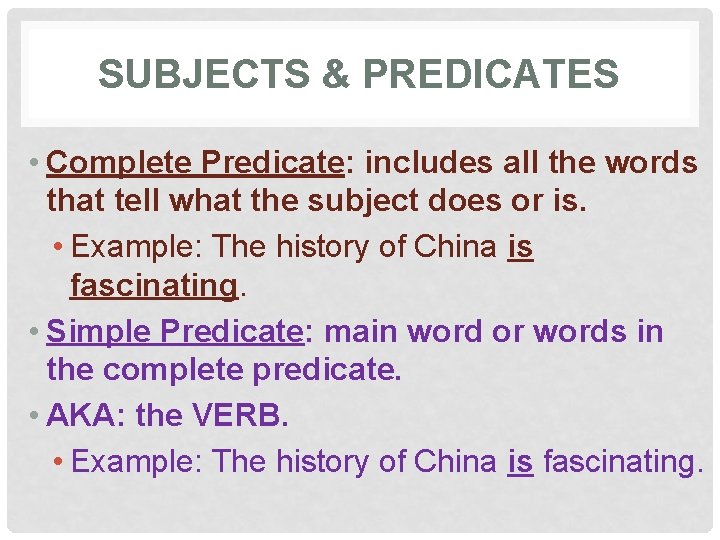
SUBJECTS & PREDICATES • Complete Predicate: includes all the words that tell what the subject does or is. • Example: The history of China is fascinating. • Simple Predicate: main word or words in the complete predicate. • AKA: the VERB. • Example: The history of China is fascinating.
WE TRY Directions: Write the sentences; draw 1 line under the complete subject and 2 lines under the complete predicate. Circle the simple subject and simple predicate. 1. The Inca ruled Peru over four hundred years ago. 2. These hearty people built a city on the top of a mountain. 3. The great city was forgotten for hundreds of years.
VERBS RULE! Otherwise, your meaning is misinterpreted…
EXCEPTIONS TO THE RULES • 1. Subject: 2 or more nouns or pronouns connected by and = use a plural verb • Ex. She and her friends are at the fair. • 2. 2 or more singular nouns or pronouns connected by or or nor = use a singular verb • Ex. The book or the pen is in the drawer. (Hint: one of those two items are in the drawer)
EXCEPTIONS TO THE RULE • 3. Compound subject contains both a singular and a plural noun or pronoun joined by or or nor = verb agrees with the subject that is closest to the verb. • The boy or his friends run every day. • The plural subject takes the plural verb; the plural verb is the BASE form verb. • His friends or the boy runs every day. • The singular subject takes the singular verb; the singular verb is the “S” FORM verb.
EXCEPTIONS TO THE RULE • 4. Doesn’t: does + not = singular subject • Don’t: do + not = plural subject • Exception to this rule: first person and second person pronouns I and you. With these pronouns, the contraction don't should be used. • He doesn't like it. INCORRECT: She don’t know. • They don't like it.
EXCEPTIONS TO THE RULE • 5. What if a phrase that comes between the subject and the verb? • The verb agrees with the subject, NOT with a noun or pronoun in the phrase. • One of the boxes is open • The people who listen to that music are few. • The team captain, as well as his players, is anxious.
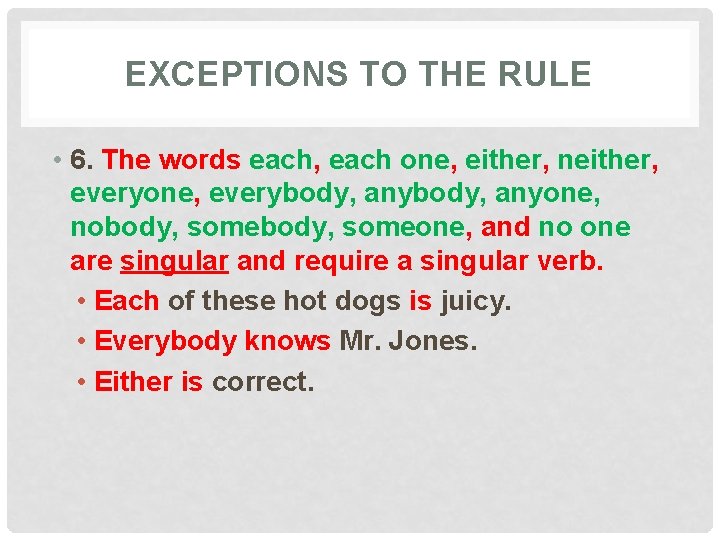
EXCEPTIONS TO THE RULE • 6. The words each, each one, either, neither, everyone, everybody, anyone, nobody, someone, and no one are singular and require a singular verb. • Each of these hot dogs is juicy. • Everybody knows Mr. Jones. • Either is correct.
EXCEPTIONS TO THE RULE • 7. Nouns such as civics, mathematics, dollars, measles, and news require singular verbs. • The news is on at six. • Note: the word “dollars” is a special case. When talking about an amount of money, it requires a singular verb, but when referring to the dollars themselves, plural verb is required. • One hundred dollars is a lot of money. • Dollars are often used instead of rubles in Russia.
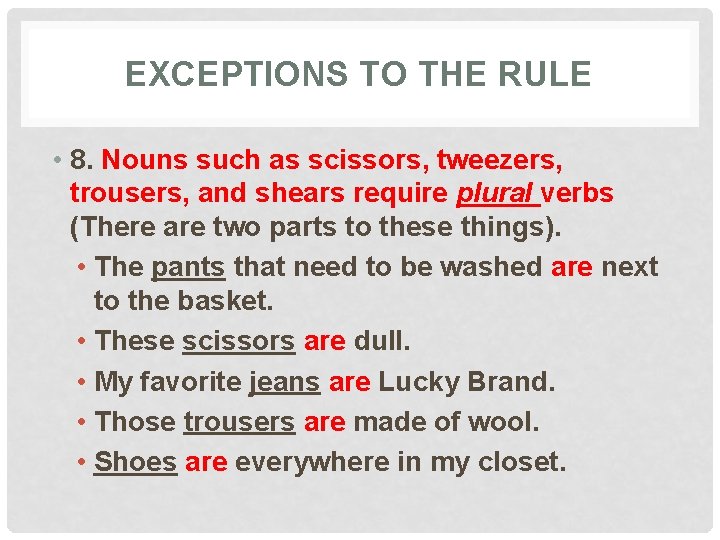
EXCEPTIONS TO THE RULE • 8. Nouns such as scissors, tweezers, trousers, and shears require plural verbs (There are two parts to these things). • The pants that need to be washed are next to the basket. • These scissors are dull. • My favorite jeans are Lucky Brand. • Those trousers are made of wool. • Shoes are everywhere in my closet.
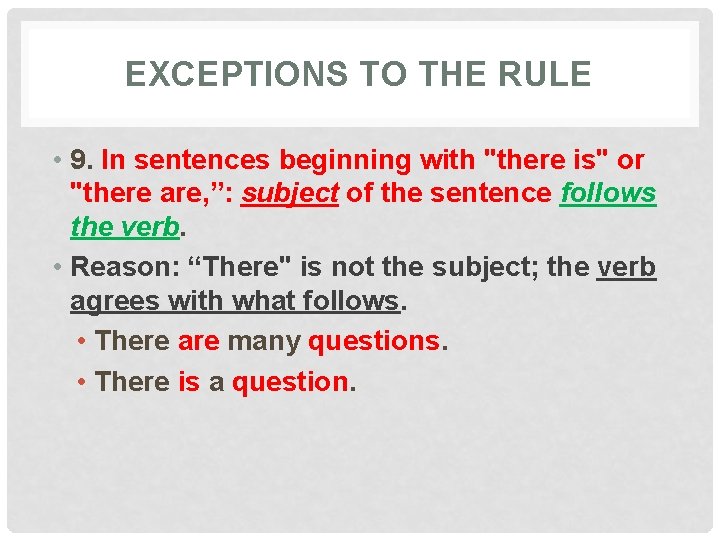
EXCEPTIONS TO THE RULE • 9. In sentences beginning with "there is" or "there are, ”: subject of the sentence follows the verb. • Reason: “There" is not the subject; the verb agrees with what follows. • There are many questions. • There is a question.
EXCEPTIONS TO THE RULE • 10. Collective nouns: imply more than one person BUT are considered singular and take a singular verb (such as group, team, committee, class, and family) • The team runs during practice. • The committee decides how to proceed. • The audience considers the performance.
EXCEPTIONS TO THE RULE • 11. Expressions such as with, together with, including, accompanied by, in addition to, or as well DO NOT change the number of the subject. • If the subject is singular, the verb is too. • The President, accompanied by his wife, is traveling to India. • All of the books, including yours, are in that box.
WHY DO WE NEED TO KNOW THIS? ! • When you write in your journals, make sure your SUBJECT agrees with your VERB. • IF IT DOESN’T, your meaning will be misconstrued (misinterpreted like Wilbur’s) • We should strive to be better writers • Remember: making someone understand what we are trying to say is KEY • WRITING PROPERLY IS IMPORTANT; IT MAKES YOU LOOK LITERATE
LET’S PRACTICE! • Part 1 – Underline the verb in parentheses that best completes each sentence! • Part 2 – Underline the subject in parentheses that best completes each sentence! • Part 3 – Rewrite each sentence, changing the underlined subject from SINGULAR to PLURAL. You will, of course, need to change the verb so that it agrees with the subject. • Part 4 – Rewrite each sentence, changing the conjunction that joins the subjects to the one given in parentheses.
STAGE 2: DRAFTING • ALL DRAFTS Should include: • a STRONG INTRODUCTION (this should grab the reader’s attention) • BODY PARAGRAPHS that supports the main point (2 -3) • A CONCLUSION that readers will remember • When/IF you get stuck (tips): • Refer to your prewriting notes • Take a break and think • Start FREEWRITING OR BRAINSTORMING again; do not stay stuck
DIRECTIONS: JUST TRY IT! • Planning a Draft: Look back at your road trip gone wrong rough draft… • As we look through some “do’s” and “do not’s, ” refer back to that rough draft as we go.
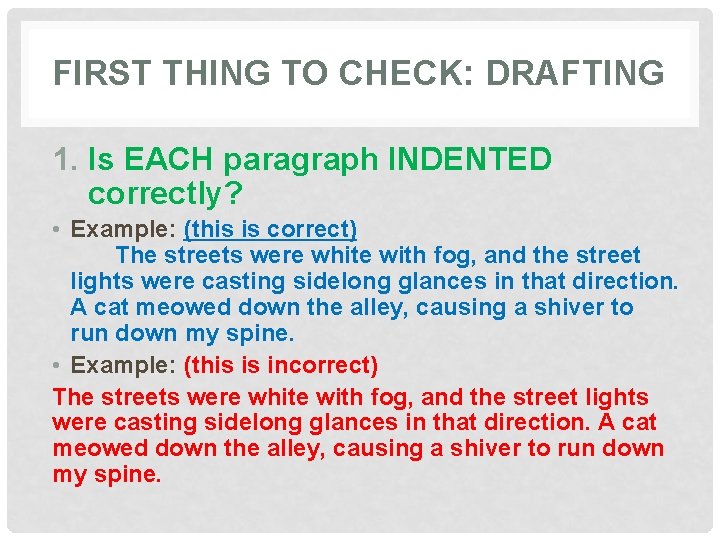
FIRST THING TO CHECK: DRAFTING 1. Is EACH paragraph INDENTED correctly? • Example: (this is correct) The streets were white with fog, and the street lights were casting sidelong glances in that direction. A cat meowed down the alley, causing a shiver to run down my spine. • Example: (this is incorrect) The streets were white with fog, and the street lights were casting sidelong glances in that direction. A cat meowed down the alley, causing a shiver to run down my spine.
NEXT THING TO CHECK: SENTENCE VARIETIES 2) Try to avoid a string of short or long sentences in a row. • Vary the length of your sentences to create a LIVELY writing style with sentence variety. • This means using short sentences as well as long, complex sentences.
WHAT I MEAN: • Too many short sentences in a row = looks choppy • Ex: Michelle lived on a quiet street. Her house was quiet. She lived a peaceful life. Her life was ordinary. • REALLY? ! You’re better than this. • REVISED: Michelle lived on a quiet street in a quiet house, and she lived a peaceful, ordinary life.
WHAT I MEAN: • On the other hand: too many long, rambling sentences can also sound repetitive. • What to do: • Cut out unnecessary words to create shorter sentences that will FLOW smoothly together. • Sentences must flow to help the reader understand your meaning, which is KEY!!! You want them to stay INTERESTED!!
EXAMPLE OF “TOO LONG” • Ex: The moonlight cast an eerie shadow across the floor, and the curtains fluttered in the breeze, and the chilly air made Michelle shake and shiver. She collapsed on the sofa because she was exhausted, and she wanted to sleep, so she closed her eyes… ETC. (YES, IT KEEPS GOING!!!) • REVISED: The moonlight cast an eerie shadow across the floor, and the curtains fluttered in the breeze. The chilly air made Michelle shiver as she collapsed on the sofa.
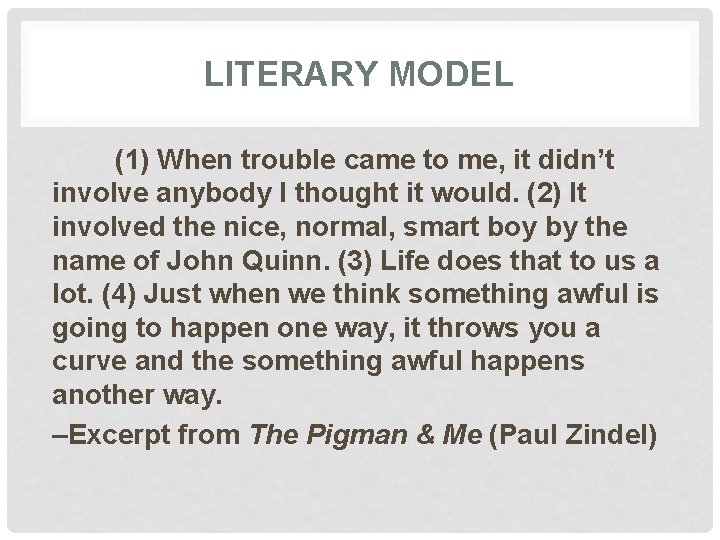
ANALYZING THE SENTENCE VARIETY • Read the literary model (I’ll show you in a second) and analyze the sentences to answer these questions. 1. Which sentence is the shortest? What is its effect? (THINK ABOUT THIS BEFORE YOU ASK FOR HELP) 2. Identify the longest sentence in the literary model. How well has the author varied the sentences in his writing?
LITERARY MODEL (1) When trouble came to me, it didn’t involve anybody I thought it would. (2) It involved the nice, normal, smart boy by the name of John Quinn. (3) Life does that to us a lot. (4) Just when we think something awful is going to happen one way, it throws you a curve and the something awful happens another way. –Excerpt from The Pigman & Me (Paul Zindel)
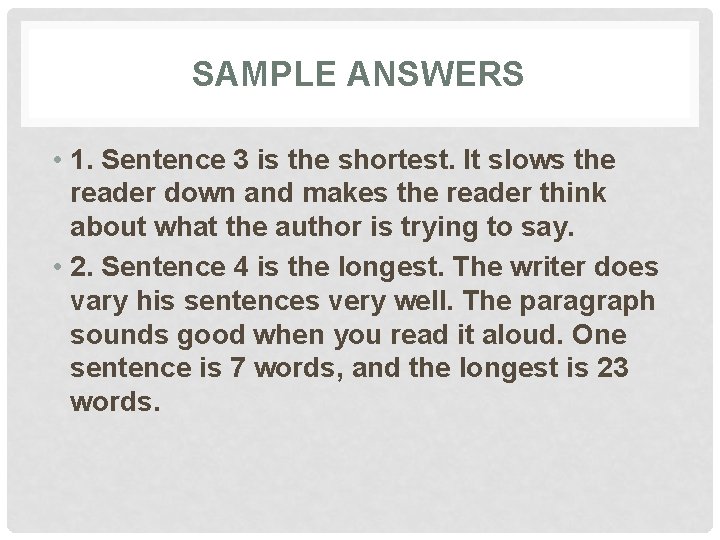
SAMPLE ANSWERS • 1. Sentence 3 is the shortest. It slows the reader down and makes the reader think about what the author is trying to say. • 2. Sentence 4 is the longest. The writer does vary his sentences very well. The paragraph sounds good when you read it aloud. One sentence is 7 words, and the longest is 23 words.
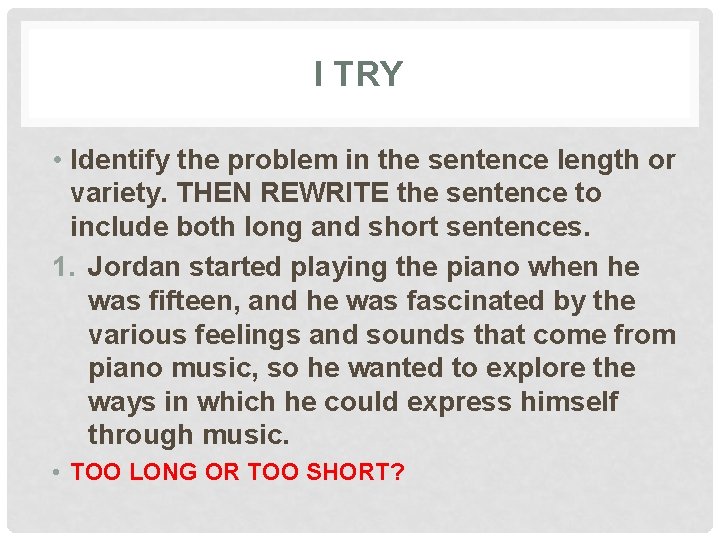
I TRY • Identify the problem in the sentence length or variety. THEN REWRITE the sentence to include both long and short sentences. 1. Jordan started playing the piano when he was fifteen, and he was fascinated by the various feelings and sounds that come from piano music, so he wanted to explore the ways in which he could express himself through music. • TOO LONG OR TOO SHORT?
WE TRY • Identify the problem in the sentence length or variety. THEN REWRITE the sentence to include both long and short sentences. • 2. Jessie likes communication. She likes to help people. She can always make me feel better. She asks all the right questions. When she grows up, she wants a job to help others talk about and understand their feelings. • TOO LONG OR TOO SHORT?
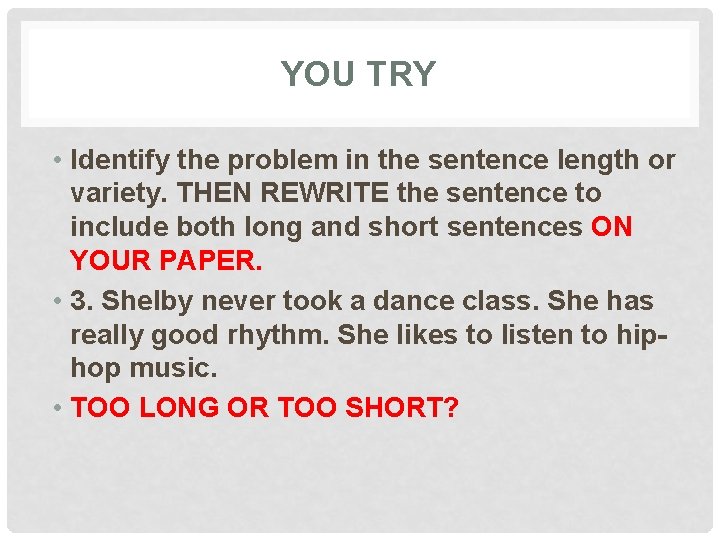
YOU TRY • Identify the problem in the sentence length or variety. THEN REWRITE the sentence to include both long and short sentences ON YOUR PAPER. • 3. Shelby never took a dance class. She has really good rhythm. She likes to listen to hiphop music. • TOO LONG OR TOO SHORT?
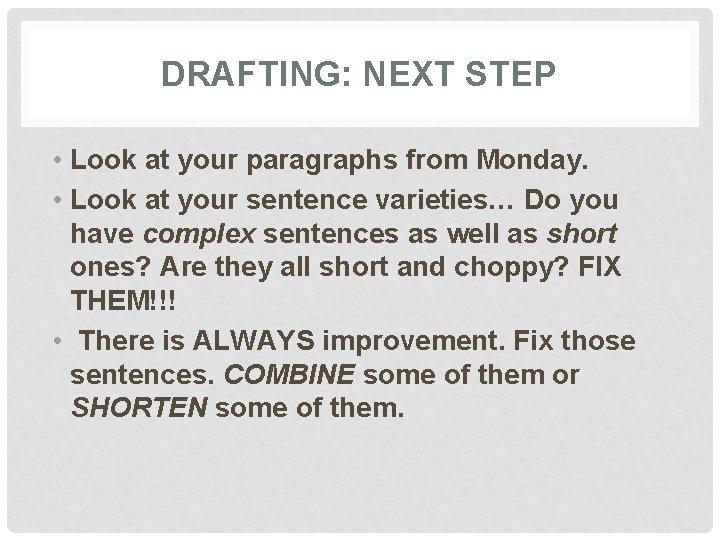
DRAFTING: NEXT STEP • Look at your paragraphs from Monday. • Look at your sentence varieties… Do you have complex sentences as well as short ones? Are they all short and choppy? FIX THEM!!! • There is ALWAYS improvement. Fix those sentences. COMBINE some of them or SHORTEN some of them.
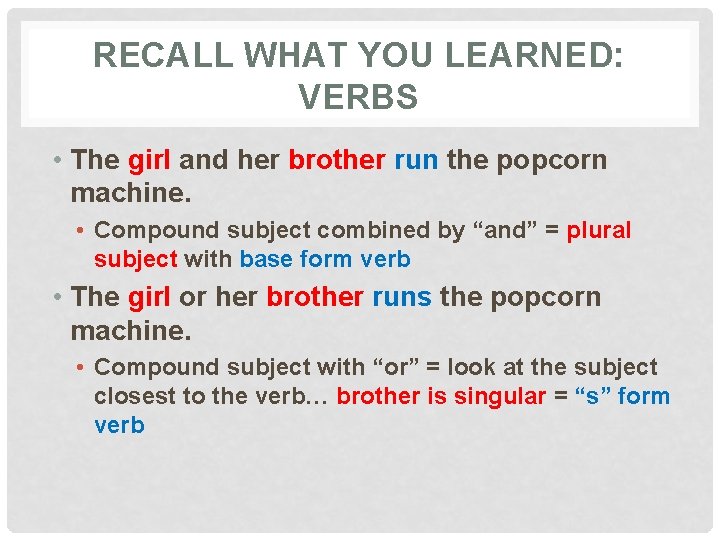
RECALL WHAT YOU LEARNED: VERBS • The girl and her brother run the popcorn machine. • Compound subject combined by “and” = plural subject with base form verb • The girl or her brother runs the popcorn machine. • Compound subject with “or” = look at the subject closest to the verb… brother is singular = “s” form verb
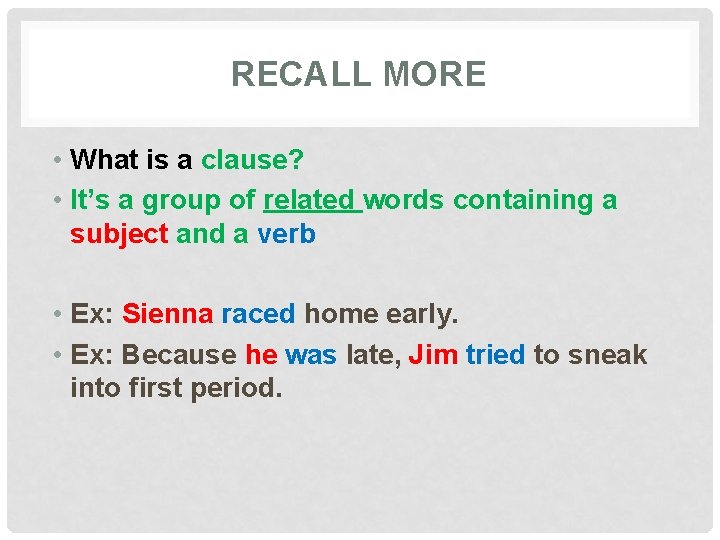
RECALL MORE • What is a clause? • It’s a group of related words containing a subject and a verb • Ex: Sienna raced home early. • Ex: Because he was late, Jim tried to sneak into first period.
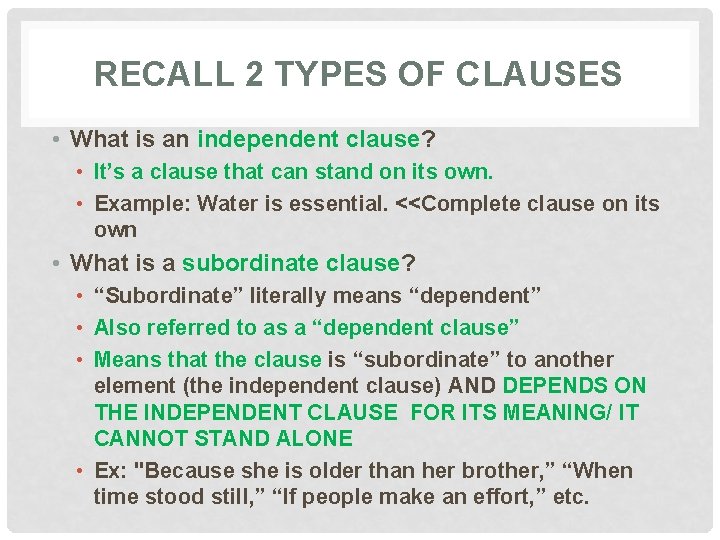
RECALL 2 TYPES OF CLAUSES • What is an independent clause? • It’s a clause that can stand on its own. • Example: Water is essential. <<Complete clause on its own • What is a subordinate clause? • “Subordinate” literally means “dependent” • Also referred to as a “dependent clause” • Means that the clause is “subordinate” to another element (the independent clause) AND DEPENDS ON THE INDEPENDENT CLAUSE FOR ITS MEANING/ IT CANNOT STAND ALONE • Ex: "Because she is older than her brother, ” “When time stood still, ” “If people make an effort, ” etc.
EXAMPLES 1. I recently visited Boston, Massachusetts. [one independent clause] = I is the subject and visited is the verb. 2. Our family flew there last month, and we stayed for six days. [two independent clauses] = family is the subject and flew is the verb.
EXAMPLES 1. While we were there, we went to a game. [one subordinate clause, followed by an independent clause] = we is the subject and went is the verb 2. Many buildings that we saw on the bus tour were built before the Revolutionary War. [one subordinate clause in the middle of an independent clause] 3. I ate a lot of chowder, which is a Boston specialty. [one independent clause, followed by a subordinate clause]
FURTHER EXPLANATION • ***Words that introduce a subordinate clause are called Subordinating Conjunctions • NOT EVERY subordinate clause starts with one, but most do. • Subordinating Conjunctions: • After before than when if • Although where as since • Unless which because so that • Until while
HERE WE GO! PRACTICE! • Write the following sentences. Then draw ONE line under each independent clause; draw TWO lines under each dependent clause. 1. Lora happily sang songs, but she could not play an instrument. 2. She has decided to start piano lessons because she loves piano. 3. Although Lora is not very good, she increases her practice daily, and she desires to be the best.
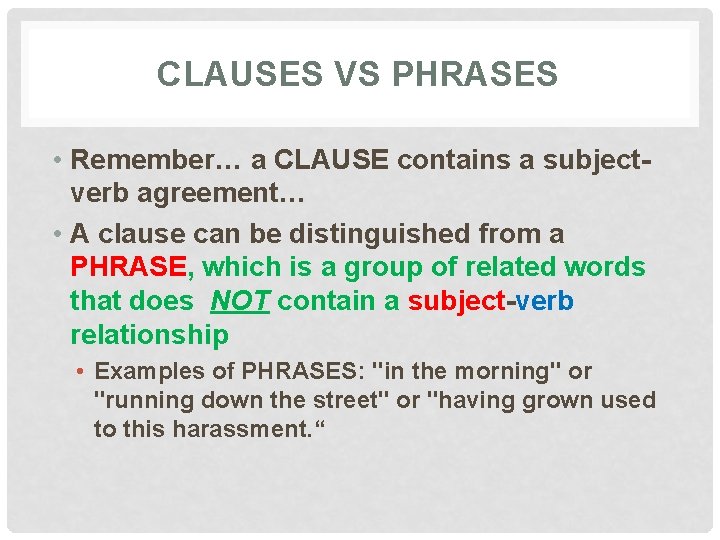
CLAUSES VS PHRASES • Remember… a CLAUSE contains a subjectverb agreement… • A clause can be distinguished from a PHRASE, which is a group of related words that does NOT contain a subject-verb relationship • Examples of PHRASES: "in the morning" or "running down the street" or "having grown used to this harassment. “
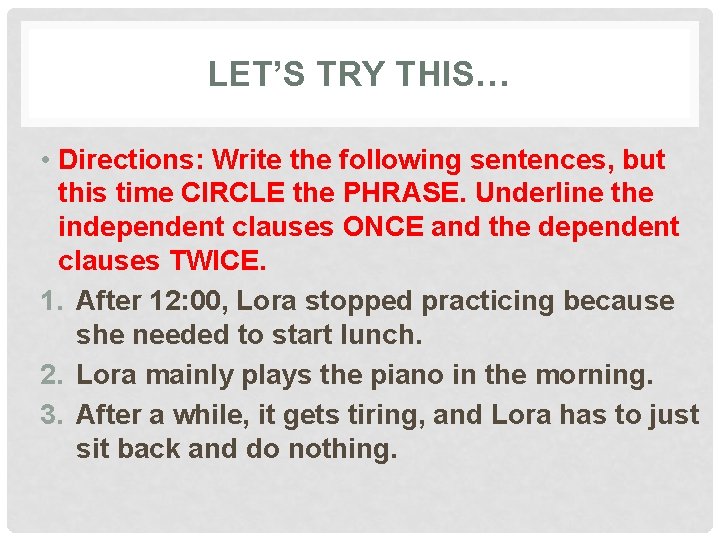
LET’S TRY THIS… • Directions: Write the following sentences, but this time CIRCLE the PHRASE. Underline the independent clauses ONCE and the dependent clauses TWICE. 1. After 12: 00, Lora stopped practicing because she needed to start lunch. 2. Lora mainly plays the piano in the morning. 3. After a while, it gets tiring, and Lora has to just sit back and do nothing.
WARM UP 1. Look at the worksheet located in the back. 2. Make sure you follow the directions. 3. Make sure you also do the back; add three subordinating clauses to your sentences from your paragraphs.
VARYING SENTENCE STRUCTURE 1. Simple sentences – have only 1 independent clause and no subordinate clause. 1. These are not ALL short sentences 2. They can have compound subjects and verbs or several prepositional phrases (they can be long and complicated) • Ex: Water is important. (1 subject & 1 verb) • Ex: All plants and animals need a surprising amount of water and depend on it to stay healthy. (compound subject & compound verb)
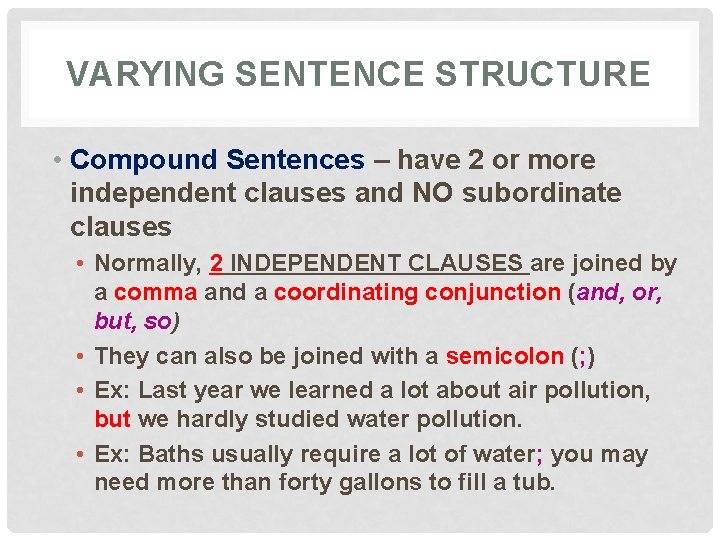
VARYING SENTENCE STRUCTURE • Compound Sentences – have 2 or more independent clauses and NO subordinate clauses • Normally, 2 INDEPENDENT CLAUSES are joined by a comma and a coordinating conjunction (and, or, but, so) • They can also be joined with a semicolon (; ) • Ex: Last year we learned a lot about air pollution, but we hardly studied water pollution. • Ex: Baths usually require a lot of water; you may need more than forty gallons to fill a tub.
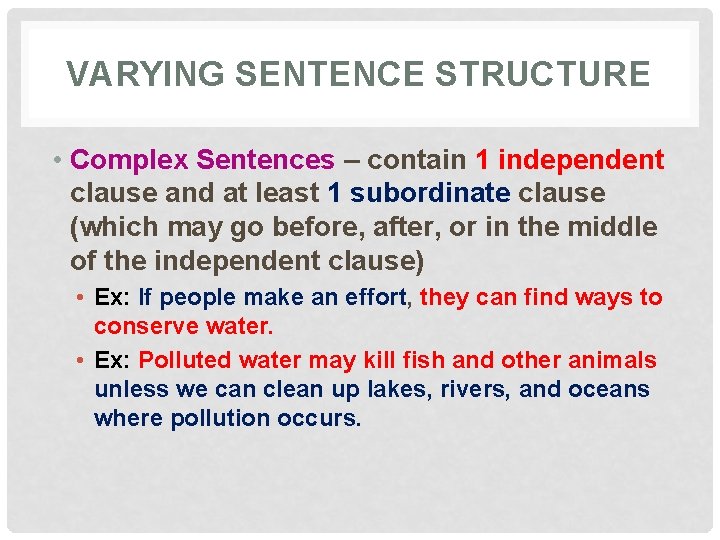
VARYING SENTENCE STRUCTURE • Complex Sentences – contain 1 independent clause and at least 1 subordinate clause (which may go before, after, or in the middle of the independent clause) • Ex: If people make an effort, they can find ways to conserve water. • Ex: Polluted water may kill fish and other animals unless we can clean up lakes, rivers, and oceans where pollution occurs.
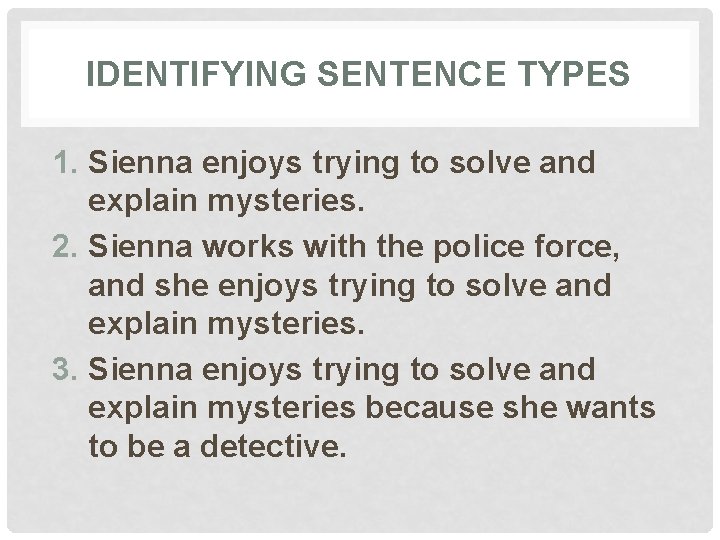
IDENTIFYING SENTENCE TYPES 1. Sienna enjoys trying to solve and explain mysteries. 2. Sienna works with the police force, and she enjoys trying to solve and explain mysteries. 3. Sienna enjoys trying to solve and explain mysteries because she wants to be a detective.
NOW TRY IT YOURSELF • Look at the worksheet I am giving you – THIS IS FOR YOU TO PRACTICE THE CONCEPTS TO REACH A LEVEL OF MASTERY • If you get stuck, LOOK AT YOUR NOTES! THAT’S WHAT THEY ARE FOR!
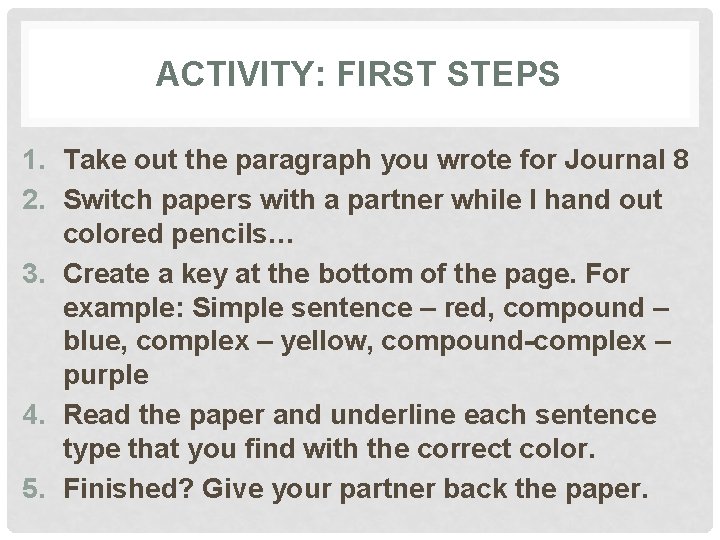
ACTIVITY: FIRST STEPS 1. Take out the paragraph you wrote for Journal 8 2. Switch papers with a partner while I hand out colored pencils… 3. Create a key at the bottom of the page. For example: Simple sentence – red, compound – blue, complex – yellow, compound-complex – purple 4. Read the paper and underline each sentence type that you find with the correct color. 5. Finished? Give your partner back the paper.
ACTIVITY: LAST STEPS 6. Partner, when you get your paper back, look at what sentences you have created, and make some changes. **If you have a bunch of simple sentences, add in a complex, and compound. Vary your sentence lengths and structures to create a LIVELY writing style!! MAKE IT FLOW!!! *This activity will lead us into the last stage of writing…