
The writing mat AQA French 90 Word Paper
- Slides: 3
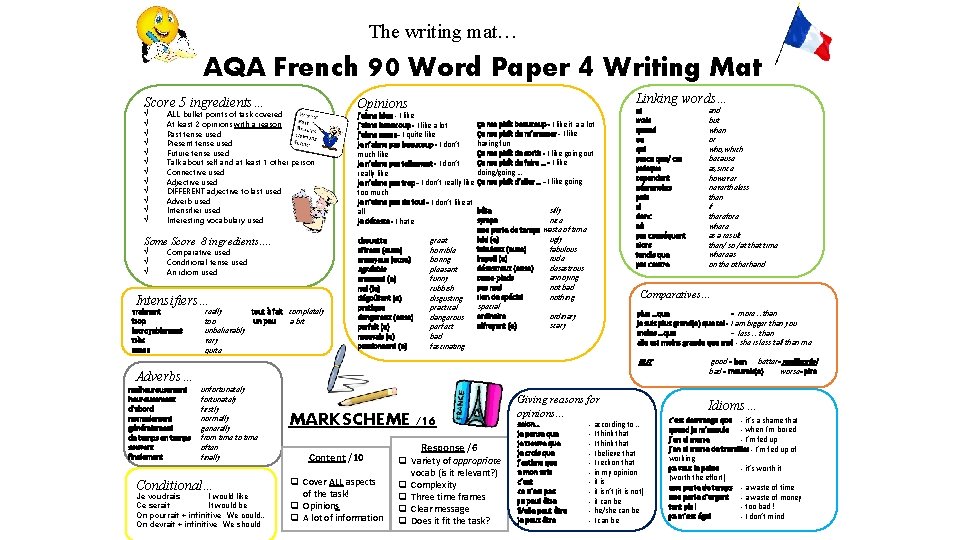
The writing mat… AQA French 90 Word Paper 4 Writing Mat Score 5 ingredients… √ √ √ ALL bullet points of task covered At least 2 opinions with a reason Past tense used Present tense used Future tense used Talk about self and at least 1 other person Connective used Adjective used DIFFERENT adjective to last used Adverb used Intensifier used Interesting vocabulary used Some Score 8 ingredients…. √ √ √ Intensifiers… vraiment trop incroyablement très assez j’aime bien - I like j’aime beaucoup - I like a lot j’aime assez - I quite like je n’aime pas beaucoup - I don’t much like je n’aime pas tellement - I don’t really like je n’aime pas trop - I don’t really like too much je n’aime pas du tout - I don’t like at all je déteste - I hate chouette affreux (euse) ennuyeux (euse) Comparative used Conditional tense used An idiom used agréable tout à fait completely really un peu a bit too unbelievably very quite Linking words… Opinions amusant (e) nul (le) dégoûtant (e) pratique dangereux (euse) parfait (e) mauvais (e) passionnant (e) great horrible boring pleasant funny rubbish disgusting practical dangerous perfect bad fascinating Ça me plaît beaucoup - I like it a a lot Ça me plaît de m’amuser - I like having fun Ça me plaît de sortir - I like going out Ça me plaît de faire … - I like doing/going … Ça me plaît d’aller … - I like going bête silly sympa nice une perte de temps waste of time laid (e) ugly fabuleux (euse) fabulous impoli (e) rude désastreux (euse) desastrous casse-pieds annoying pas mal not bad rien de spécial nothing special ordinaire effrayant (e) et mais quand ou qui parce que/ car puisque cependant néanmoins puis si donc où par conséquent alors tandis que par contre Comparatives… plus …que - more …than je suis plus grand(e) que toi - I am bigger than you moins …que - less … than elle est moins grande que moi - she is less tall than me ordinary scary BUT Adverbs… malheureusement d’abord normalement généralement de temps en temps souvent finalement unfortunately firstly normally generally from time to time often finally Conditional… Je voudrais I would like Ce serait It would be On pourrait + infinitive We could. . On devrait + infinitive We should MARKSCHEME /16 Content /10 q Cover ALL aspects of the task! q Opinions q A lot of information Response /6 q Variety of appropriate vocab (is it relevant? ) q Complexity q Three time frames q Clear message q Does it fit the task? Giving reasons for opinions… selon… je pense que je trouve que je crois que j’estime que a mon avis c’est ce n’est pas ça peut être il/elle peut être je peux être and but when or who, which because as, since however nevertheless then if therefore where as a result then/ so /at that time whereas on the other hand - according to. . - I think that - I believe that - I reckon that - in my opinion - it isn’t (it is not) - it can be - he/she can be - I can be good = bon better= meilleur(e) bad = mauvais(e) worse= pire Idioms… c’est dommage que - it’s a shame that quand je m’ennuie - when I’m bored j’en ai marre - I’m fed up j’en ai marre de travailler - I’m fed up of working ça vaut le peine - it’s worth it (worth the effort) une perte de temps - a waste of time une perte d’argent - a waste of money tant pis ! - too bad ! ça m’est égal - I don’t mind
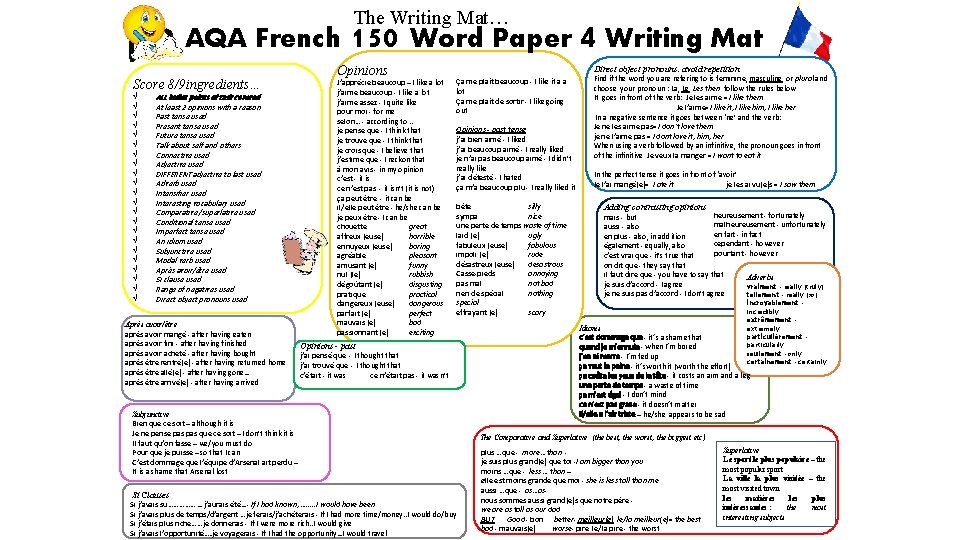
The Writing Mat… AQA French 150 Word Paper 4 Writing Mat Score 8/9 ingredients… √ √ √ √ √ √ ALL bullet points of task covered At least 2 opinions with a reason Past tense used Present tense used Future tense used Talk about self and others Connective used Adjective used DIFFERENT adjective to last used Adverb used Intensifier used Interesting vocabulary used Comparative /superlative used Conditional tense used Imperfect tense used An idiom used Subjunctive used Modal verb used Après avoir/être used Si clause used Range of negatives used Direct object pronouns used Après avoir/être après avoir mangé - after having eaten après avoir fini - after having finished après avoir acheté - after having bought après être rentré(e) - after having returned home après être allé(e) - after having gone… après être arrivé(e) - after having arrived Opinions J’apprécie beaucoup – I like a lot j’aime beaucoup - I like a lot j’aime assez - I quite like pour moi - for me selon… - according to. . je pense que - I think that je trouve que - I think that je crois que - I believe that j’estime que - I reckon that à mon avis - in my opinion c’est - it is ce n’est pas - it isn’t (it is not) ça peut être - it can be il/elle peut être - he/she can be je peux être - I can be chouette great affreux (euse) horrible ennuyeux (euse) boring agréable pleasant amusant (e) funny nul (le) rubbish dégoûtant (e) disgusting pratique practical dangereux (euse) dangerous parfait (e) perfect mauvais (e) bad passionnant (e) exciting Direct object pronouns: avoid repetition Ça me plaît beaucoup - I like it a a lot Ça me plaît de sortir - I like going out Opinions - past tense j’ai bien aimé - I liked j’ai beaucoup aimé - I really liked je n’ai pas beaucoup aimé - I didn’t really like j’ai détesté - I hated ça m’a beaucoup plu - I really liked it bête silly sympa nice une perte de temps waste of time laid (e) ugly fabuleux (euse) fabulous impoli (e) rude désastreux (euse) desastrous Casse-pieds annoying pas mal not bad rien de spécial nothing special effrayant (e) scary Opinions - past j’ai pensé que - I thought that j’ai trouvé que - I thought that c’était - it was ce n’était pas - it wasn’t Subjunctive Bien que ce soit – although it is Je ne pense pas que ce soit – I don’t think it is Il faut qu’on fasse – we/you must do Pour que je puisse – so that I can C’est dommage que l’équipe d’Arsenal ait perdu – It is a shame that Arsenal lost Si Clauses Si j’avais su……………. . j’aurais été…- If I had known, …. . . I would have been Si j’avais plus de temps/d’argent …je ferais/j’achéterais - If I had more time/money. . I would do/buy Si j’étais plus riche……je donnerais - If I were more rich. . I would give Si j’avais l’opportunité…. je voyagerais - If I had the opportunity…I would travel Find if the word you are refering to is feminine, masculine, or plural and choose your pronoun : La, Les then follow the rules below It goes in front of the verb: Je les aime = I like them Je l’aime= I like it, I like him, I like her In a negative sentence it goes between ‘ne’ and the verb: Je ne les aime pas= I don’t love them je ne l’aime pas = I dont love it, him, her When using a verb followed by an infinitive, the pronoun goes in front of the infinitive Je veux la manger = I want to eat it In the perfect tense it goes in front of ‘avoir’ Je l’ai mangé(e)= I ate it je les ai vu(e)s = I saw them Adding contrasting opinions heureusement - fortunately mais - but malheureusement - unfortunately aussi - also en fait - in fact en plus - also, in addition cependant - however également - equally, also pourtant - however c’est vrai que - it’s true that on dit que - they say that il faut dire que - you have to say that Adverbs je suis d’accord - I agree vraiment - really (truly) je ne suis pas d’accord - I don’t agree tellement - really (so) incroyablement incredibly extrêmement extremely particulièrement particularly seulement - only certainement - certainly Idioms c’est dommage que - it’s a shame that quand je m’ennuie - when I’m bored j’en ai marre - I’m fed up ça vaut le peine - it’s worth it (worth the effort) ça coûte les yeux de la tête - it costs an arm and a leg une perte de temps - a waste of time ça m’est égal - I don’t mind ce n’est pas grave - it doesn’t matter Il/elle a l’air triste – he/she appears to be sad The Comparative and Superlative (the best, the worst, the biggest etc) plus …que - more …than je suis plus grand(e) que toi -I am bigger than you moins …que - less … than – elle est moins grande que moi - she is less tall than me aussi …que - as…asnous sommes aussi grand(e)s que notre père we are as tall as our dad BUT Good - bon better- meilleur(e) le/la meilleur(e)= the best bad - mauvais(e) worse- pire le/la pire - the worst Superlative Le sport le plus populaire – the most popular sport La ville la plus visitée – the most visited town les matières les plus intéressantes : the most interesting subjects
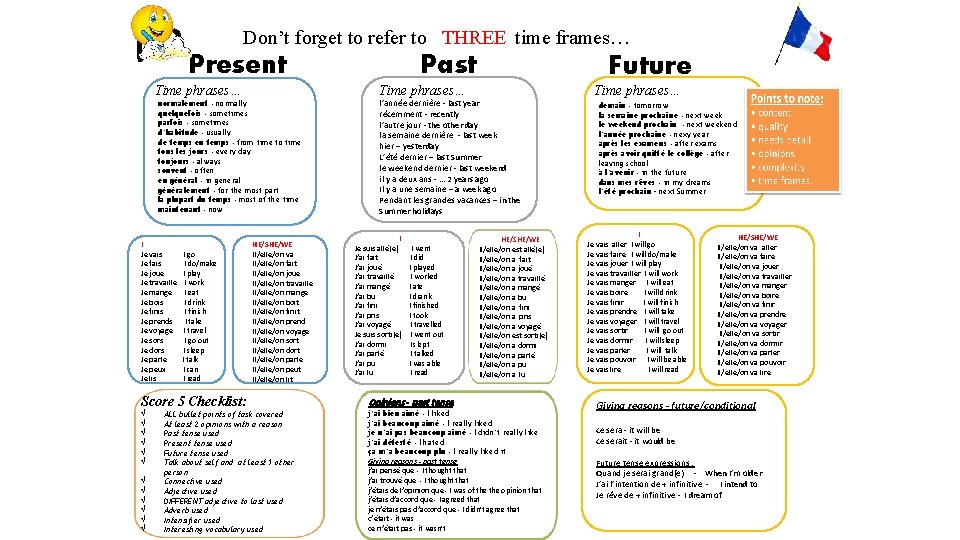
Don’t forget to refer to THREE time frames… Past Present Time phrases… normalement - normally quelquefois - sometimes parfois - sometimes d’habitude - usually de temps en temps - from time tous les jours - every day toujours - always souvent - often en général - in general généralement - for the most part la plupart du temps - most of the time maintenant - now I Je vais Je fais Je joue Je travaille Je mange Je bois Je finis Je prends Je voyage Je sors Je dors Je parle Je peux Je lis I go I do/make I play I work I eat I drink I finish I take I travel I go out I sleep I talk I can I read HE/SHE/WE Il/elle/on va Il/elle/on fait Il/elle/on joue Il/elle/on travaille Il/elle/on mange Il/elle/on boit Il/elle/on finit Il/elle/on prend Il/elle/on voyage Il/elle/on sort Il/elle/on dort Il/elle/on parle Il/elle/on peut Il/elle/on lit Score 5 Checklist: √ √ √ Future ALL bullet points of task covered At least 2 opinions with a reason Past tense used Present tense used Future tense used Talk about self and at least 1 other person Connective used Adjective used DIFFERENT adjective to last used Adverb used Intensifier used Interesting vocabulary used l’année dernière - last year récemment - recently l’autre jour - the other day la semaine dernière - last week hier – yesterday L’été dernier – last Summer le weekend dernier - last weekend il y a deux ans - … 2 years ago Il y a une semaine – a week ago Pendant les grandes vacances – in the Summer holidays I Je suis allé(e) J’ai fait J’ai joué J’ai travaillé J’ai mangé J’ai bu J’ai fini J’ai pris J’ai voyagé Je suis sorti(e) J’ai dormi J’ai parlé J’ai pu J’ai lu I went I did I played I worked I ate I drank I finished I took I travelled I went out I slept I talked I was able I read HE/SHE/WE Il/elle/on est allé(e) Il/elle/on a fait Il/elle/on a joué Il/elle/on a travaillé Il/elle/on a mangé Il/elle/on a bu Il/elle/on a fini Il/elle/on a pris Il/elle/on a voyagé Il/elle/on est sorti(e) Il/elle/on a dormi Il/elle/on a parlé Il/elle/on a pu Il/elle/on a lu Opinions - past tense j’ai bien aimé - I liked j’ai beaucoup aimé - I really liked je n’ai pas beaucoup aimé - I didn’t really like j’ai détesté - I hated ça m’a beaucoup plu - I really liked it Giving reasons - past tense j’ai pensé que - I thought that j’ai trouvé que - I thought that j’étais de l’opinion que - I was of the opinion that j’étais d’accord que - I agreed that je n’étais pas d’accord que - I didn’t agree that c’était - it was ce n’était pas - it wasn’t Time phrases… demain - tomorrow la semaine prochaine - next week le weekend prochain - next weekend l’année prochaine - nexy year après les examens - after exams après avoir quitté le collège - after leaving school à l’avenir - in the future dans mes rêves - in my dreams l’été prochain – next Summer I Je vais aller I will go Je vais faire I will do/make Je vais jouer I will play Je vais travailler I will work Je vais manger I will eat Je vais boire I will drink Je vais finir I will finish Je vais prendre I will take Je vais voyager I will travel Je vais sortir I will go out Je vais dormir I will sleep Je vais parler I will talk Je vais pouvoir I will be able Je vais lire I will read HE/SHE/WE Il/elle/on va aller Il/elle/on va faire Il/elle/on va jouer Il/elle/on va travailler Il/elle/on va manger Il/elle/on va boire Il/elle/on va finir Il/elle/on va prendre Il/elle/on va voyager Il/elle/on va sortir Il/elle/on va dormir Il/elle/on va parler Il/elle/on va pouvoir Il/elle/on va lire Giving reasons - future/conditional ce sera - it will be ce serait - it would be Future tense expressions : Quand je serai grand(e) - When I’m older J’ai l’intention de + infinitive - I intend to Je rêve de + infinitive - I dream of