
The World Wide Telescope a Digital Library Prototype
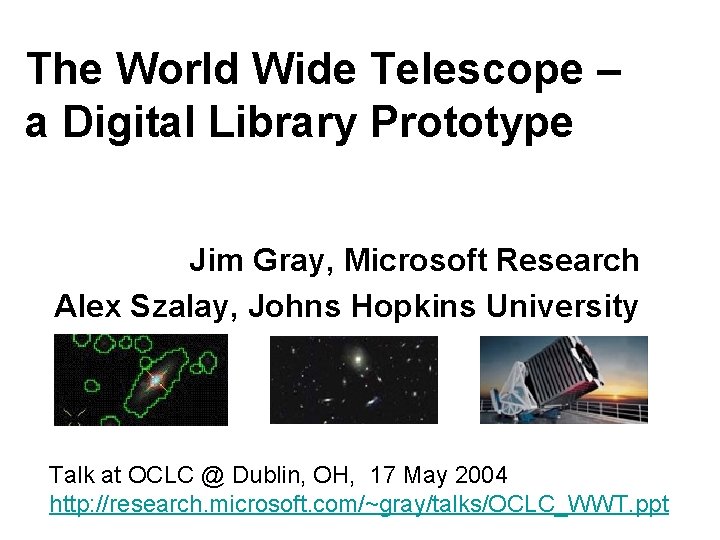
The World Wide Telescope – a Digital Library Prototype Jim Gray, Microsoft Research Alex Szalay, Johns Hopkins University Talk at OCLC @ Dublin, OH, 17 May 2004 http: //research. microsoft. com/~gray/talks/OCLC_WWT. ppt
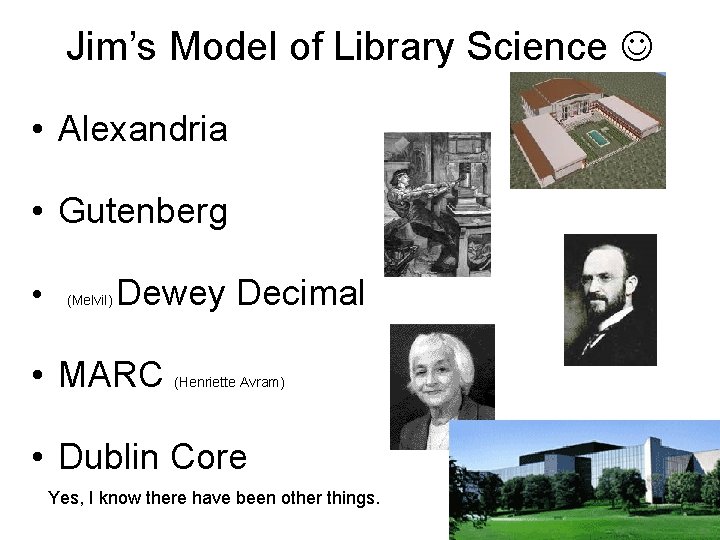
Jim’s Model of Library Science • Alexandria • Gutenberg • (Melvil) Dewey Decimal • MARC (Henriette Avram) • Dublin Core Yes, I know there have been other things.
Dublin Core Elements – – – – Elements+ Title Creator Subject Description Publisher Contributor Date Type Format Identifier Source Language Coverage Rights – – – – – – – – – Audience Alternative Table. Of. Contents Abstract Created Valid Available Issued Modified Extent Medium Is. Version. Of Has. Version Is. Replaced. By Replaces Is. Required. By Requires Is. Part. Of Has. Part Is. Referenced. By References Is. Format. Of Has. Format Conforms. To Spatial Temporal Mediator Date. Accepted Date. Copyrighted Date. Submitted Educational. Level Access. Rights Bibliographic. Citation Encoding – – – – – LCSH (Lb. Congress Subject Head) MESH (Medical Subject Head) DDC (Dewey Decimal Classification) LCC (Lb. Congress Classification) UDC (Universal Decimal Classification) DCMItype (Dublin Core Meta Type) IMT (Internet Media Type) ISO 639 -2 (ISO language names) RFC 1766 (Internet Language tags) URI (Uniform Resource Locator) Point (DCMI spatial point) ISO 3166 (ISO country codes) Box (DCMI rectangular area) TGN (Getty Thesaurus of Geo Names) Period (DCMI time interval) W 3 CDTF (W 3 C date/time) RFC 3066 (Language dialects) Types – – – Collection Dataset Event Image Interactive. Resouce Service Software Sound Text Physical. Object Still. Image Moving. Image
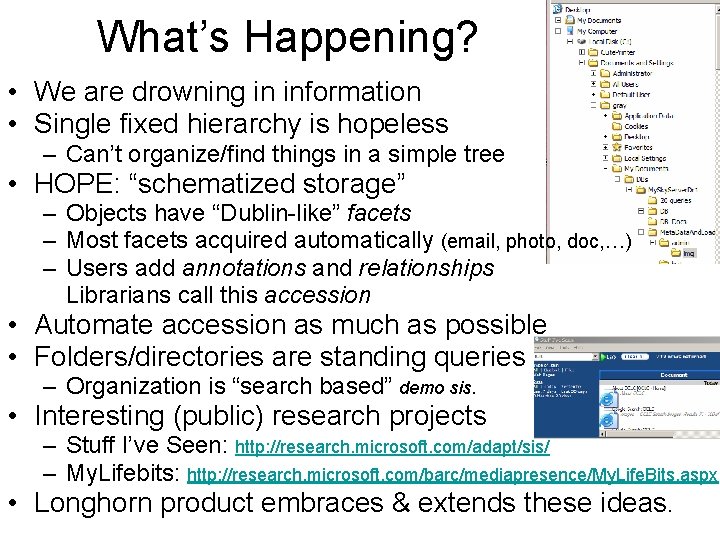
What’s Happening? • We are drowning in information • Single fixed hierarchy is hopeless – Can’t organize/find things in a simple tree • HOPE: “schematized storage” – Objects have “Dublin-like” facets – Most facets acquired automatically (email, photo, doc, …) – Users add annotations and relationships Librarians call this accession • Automate accession as much as possible • Folders/directories are standing queries – Organization is “search based” demo sis. • Interesting (public) research projects – Stuff I’ve Seen: http: //research. microsoft. com/adapt/sis/ – My. Lifebits: http: //research. microsoft. com/barc/mediapresence/My. Life. Bits. aspx • Longhorn product embraces & extends these ideas.
But, what about the talk I promised you? The World Wide Telescope – a Digital Library Prototype Jim Gray, Microsoft Research Alex Szalay, Johns Hopkins University Talk at OCLC @ Dublin, OH, 17 May 2004 http: //research. microsoft. com/~gray/talks/OCLC_WWT. ppt
The Talk • Libraries morphing to integrated text + data (you know that) • Dublin Core is bedrock, but many issues remain. (you know that) • WWT: All Astronomy data and literature online and integrated • Problems Librarians have grappled with for centuries: curation, preservation, indexing, access, summarization. 1. Overview of the World-Wide Telescope as a digital library 2. Focus on metadata, schema, curation, and preservation. . • Candidly, we have more problems than solutions, but the data is arriving and we are doing the best we can.

New Science Paradigms • Thousand years ago: science was empirical describing natural phenomena • Last few hundred years: theoretical branch using models, generalizations • Last few decades: a computational branch simulating complex phenomena • Today: data exploration (e. Science) synthesizing theory, experiment and computation with advanced data management and statistics
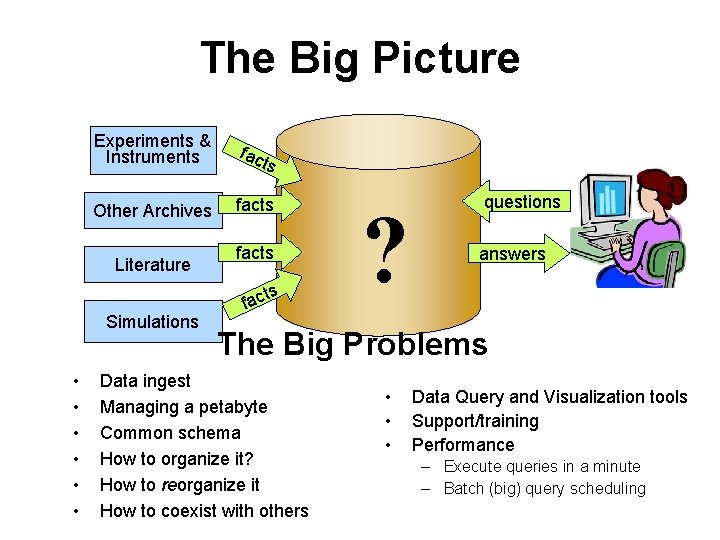
The Big Picture Experiments & Instruments fac Other Archives facts Literature ts facts ts Simulations • • • fac ? questions answers The Big Problems Data ingest Managing a petabyte Common schema How to organize it? How to reorganize it How to coexist with others • • • Data Query and Visualization tools Support/training Performance – Execute queries in a minute – Batch (big) query scheduling
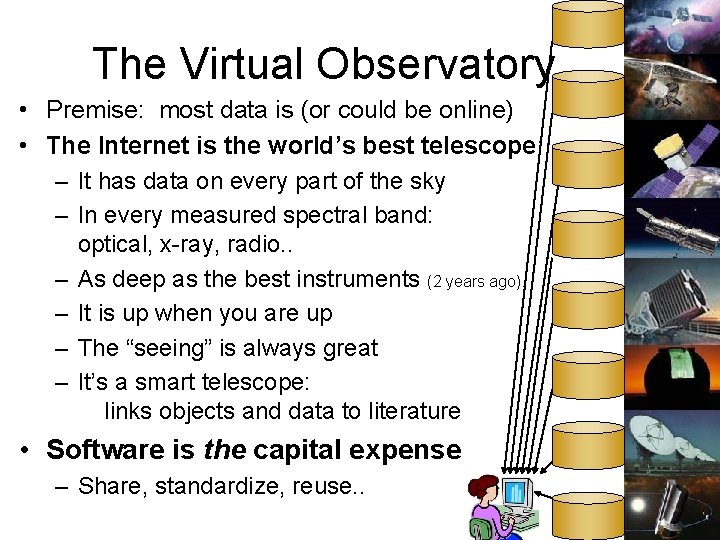
The Virtual Observatory • Premise: most data is (or could be online) • The Internet is the world’s best telescope: – It has data on every part of the sky – In every measured spectral band: – – optical, x-ray, radio. . As deep as the best instruments (2 years ago). It is up when you are up The “seeing” is always great It’s a smart telescope: links objects and data to literature • Software is the capital expense – Share, standardize, reuse. .
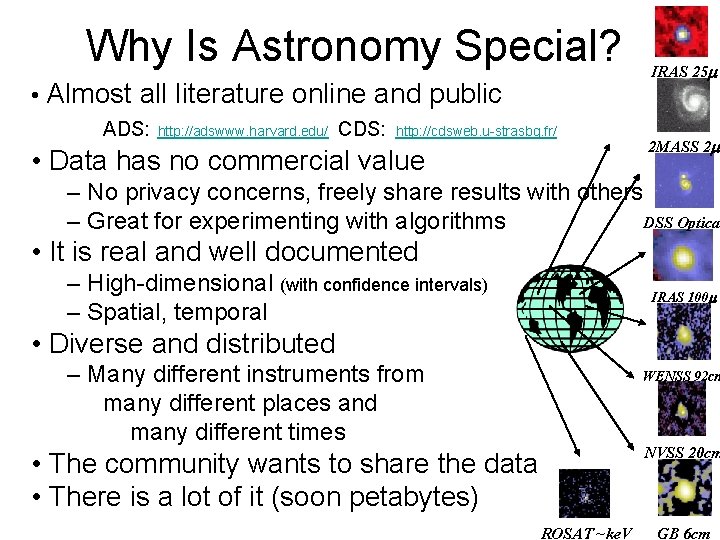
Why Is Astronomy Special? • Almost all literature online and public ADS: http: //adswww. harvard. edu/ CDS: http: //cdsweb. u-strasbg. fr/ • Data has no commercial value IRAS 25 m 2 MASS 2 m – No privacy concerns, freely share results with others DSS Optica – Great for experimenting with algorithms • It is real and well documented – High-dimensional (with confidence intervals) – Spatial, temporal IRAS 100 m • Diverse and distributed – Many different instruments from many different places and many different times WENSS 92 cm NVSS 20 cm • The community wants to share the data • There is a lot of it (soon petabytes) ROSAT ~ke. V GB 6 cm
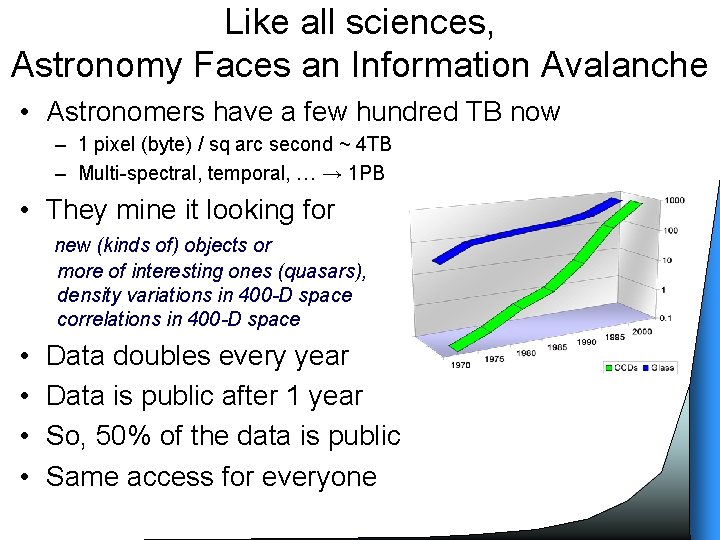
Like all sciences, Astronomy Faces an Information Avalanche • Astronomers have a few hundred TB now – 1 pixel (byte) / sq arc second ~ 4 TB – Multi-spectral, temporal, … → 1 PB • They mine it looking for new (kinds of) objects or more of interesting ones (quasars), density variations in 400 -D space correlations in 400 -D space • • Data doubles every year Data is public after 1 year So, 50% of the data is public Same access for everyone
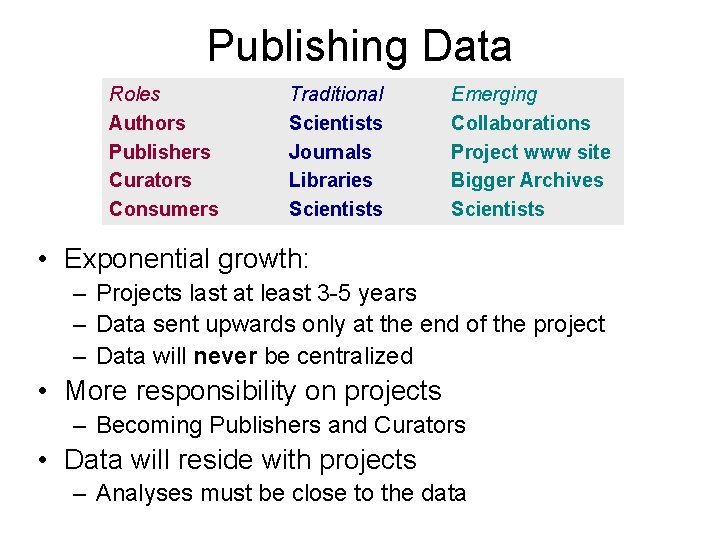
Publishing Data Roles Authors Publishers Curators Consumers Traditional Scientists Journals Libraries Scientists Emerging Collaborations Project www site Bigger Archives Scientists • Exponential growth: – Projects last at least 3 -5 years – Data sent upwards only at the end of the project – Data will never be centralized • More responsibility on projects – Becoming Publishers and Curators • Data will reside with projects – Analyses must be close to the data
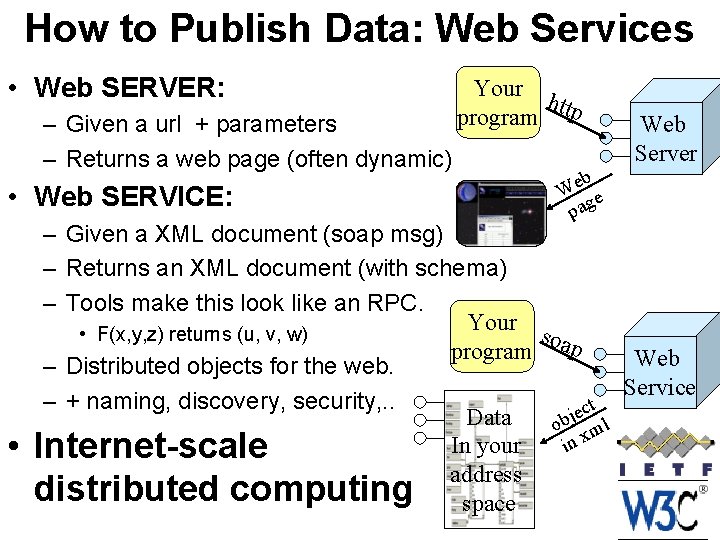
How to Publish Data: Web Services • Web SERVER: – Given a url + parameters – Returns a web page (often dynamic) • Web SERVICE: • Your h t program tp b We e pag Web Server – Given a XML document (soap msg) – Returns an XML document (with schema) – Tools make this look like an RPC. Your s • F(x, y, z) returns (u, v, w) o program ap Web – Distributed objects for the web. Service – + naming, discovery, security, . . t c e j Data ob ml x n i In your Internet-scale address distributed computing space
The Core Problem: No Economic Model • The archive user has not yet been born. How can he pay you to curate the data? • Q: The Scientist gathered data for his own purpose. Why should he pay (invest time) for your needs? A: that’s the scientific method • Curating data (documenting the design, the acquisition, and the processing) is very hard and there is no reward for doing it. Results are rewarded, not the process of getting them. • Storage/archive NOT the problem (it’s almost free) • Curating/Publishing is expensive. • Better standards & tools lower costs
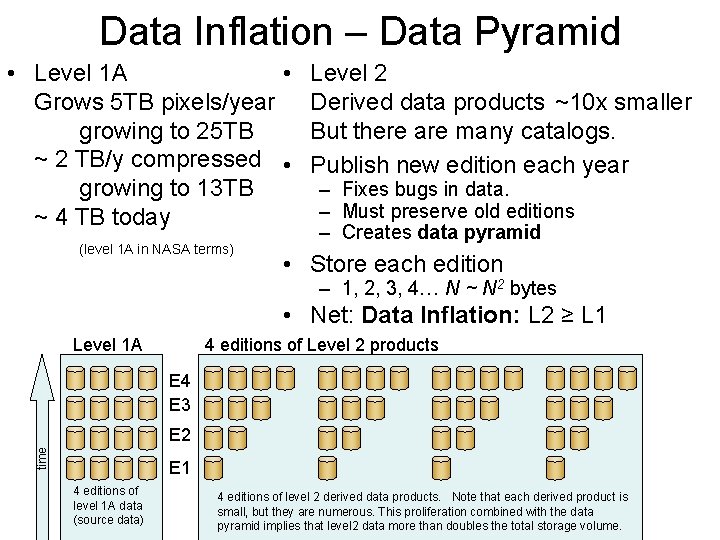
Data Inflation – Data Pyramid • Level 1 A • Level 2 Grows 5 TB pixels/year Derived data products ~10 x smaller growing to 25 TB But there are many catalogs. ~ 2 TB/y compressed • Publish new edition each year – Fixes bugs in data. growing to 13 TB – Must preserve old editions ~ 4 TB today (level 1 A in NASA terms) – Creates data pyramid • Store each edition – 1, 2, 3, 4… N ~ N 2 bytes • Net: Data Inflation: L 2 ≥ L 1 Level 1 A 4 editions of Level 2 products E 4 E 3 time E 2 E 1 4 editions of level 1 A data (source data) 4 editions of level 2 derived data products. Note that each derived product is small, but they are numerous. This proliferation combined with the data pyramid implies that level 2 data more than doubles the total storage volume.
What SDSS is Doing: Capture the Bits • Best-effort documenting data and process. • Publishing data: often by UPS (~ 5 TB today and so ~5 k$ for a copy) • Replicating data on 3 continents. • EVERYTHING online (tape data is dead data) • Archiving all email, discussions, …. • Keeping all web-logs. • Now we need to figure out how to organize/search all this metadata.
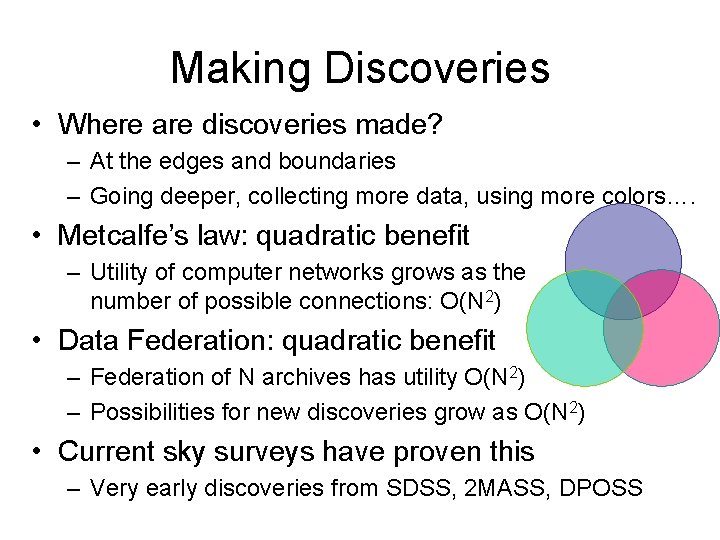
Making Discoveries • Where are discoveries made? – At the edges and boundaries – Going deeper, collecting more data, using more colors…. • Metcalfe’s law: quadratic benefit – Utility of computer networks grows as the number of possible connections: O(N 2) • Data Federation: quadratic benefit – Federation of N archives has utility O(N 2) – Possibilities for new discoveries grow as O(N 2) • Current sky surveys have proven this – Very early discoveries from SDSS, 2 MASS, DPOSS
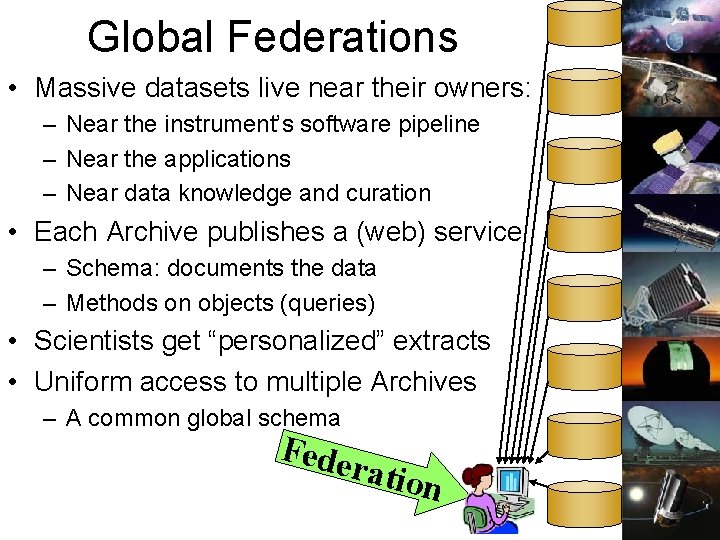
Global Federations • Massive datasets live near their owners: – Near the instrument’s software pipeline – Near the applications – Near data knowledge and curation • Each Archive publishes a (web) service – Schema: documents the data – Methods on objects (queries) • Scientists get “personalized” extracts • Uniform access to multiple Archives – A common global schema Fede ratio n
Schema (aka metadata) • Everyone starts with the same schema <stuff/> Then the start arguing about semantics. • Virtual Observatory: http: //www. ivoa. net/ • Metadata based on Dublin Core: http: //www. ivoa. net/Documents/latest/RM. html • Universal Content Descriptors (UCD): http: //vizier. u-strasbg. fr/doc/UCD. htx Captures quantitative concepts and their units Reduced from ~100, 000 tables in literature to ~1, 000 terms • VOtable – a schema for answers to questions http: //www. us-vo. org/VOTable/ • Common Queries: Cone Search and Simple Image Access Protocol, SQL • Registry: http: //www. ivoa. net/Documents/latest/RMExp. html still a work in progress.
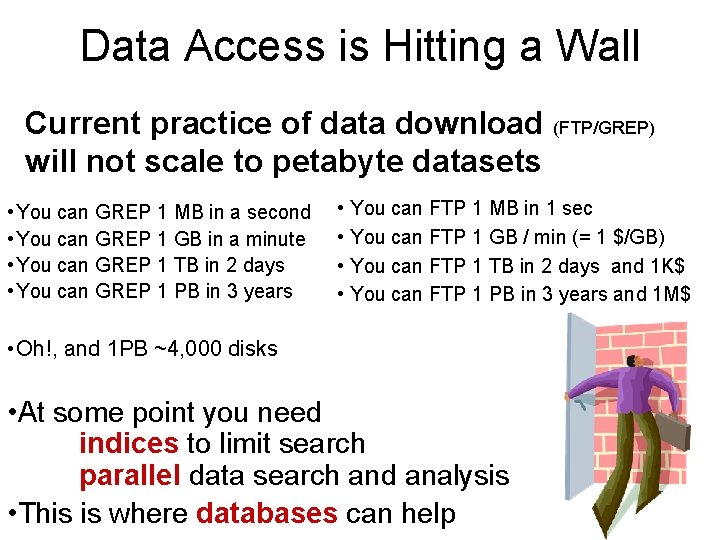
Data Access is Hitting a Wall Current practice of data download (FTP/GREP) will not scale to petabyte datasets • You can GREP 1 MB in a second • You can GREP 1 GB in a minute • You can GREP 1 TB in 2 days • You can GREP 1 PB in 3 years • You can FTP 1 MB in 1 sec • You can FTP 1 GB / min (= 1 $/GB) • You can FTP 1 TB in 2 days and 1 K$ • You can FTP 1 PB in 3 years and 1 M$ • Oh!, and 1 PB ~4, 000 disks • At some point you need indices to limit search parallel data search and analysis • This is where databases can help
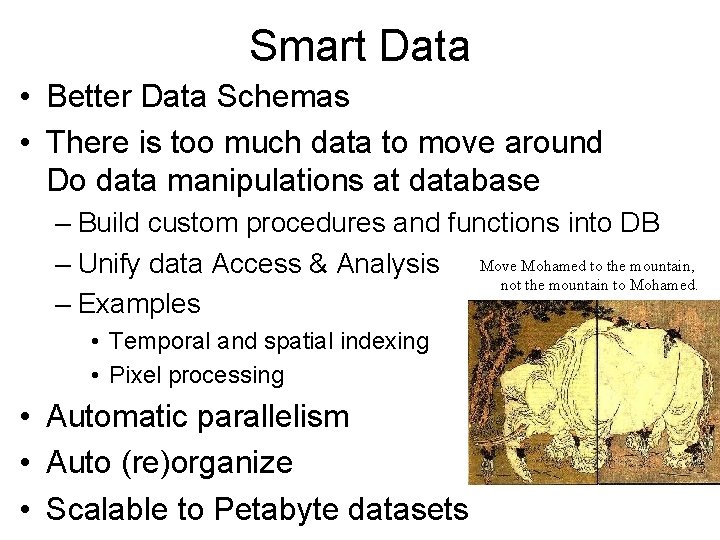
Smart Data • Better Data Schemas • There is too much data to move around Do data manipulations at database – Build custom procedures and functions into DB – Unify data Access & Analysis Move Mohamed to the mountain, not the mountain to Mohamed. – Examples • Temporal and spatial indexing • Pixel processing • Automatic parallelism • Auto (re)organize • Scalable to Petabyte datasets
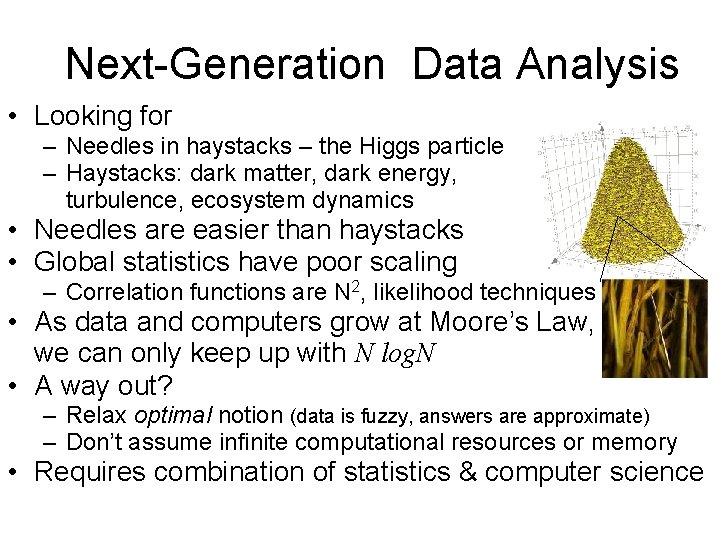
Next-Generation Data Analysis • Looking for – Needles in haystacks – the Higgs particle – Haystacks: dark matter, dark energy, turbulence, ecosystem dynamics • Needles are easier than haystacks • Global statistics have poor scaling – Correlation functions are N 2, likelihood techniques N 3 • As data and computers grow at Moore’s Law, we can only keep up with N log. N • A way out? – Relax optimal notion (data is fuzzy, answers are approximate) – Don’t assume infinite computational resources or memory • Requires combination of statistics & computer science
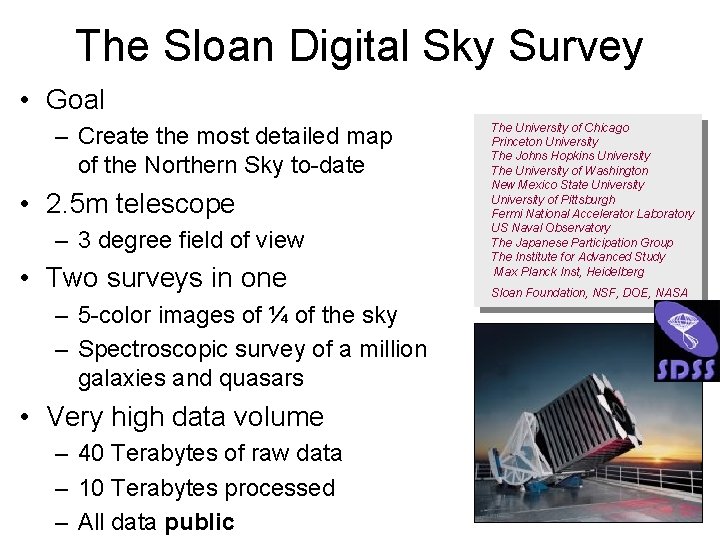
The Sloan Digital Sky Survey • Goal – Create the most detailed map of the Northern Sky to-date • 2. 5 m telescope – 3 degree field of view • Two surveys in one – 5 -color images of ¼ of the sky – Spectroscopic survey of a million galaxies and quasars • Very high data volume – 40 Terabytes of raw data – 10 Terabytes processed – All data public The University of Chicago Princeton University The Johns Hopkins University The University of Washington New Mexico State University of Pittsburgh Fermi National Accelerator Laboratory US Naval Observatory The Japanese Participation Group The Institute for Advanced Study Max Planck Inst, Heidelberg Sloan Foundation, NSF, DOE, NASA
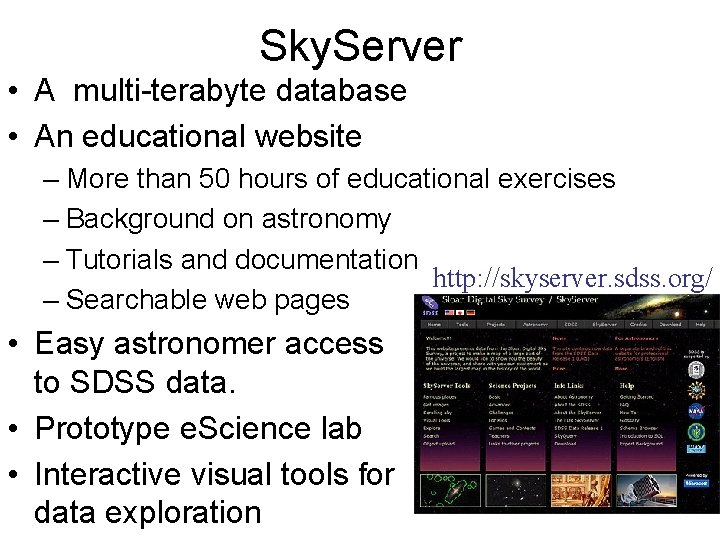
Sky. Server • A multi-terabyte database • An educational website – More than 50 hours of educational exercises – Background on astronomy – Tutorials and documentation http: //skyserver. sdss. org/ – Searchable web pages • Easy astronomer access to SDSS data. • Prototype e. Science lab • Interactive visual tools for data exploration
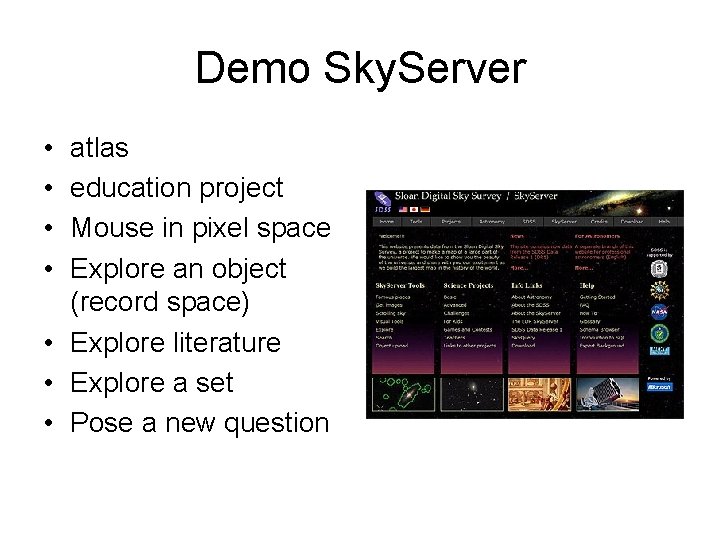
Demo Sky. Server • • atlas education project Mouse in pixel space Explore an object (record space) • Explore literature • Explore a set • Pose a new question
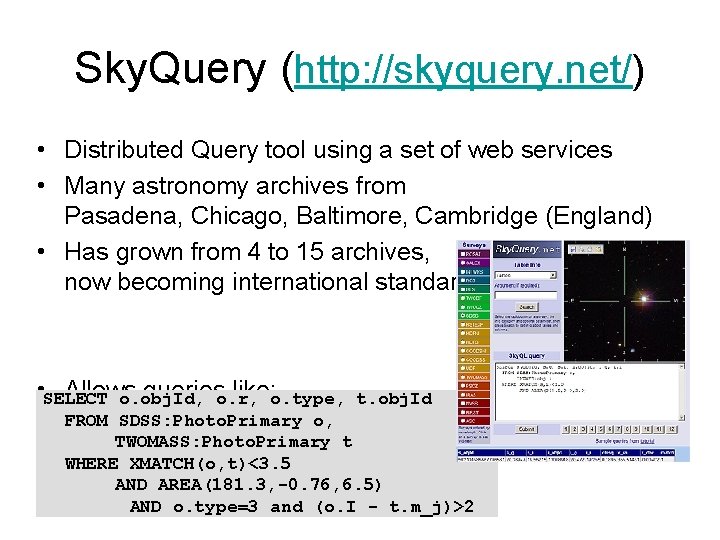
Sky. Query (http: //skyquery. net/) • Distributed Query tool using a set of web services • Many astronomy archives from Pasadena, Chicago, Baltimore, Cambridge (England) • Has grown from 4 to 15 archives, now becoming international standard • SELECT Allows querieso. r, like: o. type, o. obj. Id, t. obj. Id FROM SDSS: Photo. Primary o, TWOMASS: Photo. Primary t WHERE XMATCH(o, t)<3. 5 AND AREA(181. 3, -0. 76, 6. 5) AND o. type=3 and (o. I - t. m_j)>2
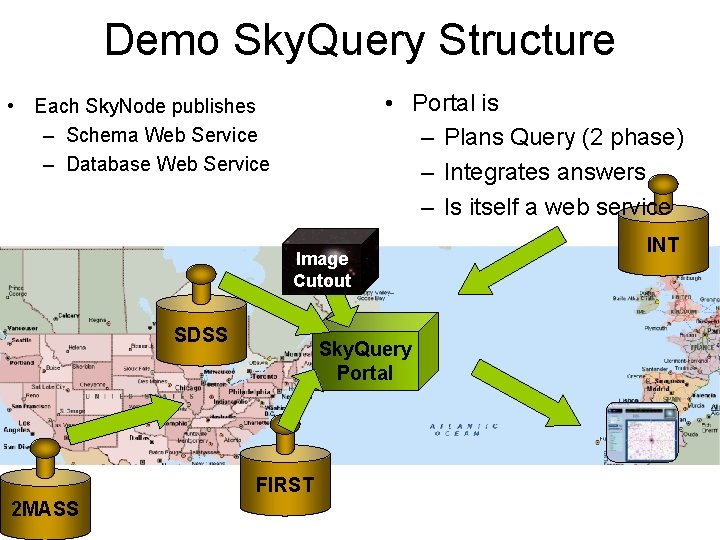
Demo Sky. Query Structure • Portal is – Plans Query (2 phase) – Integrates answers – Is itself a web service • Each Sky. Node publishes – Schema Web Service – Database Web Service Image Cutout SDSS Sky. Query Portal FIRST 2 MASS INT
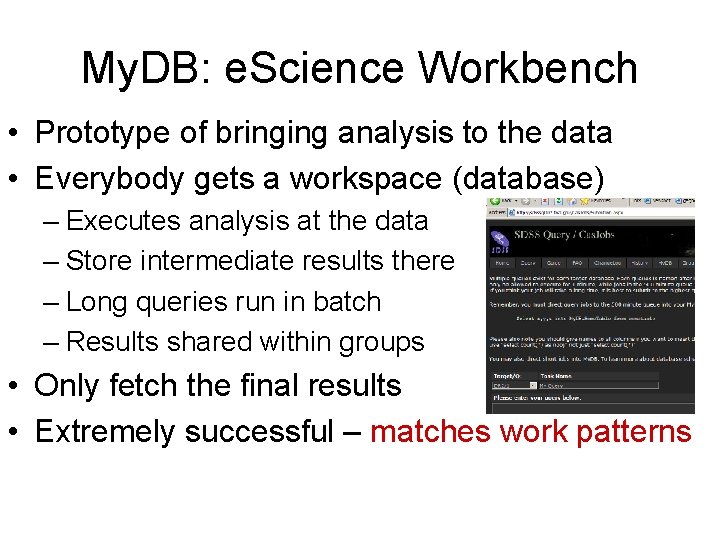
My. DB: e. Science Workbench • Prototype of bringing analysis to the data • Everybody gets a workspace (database) – Executes analysis at the data – Store intermediate results there – Long queries run in batch – Results shared within groups • Only fetch the final results • Extremely successful – matches work patterns
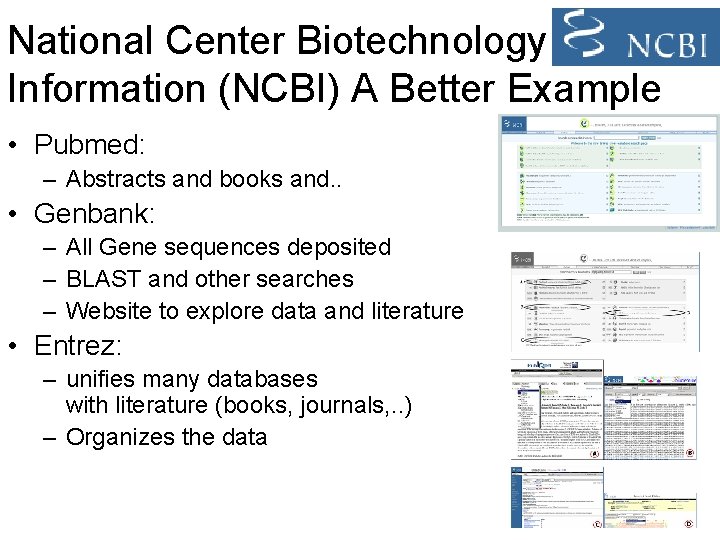
National Center Biotechnology Information (NCBI) A Better Example • Pubmed: – Abstracts and books and. . • Genbank: – All Gene sequences deposited – BLAST and other searches – Website to explore data and literature • Entrez: – unifies many databases with literature (books, journals, . . ) – Organizes the data
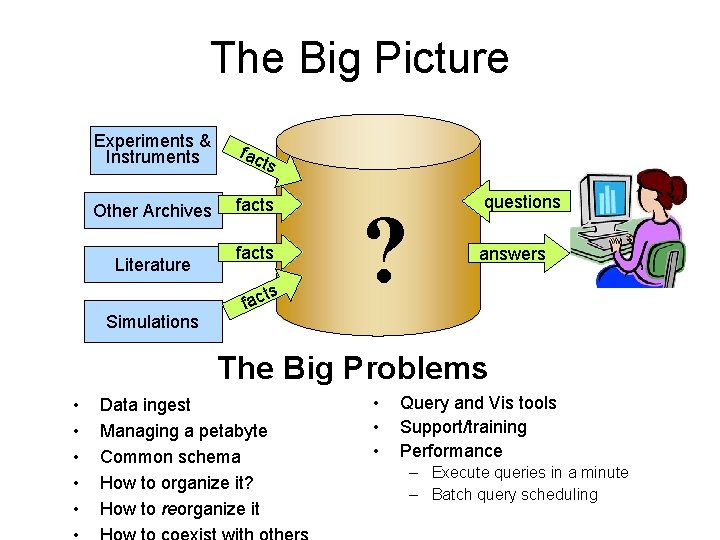
The Big Picture Experiments & Instruments fac Other Archives facts Literature ts facts ts Simulations fac ? questions answers The Big Problems • • • Data ingest Managing a petabyte Common schema How to organize it? How to reorganize it • • • Query and Vis tools Support/training Performance – Execute queries in a minute – Batch query scheduling
The Talk • Libraries morphing to integrated text + data (you know that) • Dublin Core is bedrock, but many issues remain. (you know that) • WWT: All Astronomy data and literature online and integrated • Problems Librarians have grappled with for centuries: curation, preservation, indexing, access, summarization. 1. Overview of the World-Wide Telescope as a digital library 2. Focus on metadata, schema, curation, and preservation. . • Candidly, we have more problems than solutions, but the data is arriving and we are doing the best we can.
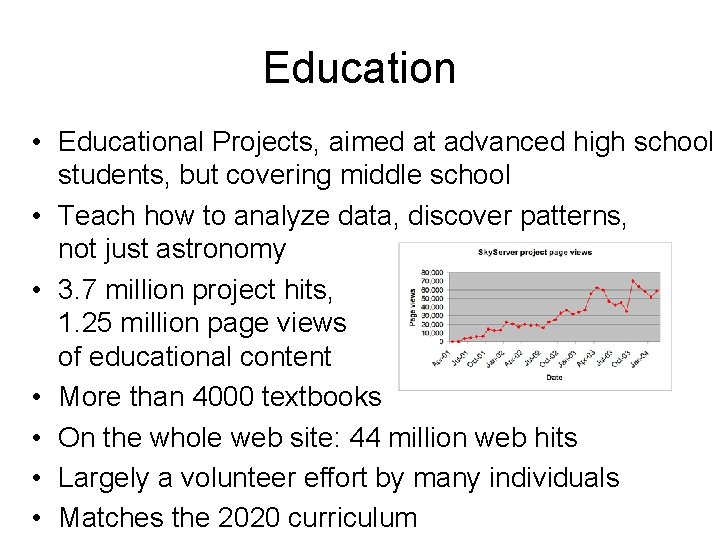
Education • Educational Projects, aimed at advanced high school students, but covering middle school • Teach how to analyze data, discover patterns, not just astronomy • 3. 7 million project hits, 1. 25 million page views of educational content • More than 4000 textbooks • On the whole web site: 44 million web hits • Largely a volunteer effort by many individuals • Matches the 2020 curriculum
- Slides: 32