
The World of Innovative Management 2017 Cengage Learning
- Slides: 50
The World of Innovative Management © 2017 Cengage Learning®. May not be scanned, copied or duplicated, or posted to a publicly accessible website, in whole or in part.
Innovation is the new imperative v Organizations cannot survive long term without innovation v Companies like Facebook are always investing in new ideas v Innovation should be a part of products, processes, people, and values v © 2017 Cengage Learning®. May not be scanned, copied or duplicated, or posted to a publicly accessible website, in whole or in part. 2
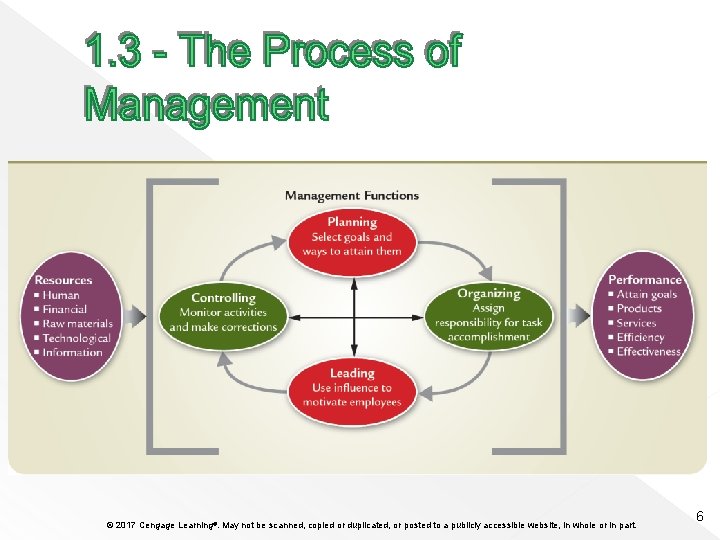
v Management is the attainment of organizational goals in an effective and efficient manner through planning, organizing, leading, and controlling organizational resources v. Managers get things done through the organization v. Create right systems and environment v. Organizations need good managers © 2017 Cengage Learning®. May not be scanned, copied or duplicated, or posted to a publicly accessible website, in whole or in part. 3
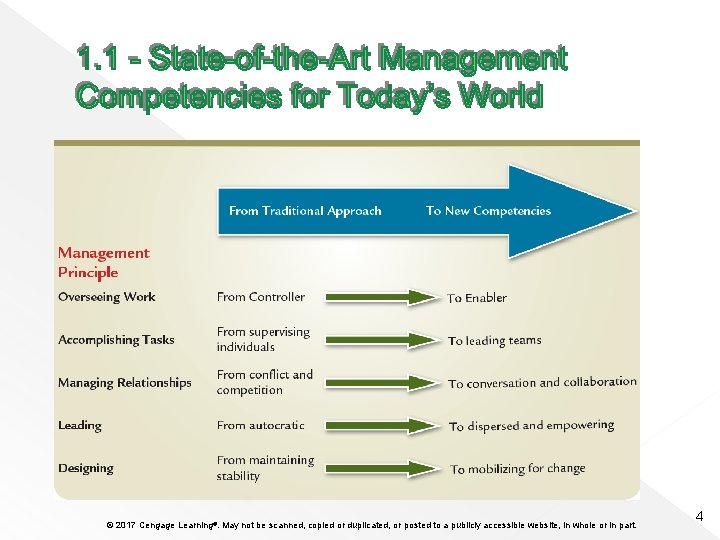
© 2017 Cengage Learning®. May not be scanned, copied or duplicated, or posted to a publicly accessible website, in whole or in part. 4
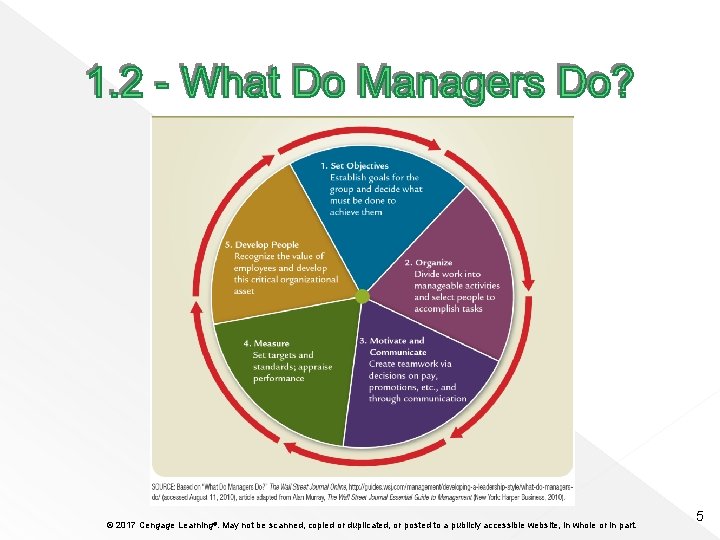
© 2017 Cengage Learning®. May not be scanned, copied or duplicated, or posted to a publicly accessible website, in whole or in part. 5
© 2017 Cengage Learning®. May not be scanned, copied or duplicated, or posted to a publicly accessible website, in whole or in part. 6
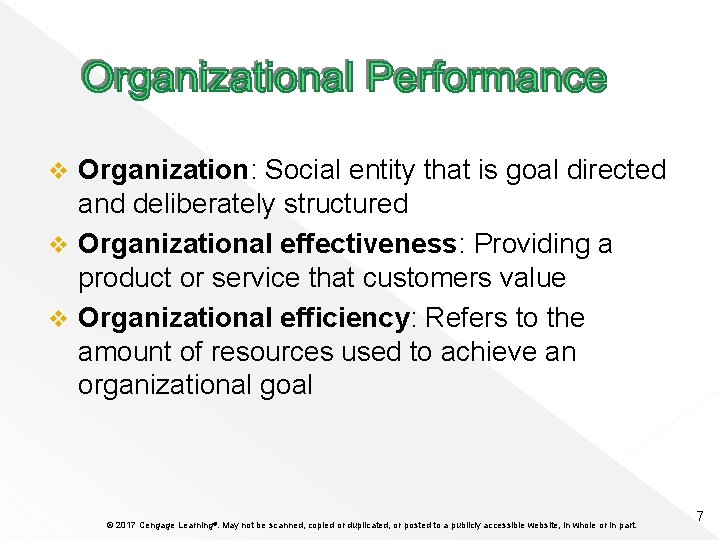
Organization: Social entity that is goal directed and deliberately structured v Organizational effectiveness: Providing a product or service that customers value v Organizational efficiency: Refers to the amount of resources used to achieve an organizational goal v © 2017 Cengage Learning®. May not be scanned, copied or duplicated, or posted to a publicly accessible website, in whole or in part. 7
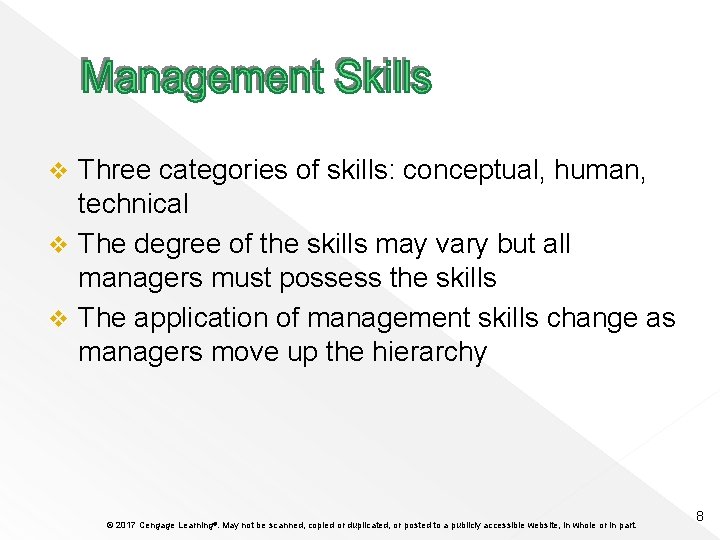
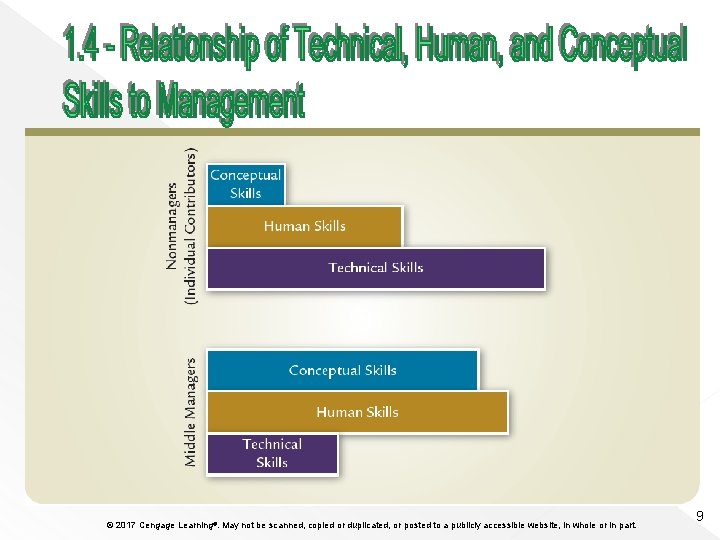
Three categories of skills: conceptual, human, technical v The degree of the skills may vary but all managers must possess the skills v The application of management skills change as managers move up the hierarchy v © 2017 Cengage Learning®. May not be scanned, copied or duplicated, or posted to a publicly accessible website, in whole or in part. 8
© 2017 Cengage Learning®. May not be scanned, copied or duplicated, or posted to a publicly accessible website, in whole or in part. 9
© 2017 Cengage Learning®. May not be scanned, copied or duplicated, or posted to a publicly accessible website, in whole or in part. 10
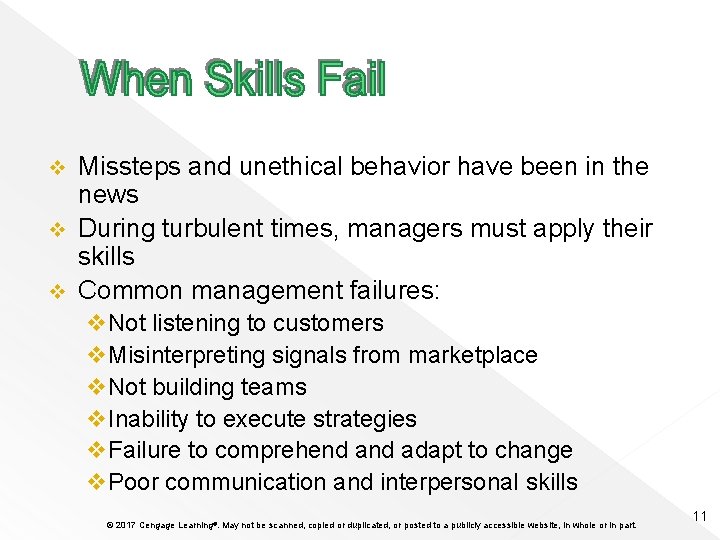
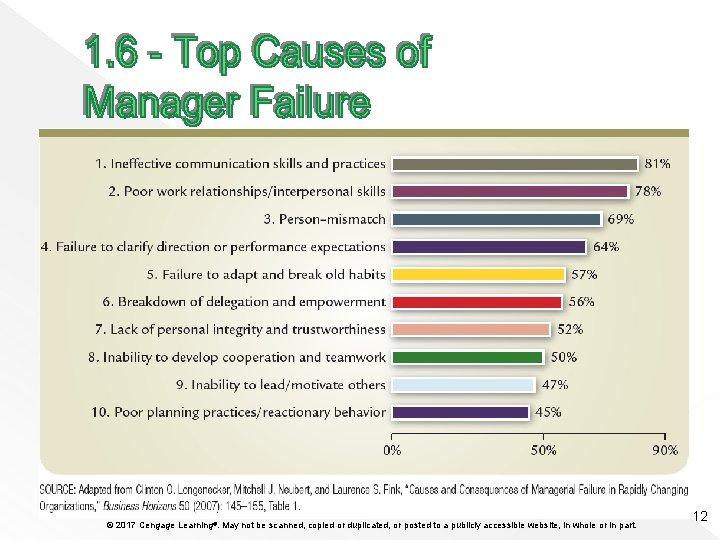
Missteps and unethical behavior have been in the news v During turbulent times, managers must apply their skills v Common management failures: v v Not listening to customers v Misinterpreting signals from marketplace v Not building teams v Inability to execute strategies v Failure to comprehend adapt to change v Poor communication and interpersonal skills © 2017 Cengage Learning®. May not be scanned, copied or duplicated, or posted to a publicly accessible website, in whole or in part. 11
© 2017 Cengage Learning®. May not be scanned, copied or duplicated, or posted to a publicly accessible website, in whole or in part. 12
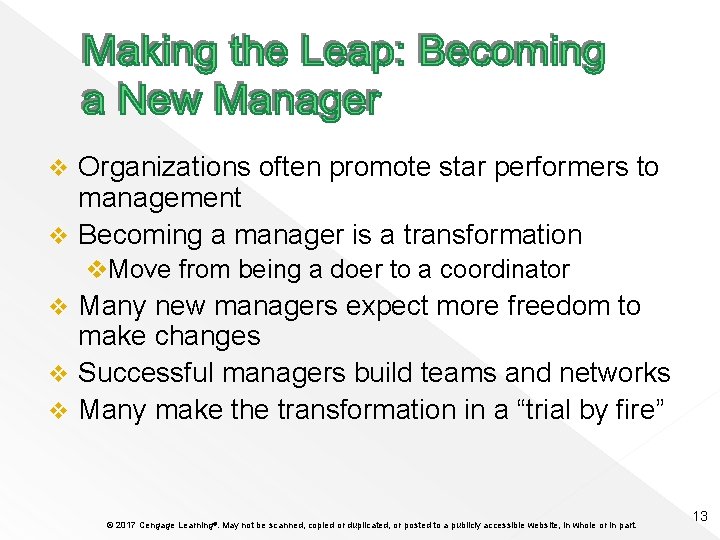
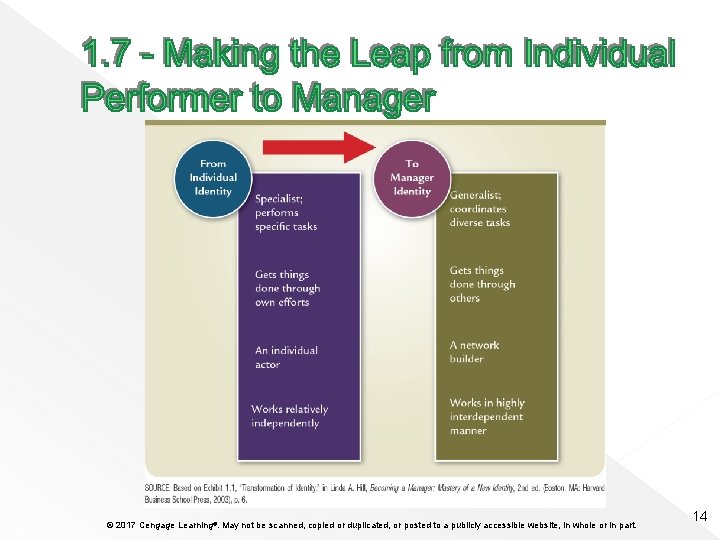
Organizations often promote star performers to management v Becoming a manager is a transformation v v. Move from being a doer to a coordinator Many new managers expect more freedom to make changes v Successful managers build teams and networks v Many make the transformation in a “trial by fire” v © 2017 Cengage Learning®. May not be scanned, copied or duplicated, or posted to a publicly accessible website, in whole or in part. 13
© 2017 Cengage Learning®. May not be scanned, copied or duplicated, or posted to a publicly accessible website, in whole or in part. 14
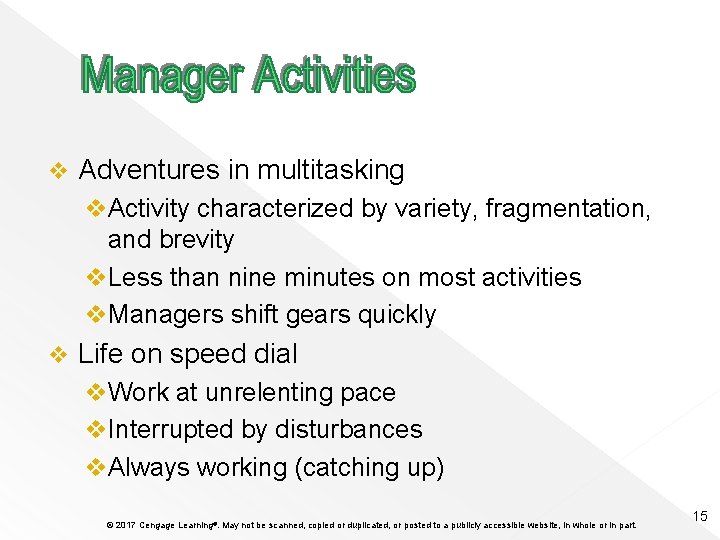
v Adventures in multitasking v. Activity characterized by variety, fragmentation, and brevity v. Less than nine minutes on most activities v. Managers shift gears quickly v Life on speed dial v. Work at unrelenting pace v. Interrupted by disturbances v. Always working (catching up) © 2017 Cengage Learning®. May not be scanned, copied or duplicated, or posted to a publicly accessible website, in whole or in part. 15
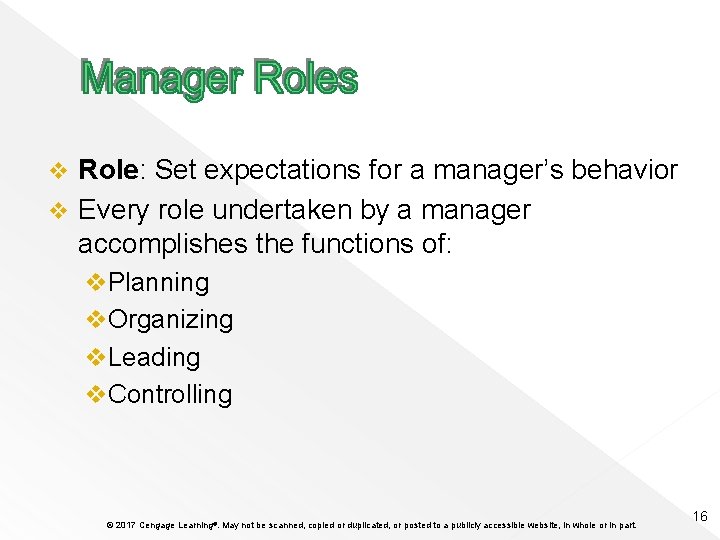
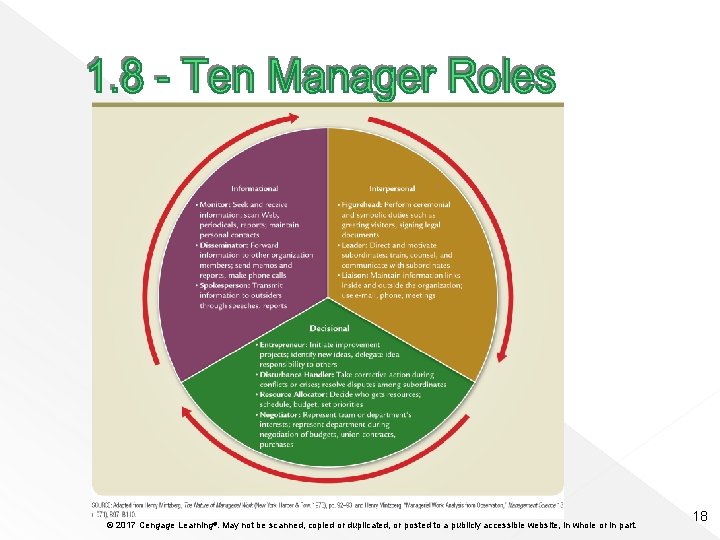
Role: Set expectations for a manager’s behavior v Every role undertaken by a manager accomplishes the functions of: v v. Planning v. Organizing v. Leading v. Controlling © 2017 Cengage Learning®. May not be scanned, copied or duplicated, or posted to a publicly accessible website, in whole or in part. 16
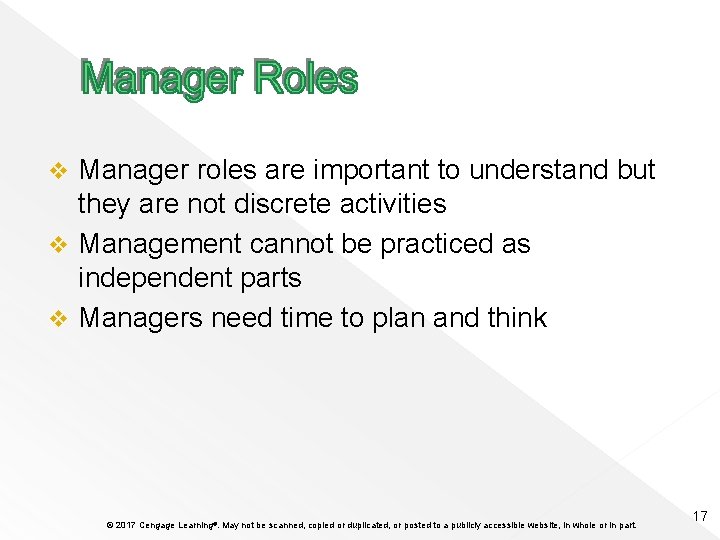
Manager roles are important to understand but they are not discrete activities v Management cannot be practiced as independent parts v Managers need time to plan and think v © 2017 Cengage Learning®. May not be scanned, copied or duplicated, or posted to a publicly accessible website, in whole or in part. 17
© 2017 Cengage Learning®. May not be scanned, copied or duplicated, or posted to a publicly accessible website, in whole or in part. 18
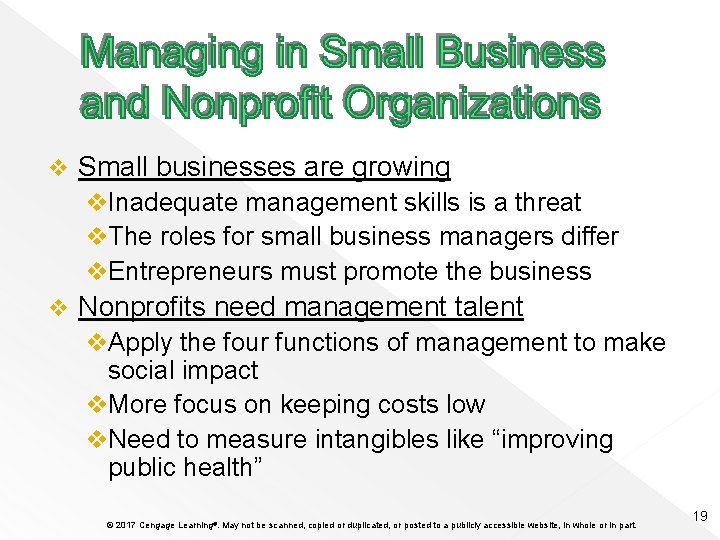
v Small businesses are growing v. Inadequate management skills is a threat v. The roles for small business managers differ v. Entrepreneurs must promote the business v Nonprofits need management talent v. Apply the four functions of management to make social impact v. More focus on keeping costs low v. Need to measure intangibles like “improving public health” © 2017 Cengage Learning®. May not be scanned, copied or duplicated, or posted to a publicly accessible website, in whole or in part. 19
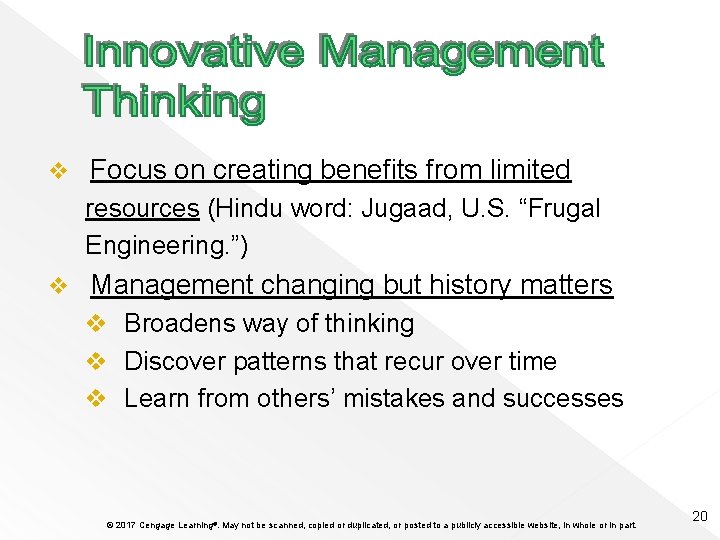
v Focus on creating benefits from limited resources (Hindu word: Jugaad, U. S. “Frugal Engineering. ”) v Management changing but history matters v Broadens way of thinking v Discover patterns that recur over time v Learn from others’ mistakes and successes © 2017 Cengage Learning®. May not be scanned, copied or duplicated, or posted to a publicly accessible website, in whole or in part. 20
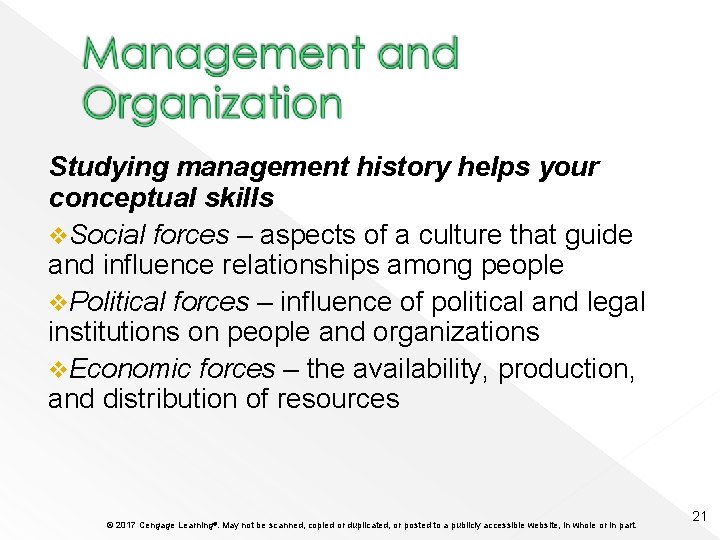
Studying management history helps your conceptual skills v. Social forces – aspects of a culture that guide and influence relationships among people v. Political forces – influence of political and legal institutions on people and organizations v. Economic forces – the availability, production, and distribution of resources © 2017 Cengage Learning®. May not be scanned, copied or duplicated, or posted to a publicly accessible website, in whole or in part. 21
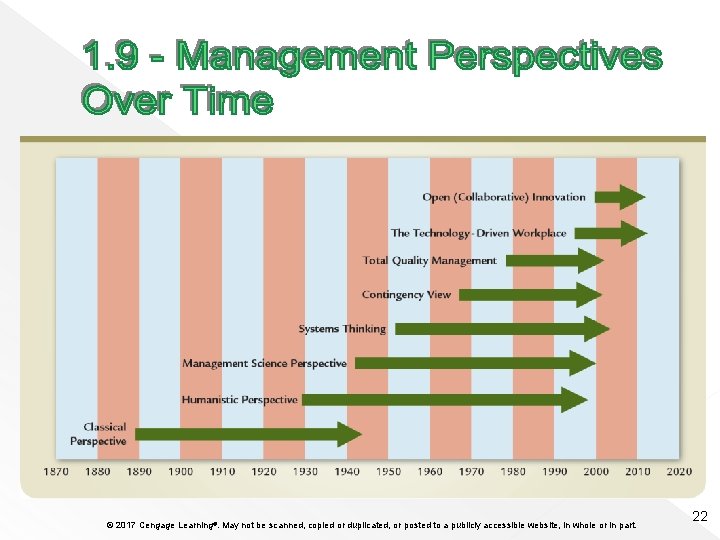
© 2017 Cengage Learning®. May not be scanned, copied or duplicated, or posted to a publicly accessible website, in whole or in part. 22
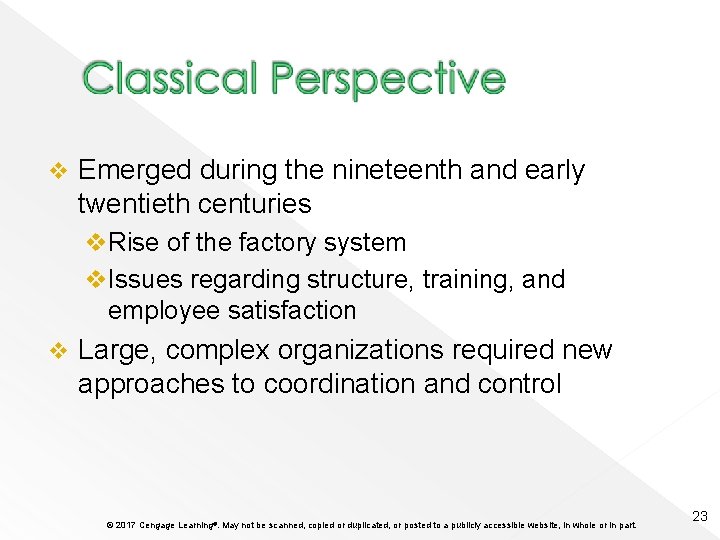
v Emerged during the nineteenth and early twentieth centuries v. Rise of the factory system v. Issues regarding structure, training, and employee satisfaction v Large, complex organizations required new approaches to coordination and control © 2017 Cengage Learning®. May not be scanned, copied or duplicated, or posted to a publicly accessible website, in whole or in part. 23
v Three subfields: v. Scientific management v. Bureaucratic organizations v. Administrative principles © 2017 Cengage Learning®. May not be scanned, copied or duplicated, or posted to a publicly accessible website, in whole or in part. 24
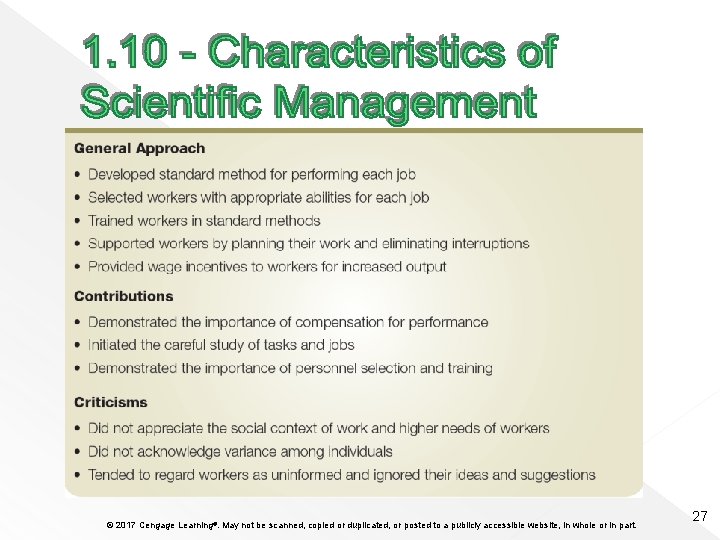
Improve efficiency and labor productivity through scientific methods v Frederick Winslow Taylor proposed that workers “could be retooled like machines” v Management decisions would be based on precise procedures based on study v © 2017 Cengage Learning®. May not be scanned, copied or duplicated, or posted to a publicly accessible website, in whole or in part. 25
Henry Gantt developed the Gantt chart to measure and plan work v The Gilbreths pioneered time and motion studies to promote efficiency v © 2017 Cengage Learning®. May not be scanned, copied or duplicated, or posted to a publicly accessible website, in whole or in part. 26
© 2017 Cengage Learning®. May not be scanned, copied or duplicated, or posted to a publicly accessible website, in whole or in part. 27
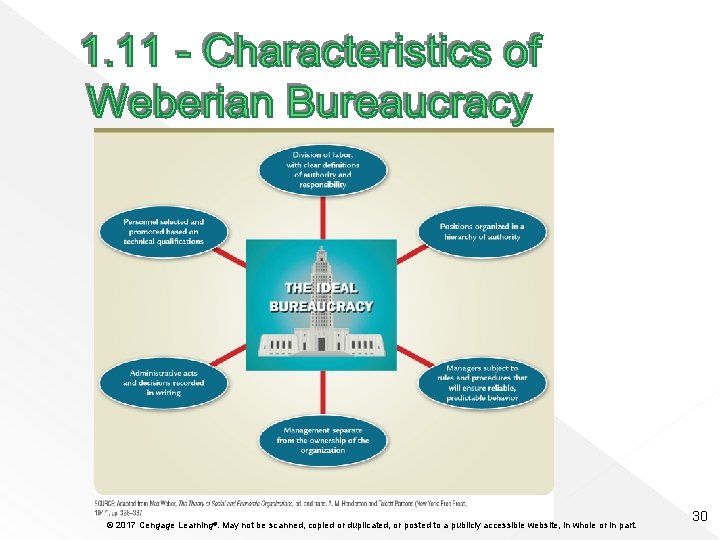
v Max Weber, a German theorist, introduced the concepts v Manage organizations on impersonal, rational basis v Organization depends on rules and records © 2017 Cengage Learning®. May not be scanned, copied or duplicated, or posted to a publicly accessible website, in whole or in part. 28
v Managers use power instead of personality to delegate Although important productivity gains come from this foundation, bureaucracy has taken on a negative tone © 2017 Cengage Learning®. May not be scanned, copied or duplicated, or posted to a publicly accessible website, in whole or in part. 29
© 2017 Cengage Learning®. May not be scanned, copied or duplicated, or posted to a publicly accessible website, in whole or in part. 30
Focused on the entire organization v Henri Fayol, a French mining engineer, was a major contributor v 14 general principles of management; many still used today: v v. Unity of command v. Division of work v. Unity of direction v. Scalar chain © 2017 Cengage Learning®. May not be scanned, copied or duplicated, or posted to a publicly accessible website, in whole or in part. 31
v Identified five functions of management: v. Planning v. Organizing v. Commanding v. Coordinating v. Controlling © 2017 Cengage Learning®. May not be scanned, copied or duplicated, or posted to a publicly accessible website, in whole or in part. 32
Understand human behaviors, needs, and attitudes in the workplace v Mary Parker Follett and Chester Barnard v Contrast to scientific management - Importance of people rather than engineering techniques v © 2017 Cengage Learning®. May not be scanned, copied or duplicated, or posted to a publicly accessible website, in whole or in part. 33
Empowerment: facilitating instead of controlling v Recognition of the informal organization v Introduced acceptance theory of authority v © 2017 Cengage Learning®. May not be scanned, copied or duplicated, or posted to a publicly accessible website, in whole or in part. 34
v v v Effective control comes from within the employee Hawthorne studies were key contributor Human relations played key variable in increasing performance Employees performed better when managers treated them positively Strongly shaped management practice and research © 2017 Cengage Learning®. May not be scanned, copied or duplicated, or posted to a publicly accessible website, in whole or in part. 35
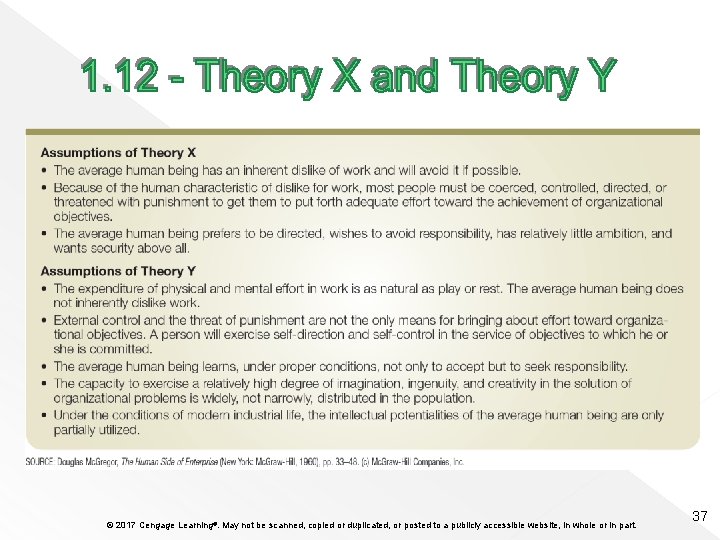
From worker participation and considerate leadership to managing work performance v Combine motivation with job design v Maslow and Mc. Gregor extended and challenged current theories v v. Maslow’s Hierarchy v. Theory X and Theory Y © 2017 Cengage Learning®. May not be scanned, copied or duplicated, or posted to a publicly accessible website, in whole or in part. 36
© 2017 Cengage Learning®. May not be scanned, copied or duplicated, or posted to a publicly accessible website, in whole or in part. 37
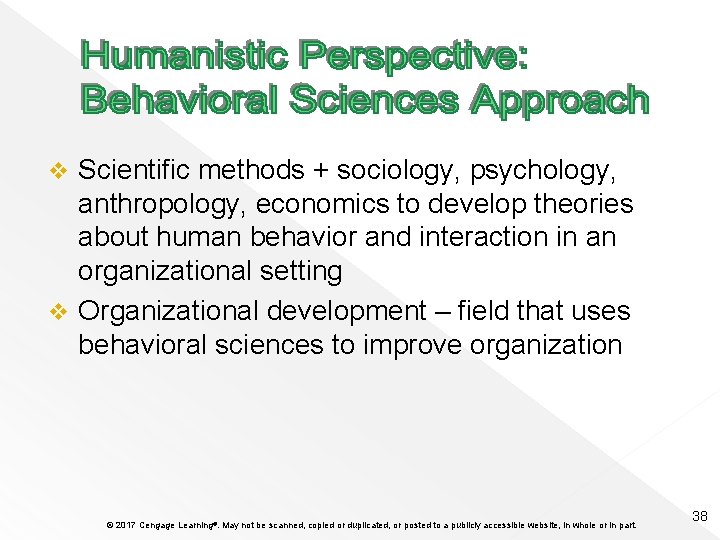
Scientific methods + sociology, psychology, anthropology, economics to develop theories about human behavior and interaction in an organizational setting v Organizational development – field that uses behavioral sciences to improve organization v © 2017 Cengage Learning®. May not be scanned, copied or duplicated, or posted to a publicly accessible website, in whole or in part. 38
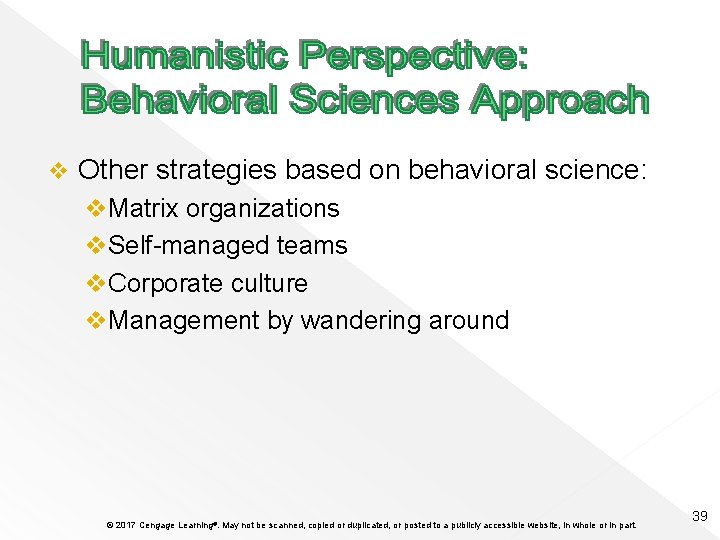
v Other strategies based on behavioral science: v. Matrix organizations v. Self-managed teams v. Corporate culture v. Management by wandering around © 2017 Cengage Learning®. May not be scanned, copied or duplicated, or posted to a publicly accessible website, in whole or in part. 39
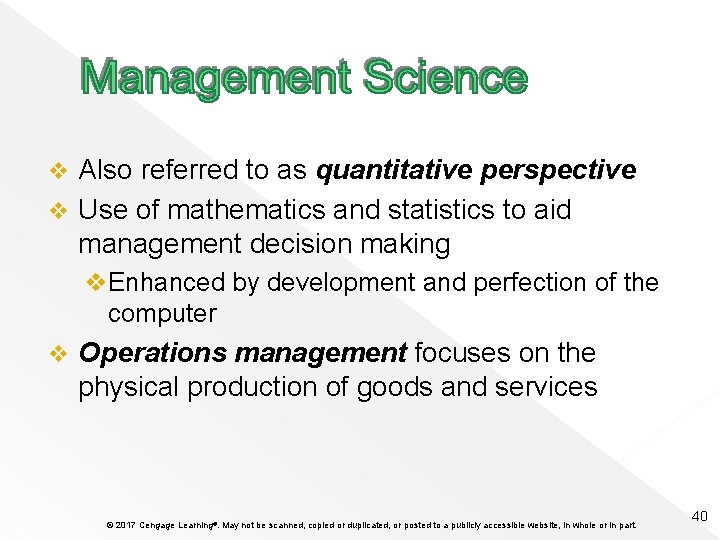
Also referred to as quantitative perspective v Use of mathematics and statistics to aid management decision making v v. Enhanced by development and perfection of the computer v Operations management focuses on the physical production of goods and services © 2017 Cengage Learning®. May not be scanned, copied or duplicated, or posted to a publicly accessible website, in whole or in part. 40
Information technology – focuses on technology and software to aid managers v Quants – financial managers who base their decisions on complex quantitative analysis v © 2017 Cengage Learning®. May not be scanned, copied or duplicated, or posted to a publicly accessible website, in whole or in part. 41
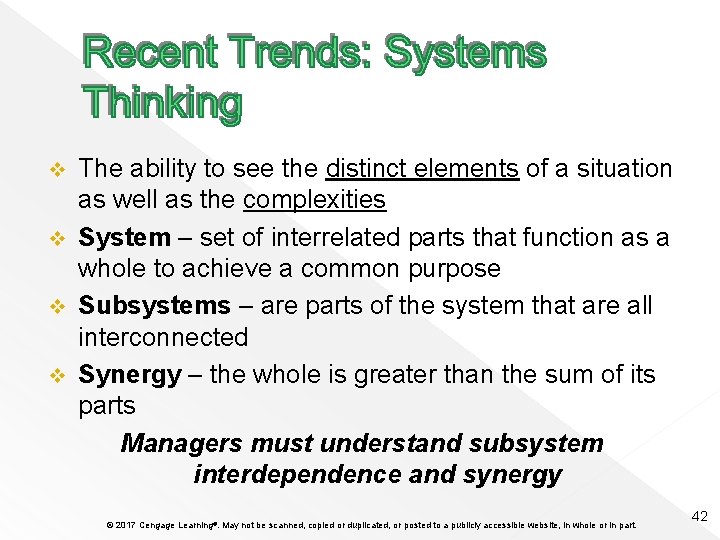
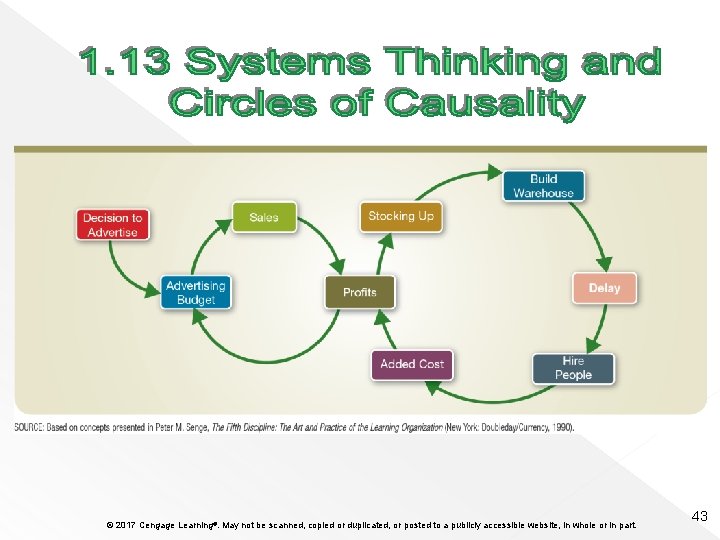
The ability to see the distinct elements of a situation as well as the complexities v System – set of interrelated parts that function as a whole to achieve a common purpose v Subsystems – are parts of the system that are all interconnected v Synergy – the whole is greater than the sum of its parts Managers must understand subsystem interdependence and synergy v © 2017 Cengage Learning®. May not be scanned, copied or duplicated, or posted to a publicly accessible website, in whole or in part. 42
© 2017 Cengage Learning®. May not be scanned, copied or duplicated, or posted to a publicly accessible website, in whole or in part. 43
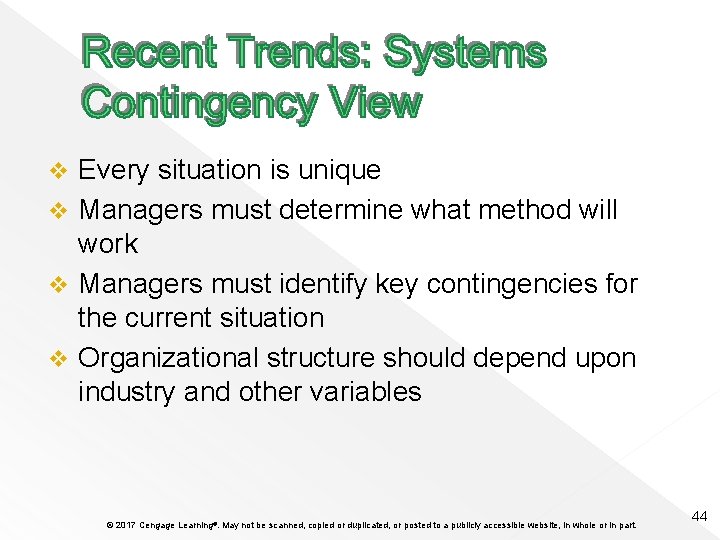
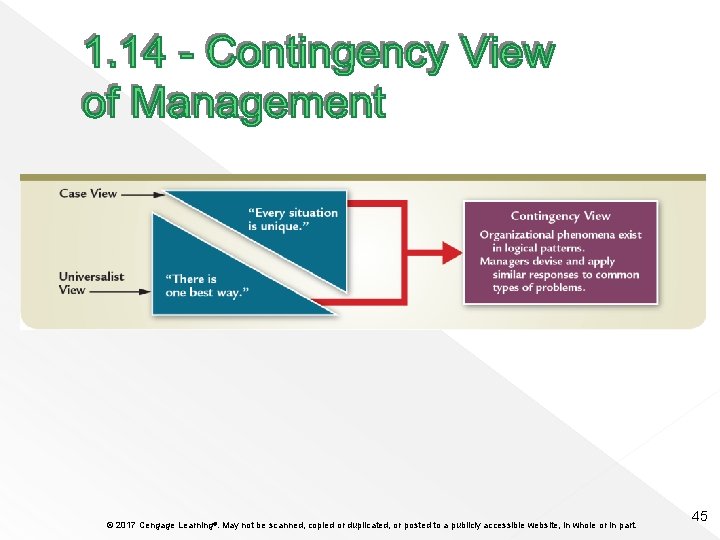
Every situation is unique v Managers must determine what method will work v Managers must identify key contingencies for the current situation v Organizational structure should depend upon industry and other variables v © 2017 Cengage Learning®. May not be scanned, copied or duplicated, or posted to a publicly accessible website, in whole or in part. 44
© 2017 Cengage Learning®. May not be scanned, copied or duplicated, or posted to a publicly accessible website, in whole or in part. 45
v Quality movement is strongly associated with Japan v The U. S. ignored the ideas of W. Edwards Deming, “Father of the Quality Movement” v Total Quality Management (TQM) became popular in the 1980 s and 1990 s v Integrate high-quality values in every activity © 2017 Cengage Learning®. May not be scanned, copied or duplicated, or posted to a publicly accessible website, in whole or in part. 46
Employee involvement Focus on the customer Benchmarking Continuous improvement © 2017 Cengage Learning®. May not be scanned, copied or duplicated, or posted to a publicly accessible website, in whole or in part. 47
v Management ideas trace their roots to historical perspectives v New ideas continue to emerge to meet the changing needs and difficult times v The shelf life of trends is getting shorter and new ideas peak in fewer than three years © 2017 Cengage Learning®. May not be scanned, copied or duplicated, or posted to a publicly accessible website, in whole or in part. 48
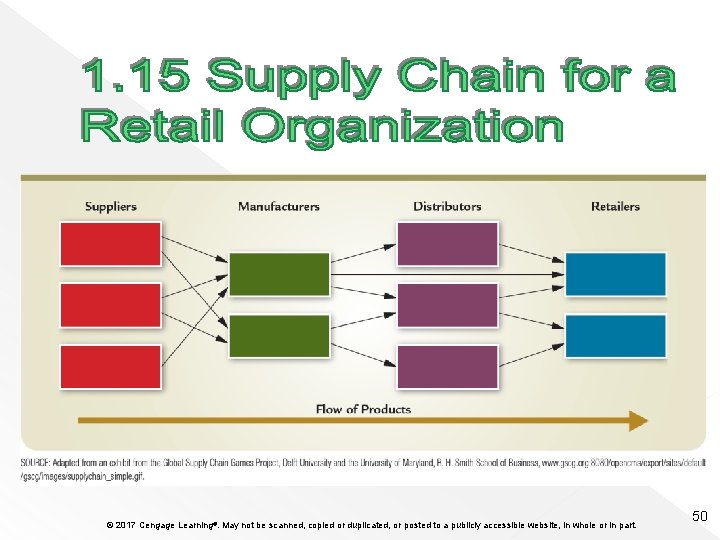
Social media programs – Company online community pages, social media sites, microblogging platforms, and online forums v Customer relationship management – technology used to build relationships with customers v Outsourcing – contracting functions or activities to other organizations to cut costs v Supply chain management – managing supplier and purchaser relationships to get goods to consumers v © 2017 Cengage Learning®. May not be scanned, copied or duplicated, or posted to a publicly accessible website, in whole or in part. 49
© 2017 Cengage Learning®. May not be scanned, copied or duplicated, or posted to a publicly accessible website, in whole or in part. 50