
The Working Capital Fund Budget Process Learning Objectives
The Working Capital Fund Budget Process
Learning Objectives 1) Learn the history of Working Capital Fund activities ü Understand the seller-buyer relationship ü Understand the role of Congress 2) Understand the basic definitions of outputs and workcounts ü Workcounts as a unit of sale 3) Understand the basic concepts of funding, costs, revenue, and operating results ü Cost authority ü Net Operating Results and the break even concept 4) Understand the types of expenses and important expense elements ü Direct, indirect, general & administrative 5) Understand billing rates and how they impact operations ü Stabilized billing rates ü Billing rate development 6) Understand the budget cycle 2
Working Capital Fund (DWCF) History » Section 2208 of Title 10 grants Secretary of Defense authority to establish a variety of working capital funds » Defense Management Reform Directive (DMRD) 910 of 1991 ü Moved the responsibility for finance & accounting activities across the Do. D to DFAS as part of the Defense Business Operations Fund (DBOF) ü In 1997 the DBOF was split into 5 Defense Working Capital Funds § DFAS is 1 of 6 DWCFs within the Defense-Wide Working Capital Fund (DWWCF) » Defense Working Capital Fund (DWCF) – allows certain activities, including DFAS, to account for costs & revenue in the same manner as commercial businesses » DFAS Customers: Army, Air Force, Navy, Marines, Other Defense Agencies, Other Federal Agencies 3
A Defense Working Capital Fund (DWCF) » A DWCF receives no direct or appropriated funding from Congress for daily operations » A DWCF is a reimbursable operations fund that sells goods and services to the Do. D and other users at prices (billing rates) necessary to recover all material and operating expenses (full-cost-recovery principle) » A DWCF is a type of revolving fund (without fiscal year limitations) with a zero-profit goal - actual revenue should equal actual costs over the long run » Other examples of DWCF’s are: ü Defense Information System Agency (DISA): Provides information services across the Do. D ü Defense Automated Printing Service (DAPS): Do. D printing, duplicating, and document automation ü Defense Logistics Energy Management: Provides comprehensive worldwide energy support for the military services Time / Accounting System DFAS Budget DWCF’s must have an accurate time and accounting system to determine the costs of producing products for each customer – leads to accurate billing rates The agency’s Congress-approved budget does not provide actual dollars, it is for cost and reimbursable authority – the authority to incur cost and bill our customers to recoup those costs 4
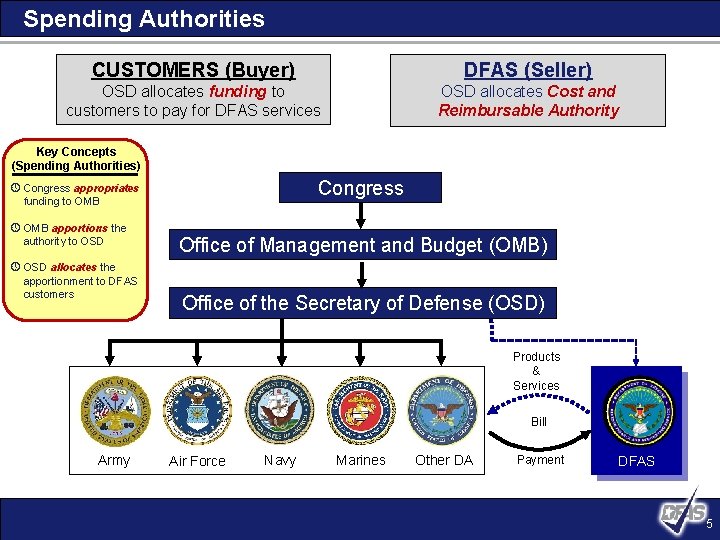
Spending Authorities CUSTOMERS (Buyer) DFAS (Seller) OSD allocates funding to customers to pay for DFAS services OSD allocates Cost and Reimbursable Authority Key Concepts (Spending Authorities) Congress » Congress appropriates funding to OMB » OMB apportions the authority to OSD » OSD allocates the apportionment to DFAS customers Office of Management and Budget (OMB) Office of the Secretary of Defense (OSD) Products & Services Bill Army Air Force Navy Marines Other DA Payment DFAS 5

DFAS Products and Services - Outputs are types of products and services provided by DFAS » Primarily grouped into mission area suites by functionality » Every output is assigned a unique number for tracking Mission Area Suites with Output Examples & Number Codes 6
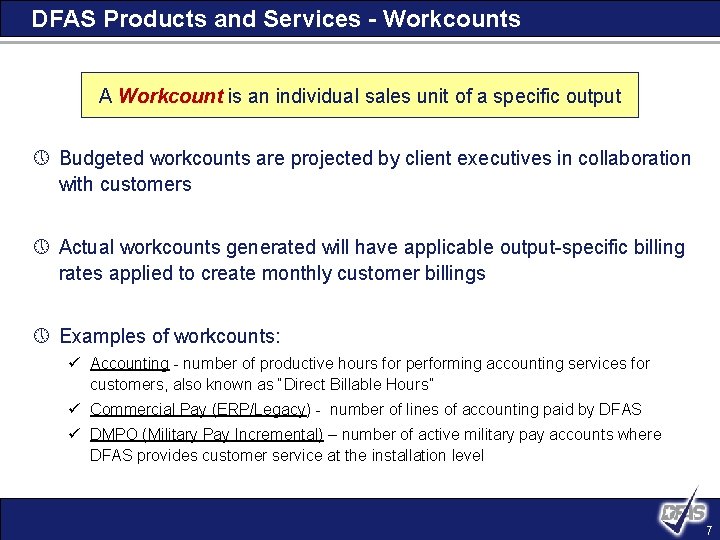
DFAS Products and Services - Workcounts A Workcount is an individual sales unit of a specific output » Budgeted workcounts are projected by client executives in collaboration with customers » Actual workcounts generated will have applicable output-specific billing rates applied to create monthly customer billings » Examples of workcounts: ü Accounting - number of productive hours for performing accounting services for customers, also known as “Direct Billable Hours” ü Commercial Pay (ERP/Legacy) - number of lines of accounting paid by DFAS ü DMPO (Military Pay Incremental) – number of active military pay accounts where DFAS provides customer service at the installation level 7
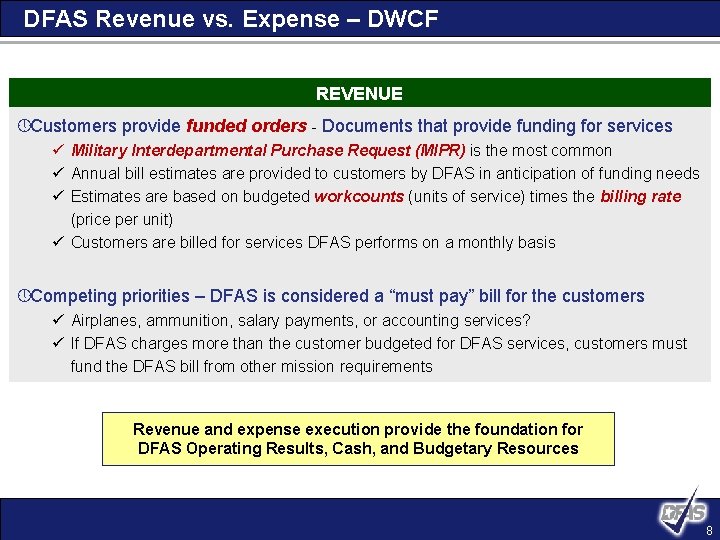
DFAS Revenue vs. Expense – DWCF REVENUE » Customers provide funded orders - Documents that provide funding for services ü Military Interdepartmental Purchase Request (MIPR) is the most common ü Annual bill estimates are provided to customers by DFAS in anticipation of funding needs ü Estimates are based on budgeted workcounts (units of service) times the billing rate (price per unit) ü Customers are billed for services DFAS performs on a monthly basis » Competing priorities – DFAS is considered a “must pay” bill for the customers ü Airplanes, ammunition, salary payments, or accounting services? ü If DFAS charges more than the customer budgeted for DFAS services, customers must fund the DFAS bill from other mission requirements Revenue and expense execution provide the foundation for DFAS Operating Results, Cash, and Budgetary Resources 8
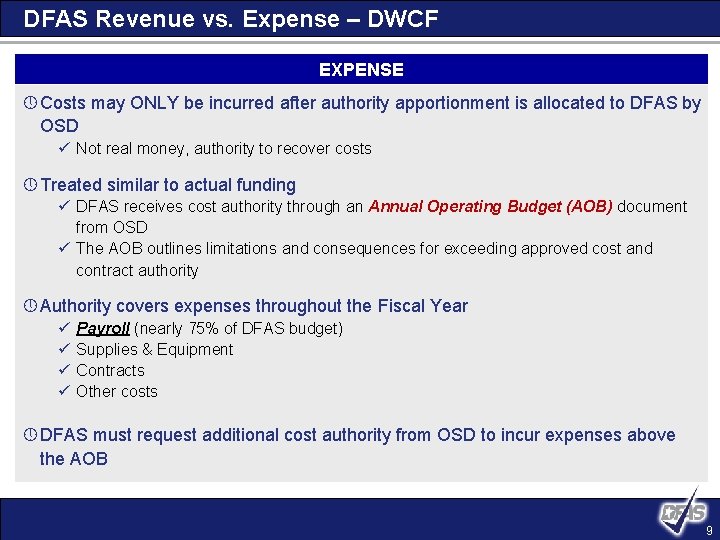
DFAS Revenue vs. Expense – DWCF EXPENSE » Costs may ONLY be incurred after authority apportionment is allocated to DFAS by OSD ü Not real money, authority to recover costs » Treated similar to actual funding ü DFAS receives cost authority through an Annual Operating Budget (AOB) document from OSD ü The AOB outlines limitations and consequences for exceeding approved cost and contract authority » Authority covers expenses throughout the Fiscal Year ü ü Payroll (nearly 75% of DFAS budget) Supplies & Equipment Contracts Other costs » DFAS must request additional cost authority from OSD to incur expenses above the AOB 9
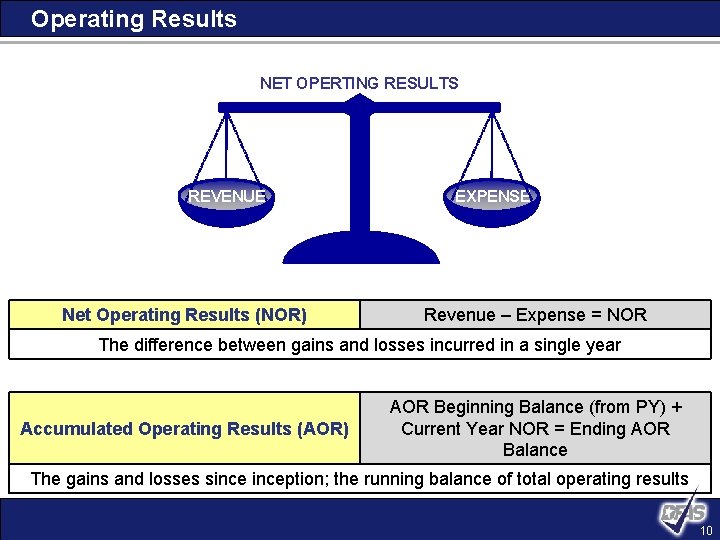
Operating Results NET OPERTING RESULTS REVENUE Net Operating Results (NOR) EXPENSE Revenue – Expense = NOR The difference between gains and losses incurred in a single year Accumulated Operating Results (AOR) AOR Beginning Balance (from PY) + Current Year NOR = Ending AOR Balance The gains and losses sinception; the running balance of total operating results 10
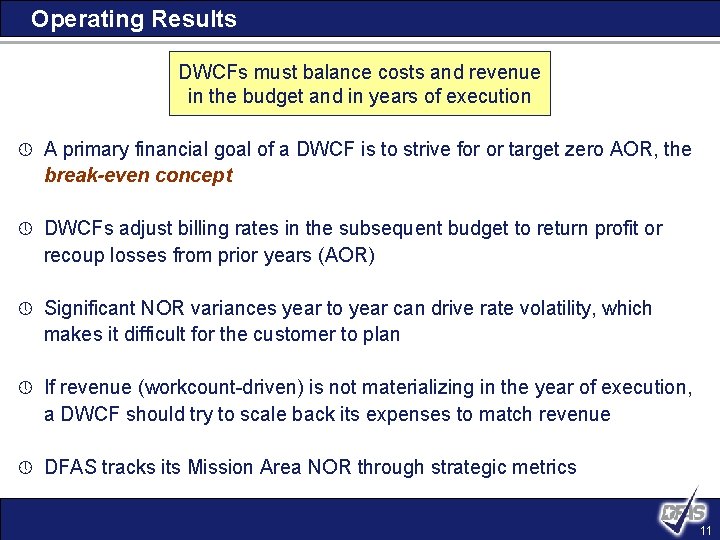
Operating Results DWCFs must balance costs and revenue in the budget and in years of execution » A primary financial goal of a DWCF is to strive for or target zero AOR, the break-even concept » DWCFs adjust billing rates in the subsequent budget to return profit or recoup losses from prior years (AOR) » Significant NOR variances year to year can drive rate volatility, which makes it difficult for the customer to plan » If revenue (workcount-driven) is not materializing in the year of execution, a DWCF should try to scale back its expenses to match revenue » DFAS tracks its Mission Area NOR through strategic metrics 11
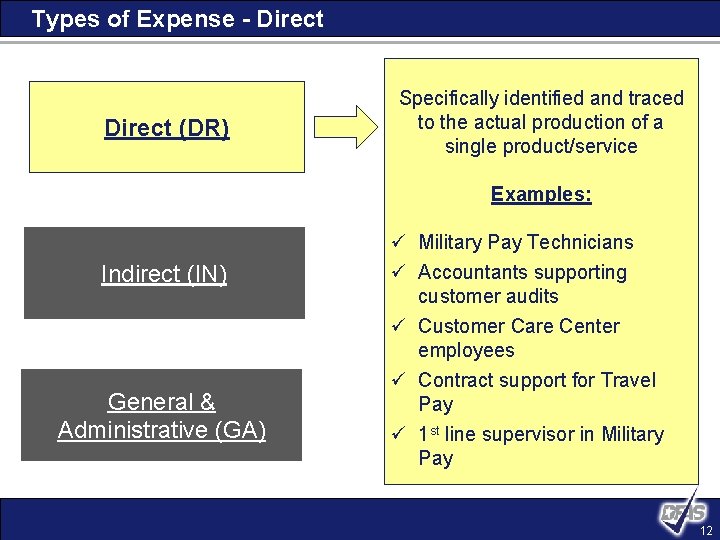
Types of Expense - Direct (DR) Specifically identified and traced to the actual production of a single product/service Examples: Indirect (IN) General & Administrative (GA) ü Military Pay Technicians ü Accountants supporting customer audits ü Customer Care Center employees ü Contract support for Travel Pay ü 1 st line supervisor in Military Pay 12
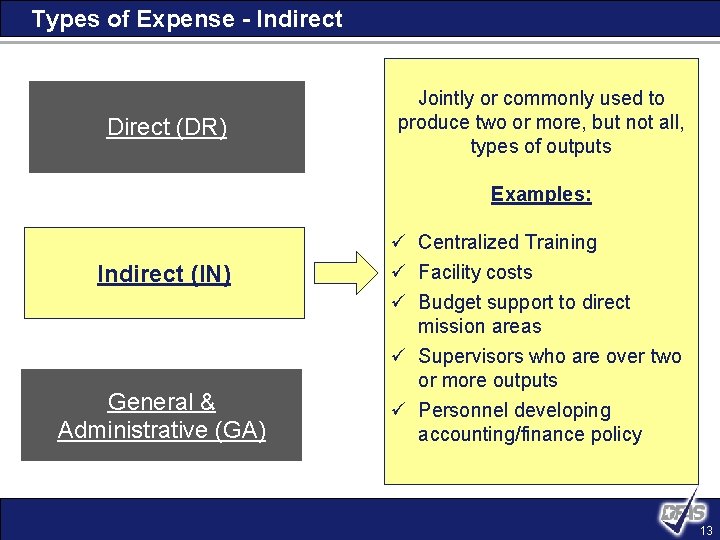
Types of Expense - Indirect Direct (DR) Jointly or commonly used to produce two or more, but not all, types of outputs Examples: Indirect (IN) General & Administrative (GA) ü Centralized Training ü Facility costs ü Budget support to direct mission areas ü Supervisors who are over two or more outputs ü Personnel developing accounting/finance policy 13
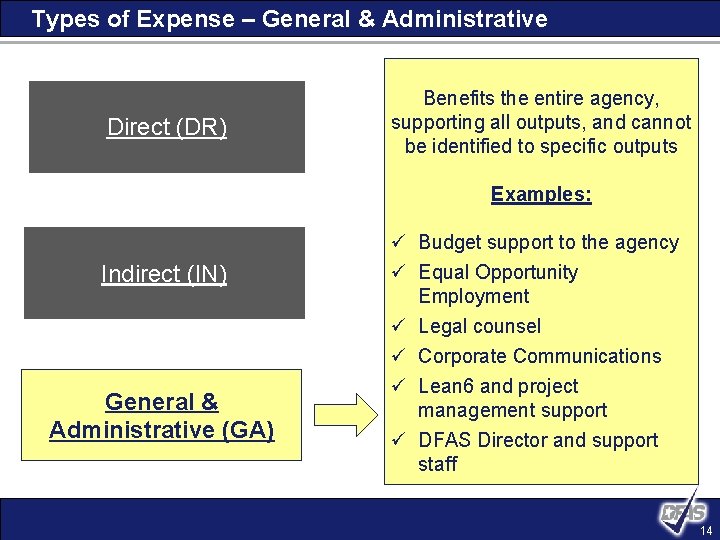
Types of Expense – General & Administrative Direct (DR) Benefits the entire agency, supporting all outputs, and cannot be identified to specific outputs Examples: Indirect (IN) General & Administrative (GA) ü Budget support to the agency ü Equal Opportunity Employment ü Legal counsel ü Corporate Communications ü Lean 6 and project management support ü DFAS Director and support staff 14
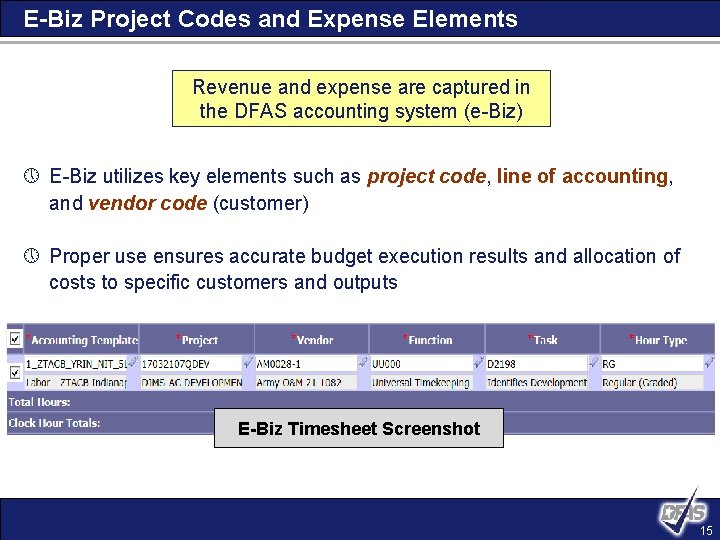
E-Biz Project Codes and Expense Elements Revenue and expense are captured in the DFAS accounting system (e-Biz) » E-Biz utilizes key elements such as project code, line of accounting, and vendor code (customer) » Proper use ensures accurate budget execution results and allocation of costs to specific customers and outputs E-Biz Timesheet Screenshot 15
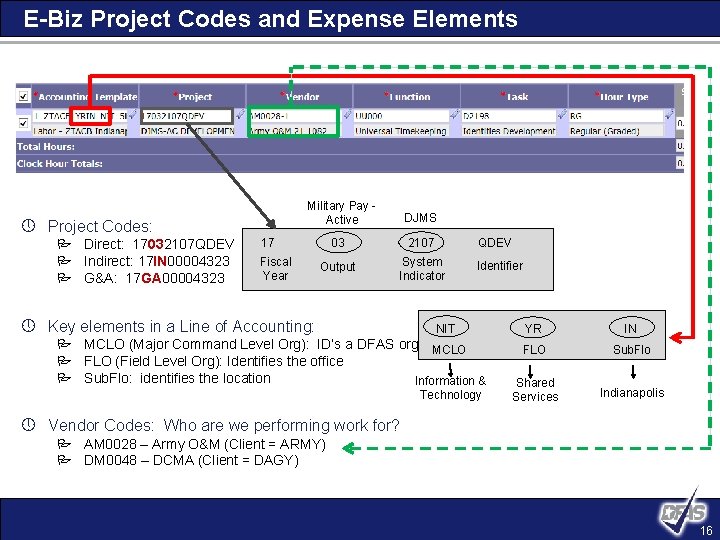
E-Biz Project Codes and Expense Elements Military Pay Active » Project Codes: P Direct: 17032107 QDEV P Indirect: 17 IN 00004323 P G&A: 17 GA 00004323 17 Fiscal Year DJMS 03 2107 Output System Indicator » Key elements in a Line of Accounting: QDEV Identifier NIT P MCLO (Major Command Level Org): ID’s a DFAS org MCLO P FLO (Field Level Org): Identifies the office P Sub. Flo: identifies the location Information & Technology YR IN FLO Sub. Flo Shared Services Indianapolis » Vendor Codes: Who are we performing work for? P AM 0028 – Army O&M (Client = ARMY) P DM 0048 – DCMA (Client = DAGY) 16
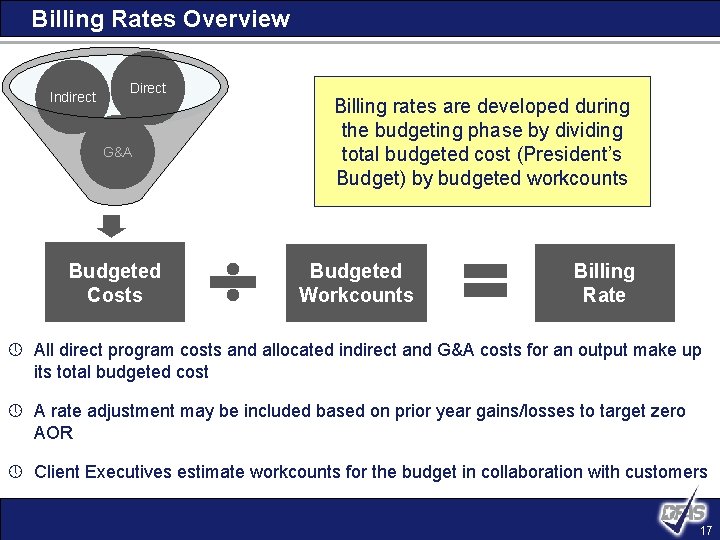
Billing Rates Overview Indirect Direct G&A Budgeted Costs Billing rates are developed during the budgeting phase by dividing total budgeted cost (President’s Budget) by budgeted workcounts Budgeted Workcounts Billing Rate » All direct program costs and allocated indirect and G&A costs for an output make up its total budgeted cost » A rate adjustment may be included based on prior year gains/losses to target zero AOR » Client Executives estimate workcounts for the budget in collaboration with customers 17
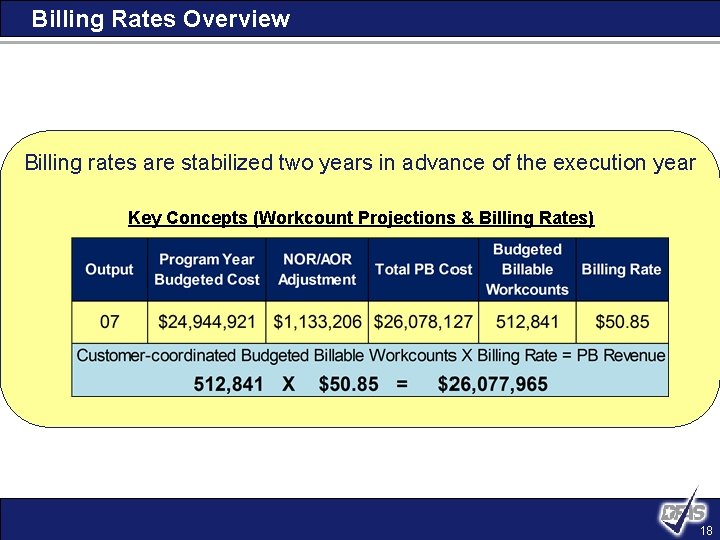
Billing Rates Overview Billing rates are stabilized two years in advance of the execution year Key Concepts (Workcount Projections & Billing Rates) 18
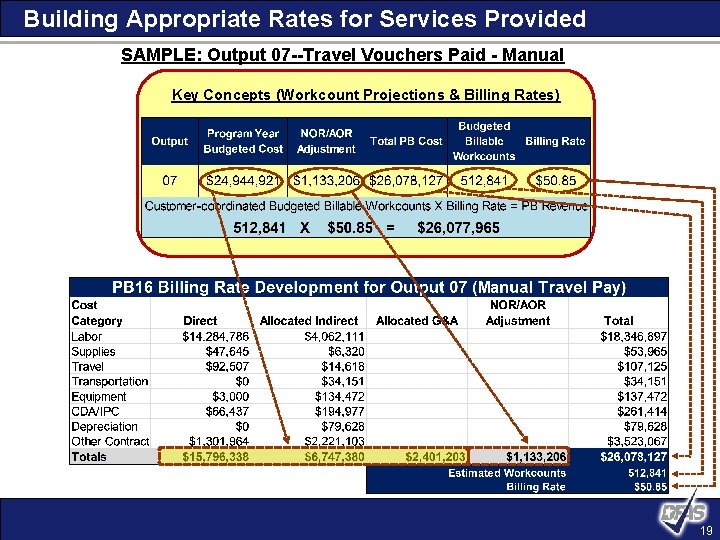
Building Appropriate Rates for Services Provided SAMPLE: Output 07 --Travel Vouchers Paid - Manual Key Concepts (Workcount Projections & Billing Rates) 19
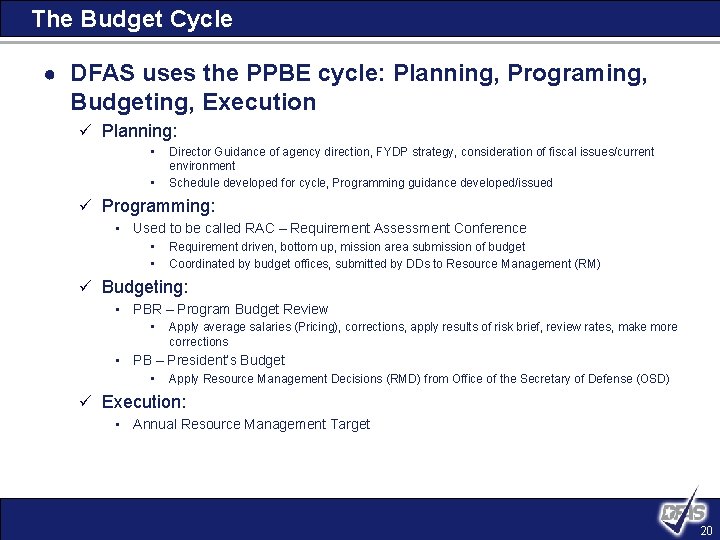
The Budget Cycle ● DFAS uses the PPBE cycle: Planning, Programing, Budgeting, Execution ü Planning: • • Director Guidance of agency direction, FYDP strategy, consideration of fiscal issues/current environment Schedule developed for cycle, Programming guidance developed/issued ü Programming: • Used to be called RAC – Requirement Assessment Conference • • Requirement driven, bottom up, mission area submission of budget Coordinated by budget offices, submitted by DDs to Resource Management (RM) ü Budgeting: • PBR – Program Budget Review • Apply average salaries (Pricing), corrections, apply results of risk brief, review rates, make more corrections • PB – President’s Budget • Apply Resource Management Decisions (RMD) from Office of the Secretary of Defense (OSD) ü Execution: • Annual Resource Management Target 20
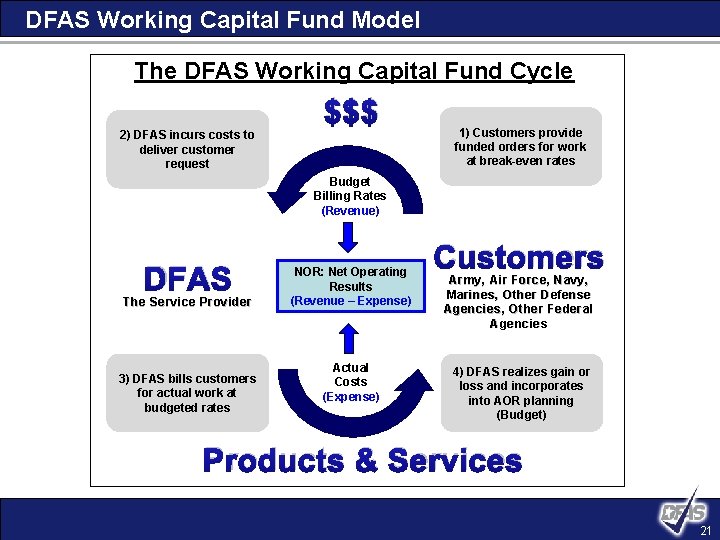
DFAS Working Capital Fund Model The DFAS Working Capital Fund Cycle $$$ 2) DFAS incurs costs to deliver customer request 1) Customers provide funded orders for work at break-even rates Budget Billing Rates (Revenue) DFAS The Service Provider 3) DFAS bills customers for actual work at budgeted rates NOR: Net Operating Results (Revenue – Expense) Actual Costs (Expense) Customers Army, Air Force, Navy, Marines, Other Defense Agencies, Other Federal Agencies 4) DFAS realizes gain or loss and incorporates into AOR planning (Budget) Products & Services 21
- Slides: 21