
The Workforce Recruitment Program Connecting Students with Disabilities
The Workforce Recruitment Program: Connecting Students with Disabilities to Federal Internships and Full-Time Jobs May 23, 2018 Office of Disability Employment Policy U. S. Department of Labor Lauren Karas and Frances Vhay
Office of Disability Employment Policy Driving Change Creating Opportunity The only non-regulatory federal agency that promotes policies and coordinates with employers and all levels of government to increase workplace success for people with disabilities. Page 2
What is the WRP? • The Workforce Recruitment Program (WRP) is a free recruitment and referral program that connects federal and select private sector employers with highly motivated postsecondary students and recent graduates with disabilities who are eager to demonstrate their abilities in the workplace. • WRP is co-managed by the Office of Disability Employment Policy at the U. S. Department of Labor and the Office of Diversity Management and Equal Opportunity at the U. S. Department of Defense. Page 3
Goals of WRP • Bring students with disabilities into the employment process, both through their schools and through contact with WRP employers. • Help college Career Centers and Disability Services Offices to engage with the issue of employment for their students with disabilities. • Function as a pipeline to bring new talent into the federal government and fill mission critical jobs. • Break down attitudinal barriers in the workplace. Page 4
How the Program Works • WRP School Coordinators register their schools for the WRP in the spring. • WRP School Coordinators receive: – – – • School Coordinator Training Guide Conference Call/Webinar Schedule Support from WRP Program Staff via wrp@dol. gov and phone We recommend participating on the calls/webinars every 2 weeks from June-September. Page 5
WRP School Registration • Registration is currently open for schools! It will close June 15. – School staff: go to wrp. gov and click on “School Registration” • Schools can register as many School Coordinators as they like; each should just register separately. Only one Coordinator needs to be registered for school to be part of WRP. • WRP operates through college campuses, so students need to register through a participating campus. Page 6
School Coordinator Responsibilities • Understand the eligibility requirements of WRP and help ensure students applying meet them. • Conduct outreach to students about the program during the student application period from late August-October. • • Confirm students via website for participation. • Work with Federal Recruiters to create an interview schedule. Educate students, answer questions, and help ensure they have completed their applications. Page 7
Best Practices • • Provide resume workshops for students. • Encourage candidates to research different federal agencies that they may be interested in working for. • Don’t forget your recent graduates or those who are studying abroad! Conduct practice interviews and provide space for interview preparation. Page 8
Program Deadlines for 2018 • • School registration deadline is June 15 th. • • The interview period is October 29 th-November 19 th. Student registration opens on August 27 th and goes until October 15 th. 2019 database goes live for federal employers in mid -December. Page 9
Who is Eligible? • To participate in WRP, applicants must: – Be eligible for hiring under the Schedule A Hiring Authority – Be a U. S. citizen – Be a current, full-time, degree-seeking, post-secondary student • Students may also participate if – they meet all of the other requirements for the program but are taking a reduced course load due to a disability. – they met the preceding requirements while enrolled, but have graduated in the past year are still eligible to participate. Candidates who graduated in April 2017 or after are eligible to participate this year. Page 10
What is the Schedule A Hiring Authority? • Schedule A is an excepted appointing authority for people with disabilities that allows them to be quickly added to the Federal government. • Candidates who are eligible for hiring using Schedule A are students with – Intellectual Disability – Psychiatric Disability – Severe Physical Disability Page 11
Who is eligible for Schedule A? Have you… –received accommodations through the Disabled Student Services office on a college campus? –received Supplemental Security Income (SSI) benefits? –been diagnosed with a condition that is treated by a mental health professional? –had an Individualized Education Program (IEP) or 504 plan in school? –received vocational rehabilitation services? –fit under the Americans with Disabilities Act Amendments Act or the Rehabilitation Act of 1973 definition of an individual with a disability? Page 12
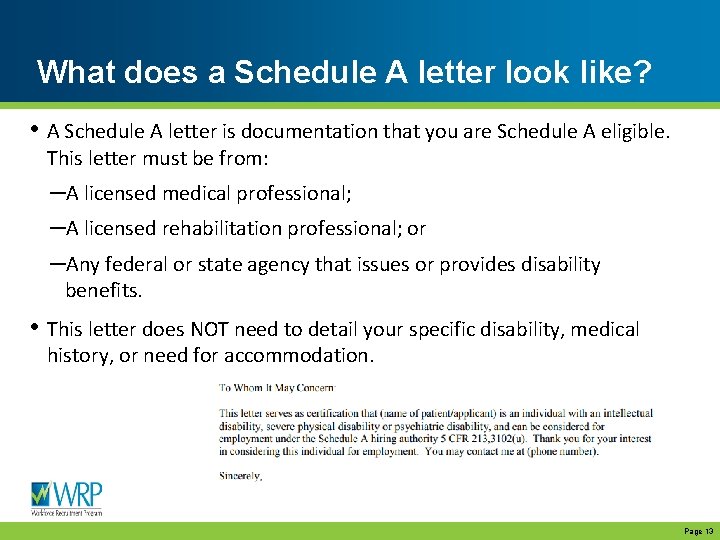
What does a Schedule A letter look like? • A Schedule A letter is documentation that you are Schedule A eligible. This letter must be from: –A licensed medical professional; –A licensed rehabilitation professional; or –Any federal or state agency that issues or provides disability benefits. • This letter does NOT need to detail your specific disability, medical history, or need for accommodation. Page 13
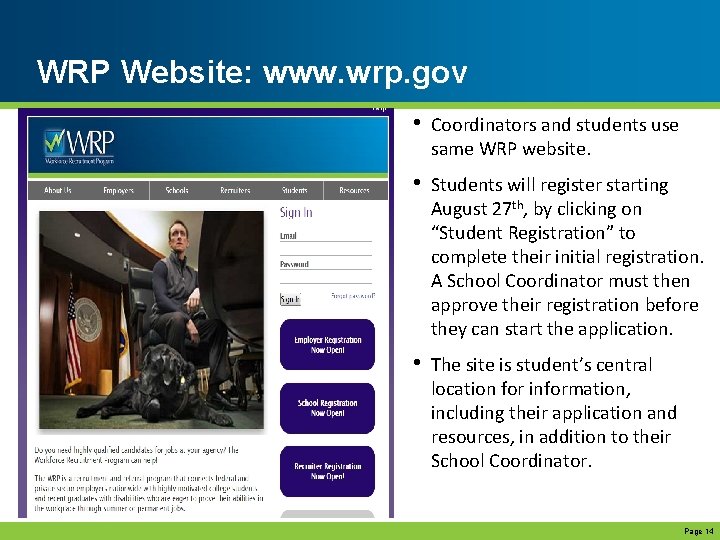
WRP Website: www. wrp. gov • Coordinators and students use same WRP website. • Students will register starting August 27 th, by clicking on “Student Registration” to complete their initial registration. A School Coordinator must then approve their registration before they can start the application. • The site is student’s central location for information, including their application and resources, in addition to their School Coordinator. Page 14
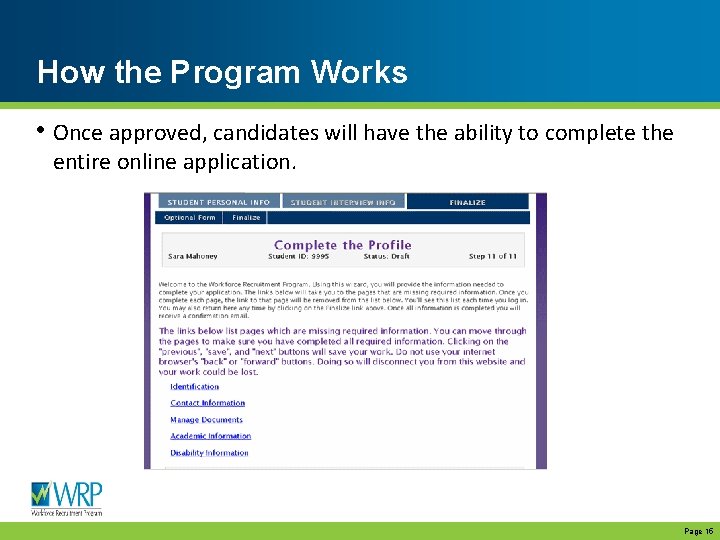
How the Program Works • Once approved, candidates will have the ability to complete the entire online application. Page 15

Required Information on the Application • Identification and Contact Information • Resume • Transcript (official or unofficial) • Academic information including major, degree, GPA, number of credit hours, credit type, etc. • Disability category (for statistical purposes only, not shown to employers) • Optional: Supporting documents, such as recommendation letters, writing samples, and Schedule A Certification letter. Page 16
Who are the Recruiters? • Recruiters are Federal employees who are trained to conduct good interviews and represent the skills of people with disabilities. • Recruiters register in the early summer and go through online training over the summer. Once their training is complete, Recruiters are assigned to specific colleges to conduct interviews. Page 17

What will the Recruiters Ask? • Recruiters interview candidates and give them a rating of 1 -5 on: PQualifications PCommunication PDirection POverall Rating • Candidate must score 3. 0 or better on the overall rating. Page 18
Best Practices for Working with Your Recruiter • Prepare your students for interviews. Practice makes perfect! • Begin communicating with your recruiter as soon as contact information is shared. • Be flexible and work with their schedule! • Have a dedicated space and phone line for students. • Debrief with your recruiter at the end of the interview process. Page 19
After the Interview • Employers contact candidates throughout the year. • Employers will contact candidates directly. Students may be asked to do an interview and if they are contacted with a job offer, they should get the contact information of the person contacting them to follow up. • Neither your recruiter nor the WRP office will be tracking student’s application. Employers will contact candidates directly without going through the main WRP Office. • Please note: the WRP is not a guarantee of employment and we always encourage students to pursue other avenues in addition to WRP. Page 20
Benefits of WRP for Students • Helps students with disabilities think about the career and internship process earlier. • • • Begin thinking about workplace accommodation needs. • Gives students a better chance at federal opportunities and introduces them to federal government. Students gain experience with interviews and resumes. Can be an opportunity for career services to get students into their offices and utilizing their resources. Page 21

WRP Success Story – Mo Fawaz • Interned at EEOC • Graduated from Thomas M. Cooley Law School • Paralegal Specialist at Defense Logistics Agency • “WRP gave me the chance I needed and deserved, to prove my abilities as a productive member of society. ” Page 22

WRP Success Story – Andrea Walton • Graduate of De. Paul University • Intern at Navy and SEC • Equal Opportunity Office Specialist for the State Department Page 23

Self Advocacy and Disclosure • Personal Responsibility: – Understand what your disability is and how it affects you in your daily life – Understand how your academic accommodation needs will transfer to the workplace – Communicate what type of accommodations you will need in order to complete the essential duties of the type of job you want during your interview • Employer’s Responsibility – Provide reasonable accommodations to qualified applicants and employees with disabilities. – Reasonable accommodations enable individuals to participate in the hiring process, perform the essential functions of jobs, and/or offer equal opportunity to enjoy the benefits and privileges of employment. Page 24
Best Practices for Preparing Students for Employment • Talk to students about disclosure and requesting accommodations in the workplace. • Help students think about what accommodations they will need in a work setting and how those may different from an academic setting. • Make sure students understand their rights and responsibilities and think thoughtfully about when and how to disclose their disability. Page 25
WRP & Private Sector Employers • WRP also works with select Private Sector Employers through our office’s technical assistance center. Private sector employer can visit WRP. jobs, our sister site for non-Federal employers. They can go to wrp. jobs to post positions or email wrp@viscardicenter. org to receive sourcing assistance. Employer Assistance and Resource Network on Disability Inclusion (EARN) helps employers recruit, hire, retain and advance people with disabilities. EARN provides information on: recruiting and hiring; retention and advancement; laws and regulations; and creating an accessible and welcoming workplace. Go to askearn. org to learn more. Page 26
Other Resources The Job Accommodation Network (JAN) is the leading source of free, expert, and confidential guidance on workplace accommodations and disability employment issues. Working toward practical solutions that benefit both employer and employee, JAN helps people with disabilities enhance their employability, and shows employers how to capitalize on the value and talent that people with disabilities add to the workplace. www. askjan. org National Collaborative on Workforce and Disability for Youth (NCWD/Youth) has resources on disability disclosure to help young people make informed decisions about whether or not to and how to disclose their disability and to understand how that decision may impact their education, employment, and social lives. Go to http: //www. ncwd-youth. info/411 -ondisability-disclosure to learn more. Page 27
Contact Information & Questions www. wrp. gov wrp@dol. gov Page 28
- Slides: 28