
The workflow of module assembly for the CBM
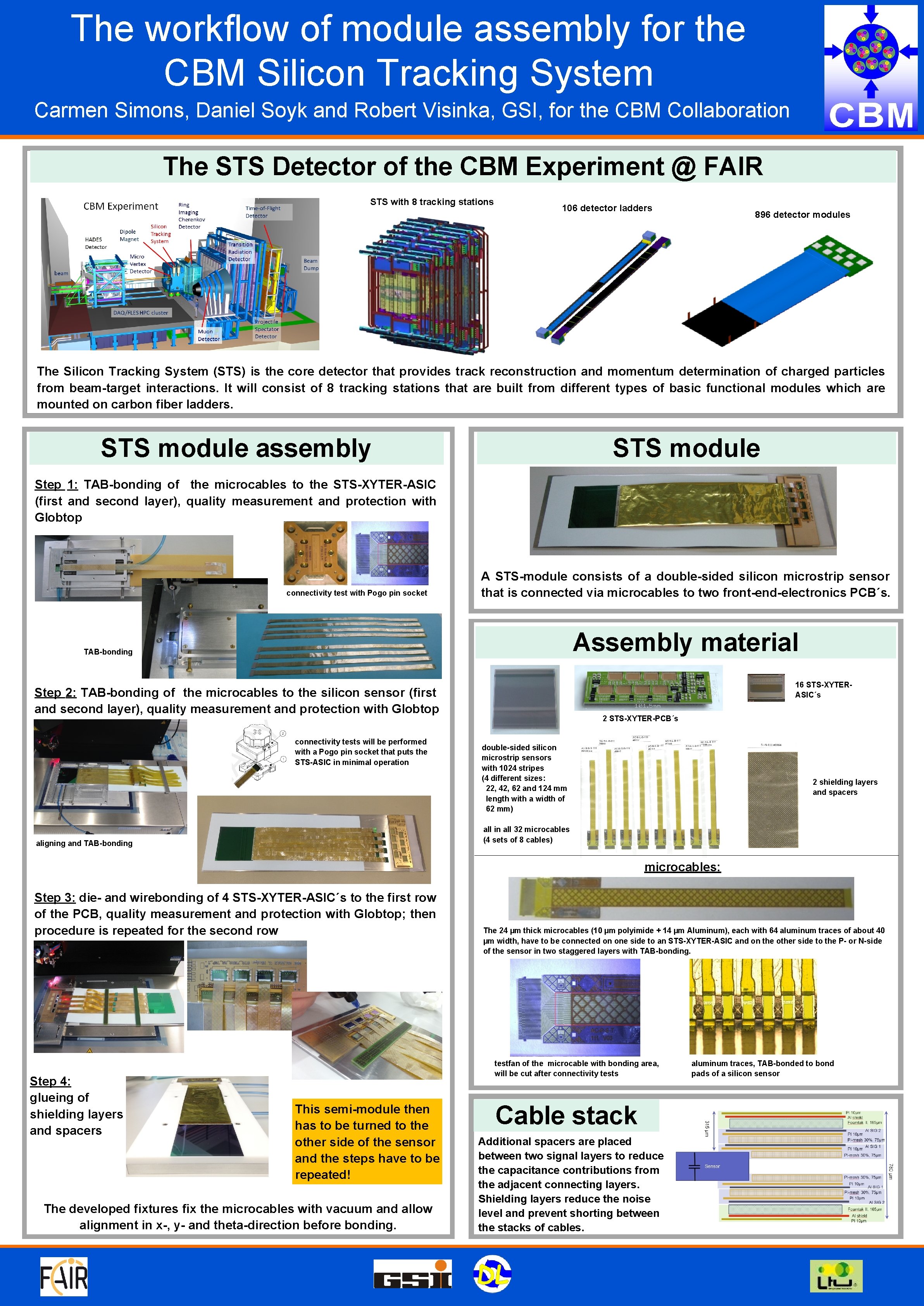
The workflow of module assembly for the CBM Silicon Tracking System Carmen Simons, Daniel Soyk and Robert Visinka, GSI, for the CBM Collaboration Øexplore QCD phase diagram the region of high baryon densities and moderate temperatures Østudy of the equation-of-state of nuclear matter at high densities, Øsearch for the de-confinement & chiral phase transitions. Ømeasure both bulk observables & rare diagnostic probes (charmed particles, vector mesons) The STS Detector of the CBM Experiment @ FAIR STS with 8 tracking stations 106 detector ladders 896 detector modules The Silicon Tracking System (STS) is the core detector that provides track reconstruction and momentum determination of charged particles from beam-target interactions. It will consist of 8 tracking stations that are built from different types of basic functional modules which are mounted on carbon fiber ladders. STS module assembly STS module Step 1: TAB-bonding of the microcables to the STS-XYTER-ASIC (first and second layer), quality measurement and protection with Globtop connectivity test with Pogo pin socket A STS-module consists of a double-sided silicon microstrip sensor that is connected via microcables to two front-end-electronics PCB´s. Assembly material TAB-bonding 16 STS-XYTERASIC´s Step 2: TAB-bonding of the microcables to the silicon sensor (first and second layer), quality measurement and protection with Globtop connectivity tests will be performed with a Pogo pin socket that puts the STS-ASIC in minimal operation 2 STS-XYTER-PCB´s double-sided silicon microstrip sensors with 1024 stripes (4 different sizes: 22, 42, 62 and 124 mm length with a width of 62 mm) all in all 32 microcables (4 sets of 8 cables) aligning and TAB-bonding MVD microcables: Step 3: die- and wirebonding of 4 STS-XYTER-ASIC´s to the first row of the PCB, quality measurement and protection with Globtop; then procedure is repeated for the second row Step 4: glueing of shielding layers and spacers 2 shielding layers and spacers The 24 µm thick microcables (10 µm polyimide + 14 µm Aluminum), each with 64 aluminum traces of about 40 µm width, have to be connected on one side to an STS-XYTER-ASIC and on the other side to the P- or N-side of the sensor in two staggered layers with TAB-bonding. testfan of the microcable with bonding area, will be cut after connectivity tests This semi-module then has to be turned to the other side of the sensor and the steps have to be repeated! The developed fixtures fix the microcables with vacuum and allow alignment in x-, y- and theta-direction before bonding. Cable stack Additional spacers are placed between two signal layers to reduce the capacitance contributions from the adjacent connecting layers. Shielding layers reduce the noise level and prevent shorting between the stacks of cables. aluminum traces, TAB-bonded to bond pads of a silicon sensor
- Slides: 1