
The Work of Gregor Mendel Chapter 11 Section
- Slides: 78
The Work of Gregor Mendel Chapter 11, Section 1
What is an inheritance? It is something we each receive from our parents—a contribution that determines our blood type, the color of our hair, and so much more.
The Experiments of Gregor Mendel An individual’s characteristics are determined by factors that are passed from one parental generation to the next. Every living thing—plant or animal, microbe or human being—has a set of characteristics inherited from its parent or parents. The delivery of characteristics from parent to offspring is called heredity. The scientific study of heredity, known as genetics, is the key to understanding what makes each organism unique.
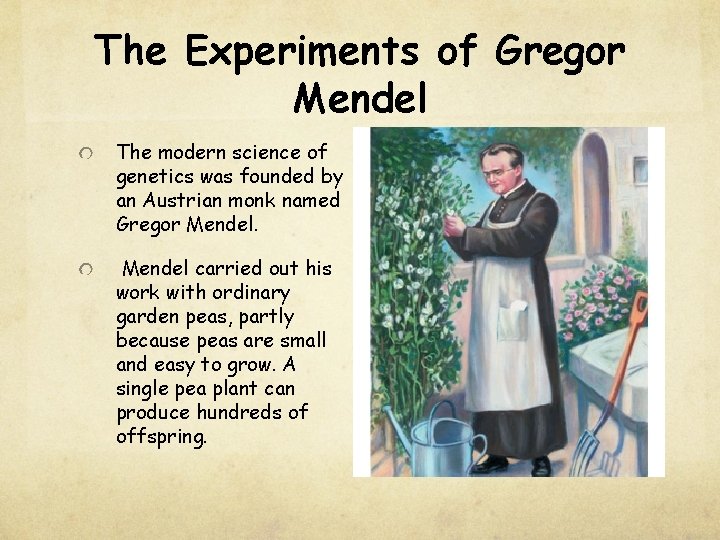
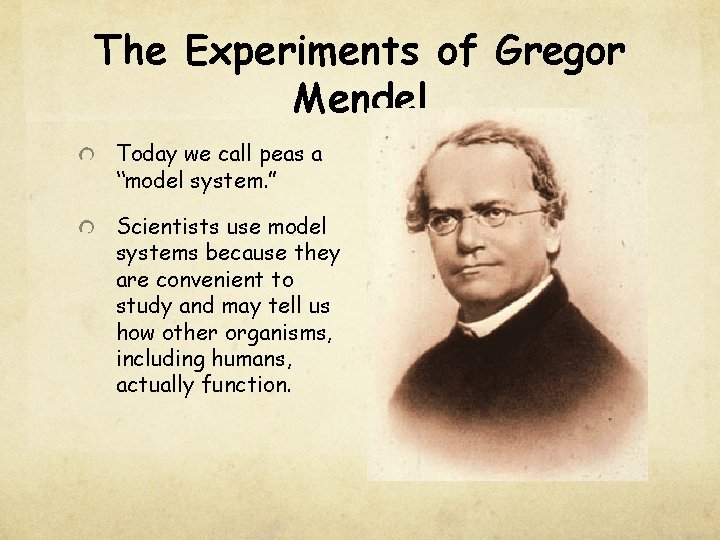
The Experiments of Gregor Mendel The modern science of genetics was founded by an Austrian monk named Gregor Mendel carried out his work with ordinary garden peas, partly because peas are small and easy to grow. A single pea plant can produce hundreds of offspring.
The Experiments of Gregor Mendel Today we call peas a “model system. ” Scientists use model systems because they are convenient to study and may tell us how other organisms, including humans, actually function.
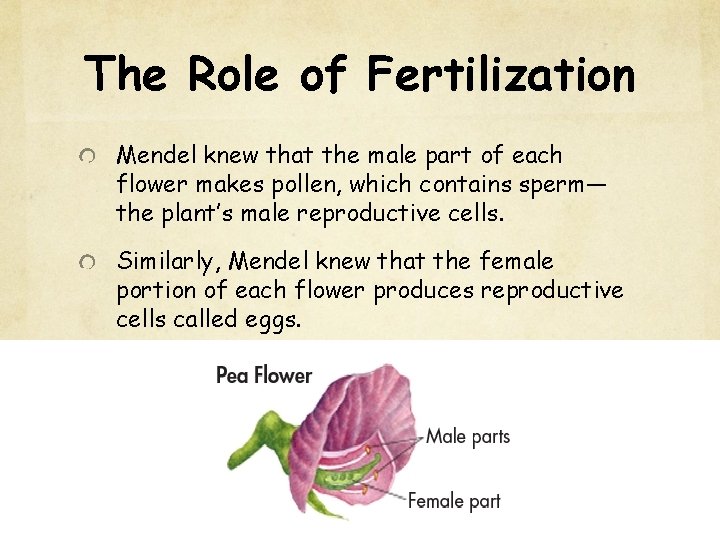
The Role of Fertilization Mendel knew that the male part of each flower makes pollen, which contains sperm— the plant’s male reproductive cells. Similarly, Mendel knew that the female portion of each flower produces reproductive cells called eggs.
The Role of Fertilization Pea flowers are normally self-pollinating, which means that sperm cells fertilize egg cells from within the same flower. A plant grown from a seed produced by self-pollination inherits all of its characteristics from the single plant that bore it. In effect, it has a single parent. Mendel’s garden had several stocks of pea plants that were “true-breeding, ” meaning that they were self-pollinating, and would produce offspring with identical traits to themselves. In other words, the traits of each successive generation would be the same. A trait is a specific characteristic of an individual, such as seed color or plant height, and may vary from one individual to another.
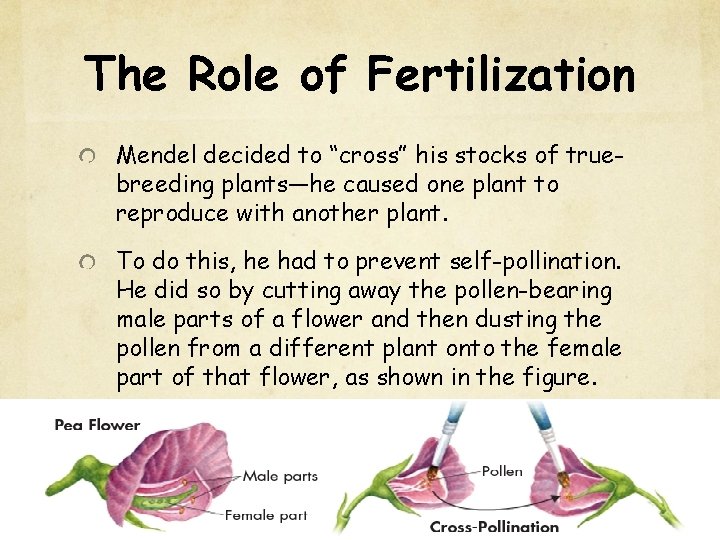
The Role of Fertilization Mendel decided to “cross” his stocks of truebreeding plants—he caused one plant to reproduce with another plant. To do this, he had to prevent self-pollination. He did so by cutting away the pollen-bearing male parts of a flower and then dusting the pollen from a different plant onto the female part of that flower, as shown in the figure.
The Role of Fertilization This process, known as cross-pollination, produces a plant that has two different parents Mendel studied seven different traits of pea plants, each of which had two contrasting characteristics, such as green seed color or yellow seed color. The offspring of crosses between parents with different traits are called hybrids.
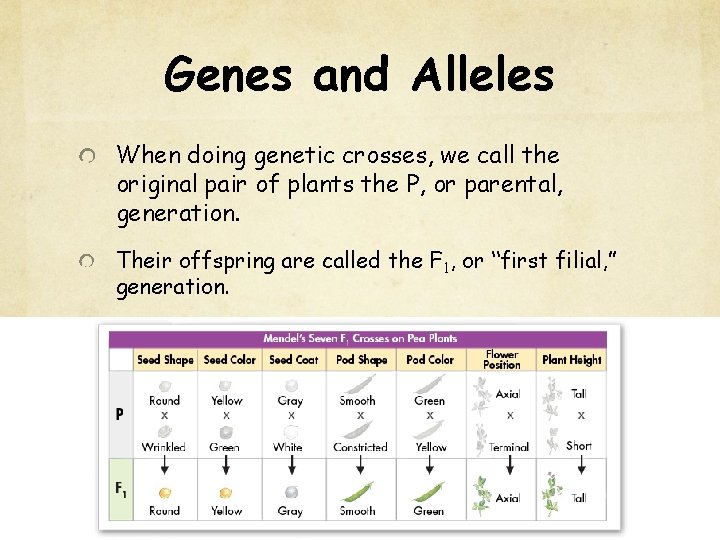
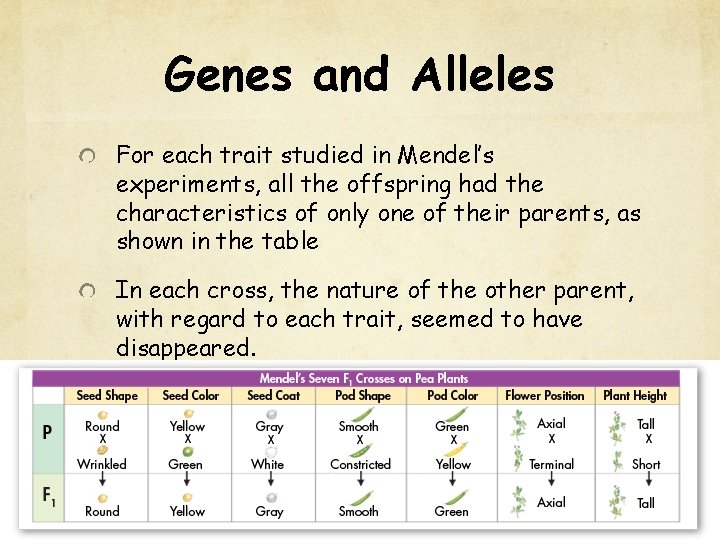
Genes and Alleles When doing genetic crosses, we call the original pair of plants the P, or parental, generation. Their offspring are called the F 1, or “first filial, ” generation.
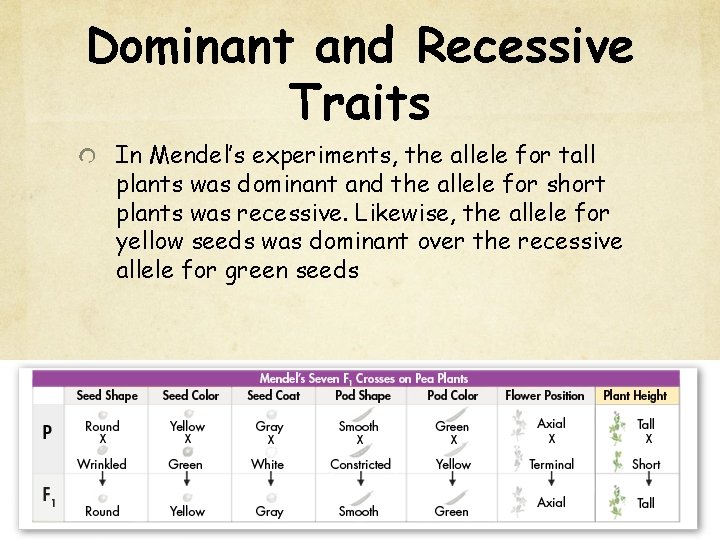
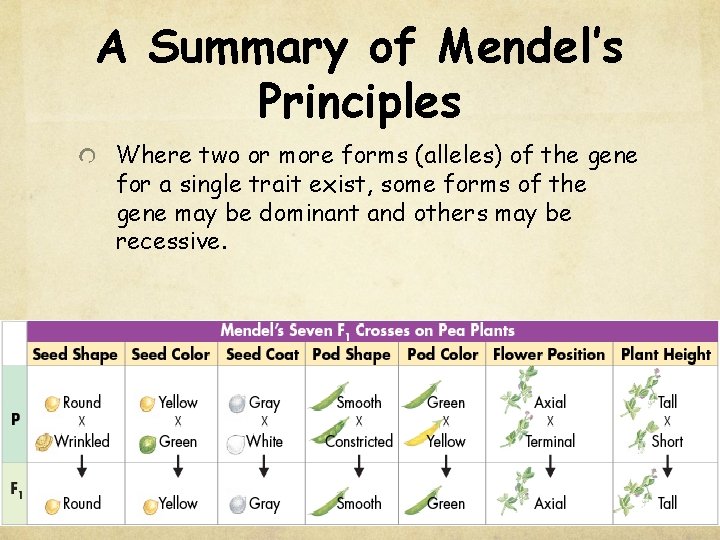
Genes and Alleles For each trait studied in Mendel’s experiments, all the offspring had the characteristics of only one of their parents, as shown in the table In each cross, the nature of the other parent, with regard to each trait, seemed to have disappeared.
Genes and Alleles From these results, Mendel drew two conclusions. His first conclusion formed the basis of our current understanding of inheritance. An individual’s characteristics are determined by factors that are passed from one parental generation to the next. Scientists call the factors that are passed from parent to offspring genes.
Genes and Alleles Each of the traits Mendel studied was controlled by one gene that occurred in two contrasting varieties. These gene variations produced different expressions, or forms, of each trait. The different forms of a gene are called alleles.
Dominant and Recessive Traits Mendel’s second conclusion is called the principle of dominance. This principle states that some alleles are dominant and others are recessive. An organism with at least one dominant allele for a particular form of a trait will exhibit that form of the trait. An organism with a recessive allele for a particular form of a trait will exhibit that form only when the dominant allele for the trait is not present.
Dominant and Recessive Traits In Mendel’s experiments, the allele for tall plants was dominant and the allele for short plants was recessive. Likewise, the allele for yellow seeds was dominant over the recessive allele for green seeds
Segregation How are different forms of a gene (alleles) distributed to offspring? During gamete formation, the alleles for each gene segregate from each other, so that each gamete carries only one allele for each gene.
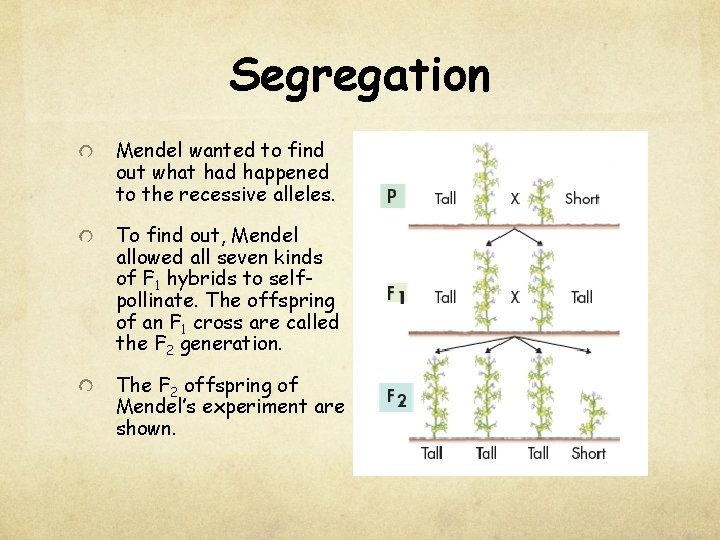
Segregation Mendel wanted to find out what had happened to the recessive alleles. To find out, Mendel allowed all seven kinds of F 1 hybrids to selfpollinate. The offspring of an F 1 cross are called the F 2 generation. The F 2 offspring of Mendel’s experiment are shown.
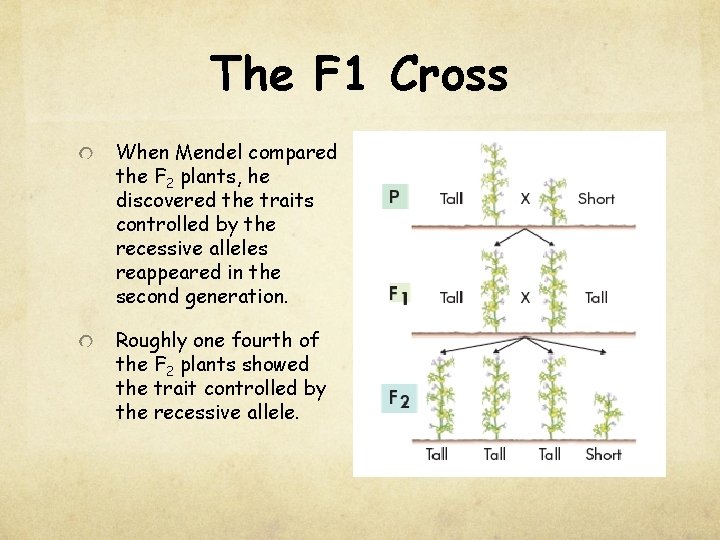
The F 1 Cross When Mendel compared the F 2 plants, he discovered the traits controlled by the recessive alleles reappeared in the second generation. Roughly one fourth of the F 2 plants showed the trait controlled by the recessive allele.
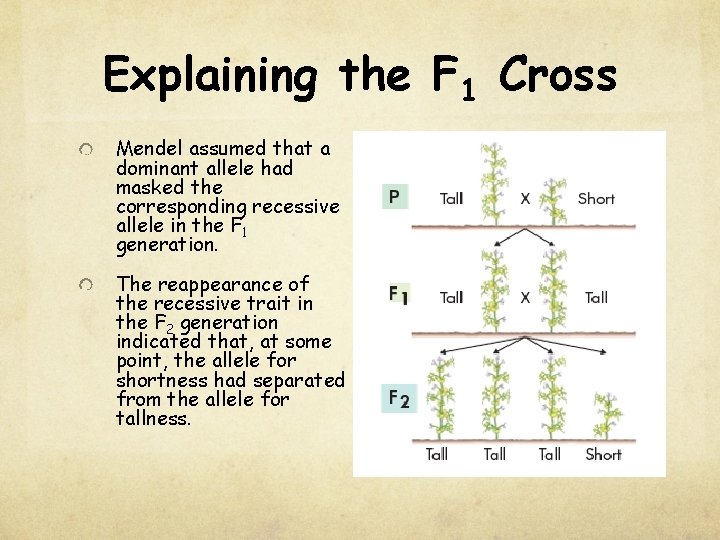
Explaining the F 1 Cross Mendel assumed that a dominant allele had masked the corresponding recessive allele in the F 1 generation. The reappearance of the recessive trait in the F 2 generation indicated that, at some point, the allele for shortness had separated from the allele for tallness.
Explaining the F 1 Cross Mendel suggested that the alleles for tallness and shortness in the F 1 plants must have segregated from each other during the formation of the sex cells, or gametes.
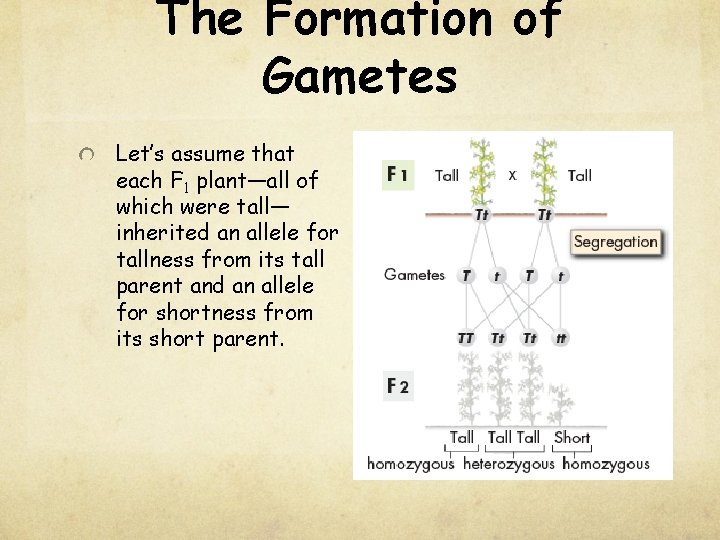
The Formation of Gametes Let’s assume that each F 1 plant—all of which were tall— inherited an allele for tallness from its tall parent and an allele for shortness from its short parent.
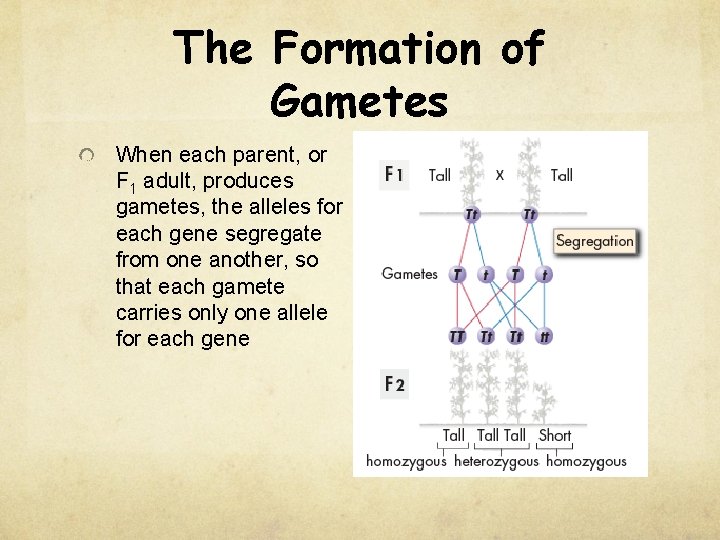
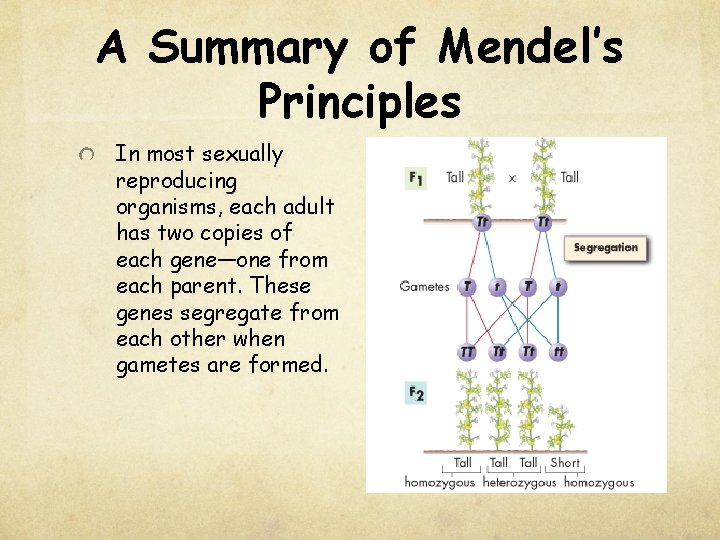
The Formation of Gametes When each parent, or F 1 adult, produces gametes, the alleles for each gene segregate from one another, so that each gamete carries only one allele for each gene
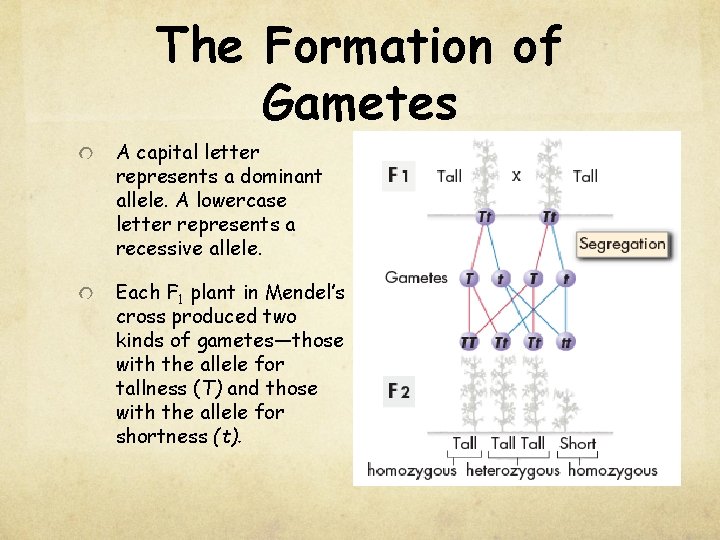
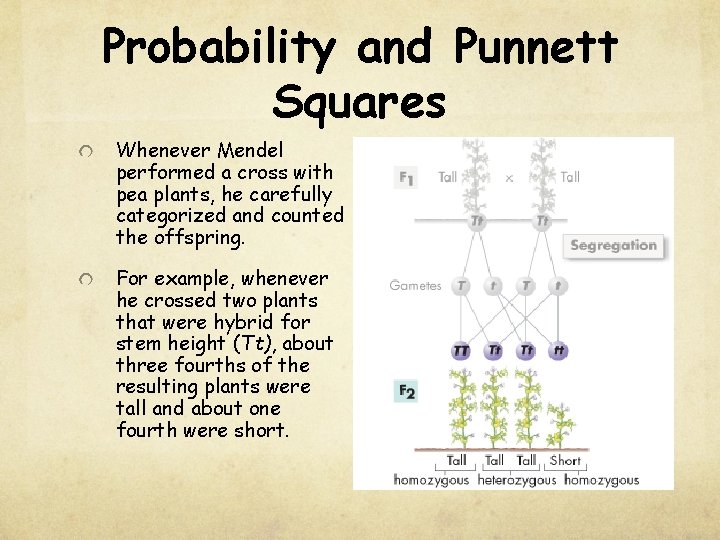
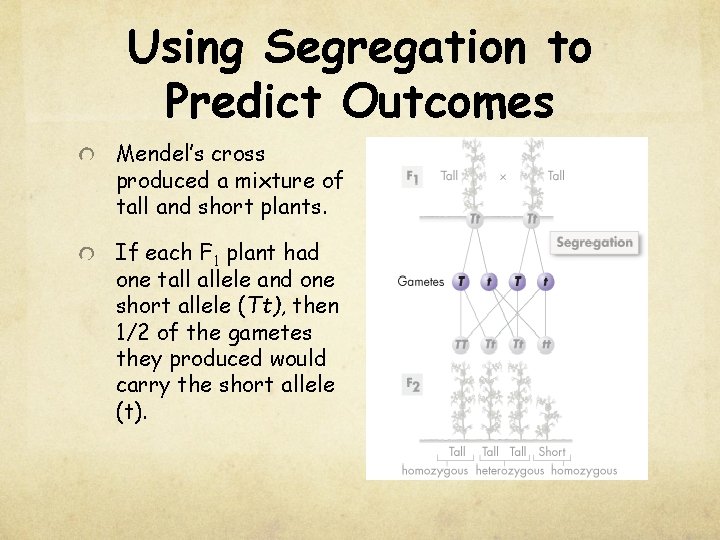
The Formation of Gametes A capital letter represents a dominant allele. A lowercase letter represents a recessive allele. Each F 1 plant in Mendel’s cross produced two kinds of gametes—those with the allele for tallness (T) and those with the allele for shortness (t).
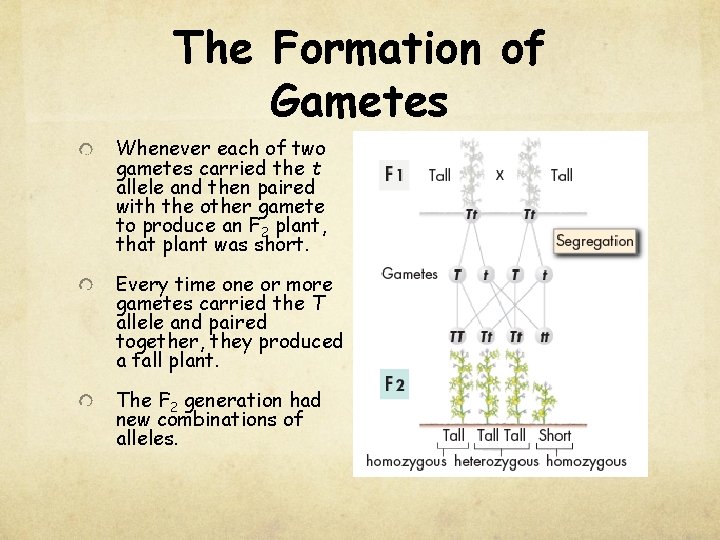
The Formation of Gametes Whenever each of two gametes carried the t allele and then paired with the other gamete to produce an F 2 plant, that plant was short. Every time one or more gametes carried the T allele and paired together, they produced a tall plant. The F 2 generation had new combinations of alleles.
Applying Mendel’s Principles Chapter 11, section 2
Probability and Punnett Squares If a parent carries two different alleles for a certain gene, we can’t be sure which of those alleles will be inherited by one of the parent’s offspring. However, even if we can’t predict the exact future, we can do something almost as useful— we can figure out the odds. Punnett squares use mathematical probability to help predict the genotype and phenotype combinations in genetic crosses.
Probability and Punnett Squares Whenever Mendel performed a cross with pea plants, he carefully categorized and counted the offspring. For example, whenever he crossed two plants that were hybrid for stem height (Tt), about three fourths of the resulting plants were tall and about one fourth were short.
Probability and Punnett Squares Mendel realized that the principles of probability could be used to explain the results of his genetic crosses. Probability is the likelihood that a particular event will occur.
Using Segregation to Predict Outcomes The way in which alleles segregate during gamete formation is every bit as random as a coin flip. Therefore, the principles of probability can be used to predict the outcomes of genetic crosses.
Using Segregation to Predict Outcomes Mendel’s cross produced a mixture of tall and short plants. If each F 1 plant had one tall allele and one short allele (Tt), then 1/2 of the gametes they produced would carry the short allele (t).
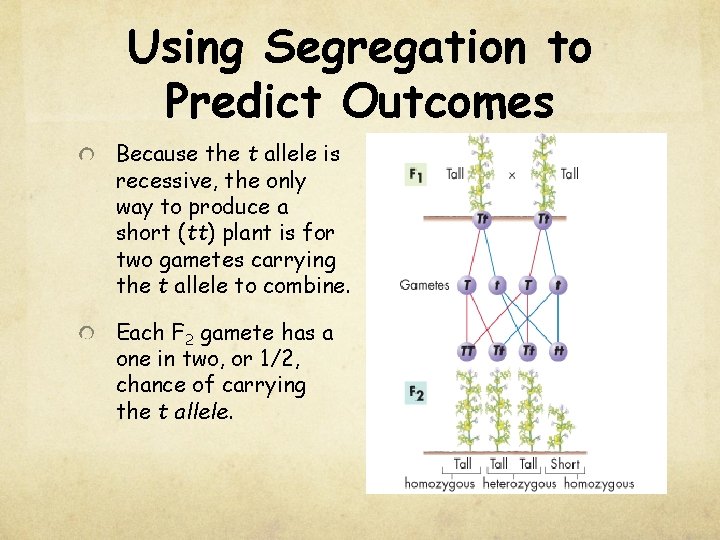
Using Segregation to Predict Outcomes Because the t allele is recessive, the only way to produce a short (tt) plant is for two gametes carrying the t allele to combine. Each F 2 gamete has a one in two, or 1/2, chance of carrying the t allele.
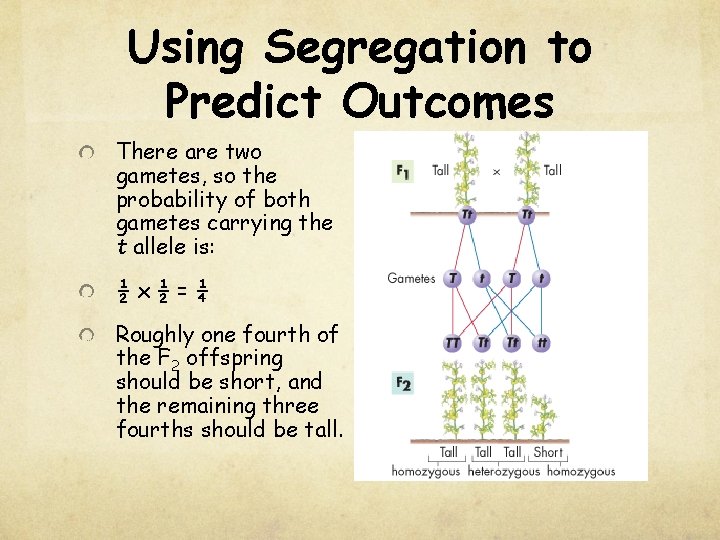
Using Segregation to Predict Outcomes There are two gametes, so the probability of both gametes carrying the t allele is: ½x½=¼ Roughly one fourth of the F 2 offspring should be short, and the remaining three fourths should be tall.
Using Segregation to Predict Outcomes Organisms that have two identical alleles for a particular gene—TT or tt in this example—are said to be homozygous. Organisms that have two different alleles for the same gene—such as Tt—are heterozygous.
Probabilities Predict Averages Probabilities predict the average outcome of a large number of events. The larger the number of offspring, the closer the results will be to the predicted values. If an F 2 generation contains just three or four offspring, it may not match Mendel’s ratios. When an F 2 generation contains hundreds or thousands of individuals, the ratios usually come very close to matching Mendel’s predictions.
Genotype and Phenotype Every organism has a genetic makeup as well as a set of observable characteristics. All of the tall pea plants had the same phenotype, or physical traits. They did not, however, have the same genotype, or genetic makeup.
Genotype and Phenotype There are three different genotypes among the F 2 plants: Tt, TT, and tt. The genotype of an organism is inherited, whereas the phenotype is formed as a result of both the environment and the genotype. Two organisms may have the same phenotype but different genotypes.
Using Punnett Squares One of the best ways to predict the outcome of a genetic cross is by drawing a simple diagram known as a Punnett squares allow you to predict the genotype and phenotype combinations in genetic crosses using mathematical probability.
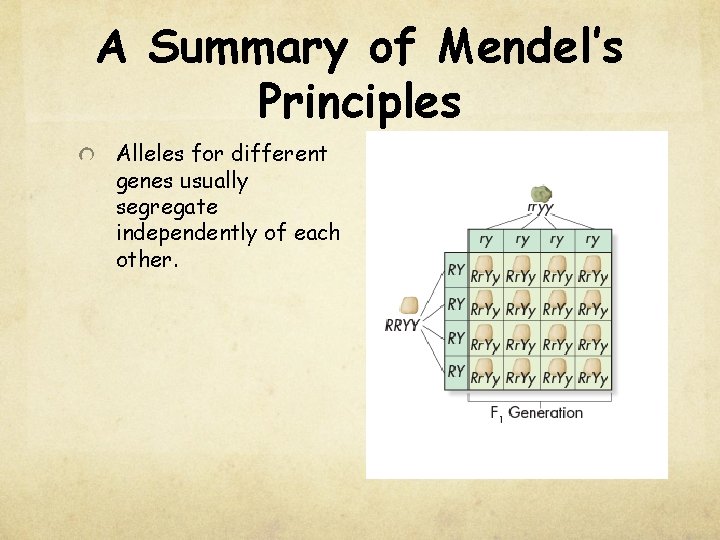
Independent Assortment The principle of independent assortment states that genes for different traits can segregate independently during the formation of gametes. Mendel wondered if the segregation of one pair of alleles affects another pair. Mendel performed an experiment that followed two different genes as they passed from one generation to the next. Because it involves two different genes, Mendel’s experiment is known as a two-factor, or dihybrid, cross. Single-gene crosses are monohybrid crosses.
A Summary of Mendel’s Principles Mendel’s principles of heredity, observed through patterns of inheritance, form the basis of modern genetics. The inheritance of biological characteristics is determined by individual units called genes, which are passed from parents to offspring.
A Summary of Mendel’s Principles Where two or more forms (alleles) of the gene for a single trait exist, some forms of the gene may be dominant and others may be recessive.
A Summary of Mendel’s Principles In most sexually reproducing organisms, each adult has two copies of each gene—one from each parent. These genes segregate from each other when gametes are formed.
A Summary of Mendel’s Principles Alleles for different genes usually segregate independently of each other.
A Summary of Mendel’s Principles At the beginning of the 1900 s, American geneticist Thomas Hunt Morgan decided to use the common fruit fly as a model organism in his genetics experiments. The fruit fly was an ideal organism for genetics because it could produce plenty of offspring, and it did so quickly in the laboratory.
Using Segregation to Predict Outcomes Probabilities predict the average outcome of a large number of events. The larger the number of offspring, the closer the results will be to the predicted values. If an F 2 generation contains just three or four offspring, it may not match Mendel’s ratios. When an F 2 generation contains hundreds or thousands of individuals, the ratios usually come very close to matching Mendel’s predictions.
A Summary of Mendel’s Principles Before long, Morgan and other biologists had tested every one of Mendel’s principles and learned that they applied not just to pea plants but to other organisms as well. The basic principles of Mendelian genetics can be used to study the inheritance of human traits and to calculate the probability of certain traits appearing in the next generation.
Other Patterns of Inheritance Chapter 11, Section 3
Beyond Dominant and Recessive Alleles Mendel’s principles offer a set of rules with which to predict various patterns of inheritance. There are exceptions to every rule, and exceptions to the exceptions. What happens if one allele is not completely dominant over another? What if a gene has several alleles?
Beyond Dominant and Recessive Alleles Some alleles are neither dominant nor recessive. Many genes exist in several different forms, and are therefore said to have multiple alleles. Many traits are produced by the interaction of several genes.
Beyond Dominant and Recessive Alleles Despite the importance of Mendel’s work, there are important exceptions to most of his principles. In most organisms, genetics is more complicated, because the majority of genes have more than two alleles. In addition, many important traits are controlled by more than one gene. Mendel’s principles alone cannot predict traits that are controlled by multiple alleles or multiple genes.
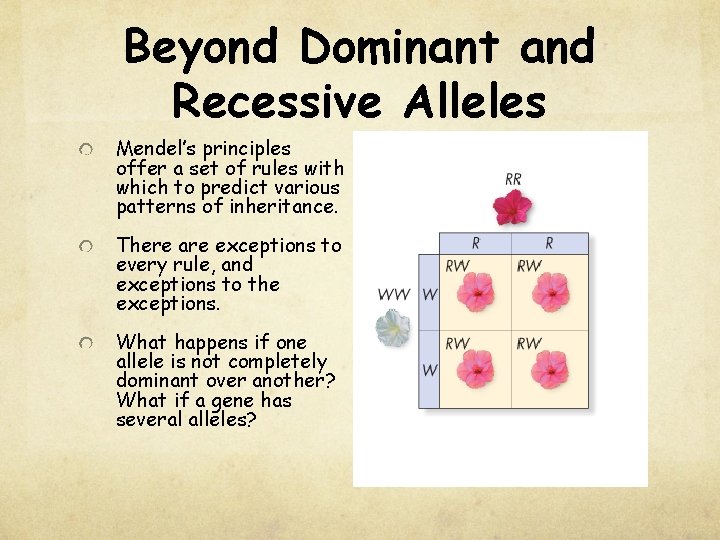
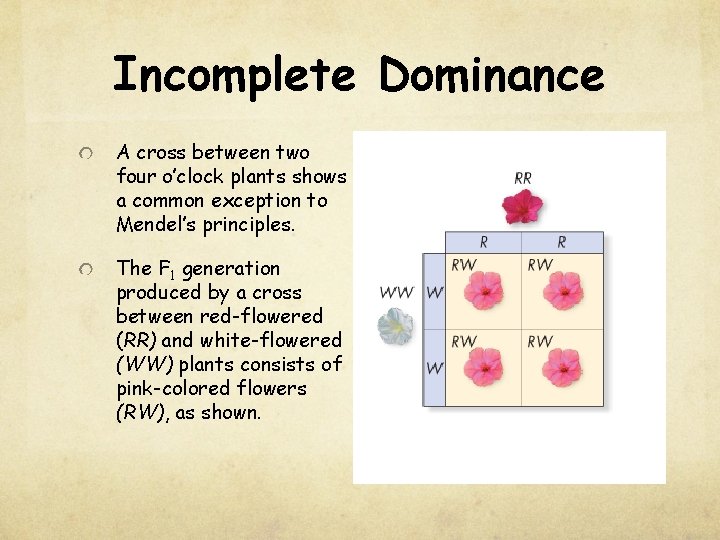
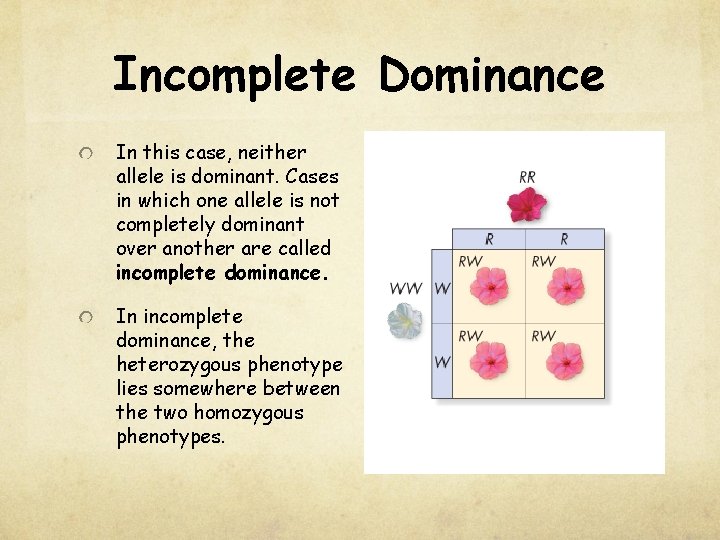
Incomplete Dominance A cross between two four o’clock plants shows a common exception to Mendel’s principles. The F 1 generation produced by a cross between red-flowered (RR) and white-flowered (WW) plants consists of pink-colored flowers (RW), as shown.
Incomplete Dominance In this case, neither allele is dominant. Cases in which one allele is not completely dominant over another are called incomplete dominance. In incomplete dominance, the heterozygous phenotype lies somewhere between the two homozygous phenotypes.
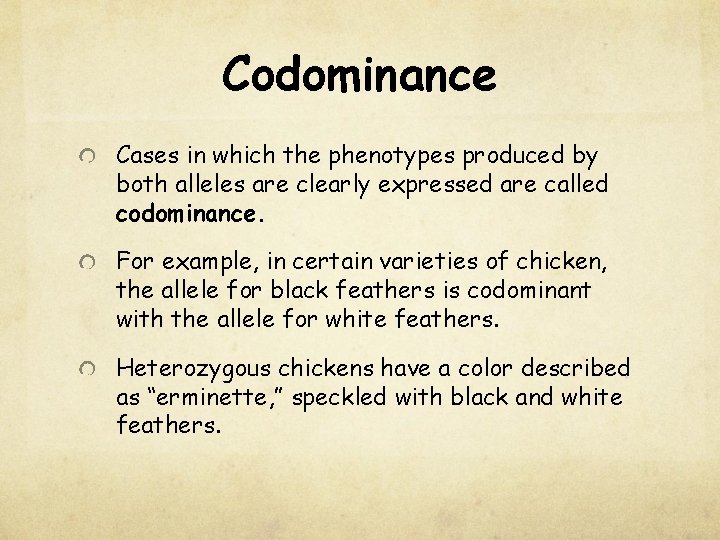
Codominance Cases in which the phenotypes produced by both alleles are clearly expressed are called codominance. For example, in certain varieties of chicken, the allele for black feathers is codominant with the allele for white feathers. Heterozygous chickens have a color described as “erminette, ” speckled with black and white feathers.
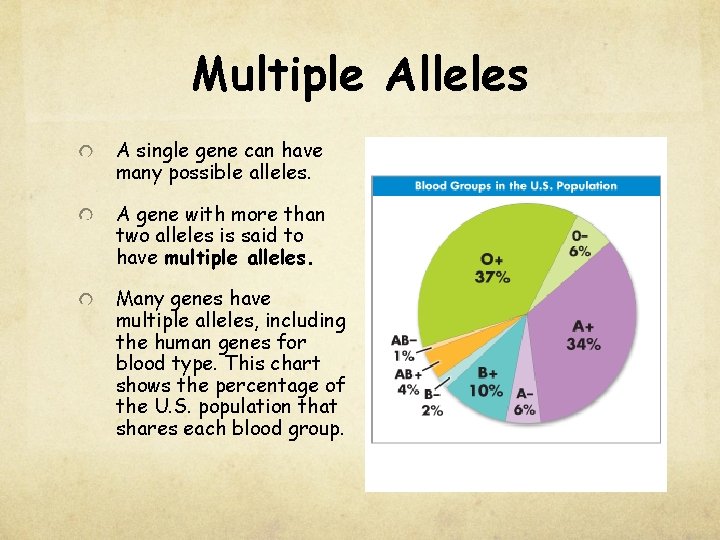
Multiple Alleles A single gene can have many possible alleles. A gene with more than two alleles is said to have multiple alleles. Many genes have multiple alleles, including the human genes for blood type. This chart shows the percentage of the U. S. population that shares each blood group.
Polygenic Traits controlled by two or more genes are said to be polygenic traits. Polygenic means “many genes. ” Polygenic traits often show a wide range of phenotypes. The variety of skin color in humans comes about partly because more than four different genes probably control this trait
Genes and the Environmental conditions can affect gene expression and influence genetically determined traits. The characteristics of any organism are not determined solely by the genes that organism inherits. Genes provide a plan for development, but how that plan unfolds also depends on the environment. The phenotype of an organism is only partly determined by its genotype.
Meiosis Chapter 11, Section 4
Chromosome Number The diploid cells of most adult organisms contain two complete sets of inherited chromosomes and two complete sets of genes. Chromosomes—those strands of DNA and protein inside the cell nucleus—are the carriers of genes. The genes are located in specific positions on chromosomes.
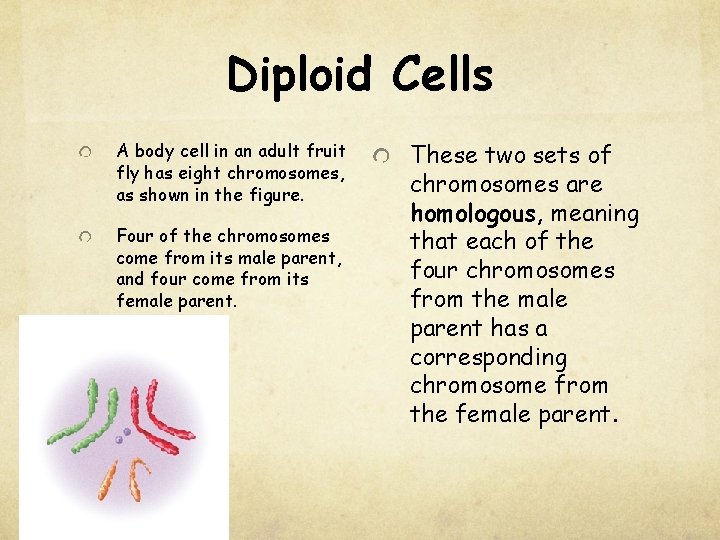
Diploid Cells A body cell in an adult fruit fly has eight chromosomes, as shown in the figure. Four of the chromosomes come from its male parent, and four come from its female parent. These two sets of chromosomes are homologous, meaning that each of the four chromosomes from the male parent has a corresponding chromosome from the female parent.
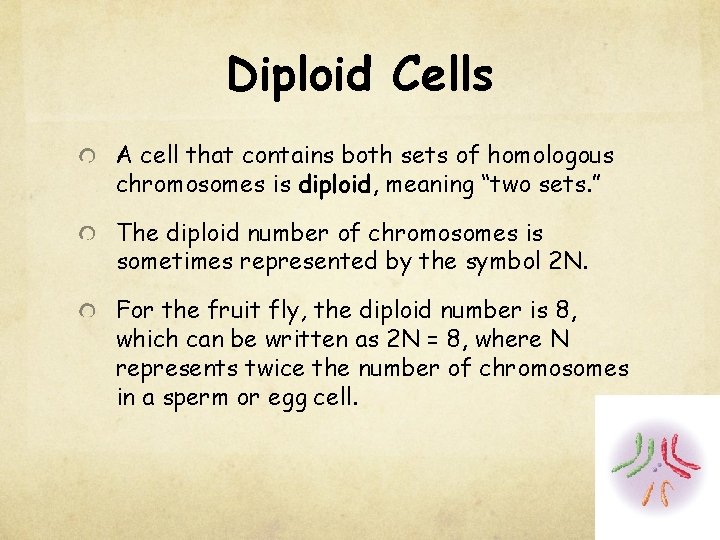
Diploid Cells A cell that contains both sets of homologous chromosomes is diploid, meaning “two sets. ” The diploid number of chromosomes is sometimes represented by the symbol 2 N. For the fruit fly, the diploid number is 8, which can be written as 2 N = 8, where N represents twice the number of chromosomes in a sperm or egg cell.
Haploid Cells Some cells contain only a single set of chromosomes, and therefore a single set of genes. Such cells are haploid, meaning “one set. ” The gametes of sexually reproducing organisms are haploid. For fruit fly gametes, the haploid number is 4, which can be written as N = 4.
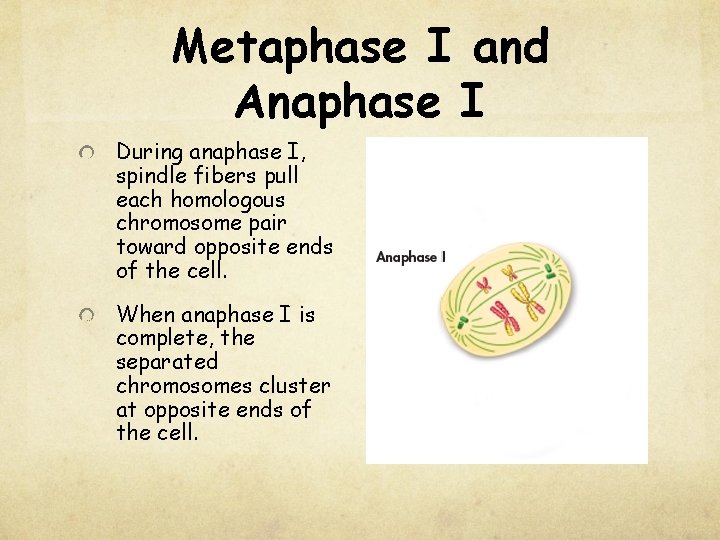
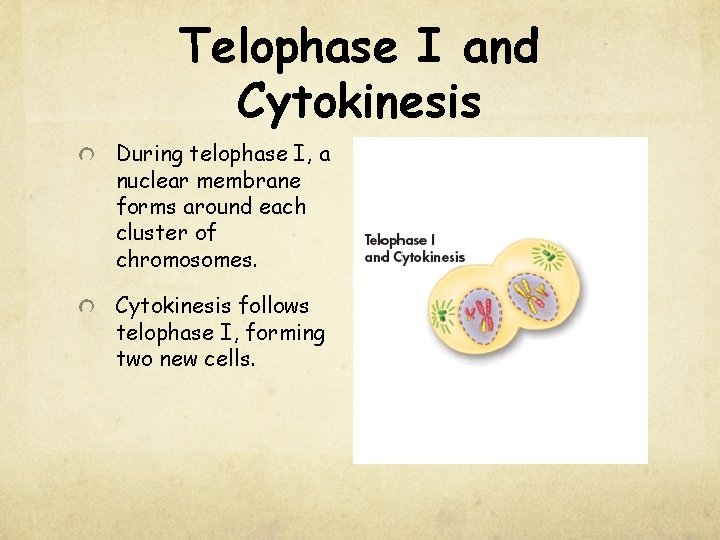
Phases of Meiosis In prophase I of meiosis, each replicated chromosome pairs with its corresponding homologous chromosome. During metaphase I of meiosis, paired homologous chromosomes line up across the center of the cell. During anaphase I, spindle fibers pull each homologous chromosome pair toward opposite ends of the cell. In telophase I, a nuclear membrane forms around each cluster of chromosomes. Cytokinesis follows telophase I, forming two new cells.
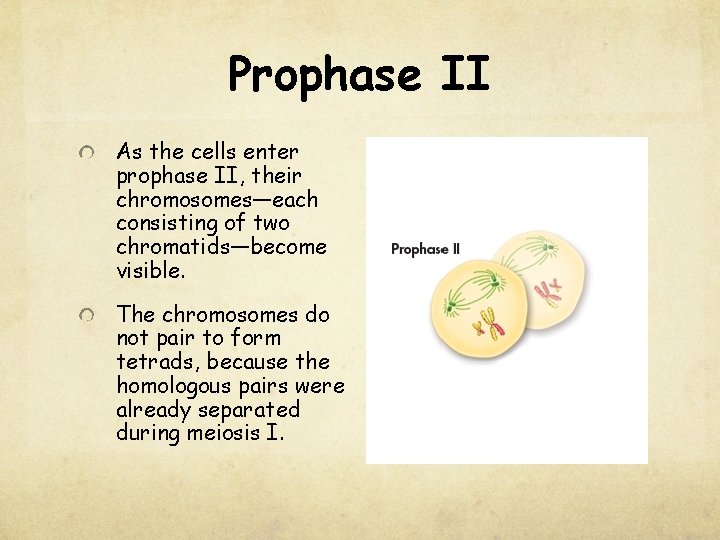
Phases of Meiosis As the cells enter prophase II, their chromosomes—each consisting of two chromatids—become visible. The final four phases of meiosis II are similar to those in meiosis I. However, the result is four haploid daughter cells.
Phases of Meiosis is a process in which the number of chromosomes per cell is cut in half through the separation of homologous chromosomes in a diploid cell. Meiosis usually involves two distinct divisions, called meiosis I and meiosis II. By the end of meiosis II, the diploid cell becomes four haploid cells.
Meiosis I Just prior to meiosis I, the cell undergoes a round of chromosome replication called interphase I Each replicated chromosome consists of two identical chromatids joined at the center.
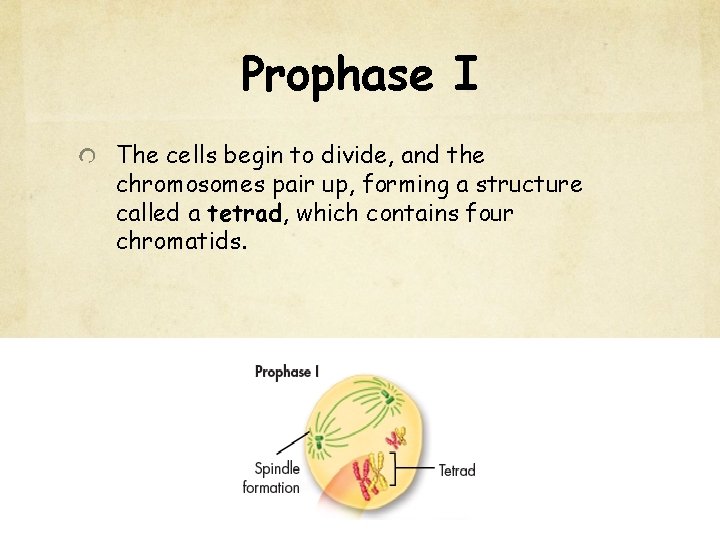
Prophase I The cells begin to divide, and the chromosomes pair up, forming a structure called a tetrad, which contains four chromatids.
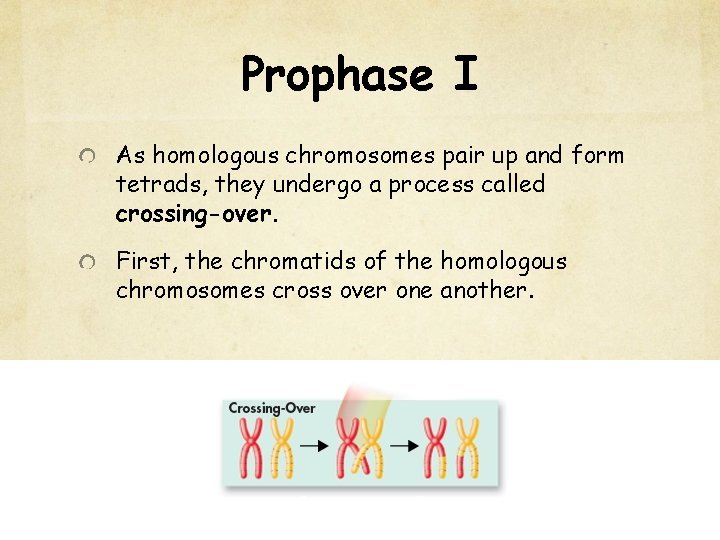
Prophase I As homologous chromosomes pair up and form tetrads, they undergo a process called crossing-over. First, the chromatids of the homologous chromosomes cross over one another.
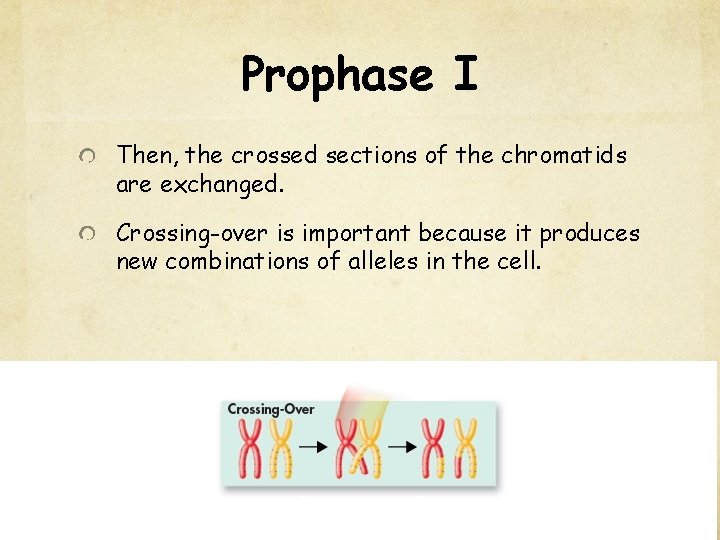
Prophase I Then, the crossed sections of the chromatids are exchanged. Crossing-over is important because it produces new combinations of alleles in the cell.
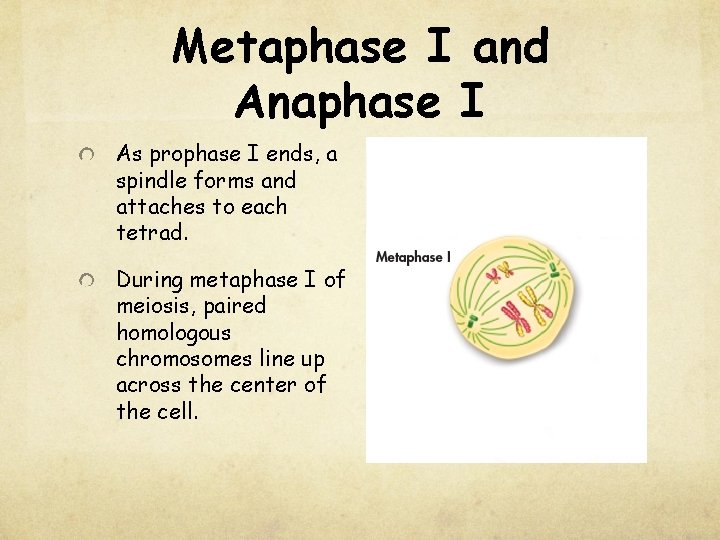
Metaphase I and Anaphase I As prophase I ends, a spindle forms and attaches to each tetrad. During metaphase I of meiosis, paired homologous chromosomes line up across the center of the cell.
Metaphase I and Anaphase I During anaphase I, spindle fibers pull each homologous chromosome pair toward opposite ends of the cell. When anaphase I is complete, the separated chromosomes cluster at opposite ends of the cell.
Telophase I and Cytokinesis During telophase I, a nuclear membrane forms around each cluster of chromosomes. Cytokinesis follows telophase I, forming two new cells.
Meiosis I results in two cells, called daughter cells, each of which has four chromatids, as it would after mitosis. Because each pair of homologous chromosomes was separated, neither daughter cell has the two complete sets of chromosomes that it would have in a diploid cell. The two cells produced by meiosis I have sets of chromosomes and alleles that are different from each other and from the diploid cell that entered meiosis I.
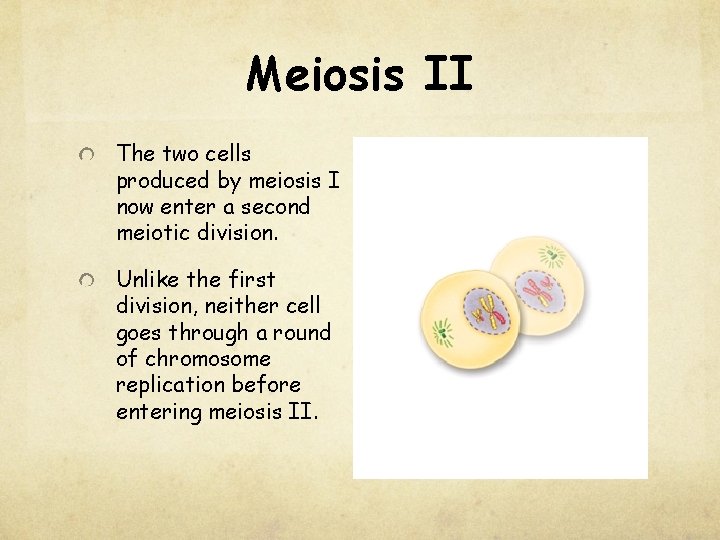
Meiosis II The two cells produced by meiosis I now enter a second meiotic division. Unlike the first division, neither cell goes through a round of chromosome replication before entering meiosis II.
Prophase II As the cells enter prophase II, their chromosomes—each consisting of two chromatids—become visible. The chromosomes do not pair to form tetrads, because the homologous pairs were already separated during meiosis I.
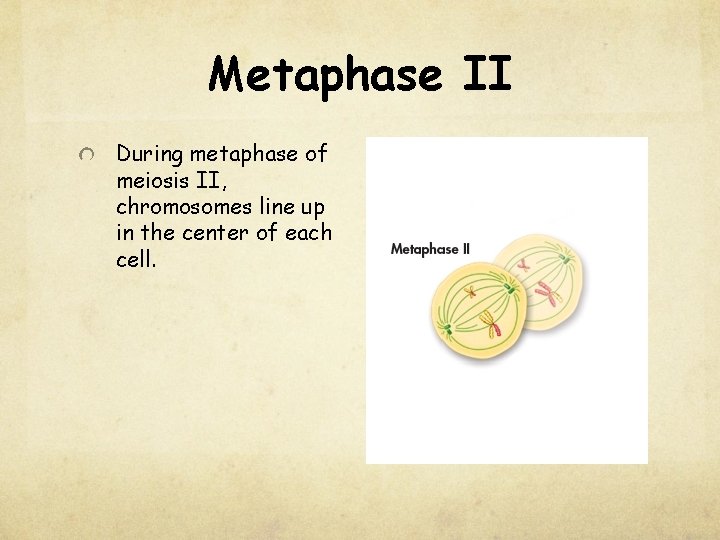
Metaphase II During metaphase of meiosis II, chromosomes line up in the center of each cell.
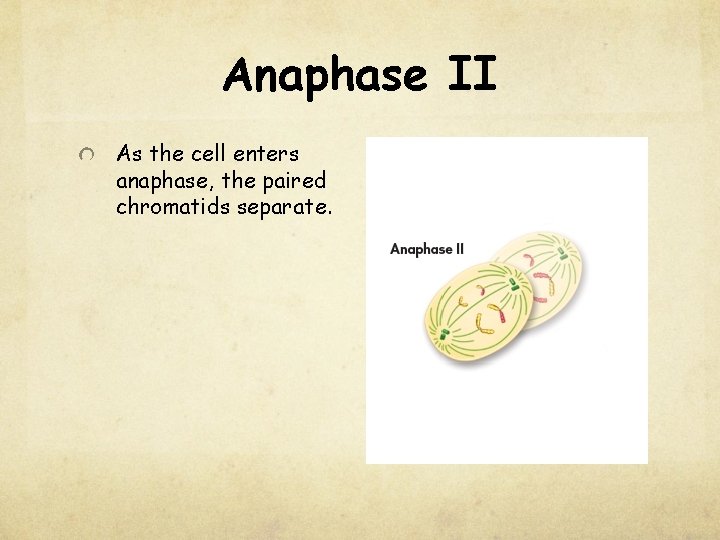
Anaphase II As the cell enters anaphase, the paired chromatids separate.
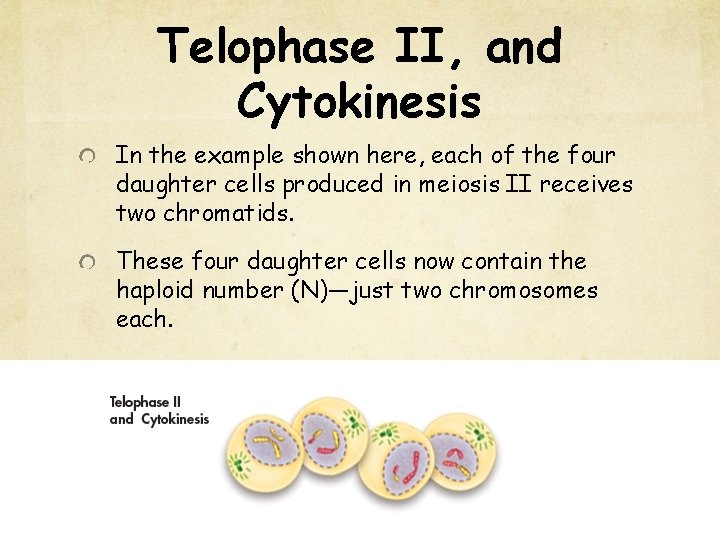
Telophase II, and Cytokinesis In the example shown here, each of the four daughter cells produced in meiosis II receives two chromatids. These four daughter cells now contain the haploid number (N)—just two chromosomes each.
Gametes to Zygotes The haploid cells produced by meiosis II are gametes. In male animals, these gametes are called sperm. In some plants, pollen grains contain haploid sperm cells. In female animals, generally one of the cells produced by meiosis is involved in reproduction. The female gamete is called an egg in animals and an egg cell in some plants.
Gametes to Zygotes Fertilization—the fusion of male and female gametes—generates new combinations of alleles in a zygote. The zygote undergoes cell division by mitosis and eventually forms a new organism.