
The Womens Suffrage Movement in the United States
- Slides: 26
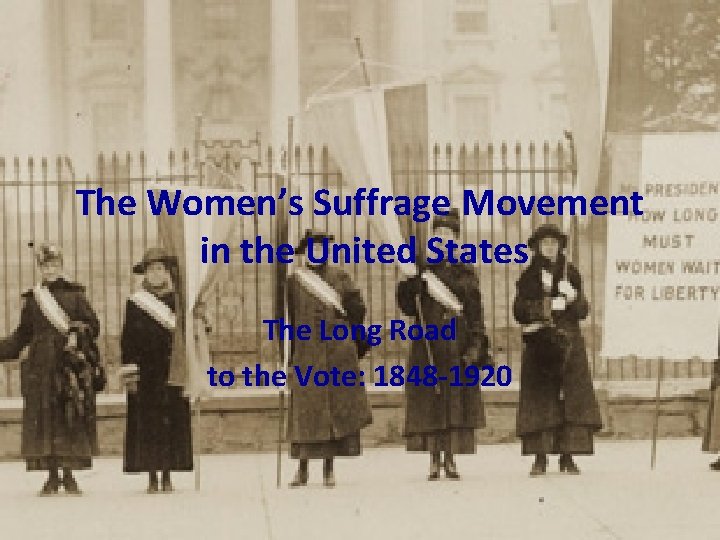
The Women’s Suffrage Movement in the United States The Long Road to the Vote: 1848 -1920
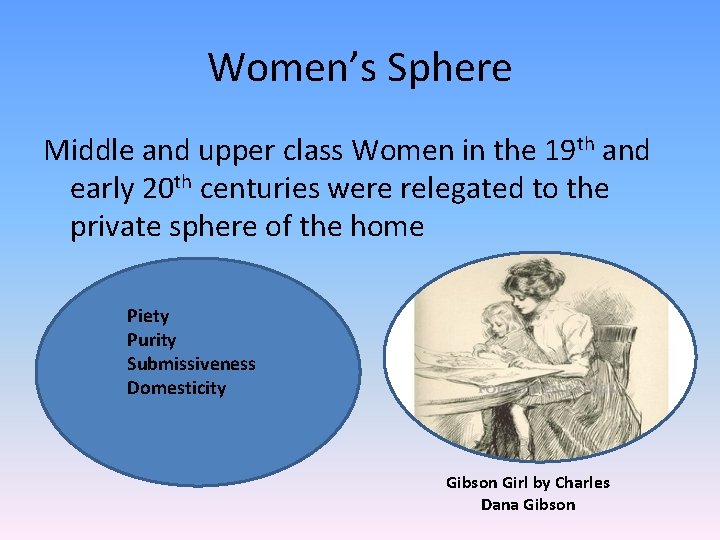
Women’s Sphere Middle and upper class Women in the 19 th and early 20 th centuries were relegated to the private sphere of the home Piety Purity Submissiveness Domesticity Gibson Girl by Charles Dana Gibson
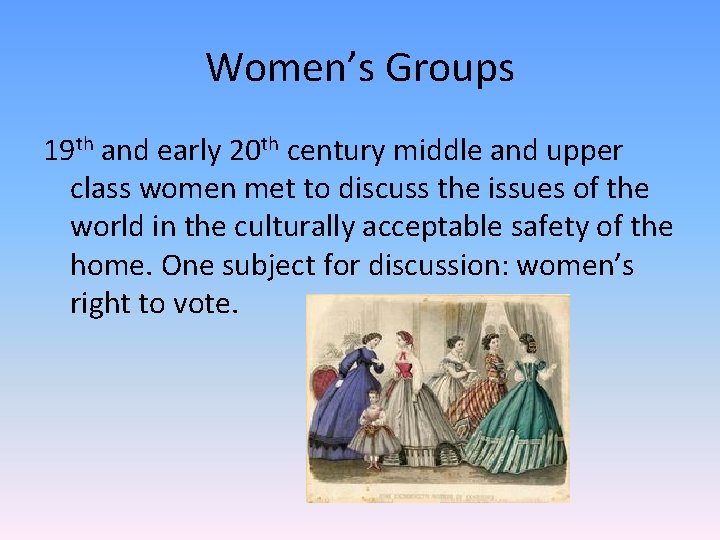
Women’s Groups 19 th and early 20 th century middle and upper class women met to discuss the issues of the world in the culturally acceptable safety of the home. One subject for discussion: women’s right to vote.
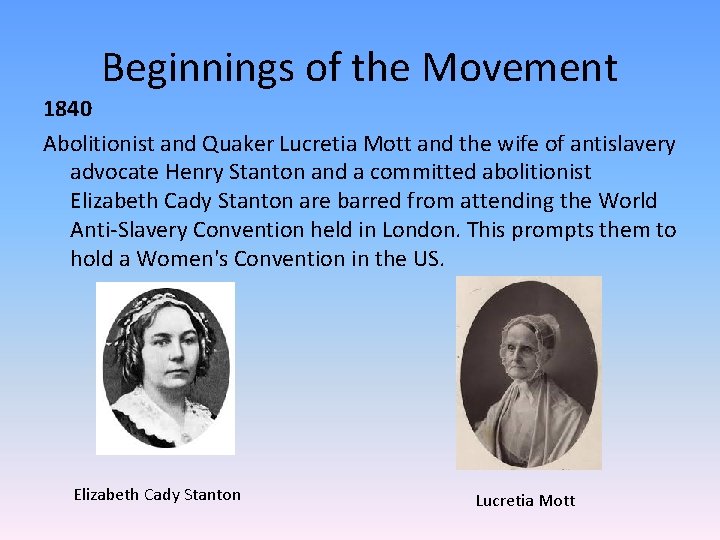
Beginnings of the Movement 1840 Abolitionist and Quaker Lucretia Mott and the wife of antislavery advocate Henry Stanton and a committed abolitionist Elizabeth Cady Stanton are barred from attending the World Anti-Slavery Convention held in London. This prompts them to hold a Women's Convention in the US. Elizabeth Cady Stanton Lucretia Mott
Seneca Falls, New York – The beginning of the Road to Suffrage 1848 • Seneca Falls, New York is the location for the first Women's Rights Convention. Elizabeth Cady Stanton writes "The Declaration of Sentiments" creating the agenda of women's activism for decades to come. • Advertised as "a convention to discuss the social, civil, and religious condition and rights of woman"
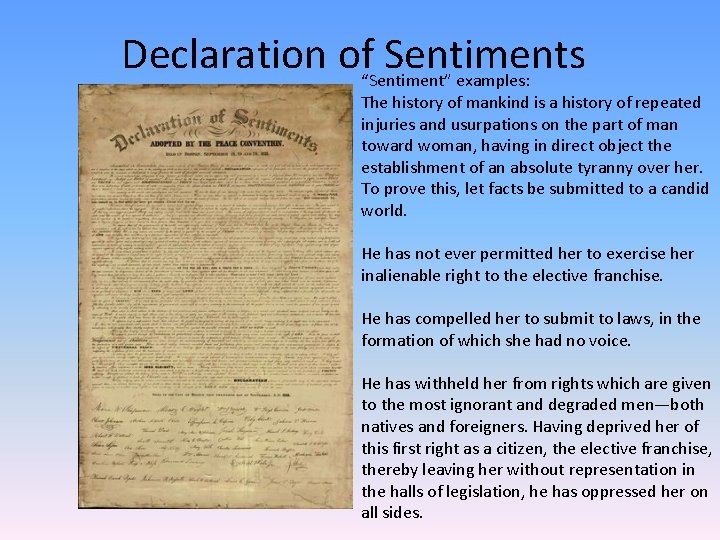
Declaration of“Sentiment” Sentiments examples: The history of mankind is a history of repeated injuries and usurpations on the part of man toward woman, having in direct object the establishment of an absolute tyranny over her. To prove this, let facts be submitted to a candid world. He has not ever permitted her to exercise her inalienable right to the elective franchise. He has compelled her to submit to laws, in the formation of which she had no voice. He has withheld her from rights which are given to the most ignorant and degraded men—both natives and foreigners. Having deprived her of this first right as a citizen, the elective franchise, thereby leaving her without representation in the halls of legislation, he has oppressed her on all sides.
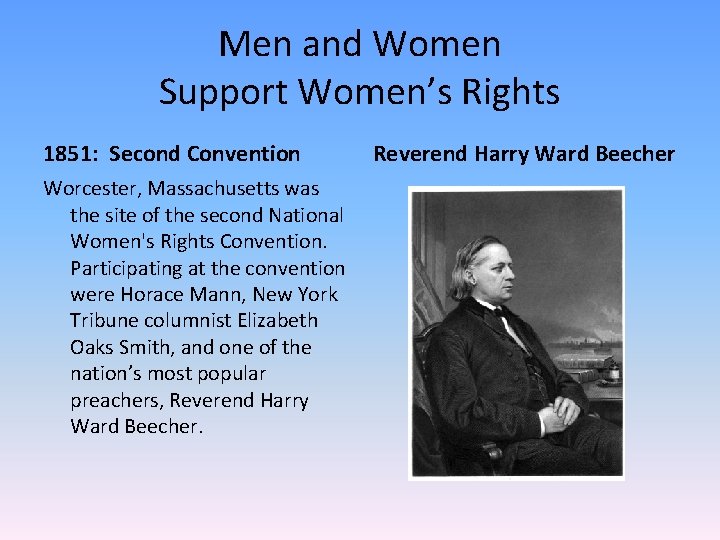
Men and Women Support Women’s Rights 1851: Second Convention Worcester, Massachusetts was the site of the second National Women's Rights Convention. Participating at the convention were Horace Mann, New York Tribune columnist Elizabeth Oaks Smith, and one of the nation’s most popular preachers, Reverend Harry Ward Beecher
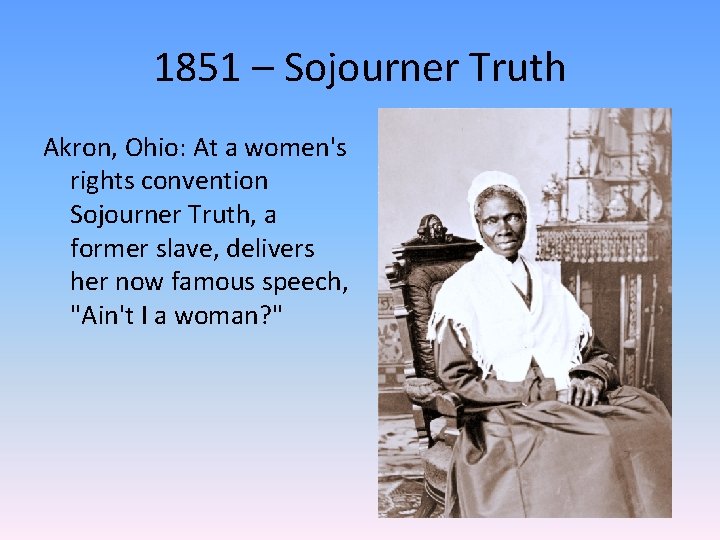
1851 – Sojourner Truth Akron, Ohio: At a women's rights convention Sojourner Truth, a former slave, delivers her now famous speech, "Ain't I a woman? "
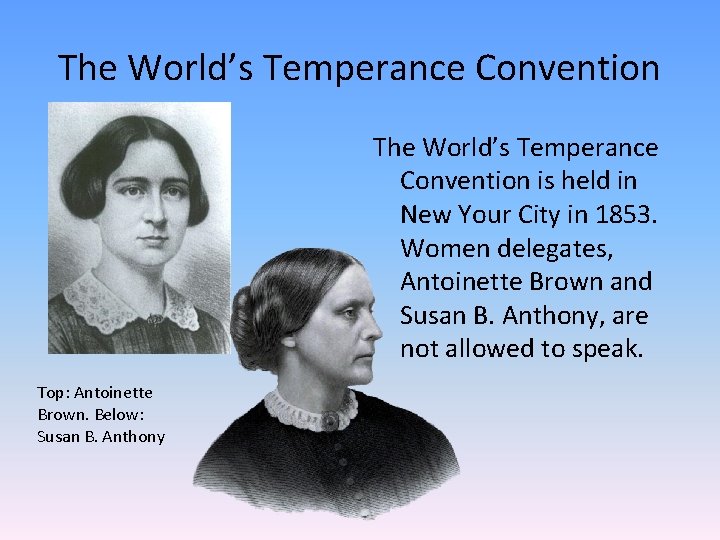
The World’s Temperance Convention is held in New Your City in 1853. Women delegates, Antoinette Brown and Susan B. Anthony, are not allowed to speak. Top: Antoinette Brown. Below: Susan B. Anthony
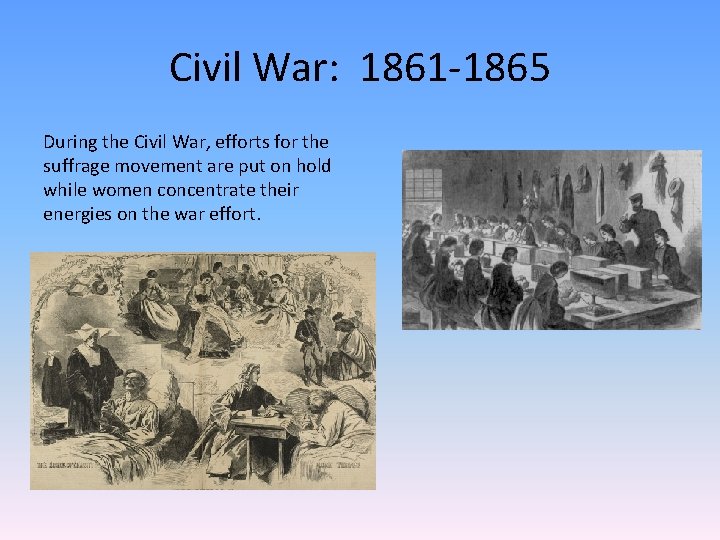
Civil War: 1861 -1865 During the Civil War, efforts for the suffrage movement are put on hold while women concentrate their energies on the war effort.
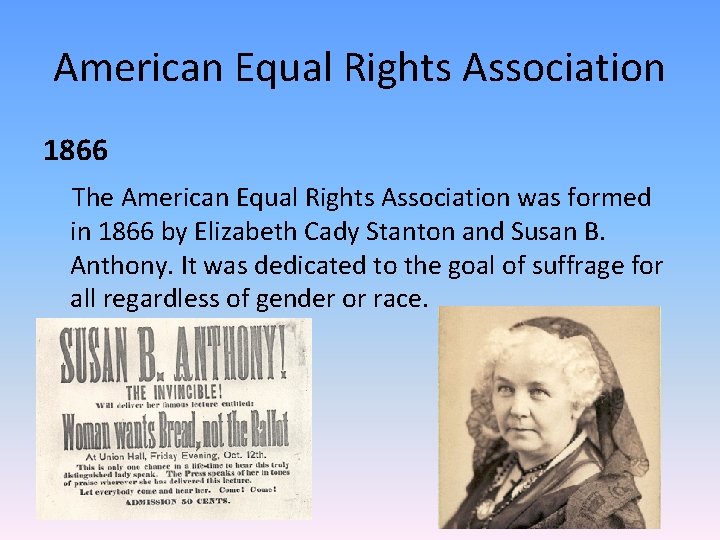
American Equal Rights Association 1866 The American Equal Rights Association was formed in 1866 by Elizabeth Cady Stanton and Susan B. Anthony. It was dedicated to the goal of suffrage for all regardless of gender or race.
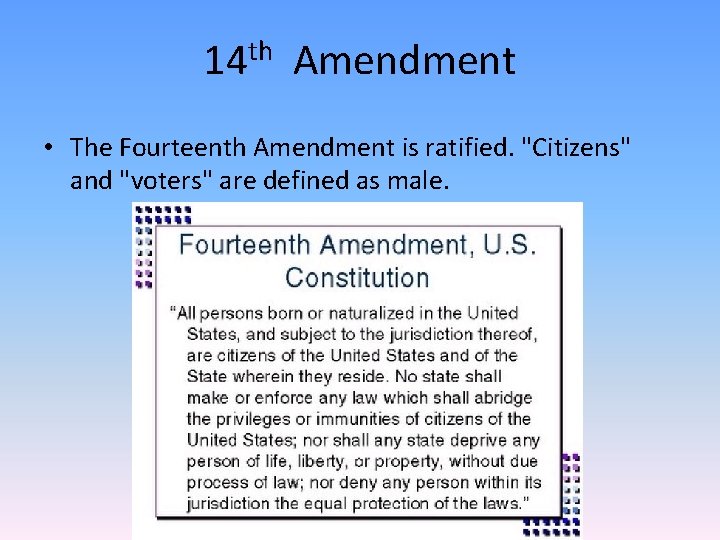
14 th Amendment • The Fourteenth Amendment is ratified. "Citizens" and "voters" are defined as male.
The Suffrage Movement Divisions over the 14 th and 15 th Amendments 1869 The American Equal Rights Association is divided by disagreements over the Fourteenth Amendment of whether to support the proposed Fifteenth Amendment which would enfranchise Black American males while avoiding woman suffrage entirely. Based in New York: Elizabeth Cady Stanton and Susan B. Anthony found the National Woman Suffrage Association (NWSA). This organization was the more radical institution, pursuing to achieve the vote through a Constitutional amendment and additional woman’s rights issues. Based in Boston: Lucy Stone, Henry Blackwell, Julia Ward Howe and other more conservative activists form the American Woman Suffrage Association (AWSA) to work for woman suffrage through amending individual state constitutions.
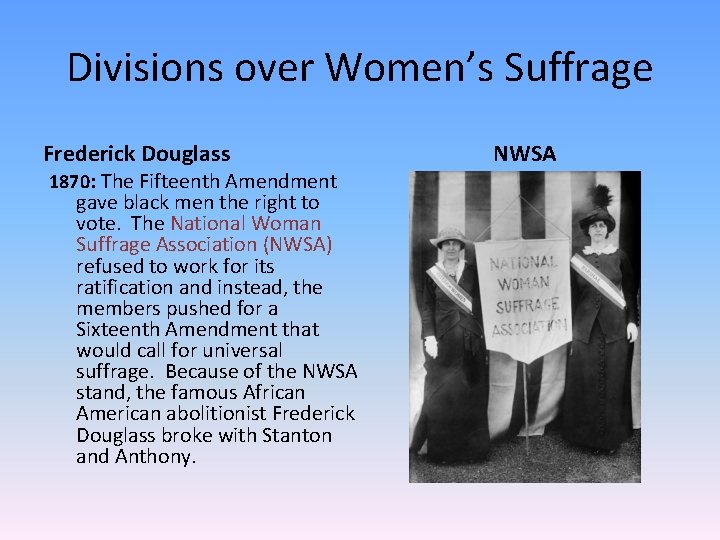
Divisions over Women’s Suffrage Frederick Douglass 1870: The Fifteenth Amendment gave black men the right to vote. The National Woman Suffrage Association (NWSA) refused to work for its ratification and instead, the members pushed for a Sixteenth Amendment that would call for universal suffrage. Because of the NWSA stand, the famous African American abolitionist Frederick Douglass broke with Stanton and Anthony. NWSA
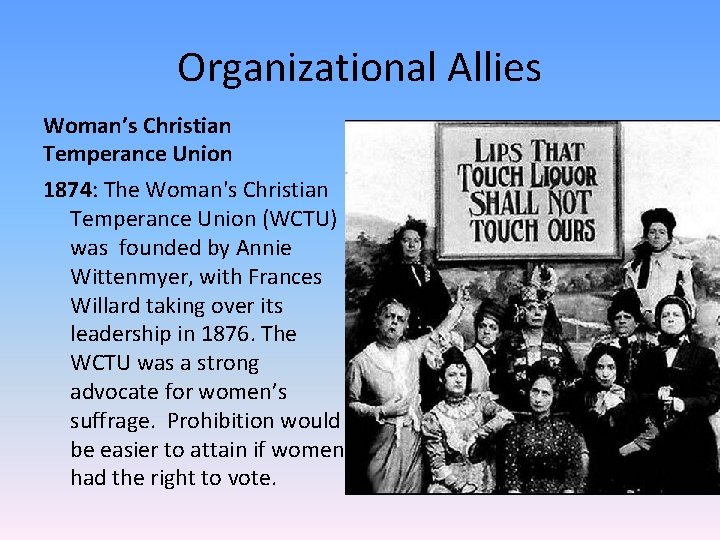
Organizational Allies Woman’s Christian Temperance Union 1874: The Woman's Christian Temperance Union (WCTU) was founded by Annie Wittenmyer, with Frances Willard taking over its leadership in 1876. The WCTU was a strong advocate for women’s suffrage. Prohibition would be easier to attain if women had the right to vote.
Healing the Division 1890: The National Woman Suffrage Association (NWSA) and American Woman Suffrage Association (AWSA) merge to form the National American Woman Suffrage Association. Elizabeth Cady Stanton is the first president. The NAWSA focuses efforts on attaining suffrage at the state level.
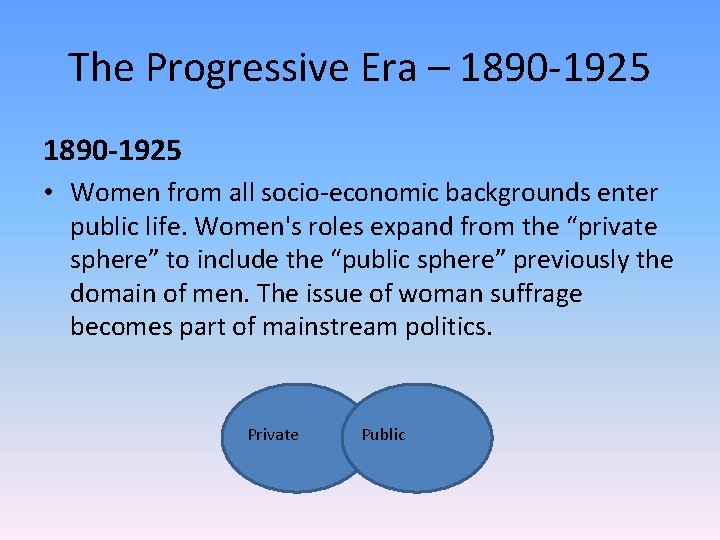
The Progressive Era – 1890 -1925 • Women from all socio-economic backgrounds enter public life. Women's roles expand from the “private sphere” to include the “public sphere” previously the domain of men. The issue of woman suffrage becomes part of mainstream politics. Private Public
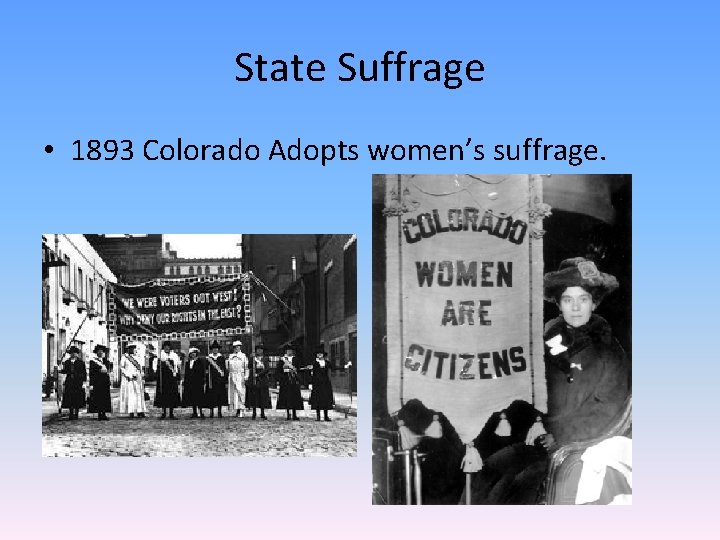
State Suffrage • 1893 Colorado Adopts women’s suffrage.
States’ Suffrage 1896: Utah joins the Union with full suffrage for women. 1896: Idaho adopts woman suffrage. 1910: Washington State adopts woman suffrage. 1911: California women win the right to vote. 1912: Oregon, Kansas, and Arizona adopt woman suffrage. 1914: Nevada and Montana adopt woman suffrage.
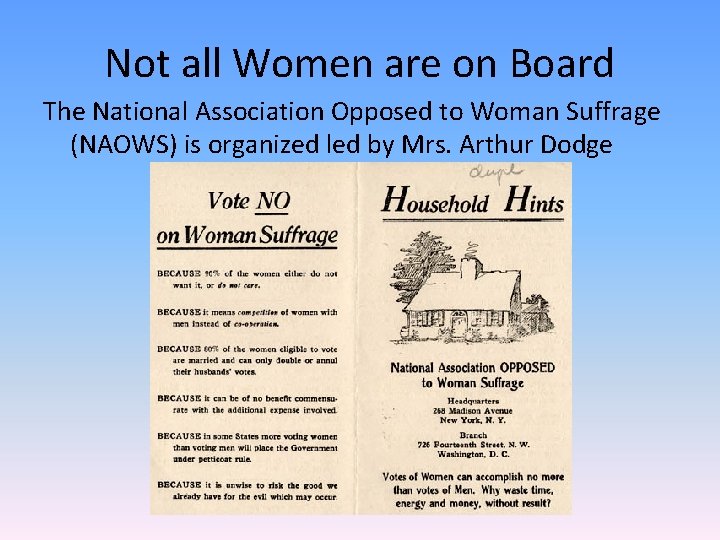
Not all Women are on Board The National Association Opposed to Woman Suffrage (NAOWS) is organized led by Mrs. Arthur Dodge
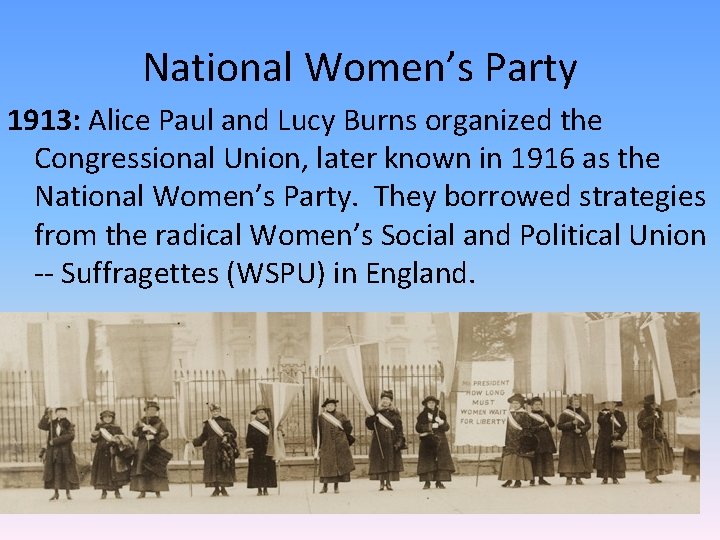
National Women’s Party 1913: Alice Paul and Lucy Burns organized the Congressional Union, later known in 1916 as the National Women’s Party. They borrowed strategies from the radical Women’s Social and Political Union -- Suffragettes (WSPU) in England.
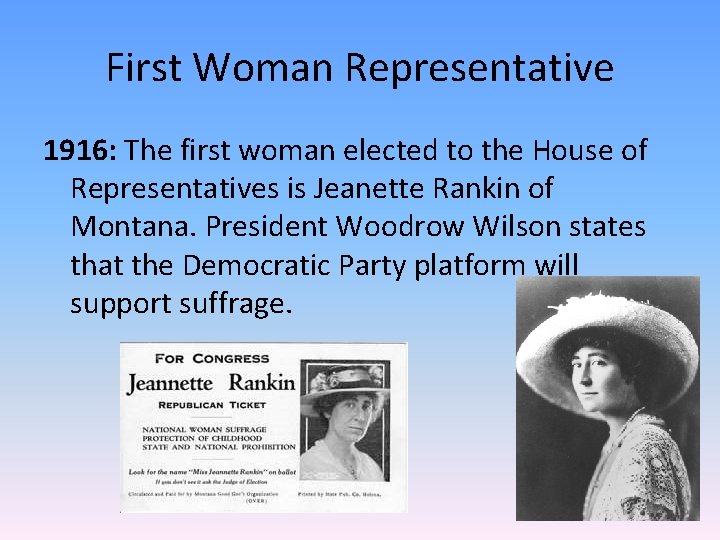
First Woman Representative 1916: The first woman elected to the House of Representatives is Jeanette Rankin of Montana. President Woodrow Wilson states that the Democratic Party platform will support suffrage.
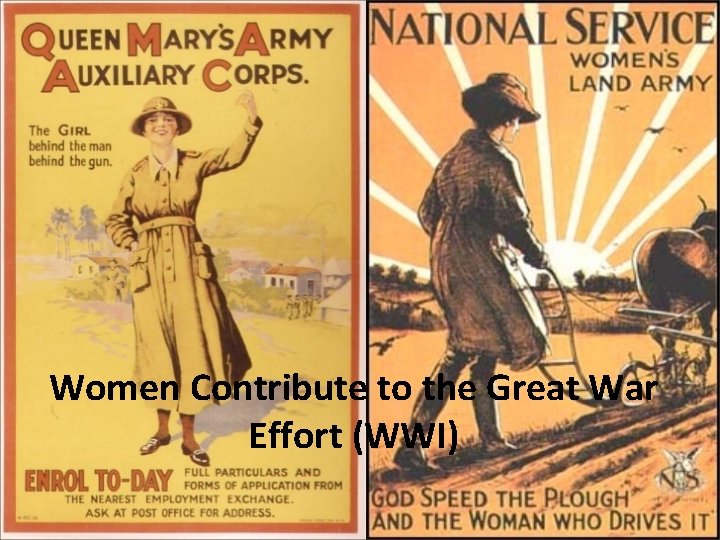
Women Contribute to the Great War Effort (WWI)
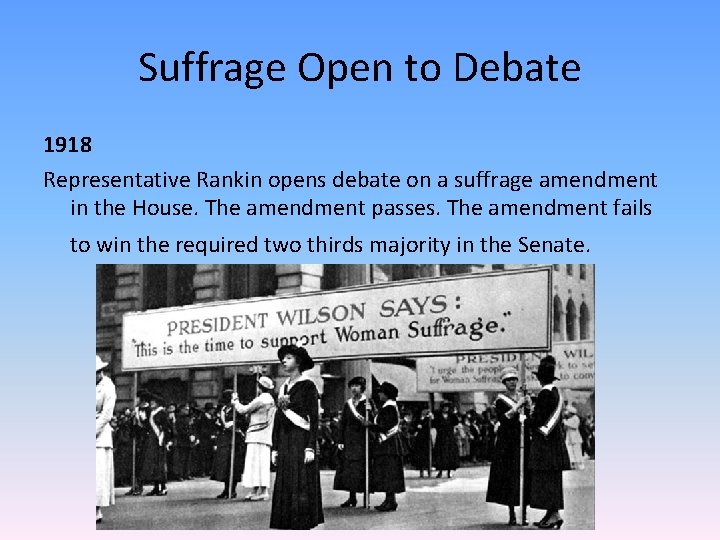
Suffrage Open to Debate 1918 Representative Rankin opens debate on a suffrage amendment in the House. The amendment passes. The amendment fails to win the required two thirds majority in the Senate.
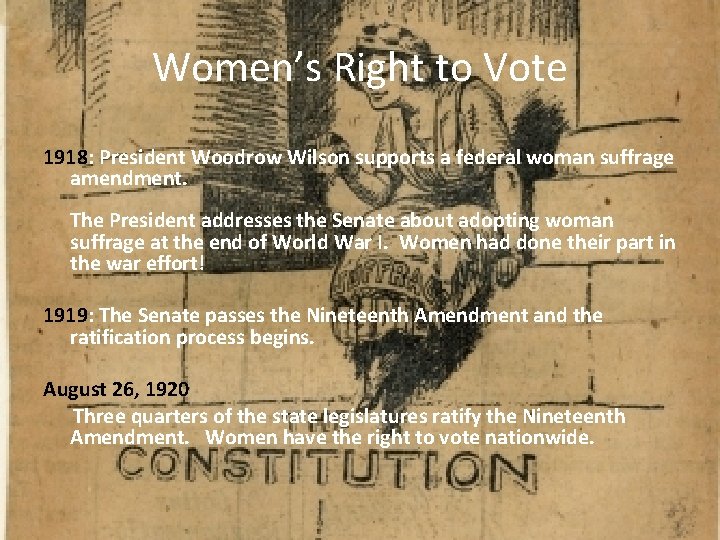
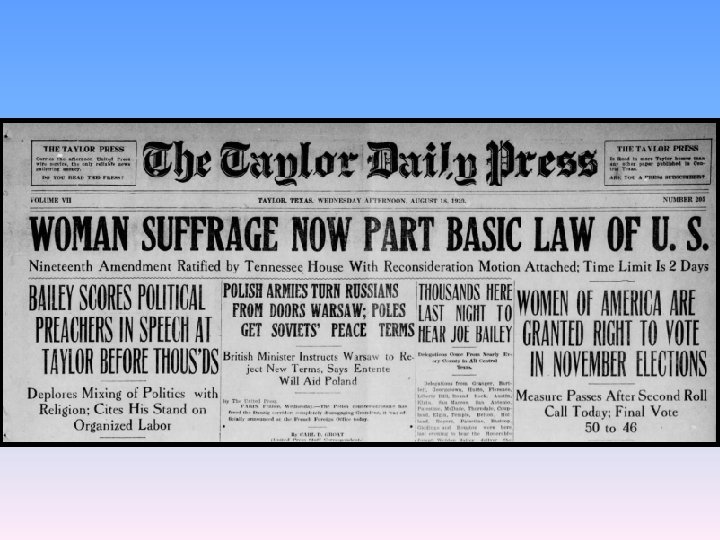
Women’s Right to Vote 1918: President Woodrow Wilson supports a federal woman suffrage amendment. The President addresses the Senate about adopting woman suffrage at the end of World War I. Women had done their part in the war effort! 1919: The Senate passes the Nineteenth Amendment and the ratification process begins. August 26, 1920 Three quarters of the state legislatures ratify the Nineteenth Amendment. Women have the right to vote nationwide.