
The Wireless Embedded Internet Protocol IPV 6 Contents
The Wireless Embedded Internet Protocol (IPV 6)
Contents �Introduction to 6 Lo. WPAN � 6 Lo. WPAN Architecture �Basic 6 Lo. WPAN Format �Addressing �MQ telemetry transport for sensor networks(MQTT-S) �Zig. Bee compact application protocol �Contiki and Uipv 6 �Wireless RFID infrastructure
Introduction “ 6 Lo. WPAN” name implies “IPV 6 over Low-Power Wireless Personal Area Networks”. 6 Lo. WPAN is a networking technology or adaptation layer that allows IPv 6 packets to be carried efficiently within small link layer frames, such as those defined by IEEE 802. 15. 4 Low-power. RF+IPV 6=Wireless Embedded Internet The 6 Lo. WPAN technology is nothing but a simple wireless mesh technology that makes the individual nodes IP-enabled. This typically involves IEEE 802. 15. 4 nodes apart as the IEEE 802. 15. 4 network In Internet of things network stack don't support IPV 6 packet of length 1280 Bytes therefore 6 Low. PAN being an adaptation layer create chunks of IPV 6 packet and make it compatible with Network stack and communicating with outer world using 6 Low. PAN and transform it into full length IPV 6 Packet. What is a personal area networks? A personal area network (PAN) is the interconnection of information technology devices within the range of an individual person, typically within a range of 10 meters. For example, a person traveling with a laptop, a personal digital assistant (PDA), and a portable printer could interconnect them without having to plug anything in, using some form of wireless technology. Typically, this kind of personal area network could also be interconnected without the wires to the Internet or other networks.
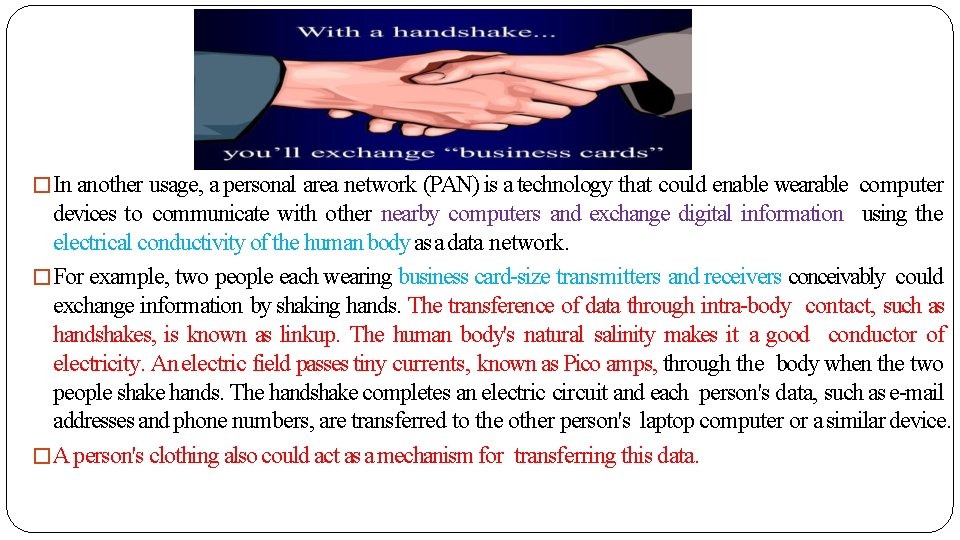
�In another usage, a personal area network (PAN) is a technology that could enable wearable computer devices to communicate with other nearby computers and exchange digital information using the electrical conductivity of the human body as a data network. �For example, two people each wearing business card-size transmitters and receivers conceivably could exchange information by shaking hands. The transference of data through intra-body contact, such as handshakes, is known as linkup. The human body's natural salinity makes it a good conductor of electricity. An electric field passes tiny currents, known as Pico amps, through the body when the two people shake hands. The handshake completes an electric circuit and each person's data, such as e-mail addresses and phone numbers, are transferred to the other person's laptop computer or a similar device. �A person's clothing also could act as a mechanism for transferring this data.
What 6 Lo. WPAN means? �In simple words 6 Lo. WPAN (IPv 6 over Low-Power Wireless Personal Area Networks), is a wireless mesh network with low-power, where every node have its own IPv 6 address, which allows it to connect directly with the Internet using open standards. With 6 Lo. WPAN, it’s possible to connect more things to the cloud. This technology is great option to use it with Io. T (Internet of Things) applications. �In other words you can say, it’s a simple low throughput wireless network which consists of low cost and low power devices. Devices connected with this network typically works together in order to connect the physical environment to real world applications for example, wireless sensors networks. Some of the common topologies it includes are like star, mesh, and combinations of star and mesh. �No doubt 6 Lo. WPAN is quite new, but still some of its characteristics makes it an ideal solutions for the market like home automation with sensors and actuators, street light monitoring and control, lighting of residential places, smart metering and generic Io. T applications with Internet connected devices. �The concept of 6 Lo. WPAN came into existence from the idea of "the Internet Protocol could and should be applied even to the smallest devices, and that low-power devices with limited processing capabilities should be able to participate in the Io. T (Internet of Things).
Characteristics of 6 Lo. WPAN: Some of the characteristics of 6 Lo. WPAN are like, � it’s of small packet size, and �media access control addresses are of 16 -bit short or IEEE 64 -bit. � It offers low bandwidth generally anywhere 250/40/20 kbps. �Usually it’s a battery operated as it uses low power and �it’s quite affordable as its price are bit low. � 6 Lo. WPAN is an IETF (Internet Engineering Task Force) Protocol designed for “Transmission of IPv 6 Packets over IEEE 802. 15. 4 Networks
Advantages of 6 Lo. WPAN: Open IP standard �Open standards including TCP, UDP, HTTP, COAP, MQTT, and web sockets �End-to-end IP addressable nodes �No gateway needed Mesh routing �One-to-many and many-to-one routing �Robust and scalable �Self-healing �Mesh routers can route data destined to others, while hosts are able to sleep for long periods of time Multiple PHY support �Freedom of frequency band &physical layer �Use across multiple communications platforms (i. e. Ethernet /Wi-Fi® / 802. 15. 4 / Sub-1 GHz ISM) �Interoperability at the IP level
Differences: �Zig. Bee VS 6 Lo. WPAN: �The Zig. Bee devices can't communicate directly with other devices over internet, it seeks additional mechanism where as 6 Low. PAN devices can communicate with other devices over the internet. Networks of Zig. Bee are managed through coordinator which are responsible to perform applicationlayer protocol translations &send data to servers and when it comes to 6 Low. Pan the servers are able to collect data directly from devices without waiting for coordinators to handle the request. Zig. Bee data transmission is slow compared to 6 Low. PAN. The network layer of IEEE 802. 15. 4 is used for Zig. Bee where as 6 Lo. WPAN uses IPv 6 internet protocol which also supports 2 power 128 IP address. Bluetooth VS 6 Lo. WPAN: �There are some of the obvious difference between these two and they are like, Bluetooth offers range of 100 m where as 6 Lo. WPAN offers 20 m range. 128 -bit AES security is provided for both, whereas Bluetooth uses BLE 4. 0 protocol and 6 Lo. WPAN use IPv 6 over 802. 15.
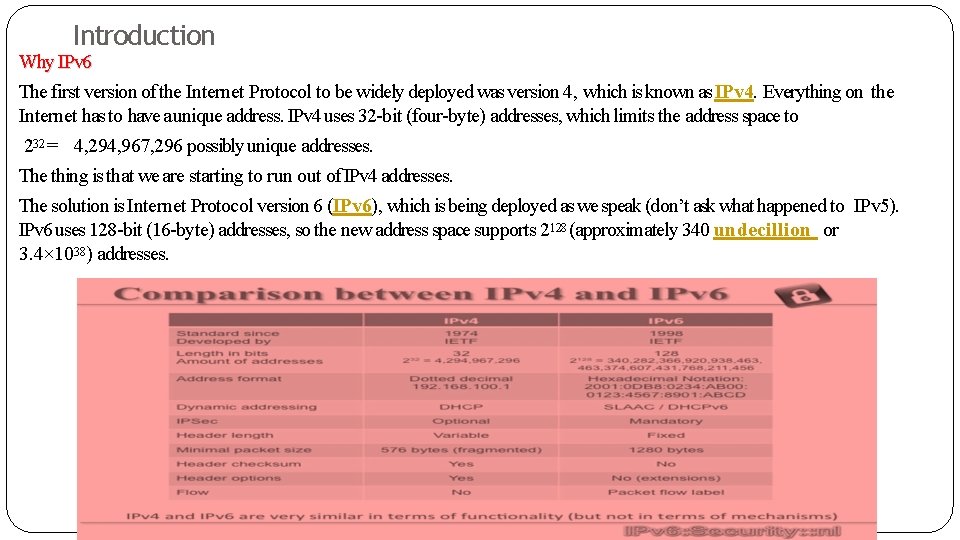
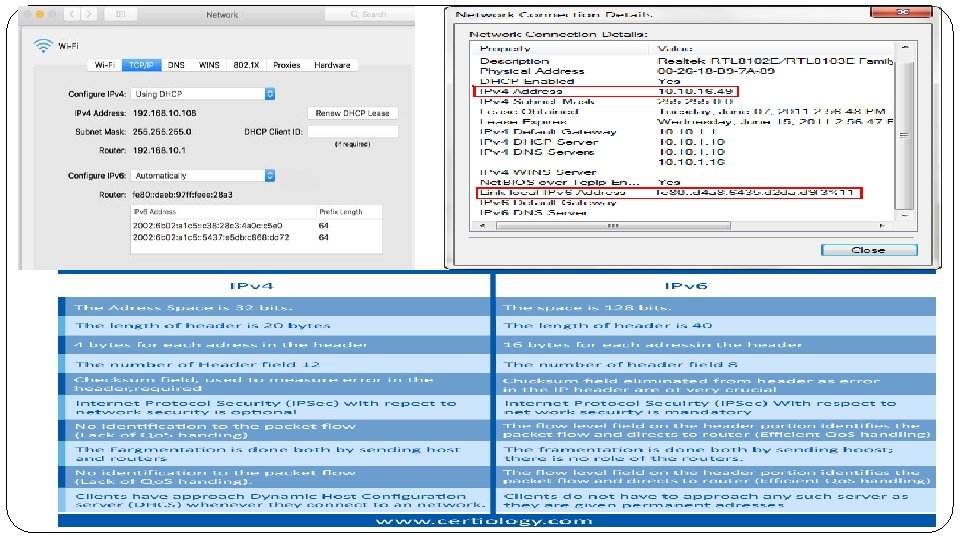
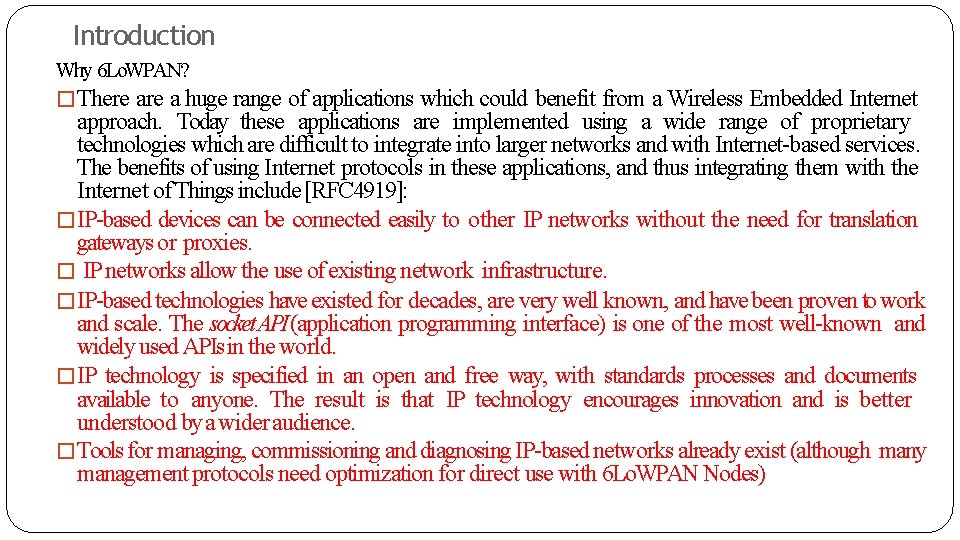
Introduction Why IPv 6 The first version of the Internet Protocol to be widely deployed was version 4, which is known as IPv 4. Everything on the Internet has to have a unique address. IPv 4 uses 32 -bit (four-byte) addresses, which limits the address space to 232 = 4, 294, 967, 296 possibly unique addresses. The thing is that we are starting to run out of IPv 4 addresses. The solution is Internet Protocol version 6 (IPv 6), which is being deployed as we speak (don’t ask what happened to IPv 5). IPv 6 uses 128 -bit (16 -byte) addresses, so the new address space supports 2128 (approximately 340 undecillion or 3. 4× 1038) addresses.
Introduction Why 6 Lo. WPAN? �There a huge range of applications which could benefit from a Wireless Embedded Internet approach. Today these applications are implemented using a wide range of proprietary technologies which are difficult to integrate into larger networks and with Internet-based services. The benefits of using Internet protocols in these applications, and thus integrating them with the Internet of Things include [RFC 4919]: �IP-based devices can be connected easily to other IP networks without the need for translation gateways or proxies. � IP networks allow the use of existing network infrastructure. �IP-based technologies have existed for decades, are very well known, and have been proven to work and scale. The socket API (application programming interface) is one of the most well-known and widely used APIs in the world. �IP technology is specified in an open and free way, with standards processes and documents available to anyone. The result is that IP technology encourages innovation and is better understood by a wider audience. �Tools for managing, commissioning and diagnosing IP-based networks already exist (although many management protocols need optimization for direct use with 6 Lo. WPAN Nodes)
Until now only powerful embedded devices and networks have been able to participate natively with the Internet. Direct communication with traditional IP networks requires many Internet protocols, often requiring an operating system to deal with the complexity and maintainability. Traditional Internet protocols are demanding for embedded devices for the following reasons: �Security: IPv 6 includes optional support for IP Security (IPsec) [RFC 4301] authentication and encryption, and web services typically make use of secure sockets or transport layer security mechanisms. These techniques may be too complex, especially for simple embedded devices. �Web services: Internet services today rely on web-services, mainly using the transmission control protocol (TCP), HTTP, SOAP and XMLwith complex transaction patterns. �Management: Management with the simple network management protocol (SNMP) and webservices is often inefficient and complex. �Frame size: Current Internet protocols require links with sufficient frame length (minimum of 1280 bytes for IPv 6), and heavy application protocols require substantial bandwidth.
Wireless embedded devices and networks are particularly challenging for Internet protocols: �Power and duty-cycle: Battery-powered wireless devices need to keep low duty cycles (the percentage of time active). The basic assumption of IP is that a device is always connected. �Multicast: Wireless embedded radio technologies, such as IEEE 802. 15. 4, do not typically support multicast, and flooding in such a network is wasteful of power and bandwidth. Multicast is crucial to the operation of many IPv 6 features. �Mesh topologies: The applications of wireless embedded radio technology typically benefit from multihop mesh networking to achieve the required coverage and cost efficiency. Current IP routing solutions may not easily be applicable to such networks. �Bandwidth and frame size: Low-power wireless embedded radio technology usually has limited bandwidth (on the order of 20– 250 kbit/s) and frame size (on the order of 40– 200 bytes). In mesh topologies, bandwidth further decreases as the channel is shared and is quickly reduced by multihop forwarding. The IEEE 802. 15. 4 standard has a 127 -byte frame size, with layer-2 payload sizes as low as 72 bytes. The minimum frame size for standard IPv 6 is 1280 bytes [RFC 2460], thus requiring fragmentation. �Reliability: Standard Internet protocols are not optimized for low-power wireless networks. For example, TCP is not able to distinguish between packets dropped because of congestion or packets lost on wireless links. Further unreliability occurs in wireless embedded networks because of node failure, energy exhaustion and sleep duty cycles.
6 LOWPAN HISTORY AND STANDARDIZATION 6 Lo. WPAN is a set of standards defined by the Internet Engineering Task Force (IETF), which creates and maintains all core Internet standards and architecture work. Astraightforward technical definition of 6 Lo. WPAN would be: “ 6 Lo. WPAN standards enable the efficient use of IPv 6 over low-power, low-rate wireless networks on simple embedded devices through an adaptation layer and the optimization of related protocols. ” The IETF 6 Lo. WPAN working group was officially started in 2005. In 1990 s it was assumed that Moore’s law would advance computing and communication capabilities so rapidly that soon any embedded device could implement IP protocols. The IEEE 802. 15. 4 standard released in 2003 was the biggest factor leading to 6 Lo. WPAN standardization. For the first time a global, widely supported standard for low power wireless embedded communications was available [IEEE 802. 15. 4]. The popularity of this new standard gave the Internet community the needed encouragement to standardize an IP adaptation for such wireless embedded links.
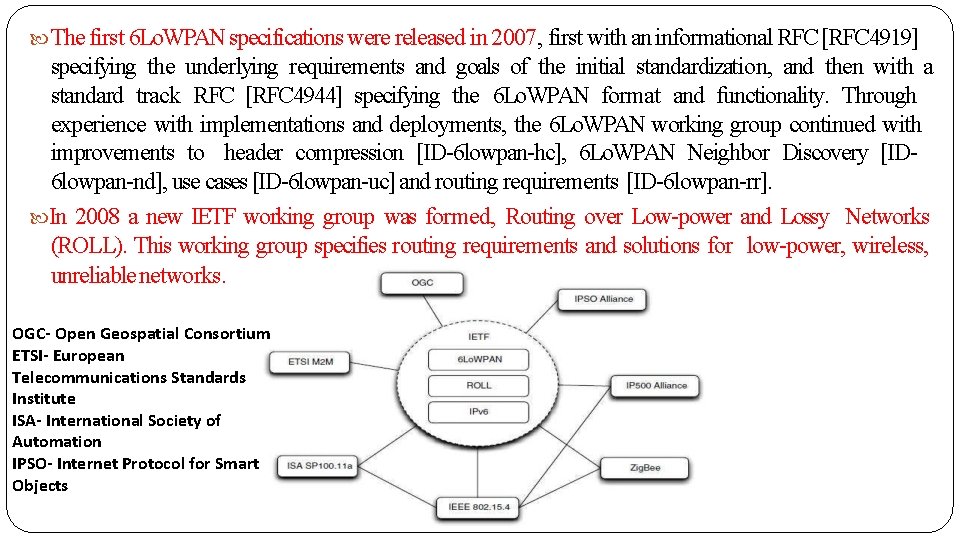
The first 6 Lo. WPAN specifications were released in 2007, first with an informational RFC [RFC 4919] specifying the underlying requirements and goals of the initial standardization, and then with a standard track RFC [RFC 4944] specifying the 6 Lo. WPAN format and functionality. Through experience with implementations and deployments, the 6 Lo. WPAN working group continued with improvements to header compression [ID-6 lowpan-hc], 6 Lo. WPAN Neighbor Discovery [ID 6 lowpan-nd], use cases [ID-6 lowpan-uc] and routing requirements [ID-6 lowpan-rr]. In 2008 a new IETF working group was formed, Routing over Low-power and Lossy Networks (ROLL). This working group specifies routing requirements and solutions for low-power, wireless, unreliable networks. OGC- Open Geospatial Consortium ETSI- European Telecommunications Standards Institute ISA- International Society of Automation IPSO- Internet Protocol for Smart Objects
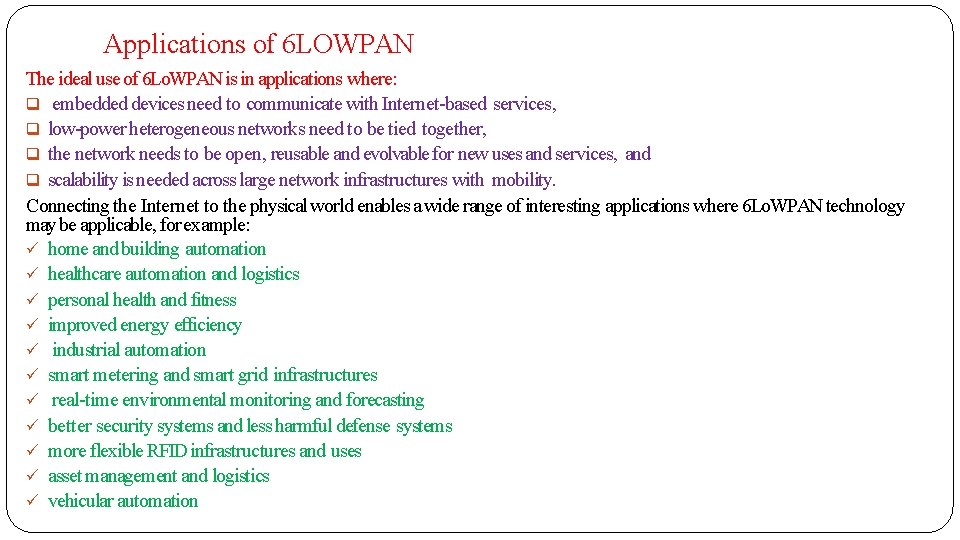
Applications of 6 LOWPAN The ideal use of 6 Lo. WPAN is in applications where: embedded devices need to communicate with Internet-based services, low-power heterogeneous networks need to be tied together, the network needs to be open, reusable and evolvable for new uses and services, and scalability is needed across large network infrastructures with mobility. Connecting the Internet to the physical world enables a wide range of interesting applications where 6 Lo. WPAN technology may be applicable, for example: home and building automation healthcare automation and logistics personal health and fitness improved energy efficiency industrial automation smart metering and smart grid infrastructures real-time environmental monitoring and forecasting better security systems and less harmful defense systems more flexible RFID infrastructures and uses asset management and logistics vehicular automation
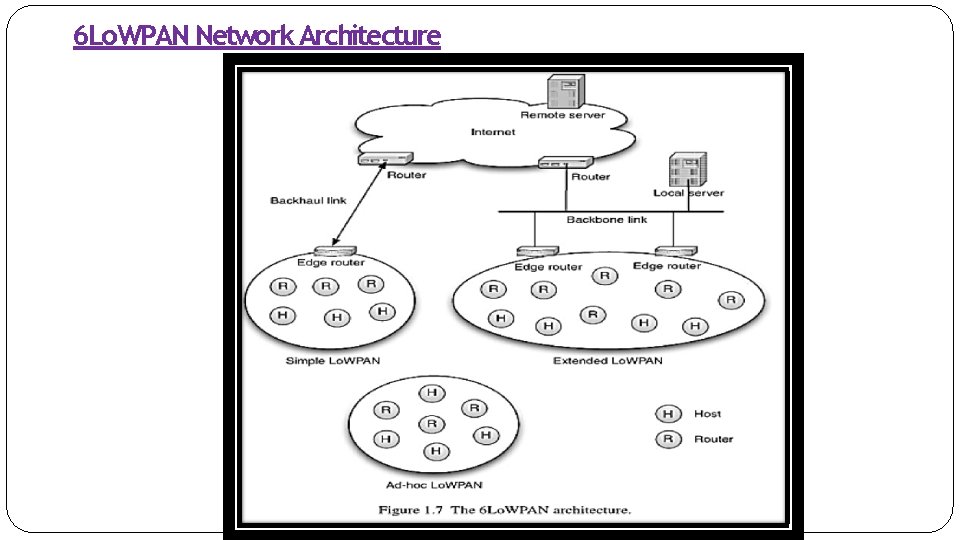
6 Lo. WPAN Network Architecture
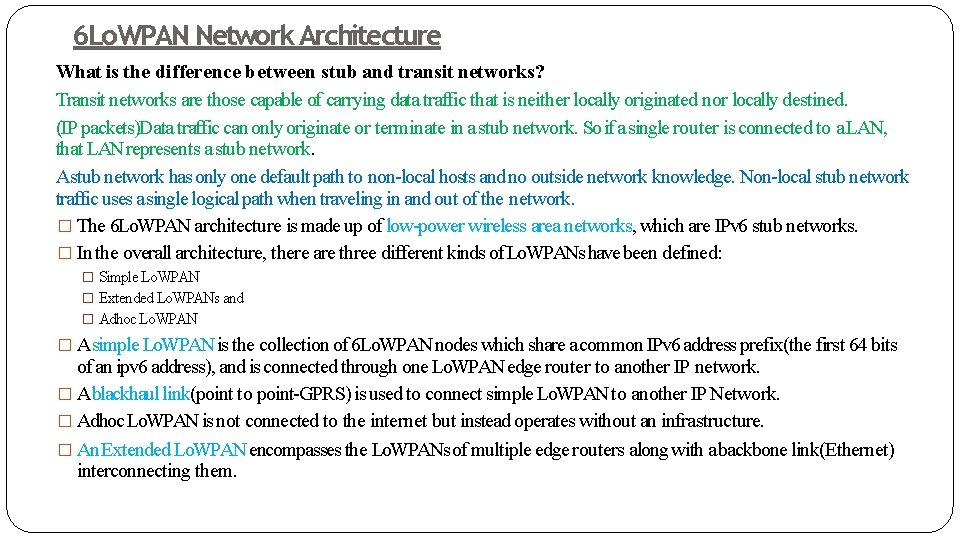
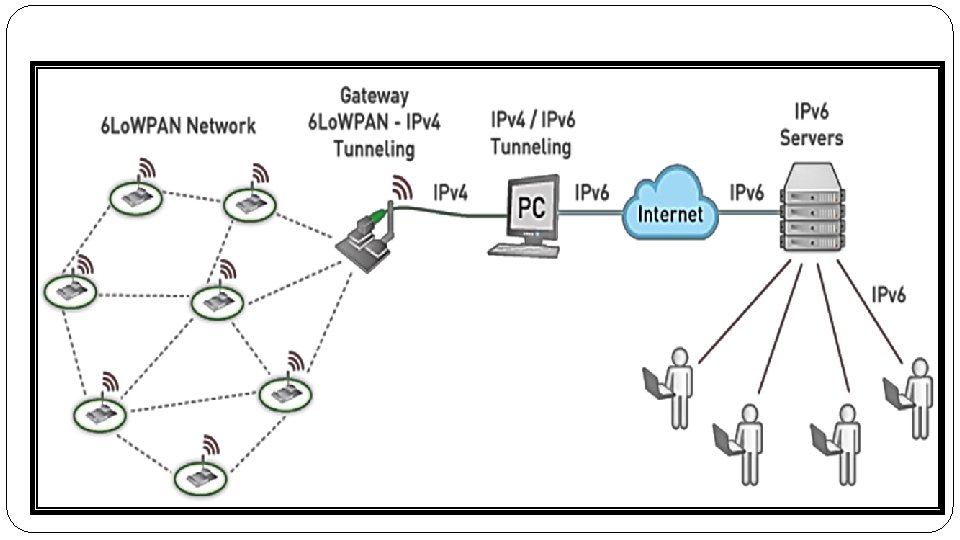
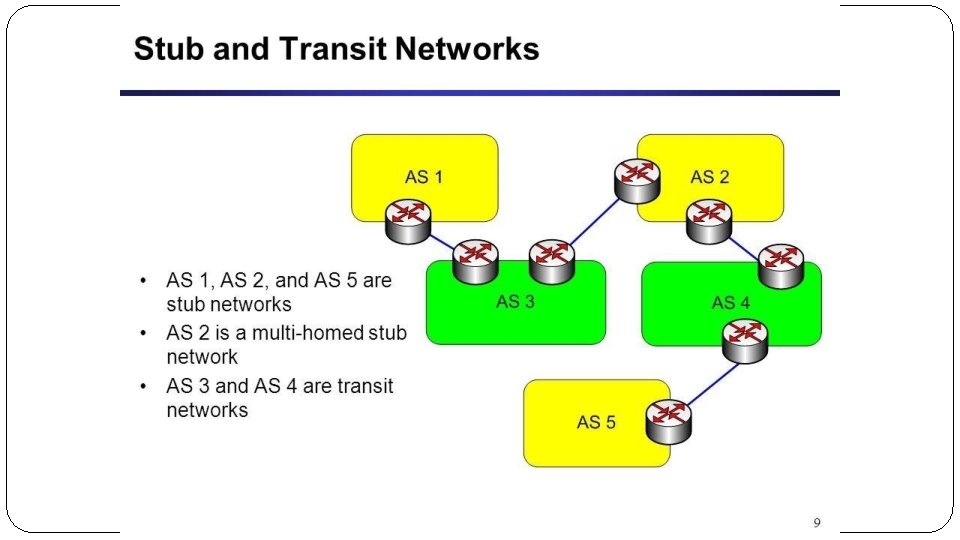
6 Lo. WPAN Network Architecture What is the difference between stub and transit networks? Transit networks are those capable of carrying data traffic that is neither locally originated nor locally destined. (IP packets)Data traffic can only originate or terminate in a stub network. So if a single router is connected to a LAN, that LAN represents a stub network. Astub network has only one default path to non-local hosts and no outside network knowledge. Non-local stub network traffic uses a single logical path when traveling in and out of the network. � The 6 Lo. WPAN architecture is made up of low-power wireless area networks, which are IPv 6 stub networks. � In the overall architecture, there are three different kinds of Lo. WPANs have been defined: � Simple Lo. WPAN � Extended Lo. WPANs and � Adhoc Lo. WPAN � Asimple Lo. WPAN is the collection of 6 Lo. WPAN nodes which share a common IPv 6 address prefix(the first 64 bits of an ipv 6 address), and is connected through one Lo. WPAN edge router to another IP network. � Ablackhaul link(point to point-GPRS) is used to connect simple Lo. WPAN to another IP Network. � Adhoc Lo. WPAN is not connected to the internet but instead operates without an infrastructure. � An Extended Lo. WPAN encompasses the Lo. WPANs of multiple edge routers along with a backbone link(Ethernet) interconnecting them.
6 Lo. WPAN Network Architecture � Lo. WPANs are connected to other IP networks through edgerouters, as seen in Figure � The Edge router plays an important role as it routes traffic in and out of the Lo. WPAN, while handling 6 Lo. WPAN compression and Neighbor Discovery for the Lo. WPAN. � Edge routers also handle IPv 6 forwarding on behalf of the nodes to the IP nodes outside the Lo. WPAN. � If the Lo. WPAN is to be connected to an IPv 4 network the edge router will also handle IPv 4 interconnectivity. � Multiple edge router can be supported in the same Lo. WPAN if they share a common backbone link. � ALo. WPAN consists of nodes, which may play the role of host or router, along with one or more edge routers. The network interfaces of the nodes in a Lo. WPAN share the same IPv 6 prefix which is distributed by the edge router and routers throughout the Lo. WPAN. � In order to facilitate efficient network operation, nodes register with an edge router. These operations are part of Neighbor Discovery(ND), which is an important basic mechanism of IPv 6. � Neighbor Discovery defines how hosts and routers interact with each other on the same link. Lo. WPAN Nodes may participate in more than one Lo. WPAN at the same time (called multi-homing), and fault tolerance can be achieved between edge routers. � Amultihop mesh topology within the Lo. WPAN is achieved either through link-layer forwarding (called Mesh-Under) or using IP routing (called Route-Over). � Both techniques are supported by 6 Lo. WPAN.
�In Figure, the Simple Lo. WPAN and Extended Lo. WPAN Nodes can communicate with either of the servers through their edge router. �The main difference between a Simple Lo. WPAN and an Extended Lo. WPAN is the existence of multiple edge routers in the Lo. WPAN, which share the same IPv 6 prefix and a common backbone link. Multiple Lo. WPANs can overlap each other (even on the same channel). When moving from one Lo. WPAN to another, a node’s IPv 6 address will change. �A Lo. WPAN Edge Router is typically connected to the Internet over a backhaul link such as cellular or DSL. �In an Extended Lo. WPAN configuration, as shown on the right-hand side of Figure multiple edge routers share a common backbone link and collaborate by sharing the same IPv 6 prefix, offloading most Neighbor Discovery messaging to the backbone link. �Asimplified edge router, implementing two basic functionalities: �unique local unicast address (ULA) generation [RFC 4193] and handling 6 Lo. WPAN Neighbor Discovery registration functionality.
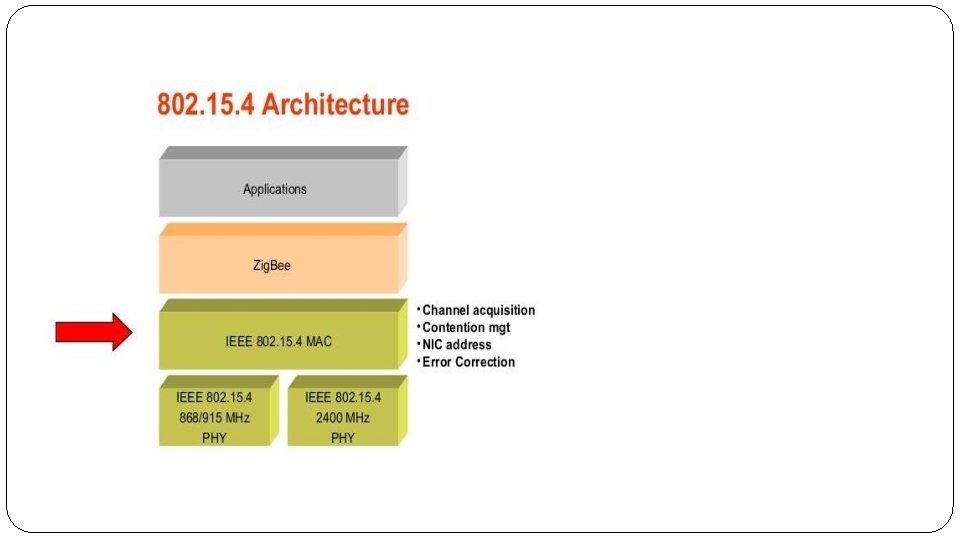
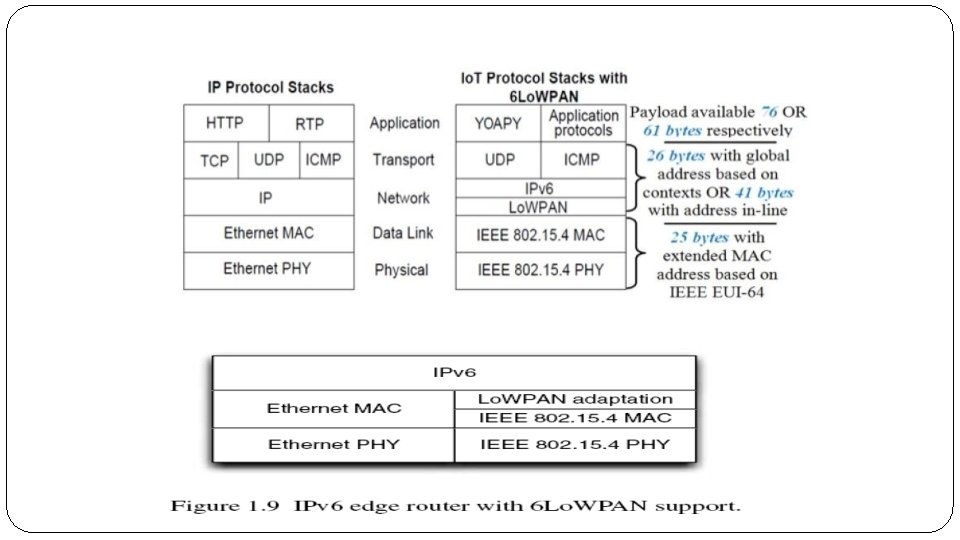
6 LOWPAN Protocol Stack Here we discuss on: �The protocol stack �Link-layer technology �Power line communications and �Addressing 1. The protocol stack: Below shows the IPv 6 protocol stack with 6 Lo. WPAN in comparison with a typical IP protocol stack and the corresponding five layers of the Internet Model. The Internet Model is sometimes referred to as a “narrow waist” model, as the Internet Protocol ties together a wide variety of link-layer technologies with multiple transport and application protocols. Asimple IPv 6 protocol stack with 6 Lo. WPAN (also called a 6 Lo. WPAN protocol stack) is almost identical to a normal IP stack with the following differences. First of all 6 Lo. WPAN only supports IPv 6, for which a small adaptation layer (called the Lo. WPAN adaptation layer) has been defined to optimize IPv 6 over IEEE 802. 15. 4 and similar link layers [RFC 4944].
�The most common transport protocol used with 6 Lo. WPAN is the user datagram protocol (UDP) [RFC 0768], which can also be compressed using the Lo. WPAN format. �The transmission control protocol (TCP) is not commonly used with 6 Lo. WPAN for performance, efficiency and complexity reasons. �The Internet control message protocol v 6 (ICMPv 6) [RFC 4443] is used for control messaging, for example ICMP echo, ICMP destination unreachable and Neighbor Discovery messages. �Application protocols are often used for application specific and in binary format, although more standard application protocols are becoming available. �Adaptation between full IPv 6 and the Lo. WPAN format is performed by routers at the edge of 6 Lo. WPAN islands, referred to as edge routers. This transformation is transparent, efficient and stateless in both directions. � Lo. WPAN adaptation in an edge router typically is performed as part of the 6 Lo. WPAN network interface driver and is usually transparent to the IPv 6 protocol stack itself. � Figure 1. 9 illustrates one realization of an edge router with 6 Lo. WPAN support.
Link layers for 6 Lo. WPAN One of the most important functions of the Internet Protocol is the interconnection of heterogeneous links into a single interoperable network, providing a universal “narrow waist”. This is equally true for 6 Lo. WPAN and embedded networks, where there are many wireless (and also wired) link-layer technologies in use. �The specialized applications of embedded networks require a wider range of communication solutions than typical personal computer networks, which almost universally use Ethernet and Wi-Fi. Luckily the IEEE 802. 15. 4 standard is the most common 2. 4 GHz wireless technology for embedded networking applications, and has been used as a baseline for 6 Lo. WPAN development. �Other technologies used with 6 Lo. WPAN include sub-GHz radios, long-range telemetry links and even power-line communications.
�There is a set of required or recommended features that a link should provide in order to work with Internet protocols. These include framing, addressing, error checking, length indication, some reliability, broadcast and a reasonable frame size. 6 Lo. WPAN is designed to be used with a special type of link, and has its own set of link requirements and recommendations. �The most basic requirements for a link layer to support 6 Lo. WPAN are framing, unicast transmission and addressing. Addressing is required to differentiate between nodes on a link. �Multi-access links should provide a broadcast service. Multicast service is required by standard IPv 6, but not by 6 Lo. WPAN (broadcast is sufficient).
Power line communications � 6 Lo. WPAN also has interesting uses over special wired communication links, such as low rate power line communications (PLC). �Applications of this technology include home automation, energy efficiency monitoring and smart metering. �This allows 6 Lo. WPAN to be used with PLC in a very similar way to IEEE 802. 15. 4 and other ISM (Industrial, Scientific and Medical)band radios. �With PLC, multihop routing is not an issue as typically all nodes are on the same stable link. �Multihop forwarding may be useful to interconnect several PLC subnets, or to integrate PLC and wireless 6 Lo. WPAN islands.
Addressing �IP addressing with 6 Lo. WPAN works just like in any IPv 6 network, and is similar to addressing over Ethernet networks as defined by [RFC 2464]. IPv 6 addresses are typically formed automatically from the prefix of the Lo. WPAN and the link-layer address of the wireless interfaces. �Low-power wireless radio links typically make use of flat link-layer addressing for all devices, and support both unique long addresses (e. g. EUI-64) and configurable short addresses (usually 8– 16 bits in length). �The IEEE 802. 15. 4 standard, for example, supports unique EUI-64 addresses carried in all radio chips, along with configurable 16 -bit short addresses. These networks by nature also support broadcast (address 0 x. FFFF in IEEE 802. 15. 4), but do not support native multicast. �IPv 6 addresses are 128 bits in length, and consist of a 64 -bit prefix part and a 64 -bit interface identifier (IID) [RFC 4291]. �Stateless addressauto configuration (SAA) [RFC 4862] is used to form the IPv 6 interface identifier from the link-layer address of the wireless interface [RFC 4944].
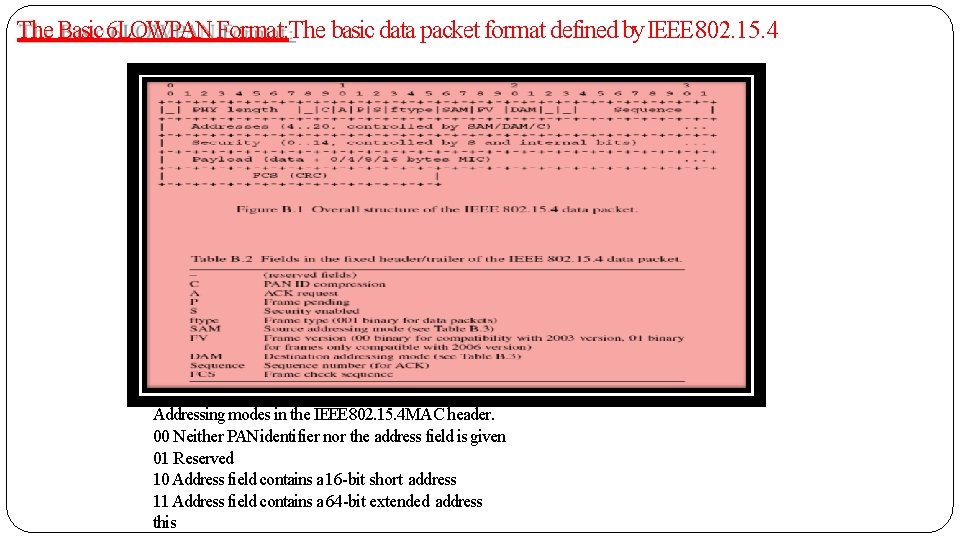
The Basic 6 LOWPAN Format: The basic data packet format defined by IEEE 802. 15. 4 Addressing modes in the IEEE 802. 15. 4 MAC header. 00 Neither PAN identifier nor the address field is given 01 Reserved 10 Address field contains a 16 -bit short address 11 Address field contains a 64 -bit extended address this
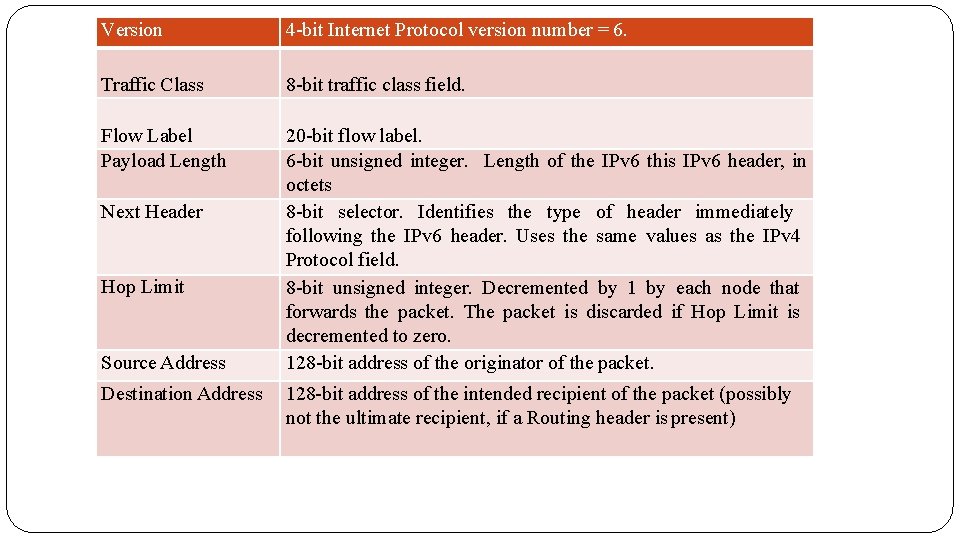
Version 4 -bit Internet Protocol version number = 6. Traffic Class 8 -bit traffic class field. Flow Label Payload Length 20 -bit flow label. 6 -bit unsigned integer. Length of the IPv 6 this IPv 6 header, in octets 8 -bit selector. Identifies the type of header immediately following the IPv 6 header. Uses the same values as the IPv 4 Protocol field. 8 -bit unsigned integer. Decremented by 1 by each node that forwards the packet. The packet is discarded if Hop Limit is decremented to zero. 128 -bit address of the originator of the packet. Next Header Hop Limit Source Address Destination Address 128 -bit address of the intended recipient of the packet (possibly not the ultimate recipient, if a Routing header is present)
�This format does not contain any fields that further identify the payload that a data packet is carrying: there is no multiplexing information that would allow a receiver to distinguish 6 Lo. WPAN packets from any other data packets that might be sent, or �to distinguish between different kinds of 6 Lo. WPAN packets. �Therefore, one of tasks of the 6 Lo. WPAN encapsulation format is to provide a packet type identifier not provided by IEEE 802. 15. 4 itself.
MQ telemetry transport for sensor networks (MQTT-S) � The MQ telemetry transport (MQTT) is a lightweight publish/subscribe protocol designed for use in enterprise applications over low-bandwidth wide area network (WAN) links such as ISDN or GSM [MQTT]. � This protocol was designed by IBMand is used in commercial products such as Web sphere and Lotus, enjoying widespread use in M 2 M applications. � MQTT uses a broker-based pub/sub architecture, to which clients publish data based on matching topic names. Subscribers then request data from the broker based on topic names. � Although MQTT was designed to be lightweight, it requires the use of TCP, and the format is inefficient over 6 Lo. WPAN networks. � In order to allow for MQTT to be used also in sensor networks, MQ telemetry transport for sensor networks (MQTT-S) was developed [MQTT-S]. � This optimized protocol can be used over Zig. Bee, UDP/6 Lo. WPAN or any other simple network providing a bi-directional datagram service. � MQTT-S is optimized for low-bandwidth wireless networks with small frame sizes and simple devices. It is still compatible with MQTT and can be seamlessly integrated with MQTT brokers using what is called an MQTT-S gateway.
�The MQTT-S architecture is shown in Figure 5. 6. �It is made up of four different elements: �MQTT brokers, �MQTT-S gateways, �MQTT-S forwarders and MQTT-S clients. �Clients connect themselves to a broker through a gateway using the MQTT-S protocol. The gateway may be located e. g. on the Lo. WPAN Edge Router, or it may be integrated in the broker itself, in which case MQTT-S messages are simply carried end-to-end over UDP. �Gateways translate between MQTT-S and MQTT. In case a gateway is not directly available, forwarders are used to forward (unmodified) messages between clients and brokers. Forwarders may not be needed with 6 Lo. WPAN as UDP datagrams can be sent directly to a gateway.
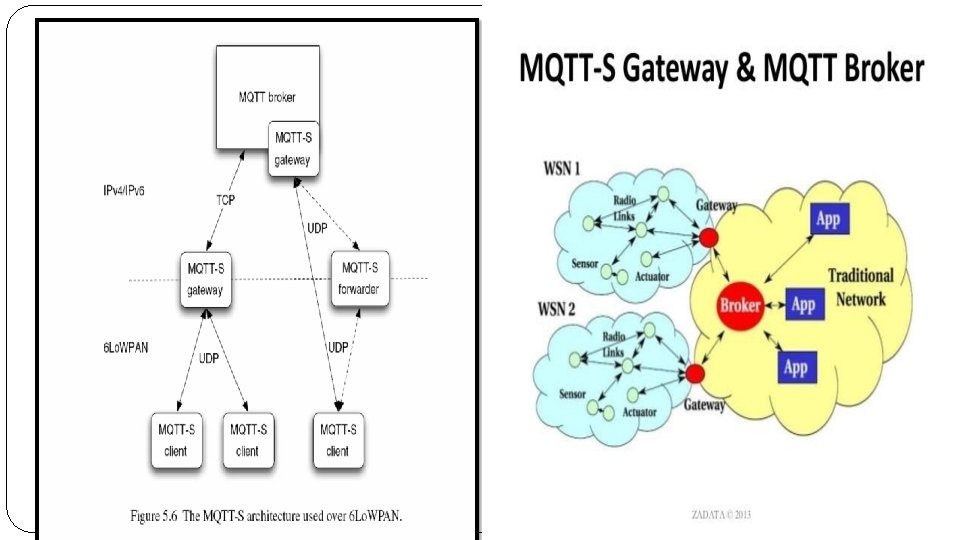
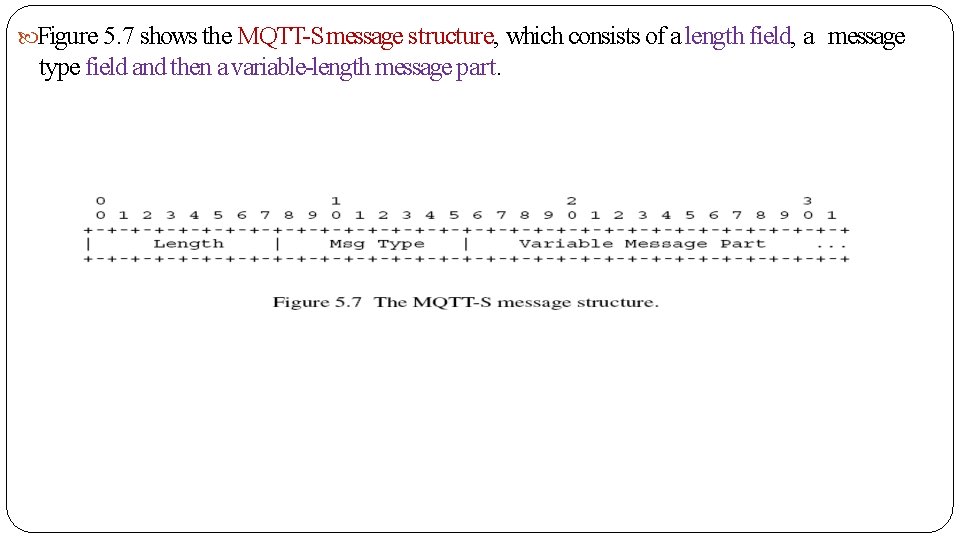
Figure 5. 7 shows the MQTT-S message structure, which consists of a length field, a message type field and then a variable-length message part.
Protocol operation �MQTT-S includes a gateway discovery procedure, which does not exist in MQTT. Alternatively clients can be pre-configured with the gateway location to avoid discovery overhead. �Gateways send periodic ADVERTISE messages, and clients may send SEARCHGW messages. �AGWINFO message is sent to a client in response to SEARCHGW with basic information about the gateway. Clients CONNECT to a gateway which responds with an ACK. �DISCONNECT is used to end a connection or to indicate a sleep period. Clients can connect with multiple gateways (and thus brokers) which are able to perform load balancing. �Gateways can function in either transparent mode, where a connection to the broker is maintained for each client, or in aggregation mode, where the gateway aggregates messages from all clients into a single broker connection. �Aggregation mode can considerably improve scalability. �MQTT-S makes use of two-byte topic IDs and short topic names to optimize the long topic name strings normally used in MQTT-S includes a registration message REGISTER, which explicitly indicates the topics that a client is publishing.
�This reduces the bandwidth compared to MQTT where the topics and data are published in the same message. A client can send a REGISTER message with the topic name, which is acknowledged with a REGACK indicating the assigned topic ID. �Topic names and IDs can also be pre-configured to avoid the need for registrations in certain cases. �The client then publishes its data with PUBLISH messages including the topic ID and possible Qo. S information. �Clients subscribe by sending SUBSCRIBE to the gateway including the topic name of interest, which is acknowledged with SUBACKincluding an assigned topic ID. �UNSUBSCRIBE is used to remove a subscription from the gateway.
Zig. Bee compact application protocol (CAP) The Zig. Bee application layer (ZAL) and the Zig. Bee cluster library (ZCL) specify an application protocol enabling interoperability between Zig. Bee devices at the application layer. �The Zig. Bee Alliance maintains a series of specifications for ad hoc networking between embedded devices using a single radio, IEEE 802. 15. 4. �Typical applications for Zig. Bee include home automation, energy applications and similar local area wireless control applications. �Zig. Bee makes use of a vertical profile approach over the ZAL and ZCL, with profiles for different industry applications such as the Zig. Bee home automation profile [Zig. Bee. HA] or the Zig. Bee smart energy profile [Zig. Bee. SE]. �The ZAL and ZCL provide the key application protocol functionality in Zig. Bee, enabling the exchange of commands and data, service discovery, binding and security along with profile support. �These protocols use compact binary formats with the goal of fitting in small IEEE 802. 15. 4 frames.
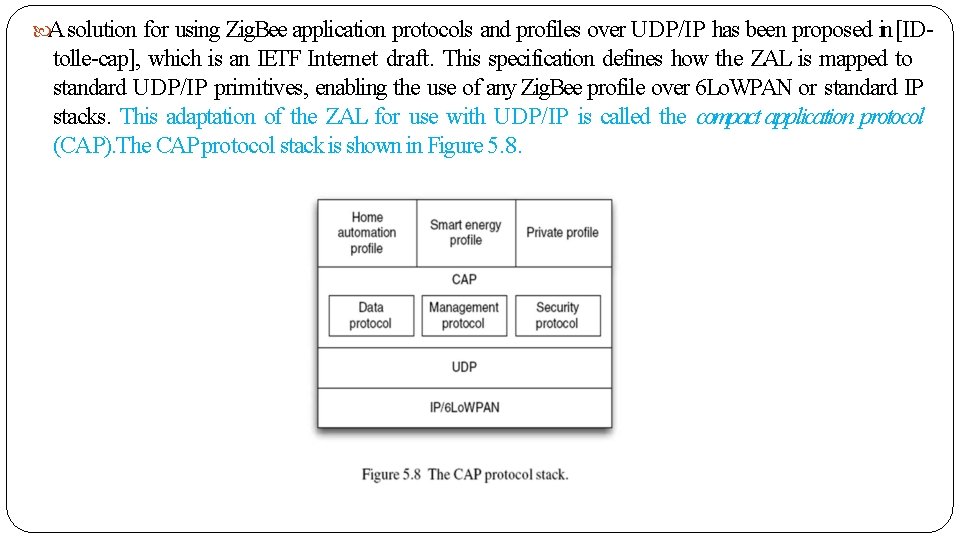
A solution for using Zig. Bee application protocols and profiles over UDP/IP has been proposed in [ID- tolle-cap], which is an IETF Internet draft. This specification defines how the ZAL is mapped to standard UDP/IP primitives, enabling the use of any Zig. Bee profile over 6 Lo. WPAN or standard IP stacks. This adaptation of the ZAL for use with UDP/IP is called the compact application protocol (CAP). The CAP protocol stack is shown in Figure 5. 8.
The main modification to the ZAL has to do with using IP hosts and IP addresses instead of IEEE 802. 15. 4 hosts and IEEE 802. 15. 4 addresses. �Zig. Bee application layer messages are placed inside UDP datagrams using the CAP data protocol instead of Zig. Bee network layer frames. To receive unsolicited notifications CAP listens to a wellknown UDP port. �The ZAL identifies nodes by their 64 -bit or 16 -bit IEEE 802. 15. 4 MAC address. In CAP this is replaced by a CAP address record which can contain an IPv 4 address plus UDP port, IPv 6 address plus UDP port, or a fully qualified domain name plus UDP port. �It is assumed that the CAP is configured with the IP address and port of the discovery cache, trust center, binding coordinator and binding cache during bootstrapping. �These can be configured manually, using DHCP, a special DNS entry or using a CAP server discovery message
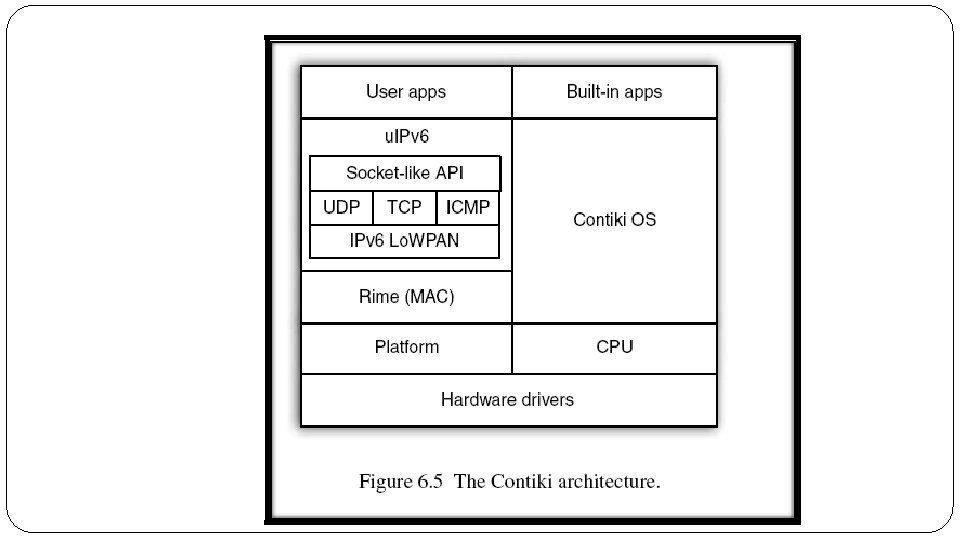
Contiki and u. IPv 6 �Contiki is a popular embedded open-source operating system for small microcontroller architectures such as AVR(Alf and Vegard's RISC processor), 8051 and MSP 430, led by the Swedish Institute for Computer Science (SICS) [Contiki]. Contiki includes a very small implementation of IP called u. IP [Dunkels 03], along with an implementation of IPv 6 with 6 Lo. WPAN support called u. IPv 6. The Contiki operating system and u. IP stack are used worldwide by hundreds of projects and companies. �The Contiki architecture is designed for supporting IP networking over low-power radios and other network interfaces. �The architecture of Contiki and u. IPv 6 are shown in Figure 6. 5. �The low-level hardware abstraction is split into platform and CPU for portability, which include hardware drivers. The Contiki OS provides basic thread and timer support. �The Rime system is a flexible medium access control and network protocol library which includes many low-level communication paradigms. �The u. IPv 6 stack makes use of Rime, and provides a socket-like API for use by applications called protosockets. Both built-in and user applications are run over Contiki using a lightweight thread model called protothreads. �The u. IP (Micro IP) is an open source implementation of the TCP/IP network protocol stack intended for use with tiny 8 - and 16 -bit microcontrollers.
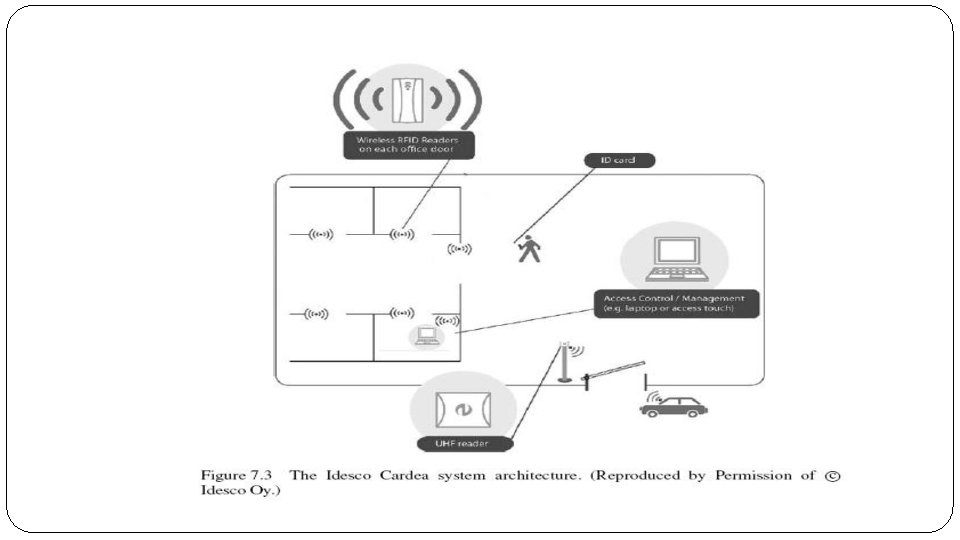
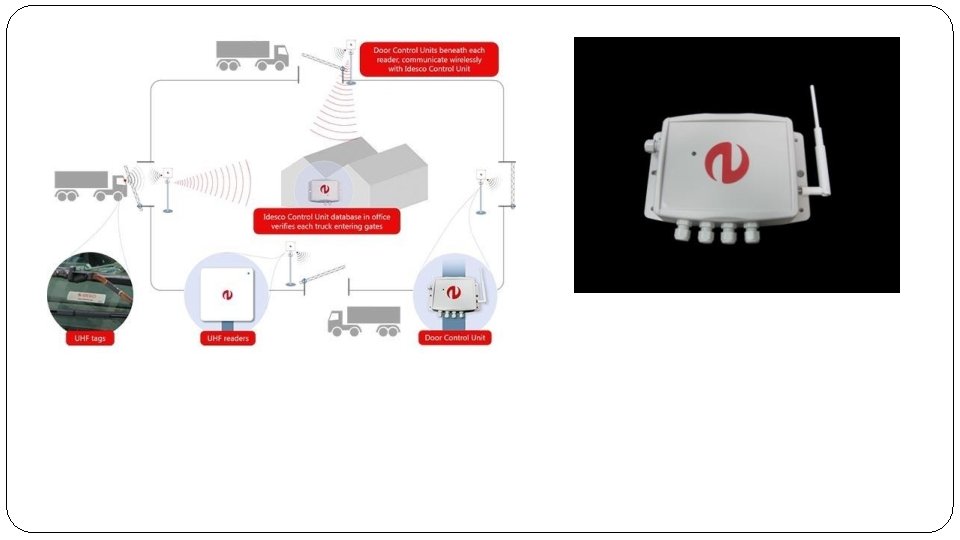
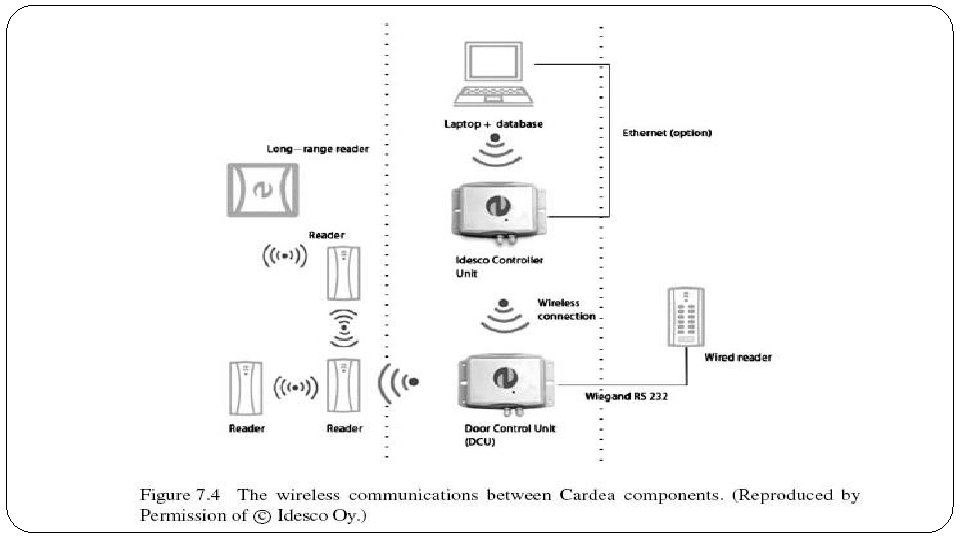
Wireless RFID Infrastructure �Asystem for deploying RFID reader infrastructures for identification and access control using wireless 6 Lo. WPAN technology has been developed by Idesco and Sensinode. Idesco is a Finnish manufacturer of identification systems, and was the first company in the world specialized in RFID [Idesco]. Idesco offers scalable open identification solutions enabling new business opportunities forerunners in the field. This new wireless system is called the Idesco Cardea system, consisting of a line of wireless RFID products including: �Idesco Cardea readers �Idesco Cardea door control unit �Idesco Cardea control unit and access touch. �The system uses Sensinode wireless networking technology, based on 2. 4 GHz IEEE 802. 15. 4 and 6 Lo. WPAN standards. Traditional RFID tags are read at short range using the RFID Cardea reader products. Instead of using wired cabling between all of the RFID infrastructure components, the Cardea system uses a wireless 6 Lo. WPAN mesh network to interconnect the devices. �The system is illustrated in Figure 7. 3. A typical system consists of RFID readers, door control units and a controller unit. The Cardea system includes both a Cardea controller unit accessible through PC software, or the Cardea access touch, which is a wall-integrated touch-screen device.
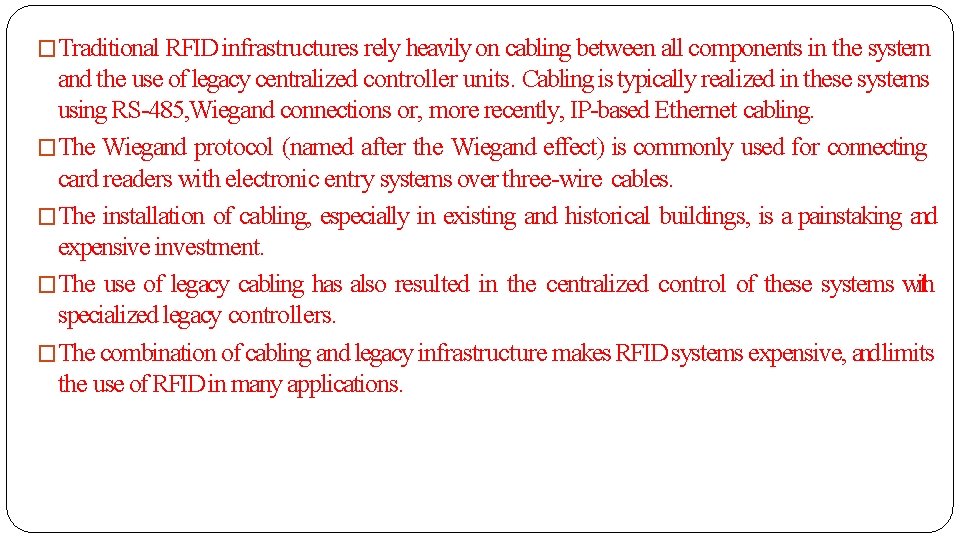
�Traditional RFID infrastructures rely heavily on cabling between all components in the system and the use of legacy centralized controller units. Cabling is typically realized in these systems using RS-485, Wiegand connections or, more recently, IP-based Ethernet cabling. �The Wiegand protocol (named after the Wiegand effect) is commonly used for connecting card readers with electronic entry systems over three-wire cables. �The installation of cabling, especially in existing and historical buildings, is a painstaking and expensive investment. �The use of legacy cabling has also resulted in the centralized control of these systems with specialized legacy controllers. �The combination of cabling and legacy infrastructure makes RFID systems expensive, andlimits the use of RFID in many applications.
Byusing a low power wireless mesh network, several benefits were achieved with the Idesco Cardea system: �The Idesco Cardea system takes just an estimated 40 minutes to install per door, compared to an average of 7 hours per door for a traditional wired RFID infrastructure. �Significant cost savings in cabling for retrofitting the system in existing buildings, or for modification of a system in a current installation. �The possibility of using RFID solutions as part of temporary installations. �RFID becomes practical and cost-effective for small office installations. �The ability to easily combine existing wired and Cardea wireless components. Typical applications of the Cardea systems include: �small installations with a few doors and a few readers (such as small offices or shops) �temporary access systems at construction sites or events systems where multiple applications need to be combined together (e. g. access control and parking lot access) applications with readers spread across large areas, such as harbors installations in existing and especially historic buildings easy expansion of existing systems without adding more cabling.
Technical overview � The system is realized using Sensinode’s Nano. Stack 2. 0 6 Lo. WPAN solution, providing communication between the wireless components in the system as shown in Figure 7. 4. � Making use of IEEE 802. 15. 4 2. 4 GHz radios with power amplification, suitable range is achieved. Furthermore, multihop routing using Sensinode’s Nano. Mesh is used to extend the network over larger areas. � Security is achieved with 128 -bit AES link-layer encryption combined with application protocol security already used in wired systems. � Devices in the network use unique 64 -bit MACaddresses so that all devices have a unique IPv 6 address. � In the future, battery-powered wireless RFID readers will be added to the cardea system. � These run as Lo. WPAN hosts with aggressive power savings for long battery life. � All powered devices, including RFID readers and door controller units act as Lo. WPAN Routers. � The controller units in the network act as Lo. WPAN Edge Routers. � The network achieves complete auto configuration, which makes the setup of the system using a graphical interface easy. � Installation of the system doesn’t require special knowledge of IPv 6 networking or wireless communications, and can be performed by existing installation personnel. � The use of IPv 6 end-to-end will enable the evolution of the Cardea system into larger-scale access control applications and integration with other building automation systems.
- Slides: 51