
The Wireless Communication Channel muse Objectives Understand fundamentals
The Wireless Communication Channel muse
Objectives • Understand fundamentals associated with free -space propagation. • Define key sources of propagation effects both at the large- and small-scales • Understand the key differences between a channel for a mobile communications application and one for a wireless sensor network muse
Objectives (cont. ) • Define basic diversity schemes to mitigate small-scale effects • Synthesize these concepts to develop a link budget for a wireless sensor application which includes appropriate margins for large- and small-scale propagation effects muse
Outline Free-space propagation Large-scale effects and models Small-scale effects and models Mobile communication channels vs. wireless sensor network channels • Diversity schemes • Link budgets • Example Application: WSSW • •
Free-space propagation • Scenario Free-space propagation: 1 of 4
Relevant Equations • Friis Equation • EIRP Free-space propagation: 2 of 4
Alternative Representations • PFD • Friis Equation in d. Bm Free-space propagation: 3 of 4
Issues • How useful is the free-space scenario for most wireless systems? Free-space propagation: 4 of 4
Outline Free-space propagation Large-scale effects and models Small-scale effects and models Mobile communication channels vs. wireless sensor network channels • Diversity schemes • Link budgets • Example Application: WSSW • •
Large-scale effects • Reflection • Diffraction • Scattering Large-scale effects: 1 of 7
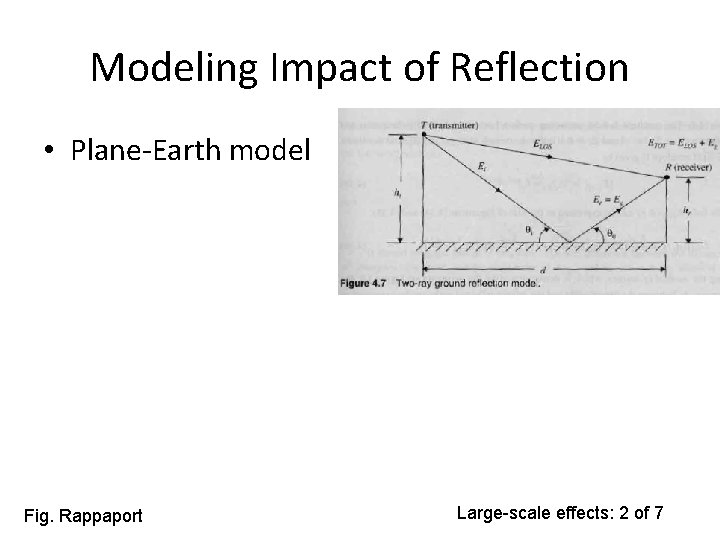
Modeling Impact of Reflection • Plane-Earth model Fig. Rappaport Large-scale effects: 2 of 7
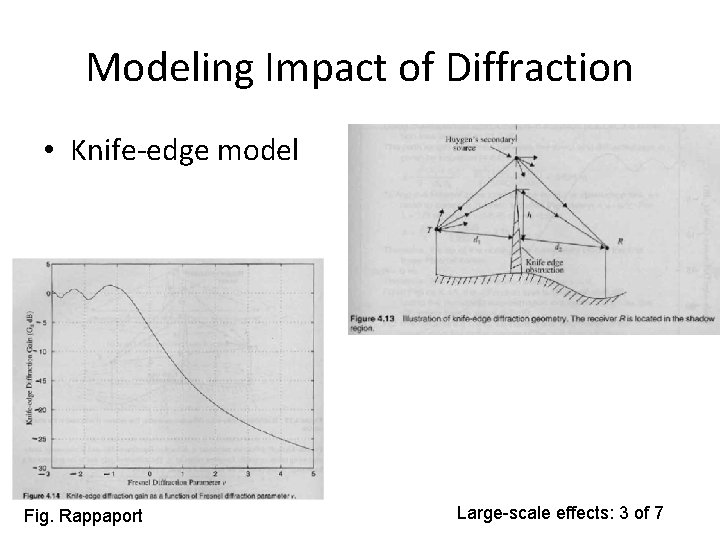
Modeling Impact of Diffraction • Knife-edge model Fig. Rappaport Large-scale effects: 3 of 7
Modeling Impact of Scattering • Radar cross-section model Large-scale effects: 4 of 7
Modeling Overall Impact • Log-normal model • Log-normal shadowing model Large-scale effects: 5 of 7
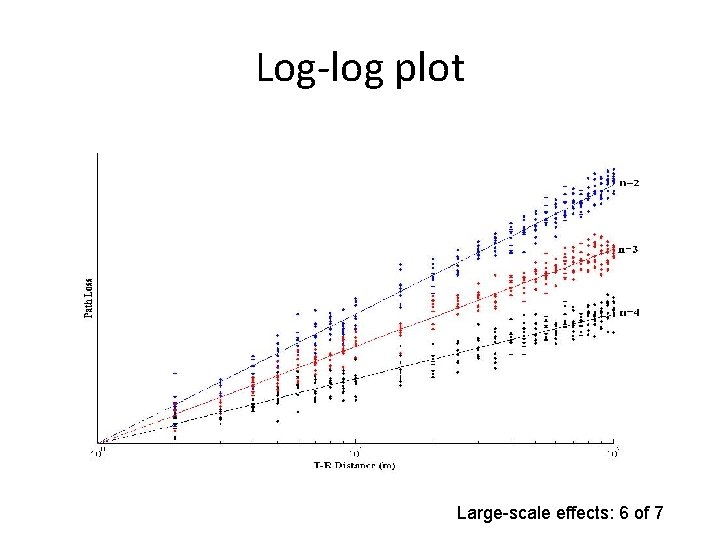
Log-log plot Large-scale effects: 6 of 7
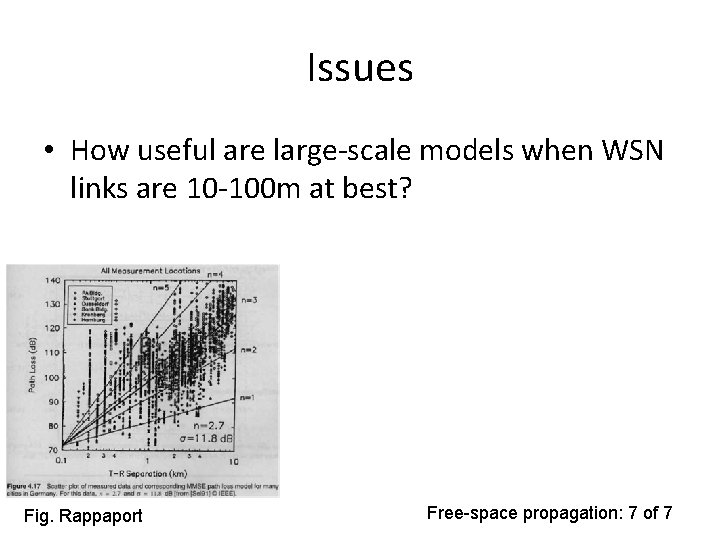
Issues • How useful are large-scale models when WSN links are 10 -100 m at best? Fig. Rappaport Free-space propagation: 7 of 7
Outline Free-space propagation Large-scale effects and models Small-scale effects and models Mobile communication channels vs. wireless sensor network channels • Diversity schemes • Link budgets • Example Application: WSSW • •
Small-scale effects • Multipath • Time and frequency response • Models Small-scale effects: 1 of 14
Multipath • Scenario • Equations Small-scale effects: 2 of 14
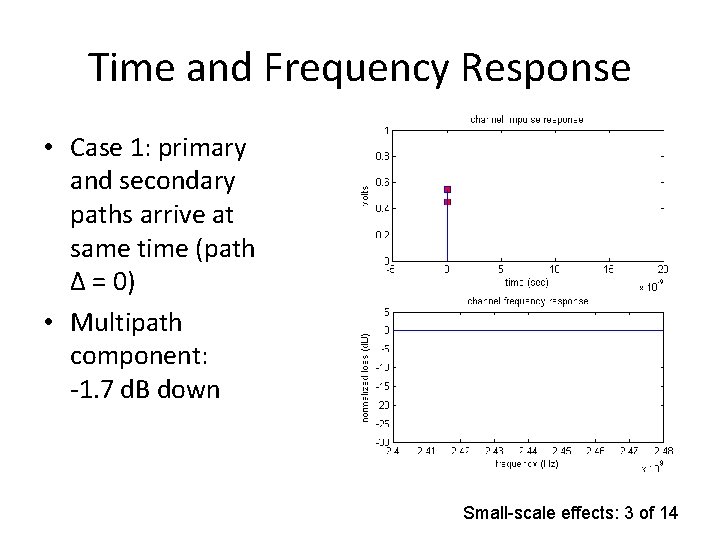
Time and Frequency Response • Case 1: primary and secondary paths arrive at same time (path Δ = 0) • Multipath component: -1. 7 d. B down Small-scale effects: 3 of 14
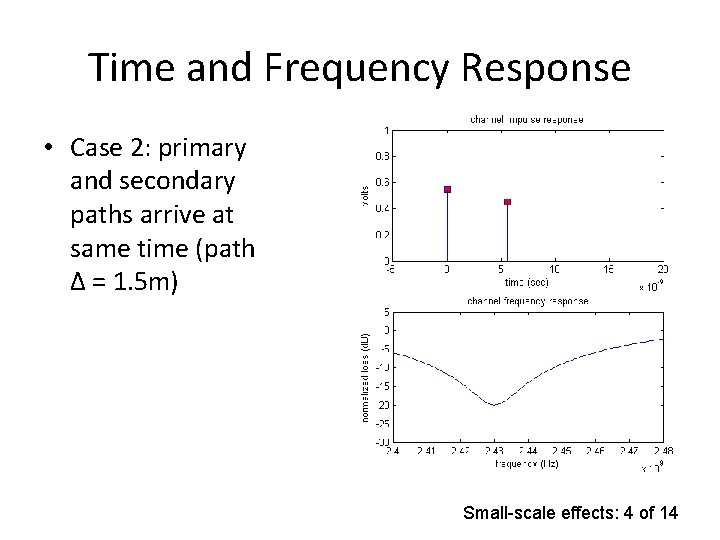
Time and Frequency Response • Case 2: primary and secondary paths arrive at same time (path Δ = 1. 5 m) Small-scale effects: 4 of 14
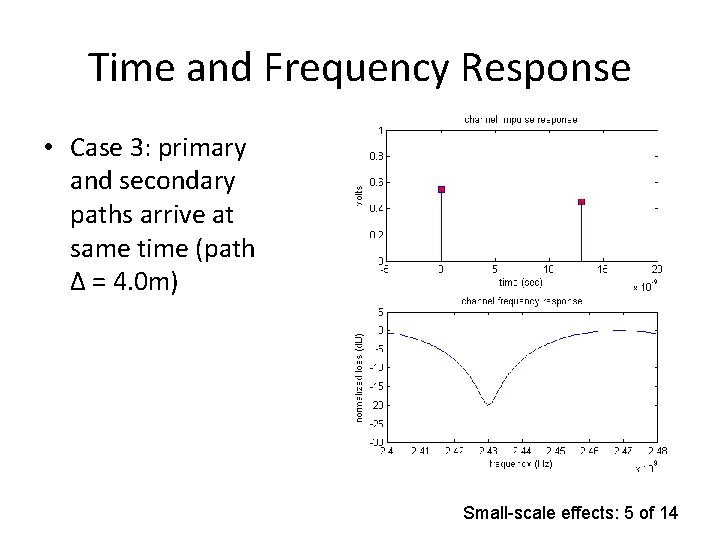
Time and Frequency Response • Case 3: primary and secondary paths arrive at same time (path Δ = 4. 0 m) Small-scale effects: 5 of 14
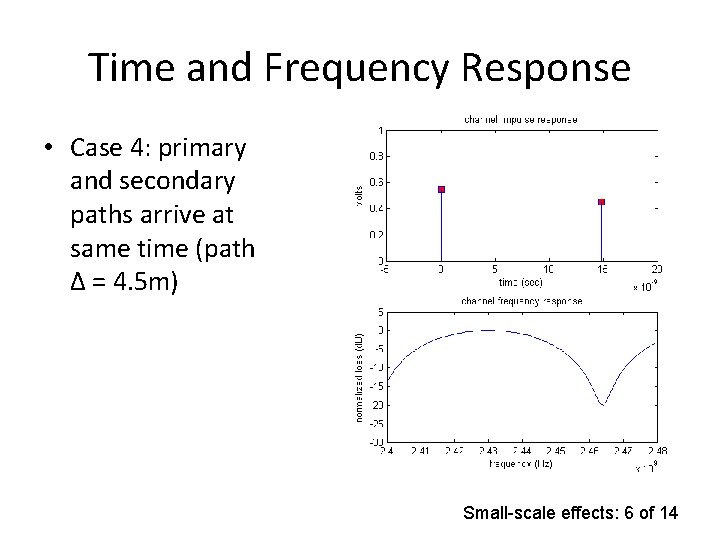
Time and Frequency Response • Case 4: primary and secondary paths arrive at same time (path Δ = 4. 5 m) Small-scale effects: 6 of 14
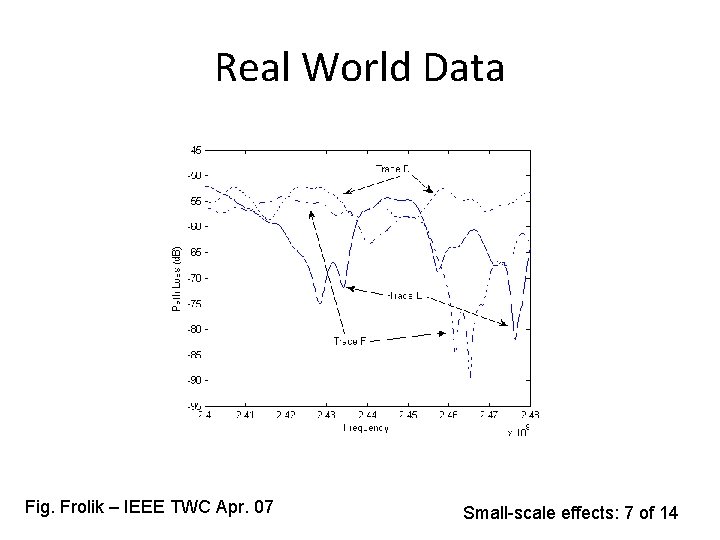
Real World Data Fig. Frolik – IEEE TWC Apr. 07 Small-scale effects: 7 of 14
Randomness in the Channel • Sources • Impact Small-scale effects: 8 of 14

Statistical Channel Models • TWDP Small-scale effects: 9 of 14
Baseline: Rayleigh Distribution • Scenario • Equations Small-scale effects: 10 of 14
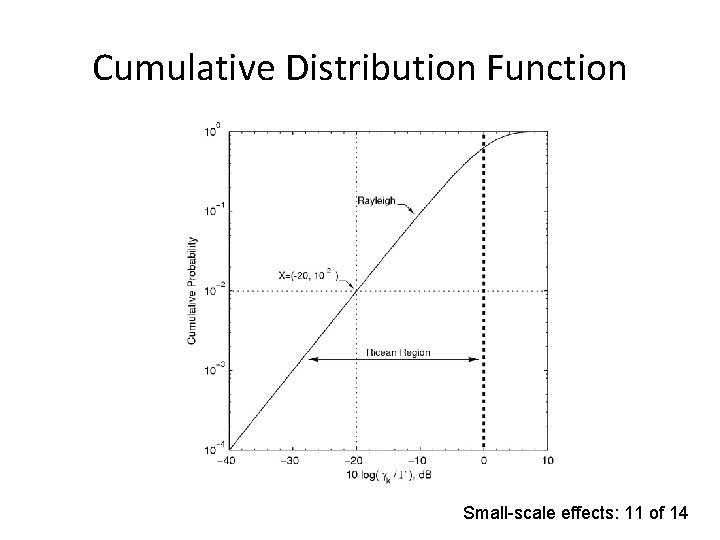
Cumulative Distribution Function Small-scale effects: 11 of 14
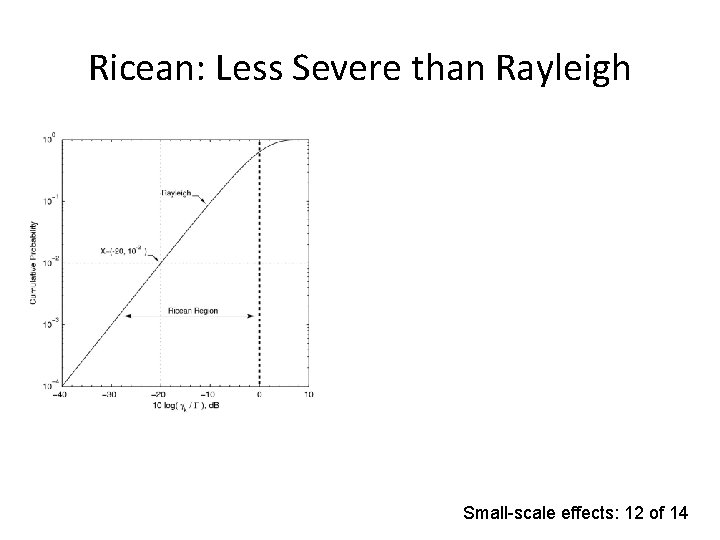
Ricean: Less Severe than Rayleigh Small-scale effects: 12 of 14
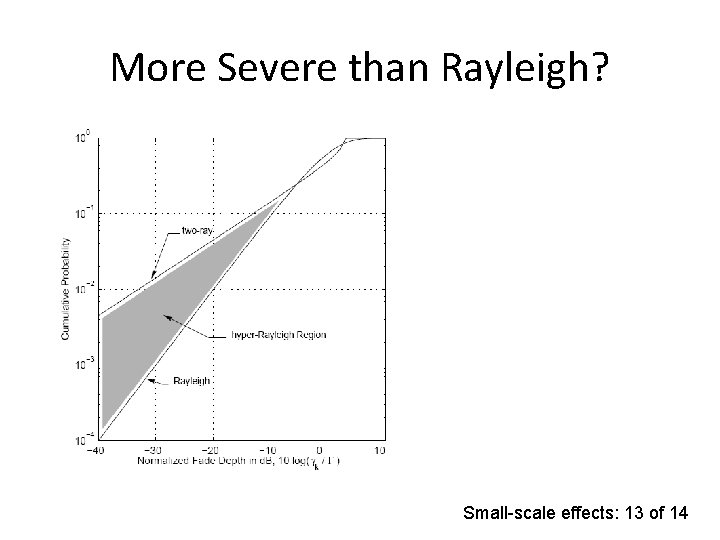
More Severe than Rayleigh? Small-scale effects: 13 of 14
Importance of Proper Model Small-scale effects: 14 of 14
Outline Free-space propagation Large-scale effects and models Small-scale effects and models Mobile communication channels vs. wireless sensor network channels • Diversity schemes • Link budgets • Example Application: WSSW • •
Mobile vs. WSN channels Mobile WSN Mobile vs. WSN: 1 of 3
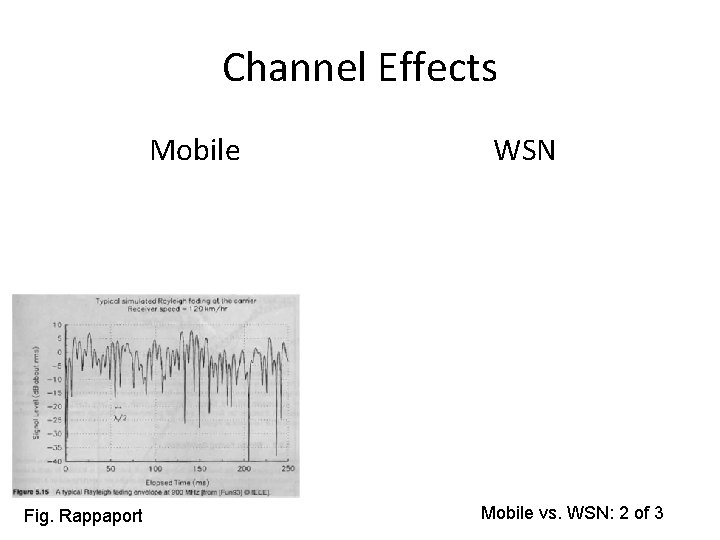
Channel Effects Mobile Fig. Rappaport WSN Mobile vs. WSN: 2 of 3
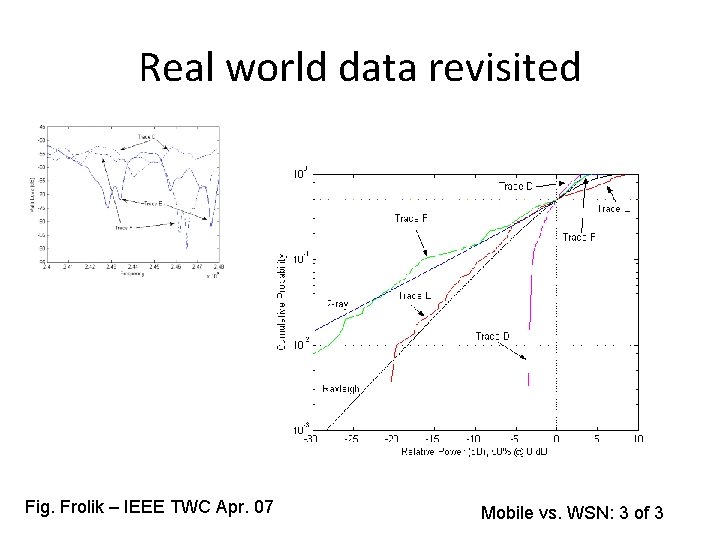
Real world data revisited Fig. Frolik – IEEE TWC Apr. 07 Mobile vs. WSN: 3 of 3
Outline Free-space propagation Large-scale effects and models Small-scale effects and models Mobile communication channels vs. wireless sensor network channels • Diversity schemes • Link budgets • Example Application: WSSW • •
Diversity schemes • Time • Space • Frequency Diversity schemes: 1 of 3
Approaches • MRC • Selection Diversity schemes: 2 of 3
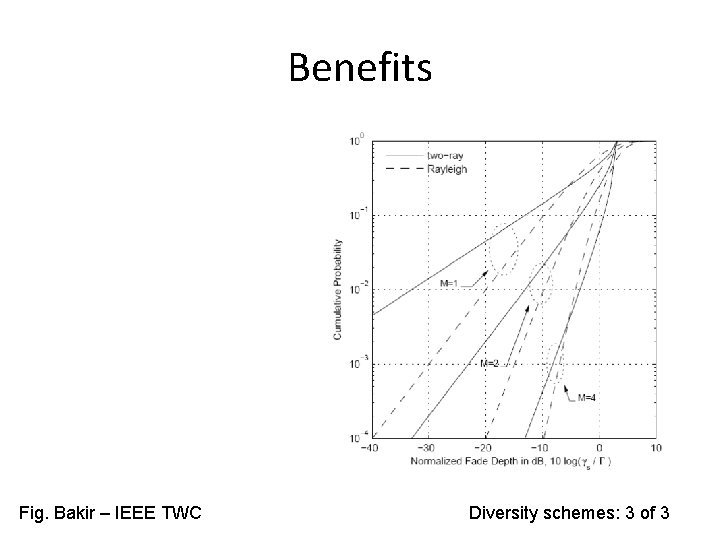
Benefits Fig. Bakir – IEEE TWC Diversity schemes: 3 of 3
Outline Free-space propagation Large-scale effects and models Small-scale effects and models Mobile communication channels vs. wireless sensor network channels • Diversity schemes • Link budgets • Example Application: WSSW • •
Link budgets • Link parameters Link budgets: 1 of 5
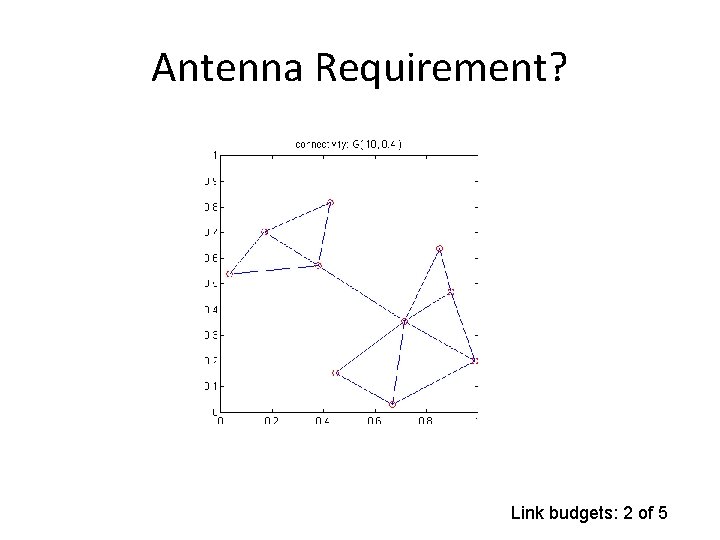
Antenna Requirement? Link budgets: 2 of 5
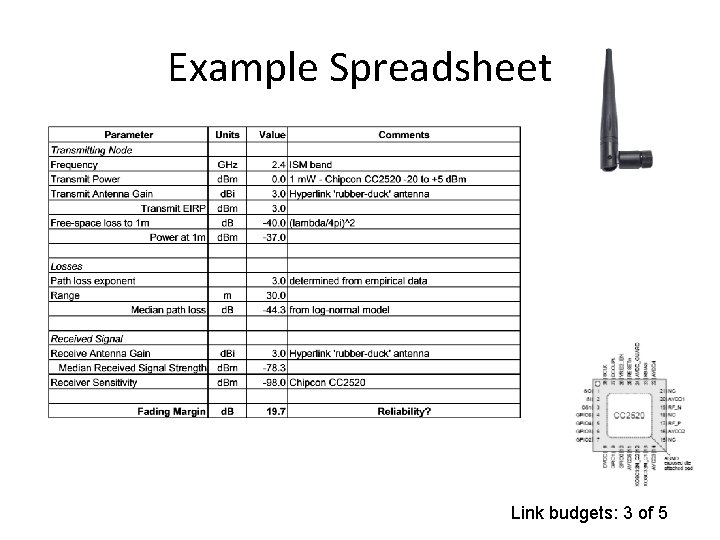
Example Spreadsheet Link budgets: 3 of 5
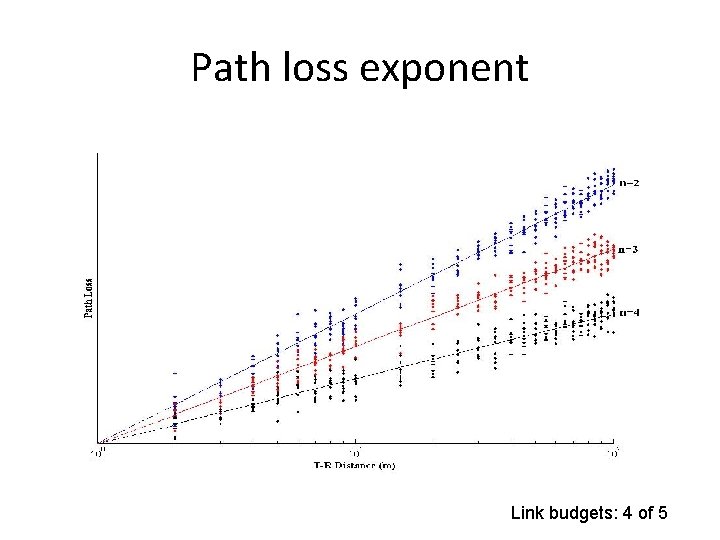
Path loss exponent Link budgets: 4 of 5
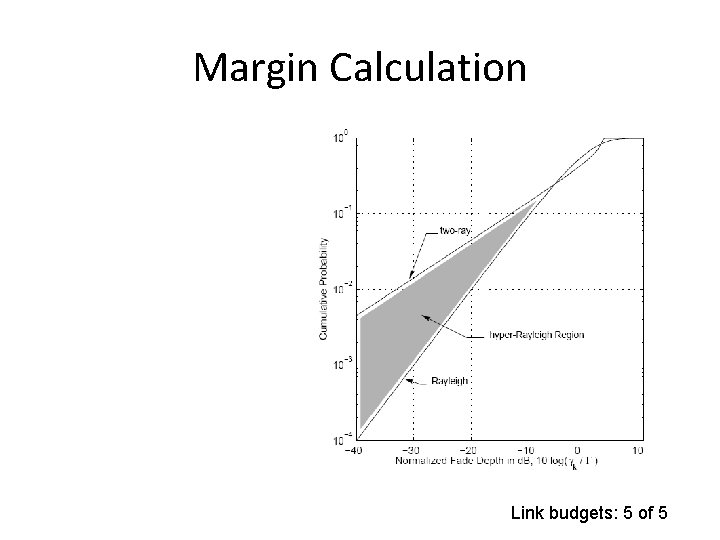
Margin Calculation Link budgets: 5 of 5
Outline Free-space propagation Large-scale effects and models Small-scale effects and models Mobile communication channels vs. wireless sensor network channels • Diversity schemes • Link budgets • Example Application: WSSW • •
Example: WSSW • Motivation • Approach WSSW: 1 of 2
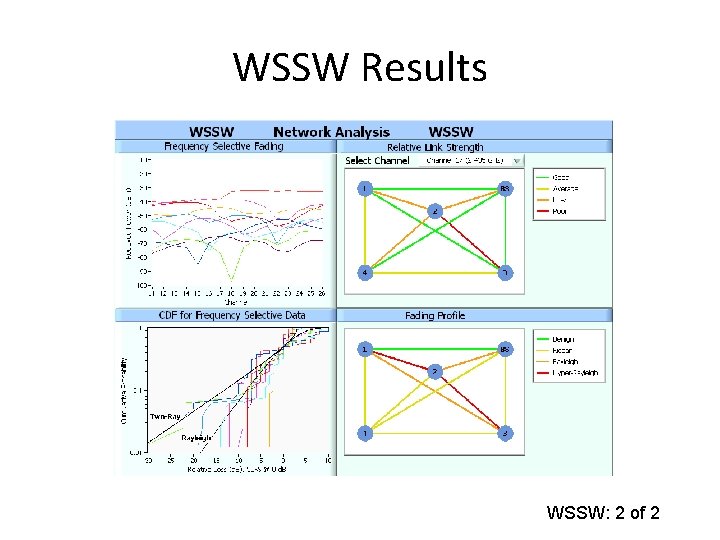
WSSW Results WSSW: 2 of 2
Conclusions - 1 • As intuitively suspected, signal strength on average decreases with T-R distance • Large-scale effects determine the rate of signal strength degradation with distance • Small-scale effects may severely impact signal strength in highly reflective environments • Diversity schemes can mitigate the small-scale effects muse
Conclusions - 2 • WSN have unique constrains which may not be best modeled using mobile communication methods • Link budgets are critical in order ascertain requisite transmit powers, expected connectivity length, etc. • Sensor nodes themselves can be utilized to ascertain channel characteristics muse
Want to know more? • T. Rappaport, Wireless Communications: Principles and Practice, 2 nd ed. , Prentice Hall. • J. Frolik, ‘A case for considering hyper-Rayleigh fading, ’ IEEE Trans. Wireless Comm. , Vol. 6, No. 4, April 2007. • L. Bakir and J. Frolik, ‘Diversity gains in two-ray fading channels, ’ in review IEEE Trans. Wireless Comm. muse
Discussion of Code: 1 of 5
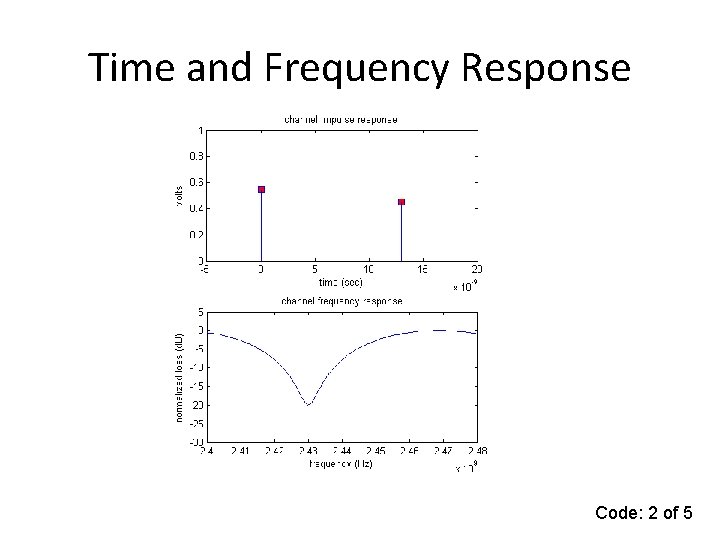
Time and Frequency Response Code: 2 of 5
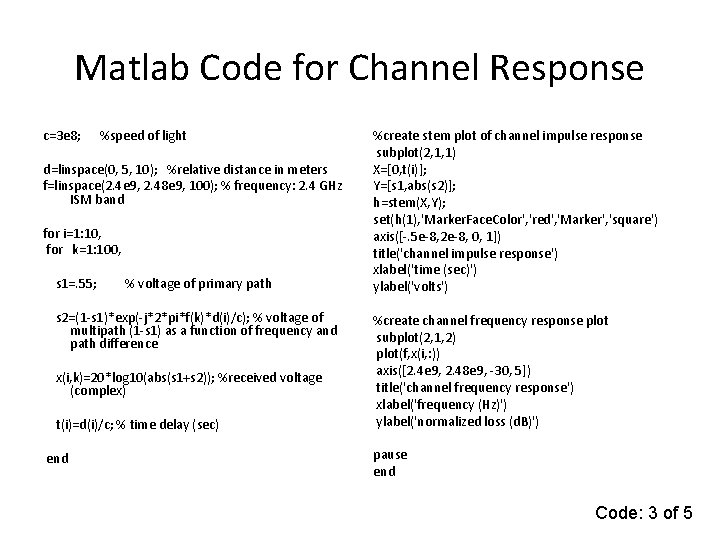
Matlab Code for Channel Response c=3 e 8; %speed of light d=linspace(0, 5, 10); %relative distance in meters f=linspace(2. 4 e 9, 2. 48 e 9, 100); % frequency: 2. 4 GHz ISM band for i=1: 10, for k=1: 100, s 1=. 55; % voltage of primary path s 2=(1 -s 1)*exp(-j*2*pi*f(k)*d(i)/c); % voltage of multipath (1 -s 1) as a function of frequency and path difference x(i, k)=20*log 10(abs(s 1+s 2)); %received voltage (complex) t(i)=d(i)/c; % time delay (sec) end %create stem plot of channel impulse response subplot(2, 1, 1) X=[0, t(i)]; Y=[s 1, abs(s 2)]; h=stem(X, Y); set(h(1), 'Marker. Face. Color', 'red', 'Marker', 'square') axis([-. 5 e-8, 2 e-8, 0, 1]) title('channel impulse response') xlabel('time (sec)') ylabel('volts') %create channel frequency response plot subplot(2, 1, 2) plot(f, x(i, : )) axis([2. 4 e 9, 2. 48 e 9, -30, 5]) title('channel frequency response') xlabel('frequency (Hz)') ylabel('normalized loss (d. B)') pause end Code: 3 of 5
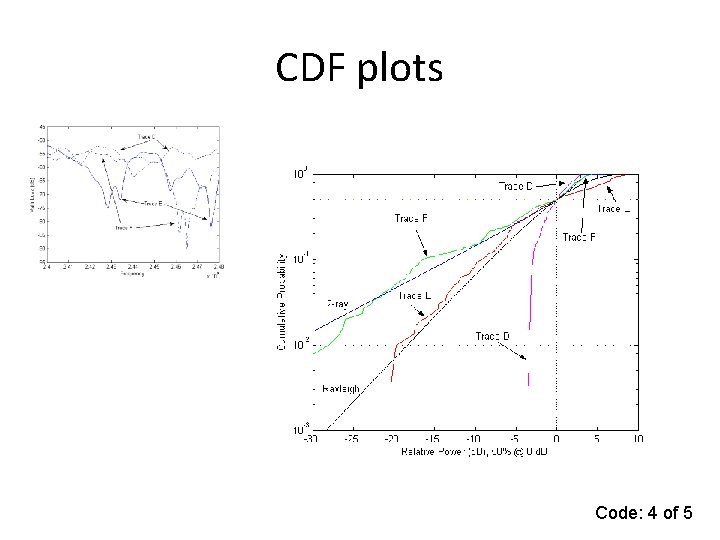
CDF plots Code: 4 of 5

Matlab Code for CDF • • • • • • % CDF routine Rsort=sort(Rlog); %Rlog is the data from the inband n=max(size(Rsort)); for i=1: n, cdf(i)=i; end cdf=cdf/max(cdf); % index equals probability % searching for 1/2 to make 0 d. B for i=1: n, if cdf(i)>=0. 5, shiftzero=Rsort(i) %median value break end Rsortzs=Rsort-shiftzero; semilogy(Rsortzs, cdf, 'g') axis([-30 10 1 e-3 1]) axis square xlabel('Relative Amplitude (d. B), 50% @ 0 d. B') ylabel('Cumulative Probability') Code: 5 of 5
- Slides: 56