
The Wild West Geography of the West o






- Slides: 18
The Wild West
Geography of the West o Towns in Missouri were thought to be the end before the frontier o Frontier – unsettled land in western United States o The West is considered states beyond the Rocky Mountains like Oregon, California, etc. o There are deserts, mountains, rivers, lakes, basins, plateaus, mesas, & even a volcano in the West
Influence of Railroads o Railroads helped settle the West o Trains carried resources like: minerals, timber, crops, & cattle to the East coast o Trains also carried miners, ranchers, & farmers to settle the West o Trains & Native Americans – not friends n Train routes often went through the routes of the animals they hunted or even through their own lands
Go West, Why? o Before the Civil War, the South did not want the land in the West settled n They feared more non-slave territories o Government decided it was time to settle the west by offering free land o Homestead Act – You can have 160 acres for free if you live on it for 5 years and improve it o Many African Americans settled in Kansas, Missouri, Indiana, & Illinois after the Civil War o The Railroads were growing n It’s easier to head west
Challenges in the West o Many challenges faced the people who moved West n There were no trees, so houses were built from sod (thick grass) n Had to dig wells for water n Blizzards, hailstorms, tornados, fires, drought n Insects ate crops o New inventions helped some of the challenges n Steel plow – helped farming & built sod houses n Windmills – helped pump water from wells n Barbed wire – kept cattle in or out n Reapers & threshers – helped harvest crops
Mining in the West o Gold has struck again in Nevada, Colorado, & South Dakota o People raced to go to these areas o Boomtowns appeared due to gold strikes o Boomtown – a town that has a sudden burst of population & economic growth o When the gold & other mined resources ran out people moved to the next town o Boomtowns became ghost towns
Cattle Drives o Cattle ranching made big money for 20 years o Ranchers hired cowhands to drive cattle from Texas to Kansas o Vaqueros – 1 st cowhands came from Mexico o Cattle was put on trains & sent east o Cattle driving was very difficult - you had to keep the cows or “the money” together o Obstacles were: nature, thieves, & Native Americans
Native American Life o Most Plains tribes lived in villages o The Spanish brought horses in the 1500’s to the Native Americans & changed their way of life o Horses helped travel & hunting buffalo o All parts of the buffalo were used: food, clothing, blankets, tools, jewelry, etc. o Now Native Americans could travel with the buffalo
The Government Lies o The Native Americans were promised no one would take their land (HA! We know better) o When the settlers kept whining they wanted more land the government broke their promise o The government set up “boundaries” or “reservations” for the Native Americans o Some Native Americans went along with this while others resisted n Sand Creek Massacre – The Cheyenne fought back & the militia killed 150 tribe members
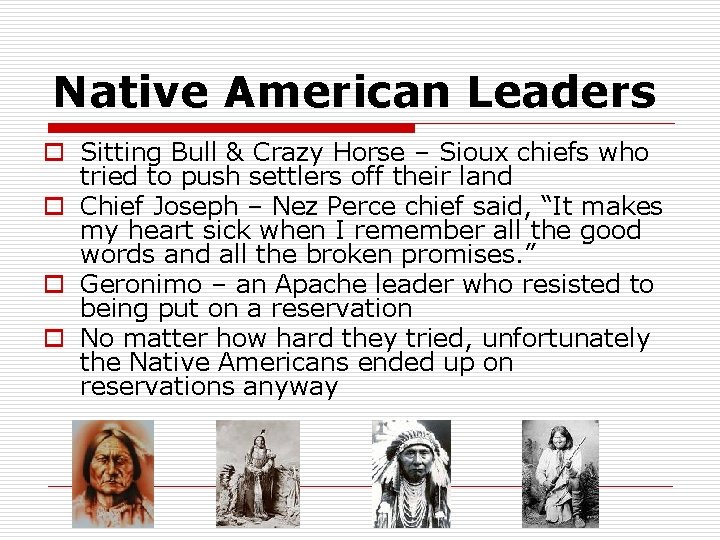
Native American Leaders o Sitting Bull & Crazy Horse – Sioux chiefs who tried to push settlers off their land o Chief Joseph – Nez Perce chief said, “It makes my heart sick when I remember all the good words and all the broken promises. ” o Geronimo – an Apache leader who resisted to being put on a reservation o No matter how hard they tried, unfortunately the Native Americans ended up on reservations anyway
Dawes Act o There were people who actually believed what we had done to the Native Americans was wrong o An idea of assimilation was discussed as a way for Native Americans to “fit in” to white culture o Dawes Act – encouraged Native Americans to give up their customs to become farmers on reservations n Not all Native Americans wanted to be farmers n If they did want to be farmers, they weren’t given the tools or technology the white man had, so it was very difficult
Women in the West o Life was challenging for women in the West n Life was lonely due to few neighbors & women did not go into town with the men n Women were doctors, nurses, cooks, mothers, teachers, & responsible for the homestead n Homestead – a piece of land & the house on it n The Western states acknowledged the importance of women o Wyoming was the first state to fight for women’s right to vote o Soon after Colorado, Utah, and Idaho stood up for women too
Western Cities o Cities grew for a few reasons n Gold & precious mineral strikes n A “refueling” or supply renewal point n Railroad stops o Many cities did not have formal laws or government n Cities & towns were rough n Some people took the law into their own hands n Vigilantes made their own rules
Don’t Forget Us o There were many groups of people who helped make the West what it is today n Vaqueros – the 1 st cowhands from Mexico n African Americans – cattle ranchers & western army soldiers n Chinese immigrants – builders of the railroad in the West n Native Americans – promises broken & forced to leave their homes n Pioneers – all those crazy, um, I mean brave people who took a chance
Closing the Frontier o Fenced in fields replaced open plains o In Oklahoma thousands of people rushed at the sound of a gun shot to claim land for themselves – 2 million acres were sold o The frontier meant opportunity for many n You could make something of yourself if you moved West n You could start a new life n A good day - was a day of good, hard work
How the West has influenced us today… o o o o Cowboy boots & hats Blue Jeans Leather goods (bags, coats, vests, suspenders, etc. ) Home remedies (Hiccups – drink water while standing on your head) Saddles Stories (Buffalo Bill, Calamity Jane, Jesse James) movies, books, poems, songs Railroad growth & travel Food - apples, potatoes, salt water taffy Activities – rodeos, card games, bull riding Patterned clothing Treasure hunts Pony Express – the 1 st post office Bandanas
Slang of the “Wild West” o o o o o Big Bug - - an important person Coffee boiler - - a lazy person Dude - - a person from the East Fandango - - a big party Fetch - - Bring or give Fork over - - to pay Fuss - - disturbance Get a wiggle on - - hurry up Grand - - excellent beautiful Hobble your lip - - be quiet Howdy - - hello In apple pie order - - in tip top shape Jig is up - - it is over Pass the buck - - to avoid responsibility Pull in your horns - - Back off! Skedaddle - - RUN! Stumped - - confused
Sources o Garcia, Jesus, et. al. (2003). Creating America. Chapter 19 Sections 1 -4. Mc. Dougal Littell. Evanston, Illinois. o Atwater, G. M. “Western Slangs & Phrases. ” A Writer’s Guide to the Old West. October 26, 2006. April 21, 2007. http: //freepages. genealogy. rootsweb. com/~ poindexterfamily/Old. West. Slang. html