
The Whole Atmosphere Community Climate Model Overview Current

- Slides: 33
The Whole Atmosphere Community Climate Model: Overview, Current Research and Future Plans Rolando Garcia CCSM June 2006
Outline 1. WACCM overview 2. Research with WACCM – – Solar cycle impacts 1950 -2003 trend simulations 21 st century prognostic simulations Upper atmosphere dynamics (2 -day wave) 3. Future work CCSM June 2006 2
Acknowledgments… the following colleagues contributed to the work presented in this talk. . . • Doug Kinnison (ACD) • Dan Marsh (ACD) • Katja Matthes (Free University Berlin) • Astrid Maute (HAO) • Jadwiga Richter (CGD) • Fabrizio Sassi (CGD) • Stan Solomon (HAO) CCSM June 2006 3
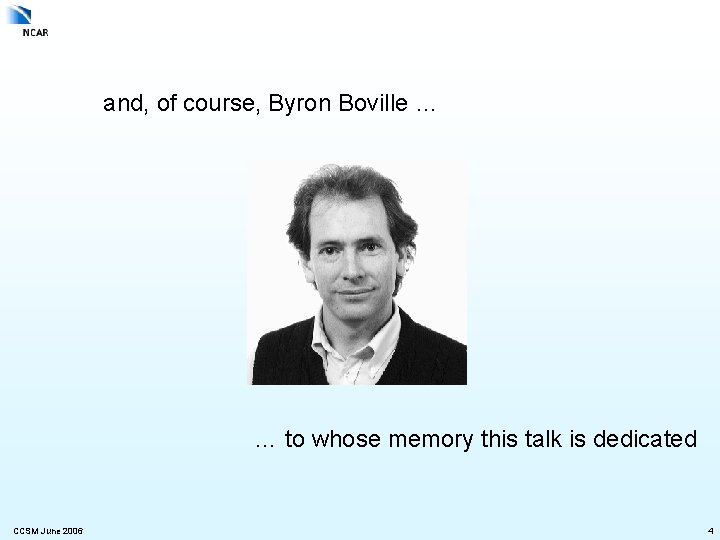
and, of course, Byron Boville … … to whose memory this talk is dedicated CCSM June 2006 4
1. Overview of WACCM CCSM June 2006 5
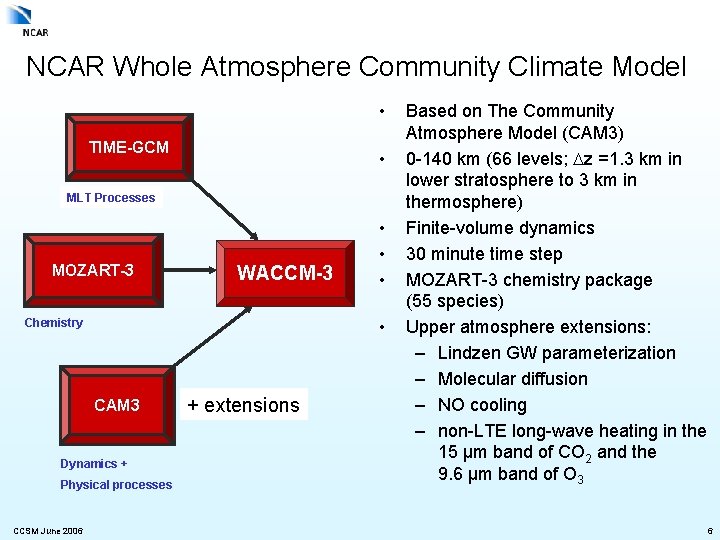
NCAR Whole Atmosphere Community Climate Model • TIME-GCM • MLT Processes MOZART-3 WACCM-3 • Chemistry CAM 3 Dynamics + Physical processes CCSM June 2006 • • • + extensions Based on The Community Atmosphere Model (CAM 3) 0 -140 km (66 levels; Dz =1. 3 km in lower stratosphere to 3 km in thermosphere) Finite-volume dynamics 30 minute time step MOZART-3 chemistry package (55 species) Upper atmosphere extensions: – Lindzen GW parameterization – Molecular diffusion – NO cooling – non-LTE long-wave heating in the 15 µm band of CO 2 and the 9. 6 µm band of O 3 6
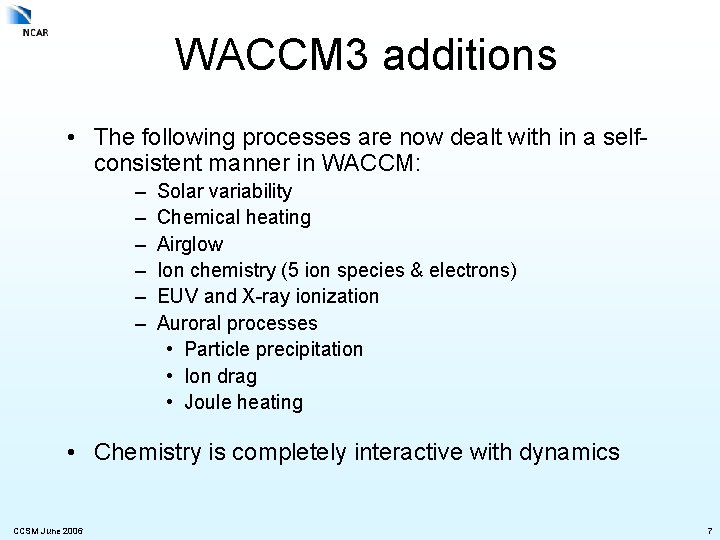
WACCM 3 additions • The following processes are now dealt with in a selfconsistent manner in WACCM: – – – Solar variability Chemical heating Airglow Ion chemistry (5 ion species & electrons) EUV and X-ray ionization Auroral processes • Particle precipitation • Ion drag • Joule heating • Chemistry is completely interactive with dynamics CCSM June 2006 7
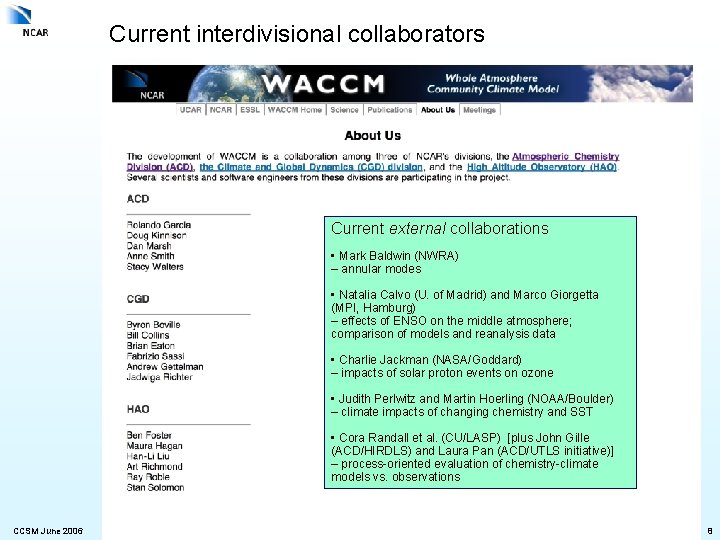
Current interdivisional collaborators Current external collaborations • Mark Baldwin (NWRA) – annular modes • Natalia Calvo (U. of Madrid) and Marco Giorgetta (MPI, Hamburg) – effects of ENSO on the middle atmosphere; comparison of models and reanalysis data • Charlie Jackman (NASA/Goddard) – impacts of solar proton events on ozone • Judith Perlwitz and Martin Hoerling (NOAA/Boulder) – climate impacts of changing chemistry and SST • Cora Randall et al. (CU/LASP) [plus John Gille (ACD/HIRDLS) and Laura Pan (ACD/UTLS initiative)] – process-oriented evaluation of chemistry-climate models vs. observations CCSM June 2006 8
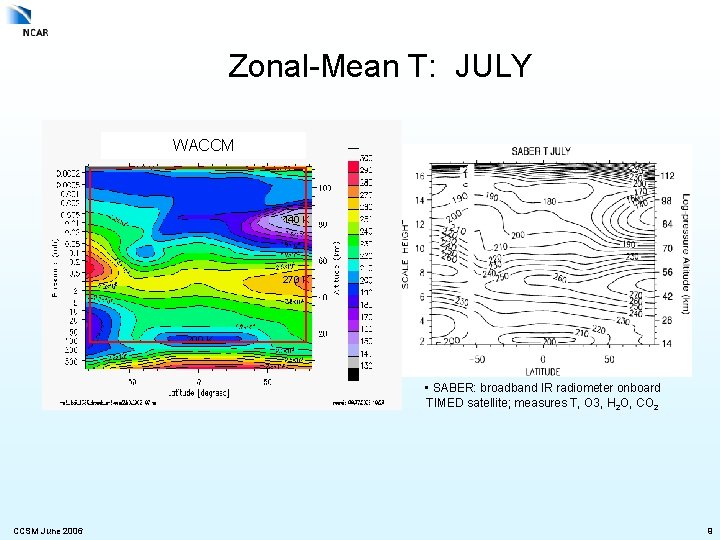
Zonal-Mean T: JULY WACCM 140 K 270 K 200 K • SABER: broadband IR radiometer onboard TIMED satellite; measures T, O 3, H 2 O, CO 2 CCSM June 2006 9
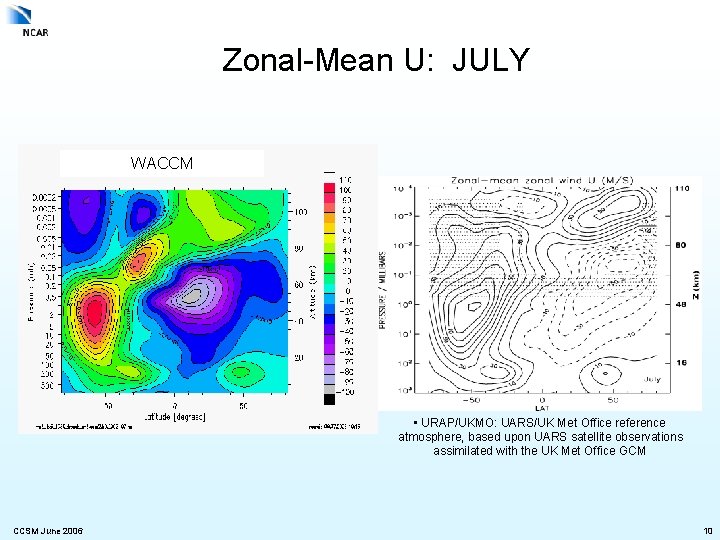
Zonal-Mean U: JULY WACCM • URAP/UKMO: UARS/UK Met Office reference atmosphere, based upon UARS satellite observations assimilated with the UK Met Office GCM CCSM June 2006 10
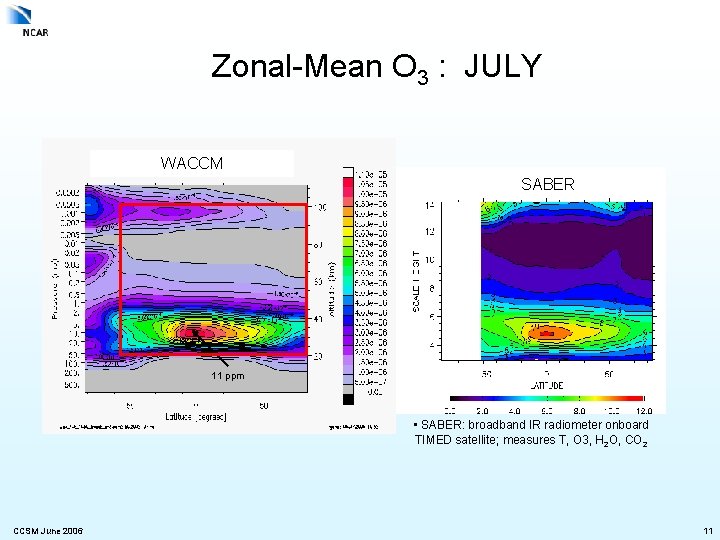
Zonal-Mean O 3 : JULY WACCM SABER 11 ppm • SABER: broadband IR radiometer onboard TIMED satellite; measures T, O 3, H 2 O, CO 2 CCSM June 2006 11
2. Research with WACCM CCSM June 2006 12
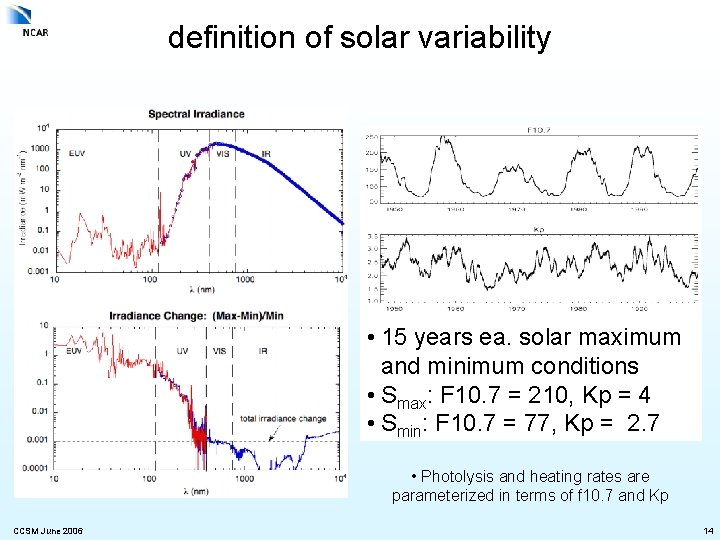
Solar min/max simulations • Fixed solar minimum and solar maximum conditions (constant F 10. 7 and Kp typical of minimum/maximum) CCSM June 2006 13
definition of solar variability • 15 years ea. solar maximum and minimum conditions • Smax: F 10. 7 = 210, Kp = 4 • Smin: F 10. 7 = 77, Kp = 2. 7 • Photolysis and heating rates are parameterized in terms of f 10. 7 and Kp CCSM June 2006 14
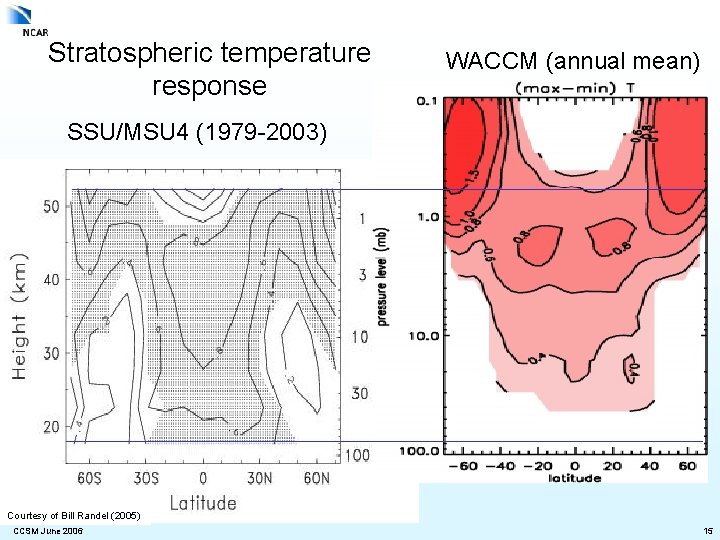
Stratospheric temperature response WACCM (annual mean) SSU/MSU 4 (1979 -2003) Courtesy of Bill Randel (2005) CCSM June 2006 15
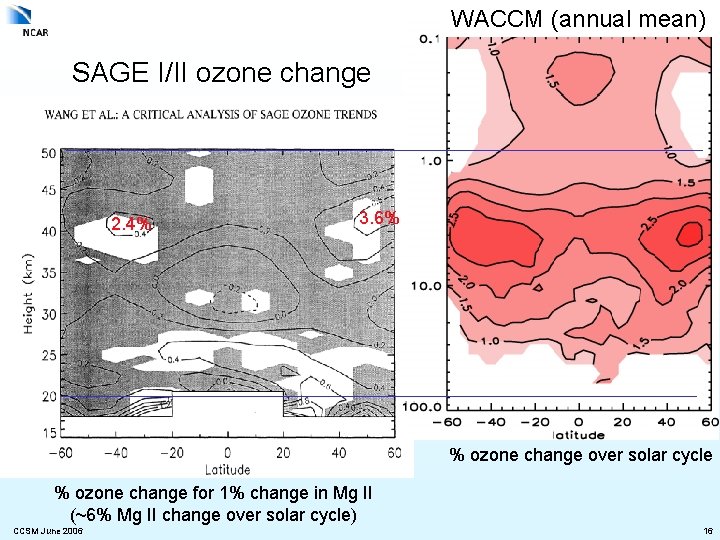
WACCM (annual mean) SAGE I/II ozone change 2. 4% 3. 6% % ozone change over solar cycle % ozone change for 1% change in Mg II (~6% Mg II change over solar cycle) CCSM June 2006 16
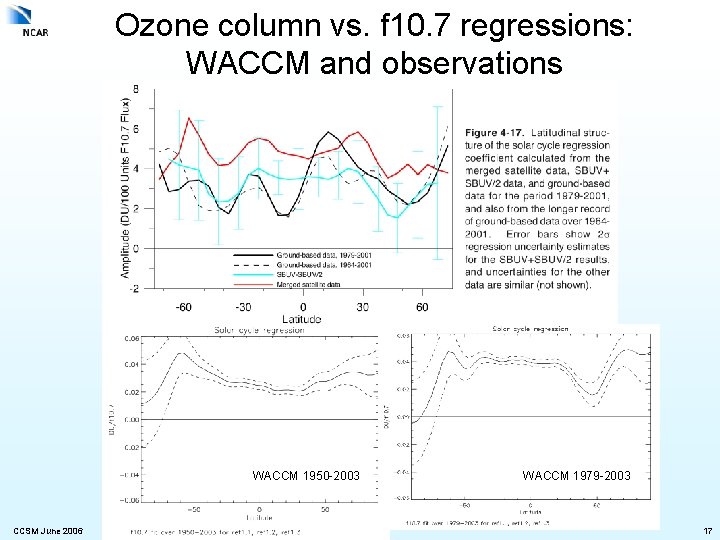
Ozone column vs. f 10. 7 regressions: WACCM and observations WACCM 1950 -2003 CCSM June 2006 WACCM 1979 -2003 17
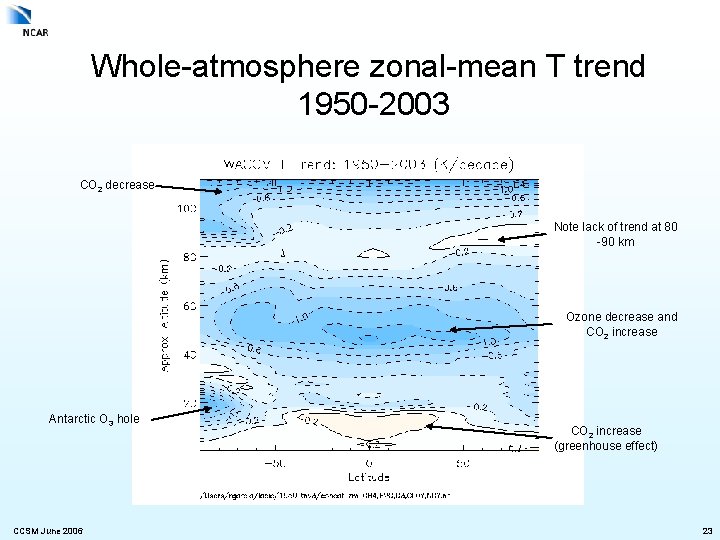
1950 -2003 trends simulation • An ensemble of “retrospective” runs, 1950 -2003, including solar variability, observed SST, observed trends in GHG and halogen species, and observed aerosol surface area densities (for heterogeneous chemistry) CCSM June 2006 18
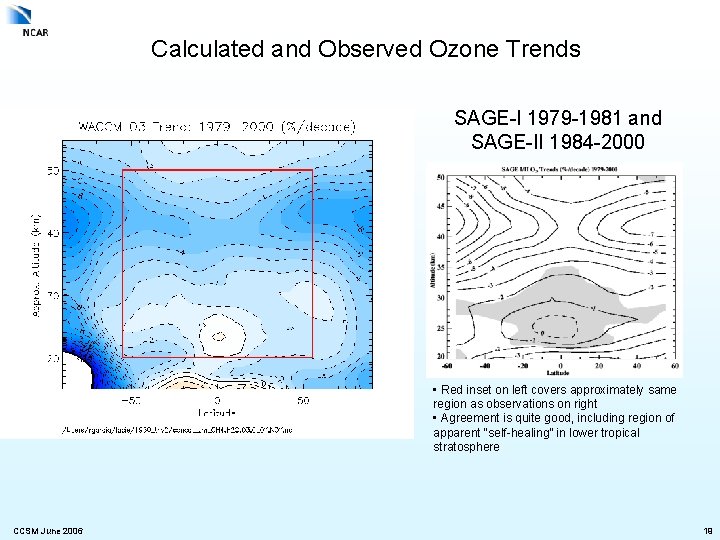
Calculated and Observed Ozone Trends SAGE-I 1979 -1981 and SAGE-II 1984 -2000 • Red inset on left covers approximately same region as observations on right • Agreement is quite good, including region of apparent “self-healing” in lower tropical stratosphere CCSM June 2006 19
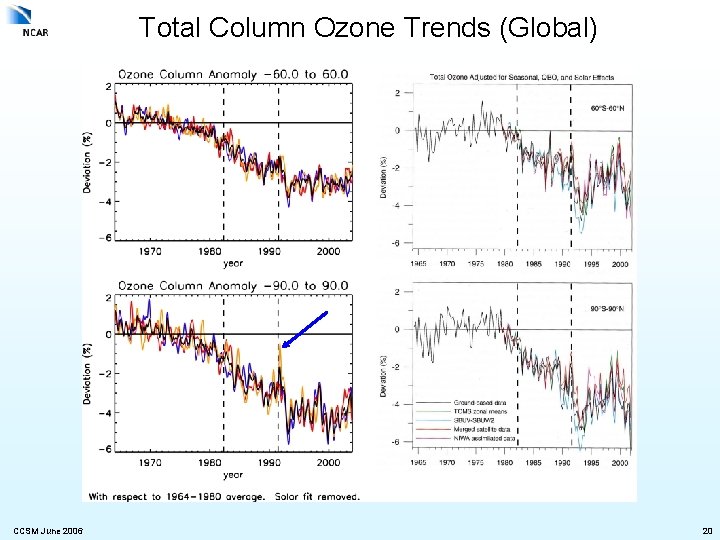
Total Column Ozone Trends (Global) CCSM June 2006 20
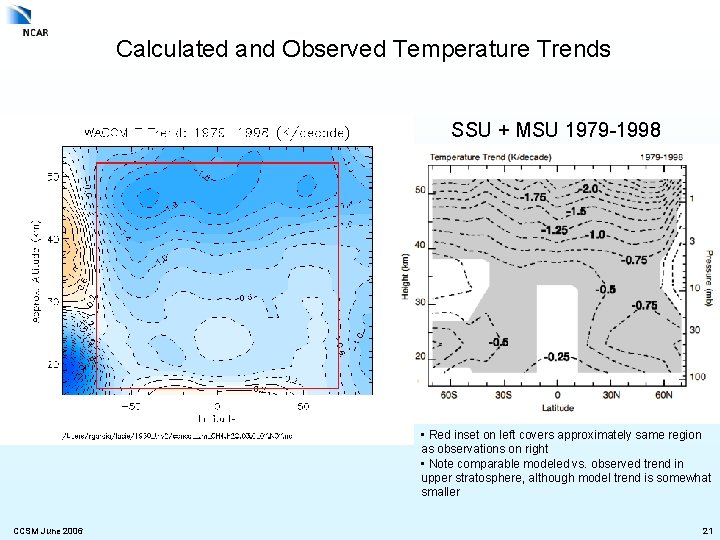
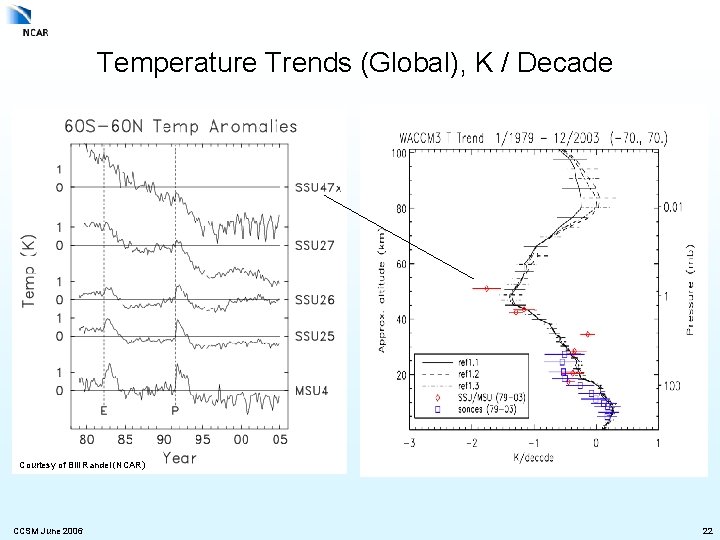
Calculated and Observed Temperature Trends SSU + MSU 1979 -1998 • Red inset on left covers approximately same region as observations on right • Note comparable modeled vs. observed trend in upper stratosphere, although model trend is somewhat smaller CCSM June 2006 21
Temperature Trends (Global), K / Decade Courtesy of Bill Randel (NCAR) CCSM June 2006 22
Whole-atmosphere zonal-mean T trend 1950 -2003 CO 2 decrease Note lack of trend at 80 -90 km Ozone decrease and CO 2 increase Antarctic O 3 hole CCSM June 2006 CO 2 increase (greenhouse effect) 23
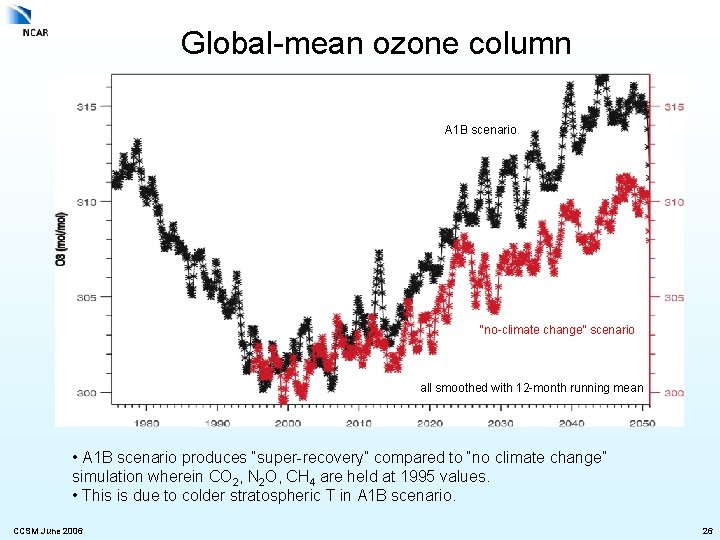
21 st century prognostic simulations • An ensemble of prognostic runs, 1975 -2050, to look at climate change and ozone recovery in the 21 st century. Follows WMO A 1 B scenario. • An additional ensemble assumed constant CO 2, CH 4, N 2 O to assess the role of stratospheric cooling by these gases. CCSM June 2006 24
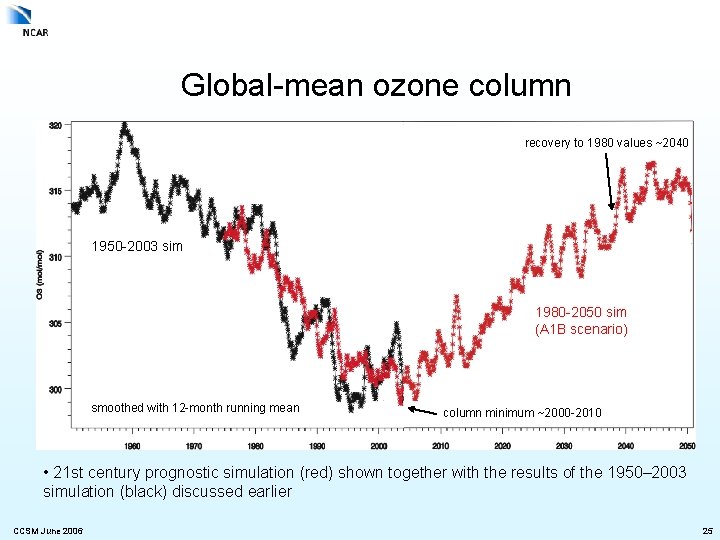
Global-mean ozone column recovery to 1980 values ~2040 1950 -2003 sim 1980 -2050 sim (A 1 B scenario) smoothed with 12 -month running mean column minimum ~2000 -2010 • 21 st century prognostic simulation (red) shown together with the results of the 1950– 2003 simulation (black) discussed earlier CCSM June 2006 25
Global-mean ozone column A 1 B scenario “no-climate change” scenario all smoothed with 12 -month running mean • A 1 B scenario produces “super-recovery” compared to “no climate change” simulation wherein CO 2, N 2 O, CH 4 are held at 1995 values. • This is due to colder stratospheric T in A 1 B scenario. CCSM June 2006 26
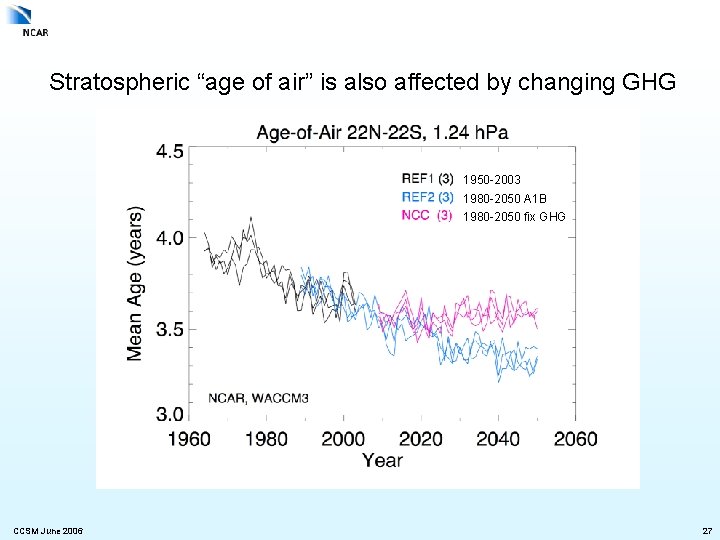
Stratospheric “age of air” is also affected by changing GHG 1950 -2003 1980 -2050 A 1 B 1980 -2050 fix GHG CCSM June 2006 27
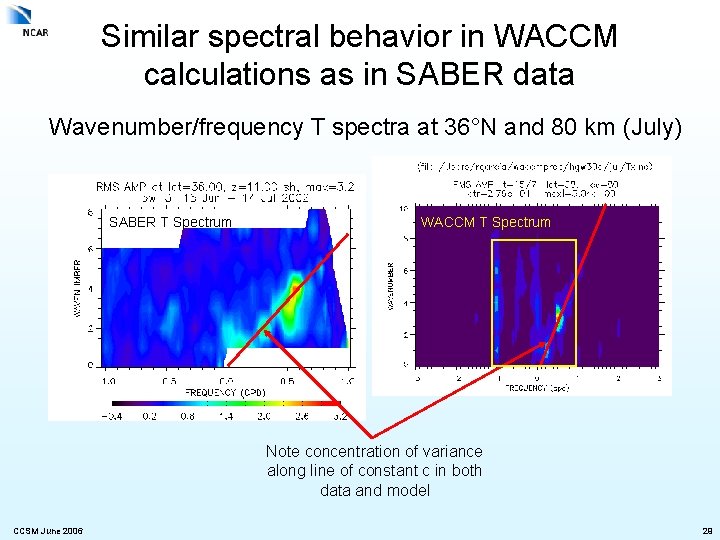
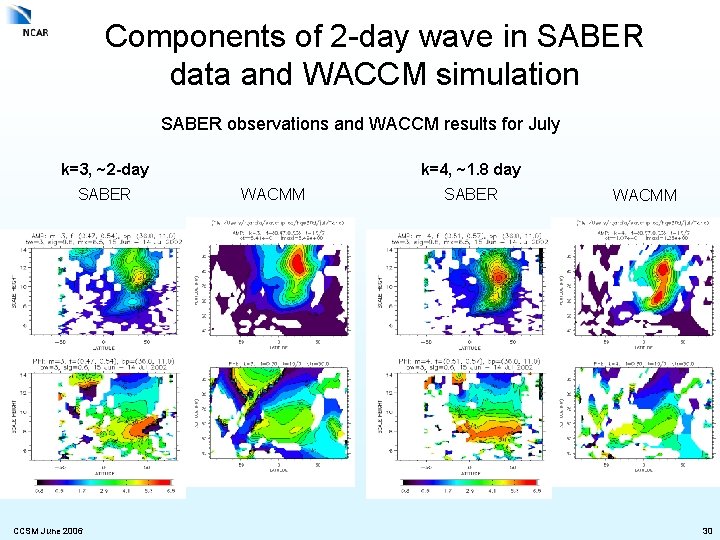
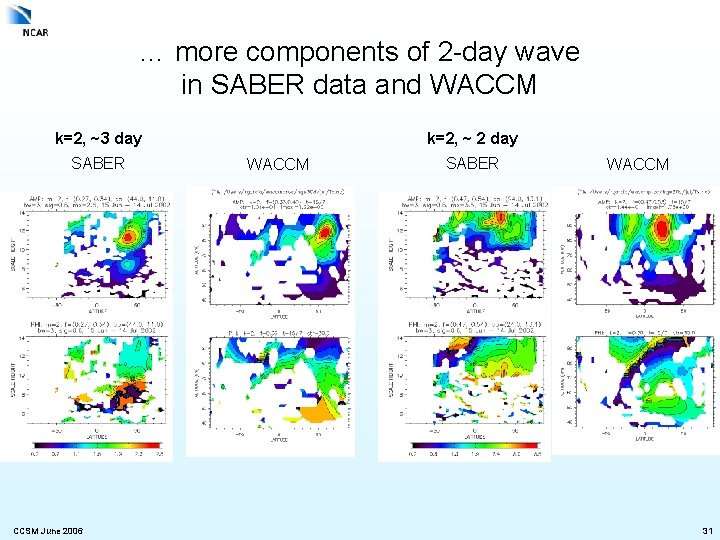
Upper atmosphere dynamics: The 2 -day wave • Apart from the tides, the 2 -day wave dominates high-frequency variability in the MLT • Has large amplitude at solstice, especially in the summer hemisphere • Has been interpreted as a normal mode (e. g. , Salby, 1981), a result of baroclinic instability (e. g. , Plumb, 1983), and a combination of both (e. g. , Randel, 1994) • Comparison of WACCM simulations and observations by the SABER instrument on the TIMED satellite CCSM June 2006 28
Similar spectral behavior in WACCM calculations as in SABER data Wavenumber/frequency T spectra at 36°N and 80 km (July) SABER T Spectrum WACCM T Spectrum Note concentration of variance along line of constant c in both data and model CCSM June 2006 29
Components of 2 -day wave in SABER data and WACCM simulation SABER observations and WACCM results for July k=3, ~2 -day SABER CCSM June 2006 k=4, ~1. 8 day WACMM SABER WACMM 30
… more components of 2 -day wave in SABER data and WACCM k=2, ~3 day SABER CCSM June 2006 k=2, ~ 2 day WACCM SABER WACCM 31
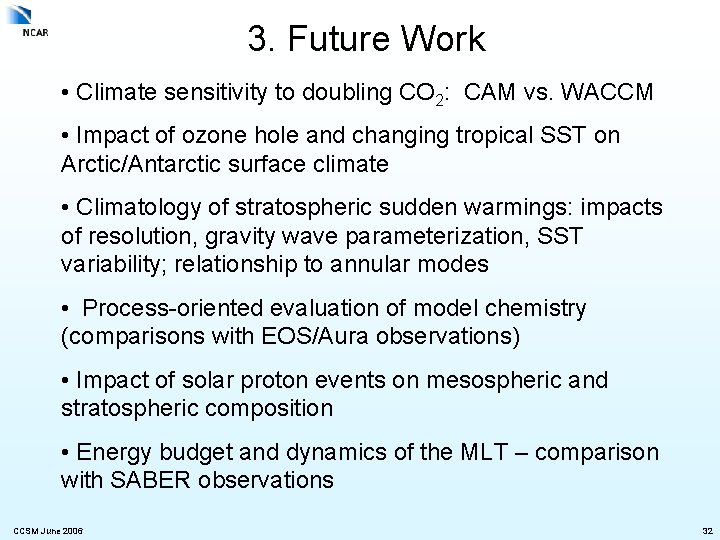
3. Future Work • Climate sensitivity to doubling CO 2: CAM vs. WACCM • Impact of ozone hole and changing tropical SST on Arctic/Antarctic surface climate • Climatology of stratospheric sudden warmings: impacts of resolution, gravity wave parameterization, SST variability; relationship to annular modes • Process-oriented evaluation of model chemistry (comparisons with EOS/Aura observations) • Impact of solar proton events on mesospheric and stratospheric composition • Energy budget and dynamics of the MLT – comparison with SABER observations CCSM June 2006 32
To keep in touch …. WACCM website and new model release • WACCM website is being hosted under ACD (http: //waccm. acd. ucar. edu/index. shtml) • Website has been updated and reformatted • 2006 CSL proposal posted on site • WACCM 3 description to be completed • Release WACCM 3 in summer 2006 CCSM June 2006 33