
The WHO Global Action Plan 2013 2020 and
The WHO Global Action Plan, 2013 -2020 and the Global Monitoring Framework 9 th WHO-IUMSP course, Lausanne, 4 – 8 May 2015 Dr Nick Banatvala, WHO Geneva, Switzerland
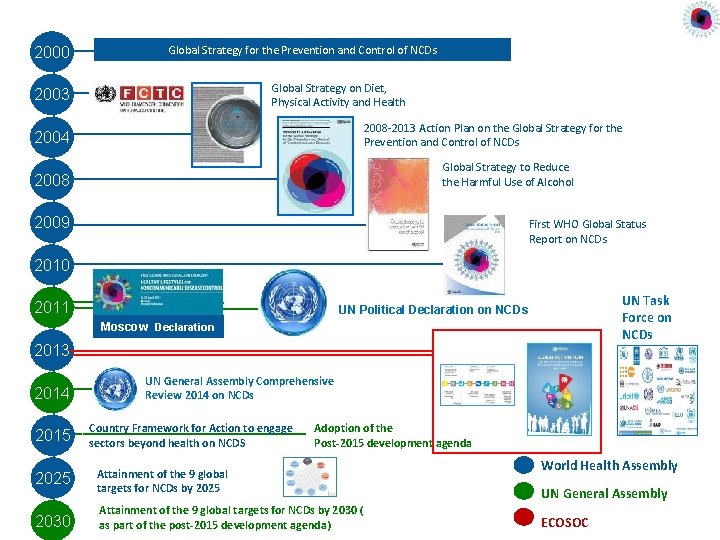
2000 Global Strategy for the Prevention and Control of NCDs Global Strategy on Diet, Physical Activity and Health 2003 2008 -2013 Action Plan on the Global Strategy for the Prevention and Control of NCDs 2004 Global Strategy to Reduce the Harmful Use of Alcohol 2008 2009 First WHO Global Status Report on NCDs 2010 2011 UN Task Force on NCDs UN Political Declaration on NCDs Moscow Declaration 2013 2014 2015 UN General Assembly Comprehensive Review 2014 on NCDs Country Framework for Action to engage sectors beyond health on NCDS Adoption of the Post-2015 development agenda 2025 Attainment of the 9 global targets for NCDs by 2025 2030 Attainment of the 9 global targets for NCDs by 2030 ( as part of the post-2015 development agenda) World Health Assembly UN General Assembly ECOSOC
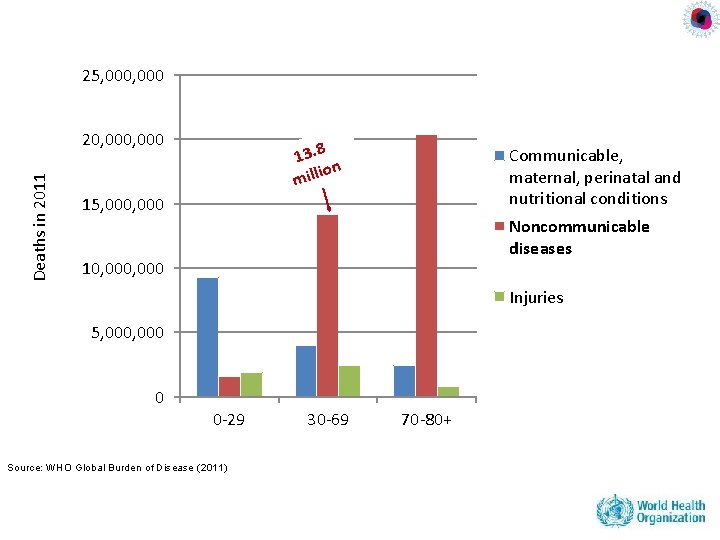
25, 000 10% Deaths in 2011 20, 000 13. 8 ion mill Communicable, maternal, perinatal and nutritional conditions 15, 000 Noncommunicable diseases 10, 000 Injuries 5, 000 0 0 -29 Source: WHO Global Burden of Disease (2011) 30 -69 Age groups 70 -80+
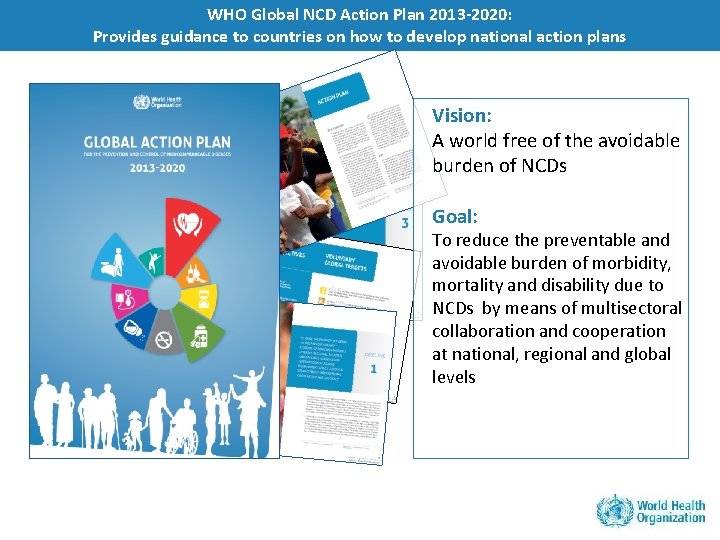
WHO Global NCD Action Plan 2013 -2020: Provides guidance to countries on how to develop national action plans Vision: A world free of the avoidable burden of NCDs Goal: To reduce the preventable and avoidable burden of morbidity, mortality and disability due to NCDs by means of multisectoral collaboration and cooperation at national, regional and global levels

WHO Global NCD Action Plan 2013 -2020: 9 high-level NCD action plan indicators 1 2 3 a 3 b 3 c 3 d 4 5 6 NCD action plan indicator Number of countries with at least one operational multisectoral national policy, strategy or action plan that integrates several NCDs and shared risk factors in conformity with the global/regional NCD action plans 2013– 2020 Number of countries that have operational NCD unit(s)/branch(es)/department(s) within the Ministry of Health, or equivalent. Number of countries with an operational policy, strategy or action plan to reduce the harmful use of alcohol, as appropriate, within the national context Number of countries with an operational policy, strategy or action plan to reduce physical inactivity and/or promote physical activity Number of countries with an operational policy, strategy or action plan, in line with the WHO Framework Convention on Tobacco Control, to reduce the burden of tobacco use Number of countries with an operational policy, strategy or action plan to reduce unhealthy diet and/or promote healthy diets. Number of countries that have evidence-based national guidelines/protocols/standards for the management of major NCD through a primary care approach, recognized/approved by government or competent authorities Number of countries that have an operational national policy and plan on NCD-related research, including community-based research and evaluation of the impact of interventions and policies. Number of countries with NCD surveillance and monitoring systems in place to enable reporting against the nine voluntary global NCD targets
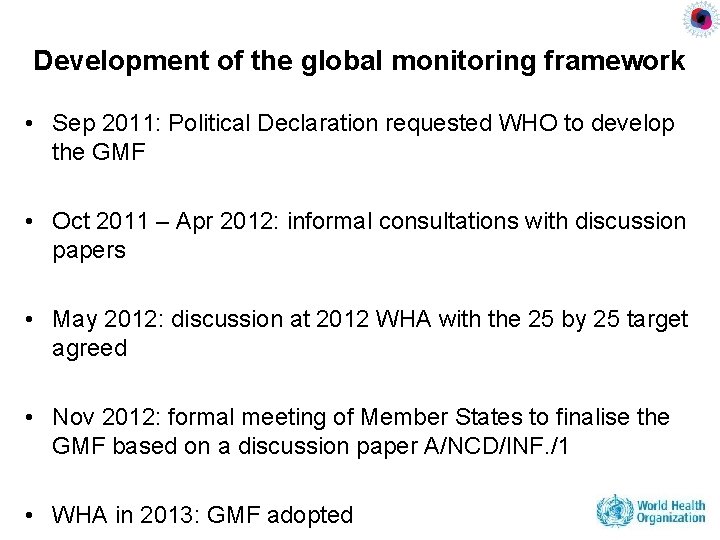
Development of the global monitoring framework • Sep 2011: Political Declaration requested WHO to develop the GMF • Oct 2011 – Apr 2012: informal consultations with discussion papers • May 2012: discussion at 2012 WHA with the 25 by 25 target agreed • Nov 2012: formal meeting of Member States to finalise the GMF based on a discussion paper A/NCD/INF. /1 • WHA in 2013: GMF adopted
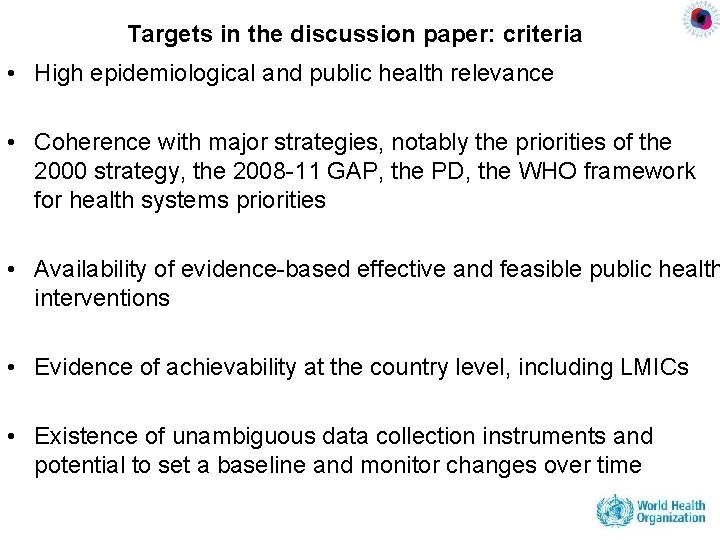
Targets in the discussion paper: criteria • High epidemiological and public health relevance • Coherence with major strategies, notably the priorities of the 2000 strategy, the 2008 -11 GAP, the PD, the WHO framework for health systems priorities • Availability of evidence-based effective and feasible public health interventions • Evidence of achievability at the country level, including LMICs • Existence of unambiguous data collection instruments and potential to set a baseline and monitor changes over time
Targets in discussion paper A/NCD/INF. /1 • Definition for each target • How it was set (target setting) • Why it was considered achievable (achievability) http: //apps. who. int/gb/ncds/pdf/A_NCD_INF 1 -en. pdf
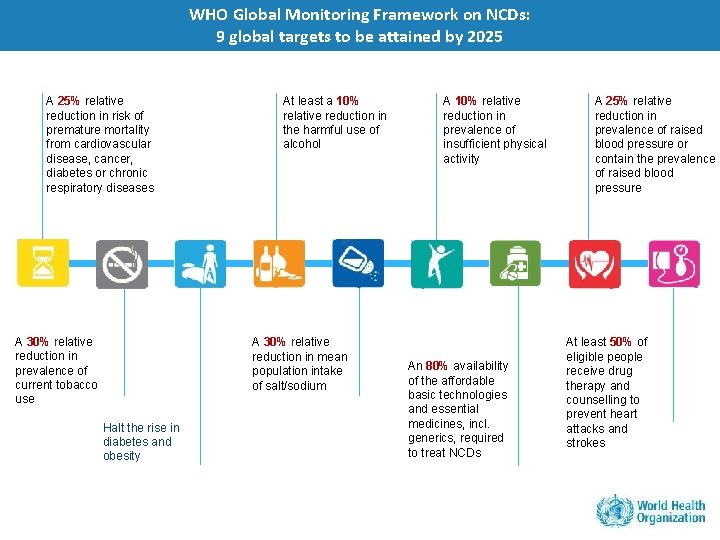
WHO Global Monitoring Framework on NCDs: 9 global targets to be attained by 2025 A 25% relative reduction in risk of premature mortality from cardiovascular disease, cancer, diabetes or chronic respiratory diseases A 30% relative reduction in prevalence of current tobacco use At least a 10% relative reduction in the harmful use of alcohol A 30% relative reduction in mean population intake of salt/sodium Halt the rise in diabetes and obesity A 10% relative reduction in prevalence of insufficient physical activity An 80% availability of the affordable basic technologies and essential medicines, incl. generics, required to treat NCDs A 25% relative reduction in prevalence of raised blood pressure or contain the prevalence of raised blood pressure At least 50% of eligible people receive drug therapy and counselling to prevent heart attacks and strokes

Accountability Framework: Global baseline (2010) against which progress will be measured Country estimates of NCD mortality and selected risk factors (2010 baseline and latest available data) o o o o o Premature mortality NCD mortality Alcohol Insufficient physical activity Tobacco Body mass index Overweight and obesity Raised blood glucose Raised blood pressure
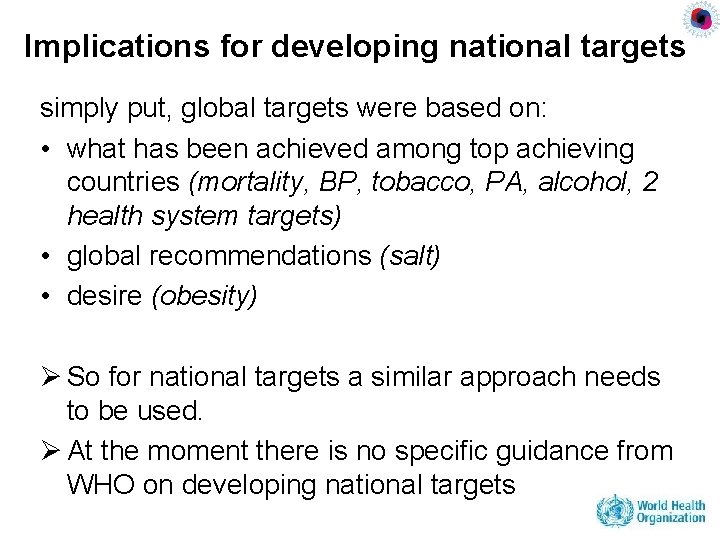
Implications for developing national targets simply put, global targets were based on: • what has been achieved among top achieving countries (mortality, BP, tobacco, PA, alcohol, 2 health system targets) • global recommendations (salt) • desire (obesity) Ø So for national targets a similar approach needs to be used. Ø At the moment there is no specific guidance from WHO on developing national targets
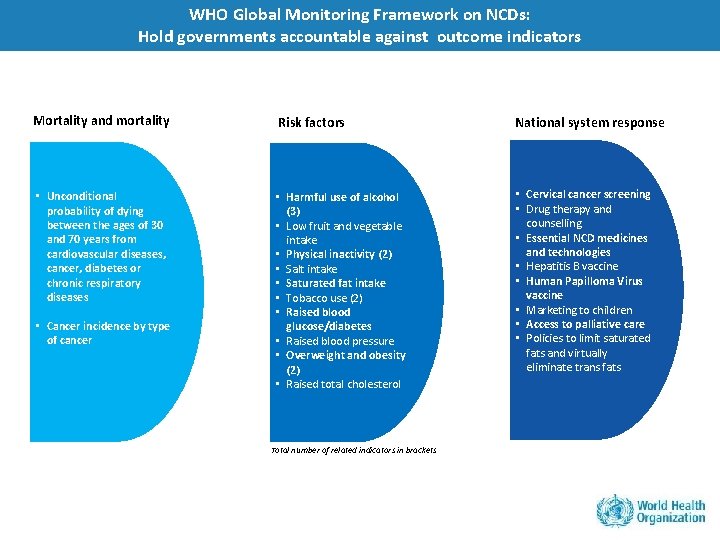
WHO Global Monitoring Framework on NCDs: Hold governments accountable against outcome indicators Mortality and mortality Risk factors National system response • Unconditional probability of dying between the ages of 30 and 70 years from cardiovascular diseases, cancer, diabetes or chronic respiratory diseases • Harmful use of alcohol (3) • Low fruit and vegetable intake • Physical inactivity (2) • Salt intake • Saturated fat intake • Tobacco use (2) • Raised blood glucose/diabetes • Raised blood pressure • Overweight and obesity (2) • Raised total cholesterol • Cervical cancer screening • Drug therapy and counselling • Essential NCD medicines and technologies • Hepatitis B vaccine • Human Papilloma Virus vaccine • Marketing to children • Access to palliative care • Policies to limit saturated fats and virtually eliminate trans fats • Cancer incidence by type of cancer Total number of related indicators in brackets
NCD GMF: indicator definitions and Specifications http: //www. who. int/nmh/ncd-tools/indicators/GMF_Indicator_Definitions_Version_NOV 2014. pdf NCD GMF: national target worksheet http: //www. who. int/entity/nmh/ncd-tools/targets/natl_target_worksheet_final. xlsx
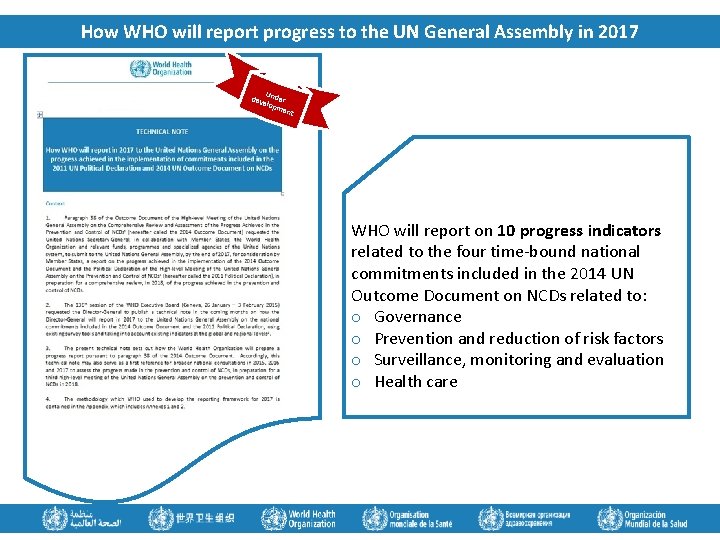
How WHO will report progress to the UN General Assembly in 2017 U dev nder elop men t WHO will report on 10 progress indicators related to the four time-bound national commitments included in the 2014 UN Outcome Document on NCDs related to: o Governance o Prevention and reduction of risk factors o Surveillance, monitoring and evaluation o Health care
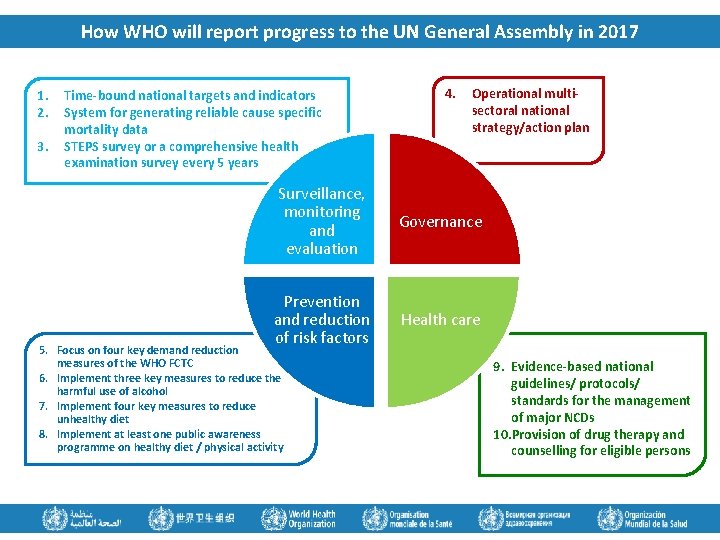
How WHO will report progress to the UN General Assembly in 2017 1. 2. 3. Time-bound national targets and indicators System for generating reliable cause specific mortality data STEPS survey or a comprehensive health examination survey every 5 years 4. Operational multisectoral national strategy/action plan Surveillance, monitoring and evaluation Governance Prevention and reduction of risk factors Health care 5. Focus on four key demand reduction measures of the WHO FCTC 6. Implement three key measures to reduce the harmful use of alcohol 7. Implement four key measures to reduce unhealthy diet 8. Implement at least one public awareness programme on healthy diet / physical activity 9. Evidence-based national guidelines/ protocols/ standards for the management of major NCDs 10. Provision of drug therapy and counselling for eligible persons

Accountability Framework: Holding governments accountable at the World Health Assembly and the UN General Assembly 2015 (2016) WHA 68 2020 (2021) WHA 73 2025 (2026) 2015 WHA 68 (2016) 2017 (2018) WHA 69 2020 (2021) 2015 Progress monitor 2016 Progress monitor WHA 78 WHA 73 2017 UNGA (2017)
- Slides: 16