
The Where What and Why of Global Disparities
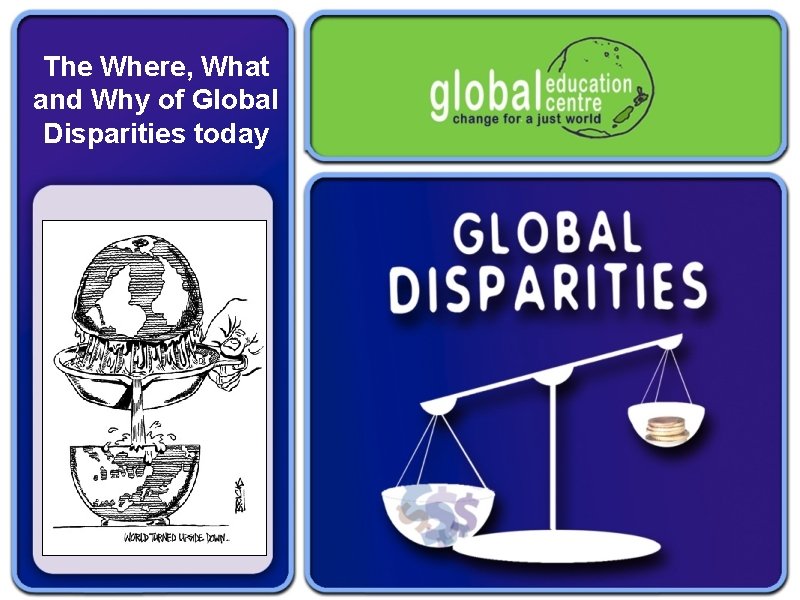
The Where, What and Why of Global Disparities today
What are Disparities? Disparities refer to differences These differences may result from different levels of access to social, economic, environmental, political or other resources. Both Natural and Cultural factors can contribute to disparities. Are there disparities within your school? Your class? What are some disparities that exist in your life? 57% of the world’s total wealth is held by just 1% of the world’s people. Why?
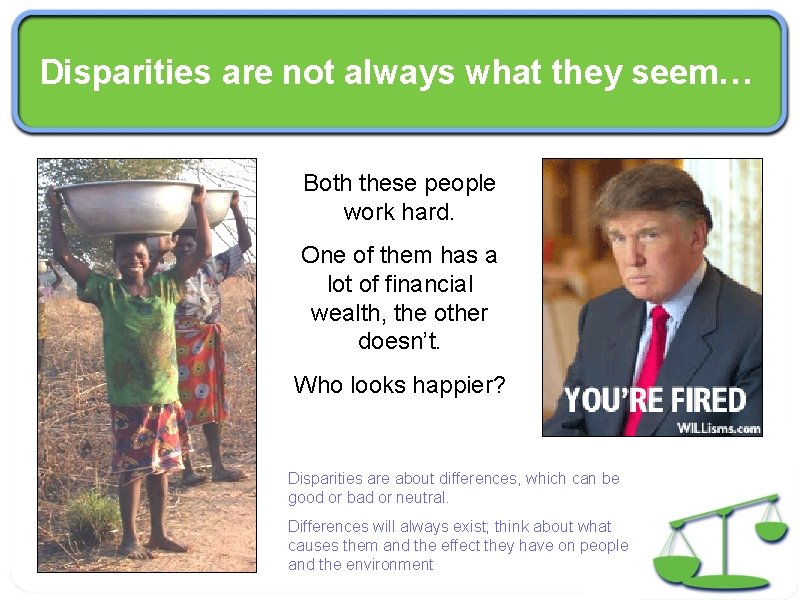
Disparities are not always what they seem… Both these people work hard. One of them has a lot of financial wealth, the other doesn’t. Who looks happier? Disparities are about differences, which can be good or bad or neutral. Differences will always exist; think about what causes them and the effect they have on people and the environment
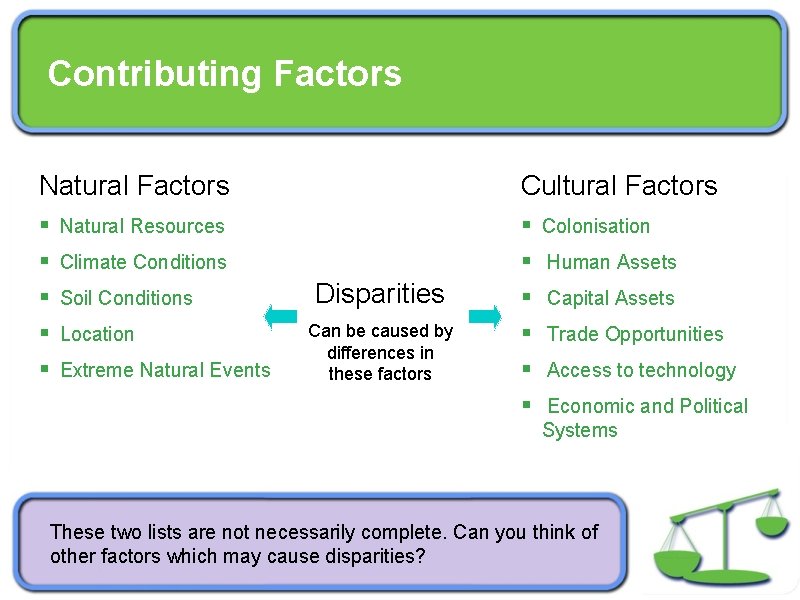
Contributing Factors Natural Factors Cultural Factors § § § Natural Resources Climate Conditions Soil Conditions Location Extreme Natural Events Disparities Can be caused by differences in these factors Colonisation Human Assets Capital Assets Trade Opportunities Access to technology Economic and Political Systems These two lists are not necessarily complete. Can you think of other factors which may cause disparities?
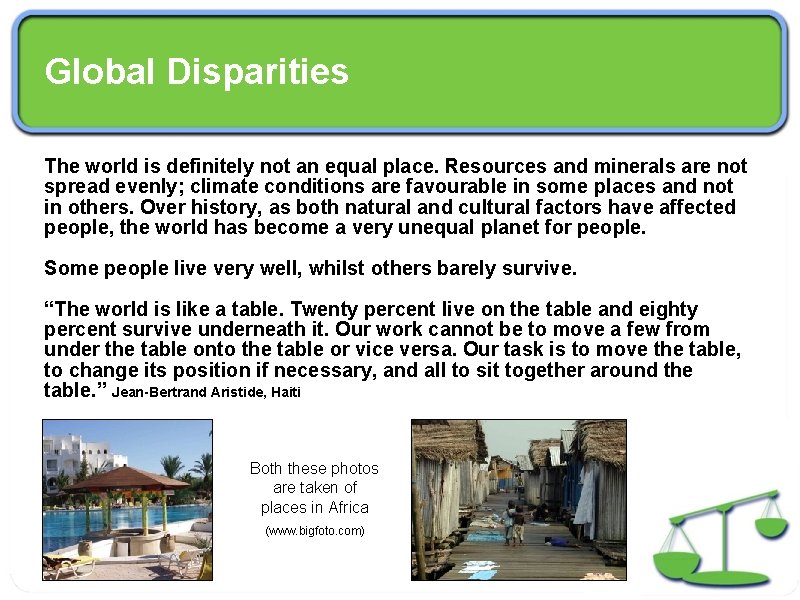
Global Disparities The world is definitely not an equal place. Resources and minerals are not spread evenly; climate conditions are favourable in some places and not in others. Over history, as both natural and cultural factors have affected people, the world has become a very unequal planet for people. Some people live very well, whilst others barely survive. “The world is like a table. Twenty percent live on the table and eighty percent survive underneath it. Our work cannot be to move a few from under the table onto the table or vice versa. Our task is to move the table, to change its position if necessary, and all to sit together around the table. ” Jean-Bertrand Aristide, Haiti Both these photos are taken of places in Africa (www. bigfoto. com)
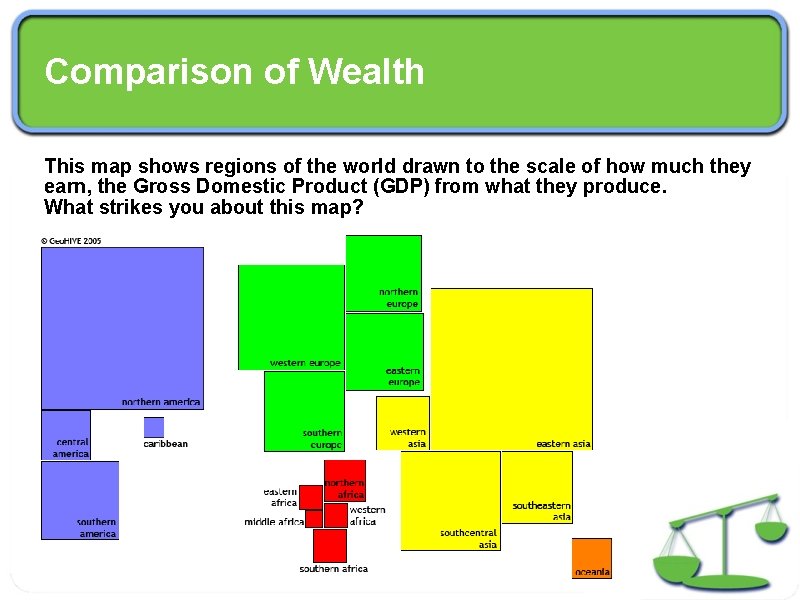
Comparison of Wealth This map shows regions of the world drawn to the scale of how much they earn, the Gross Domestic Product (GDP) from what they produce. What strikes you about this map?
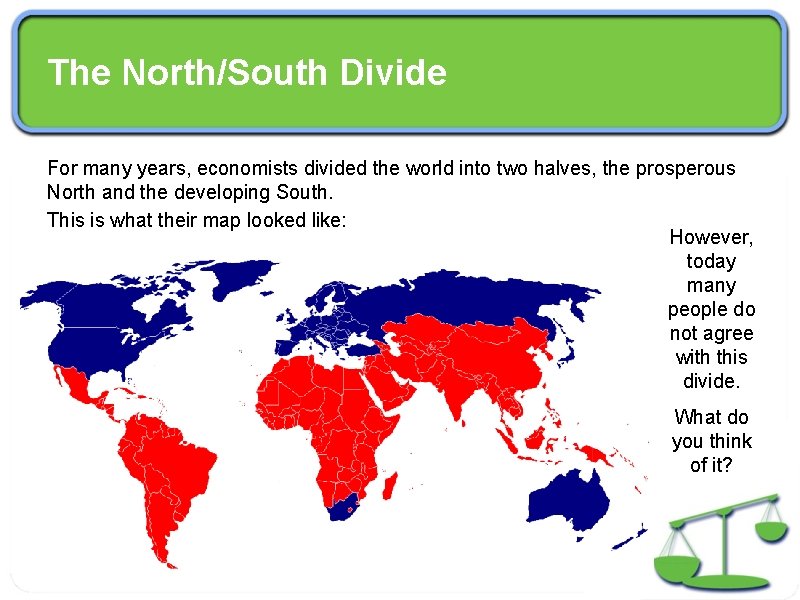
The North/South Divide For many years, economists divided the world into two halves, the prosperous North and the developing South. This is what their map looked like: However, today many people do not agree with this divide. What do you think of it?
Global Disparities Today § Today many people refer to the rich world and the poor world, but the two worlds are not necessarily divided by geography. § If we consider wealth as an example of disparity, rich people are concentrated in just a handful of countries, whilst global poverty is concentrated in South Asia, China and sub. Saharan Africa. § As a rough guide, the North/South division still works, but there are disparities within each country. For example, there are over 45 000 millionaires in Hong Kong alone, but according to the North/South Divide, Hong Kong is in the poor South. Also, there approximately 11 million people living below the poverty line in the world’s richest country, the USA.
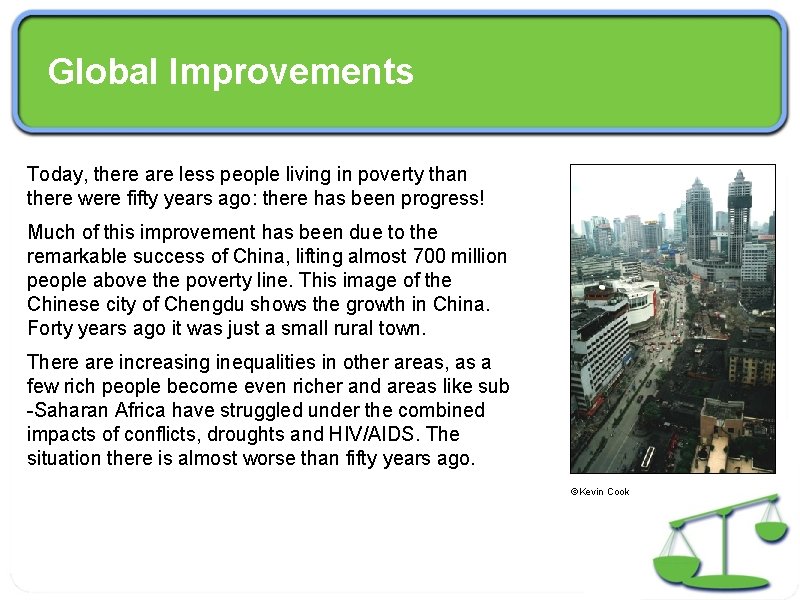
Global Improvements Today, there are less people living in poverty than there were fifty years ago: there has been progress! Much of this improvement has been due to the remarkable success of China, lifting almost 700 million people above the poverty line. This image of the Chinese city of Chengdu shows the growth in China. Forty years ago it was just a small rural town. There are increasing inequalities in other areas, as a few rich people become even richer and areas like sub -Saharan Africa have struggled under the combined impacts of conflicts, droughts and HIV/AIDS. The situation there is almost worse than fifty years ago. ©Kevin Cook
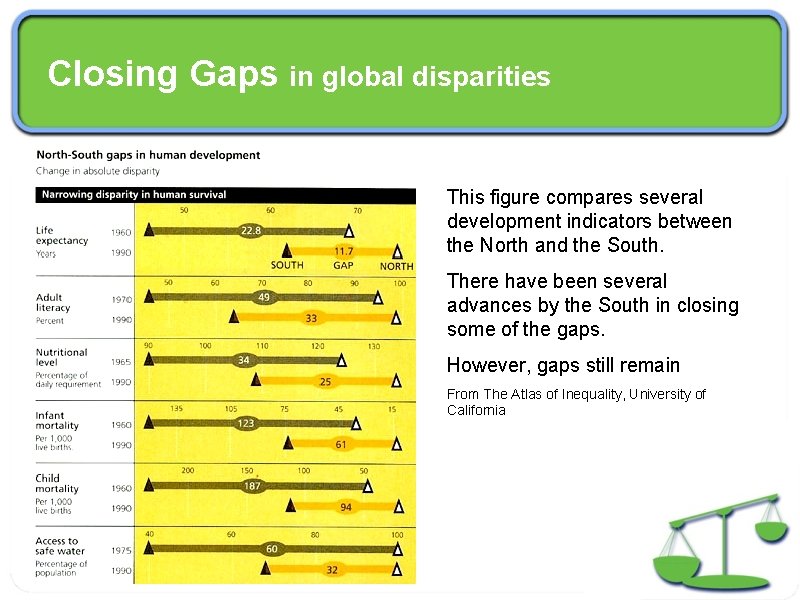
Closing Gaps in global disparities This figure compares several development indicators between the North and the South. There have been several advances by the South in closing some of the gaps. However, gaps still remain From The Atlas of Inequality, University of California
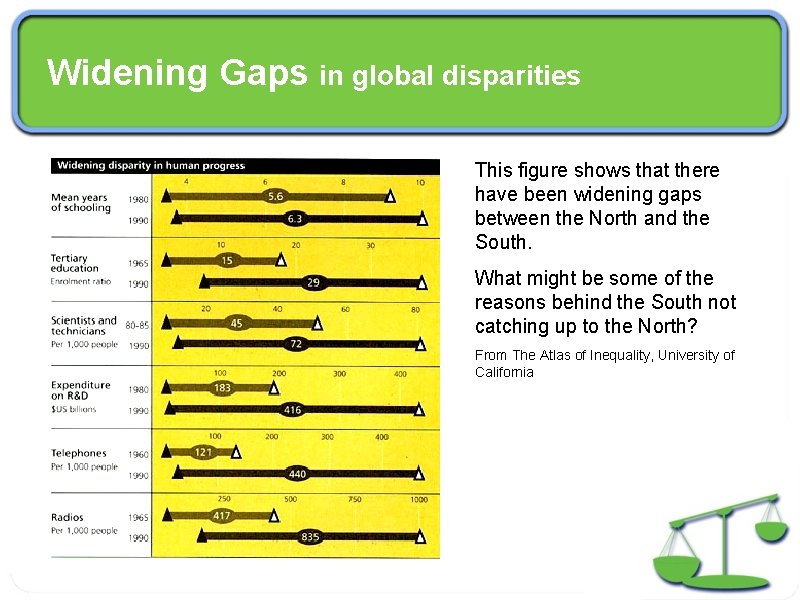
Widening Gaps in global disparities This figure shows that there have been widening gaps between the North and the South. What might be some of the reasons behind the South not catching up to the North? From The Atlas of Inequality, University of California
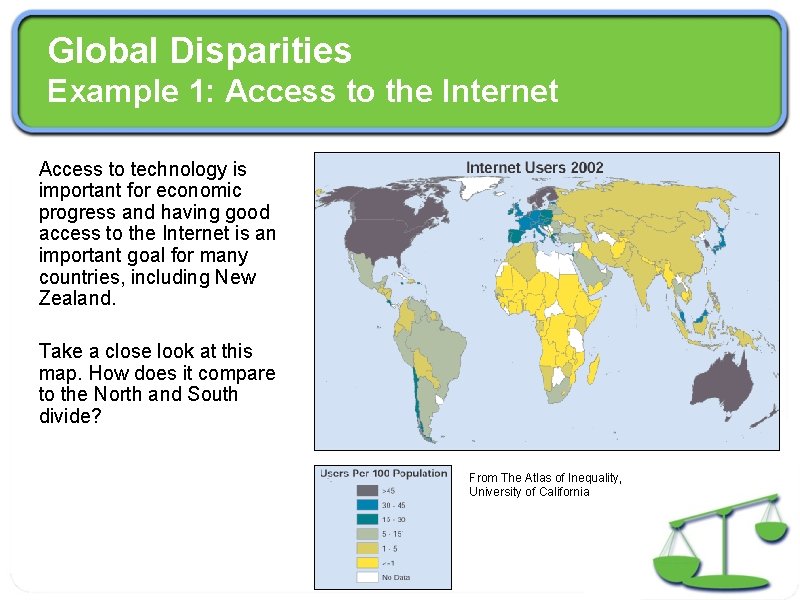
Global Disparities Example 1: Access to the Internet Access to technology is important for economic progress and having good access to the Internet is an important goal for many countries, including New Zealand. Take a close look at this map. How does it compare to the North and South divide? From The Atlas of Inequality, University of California
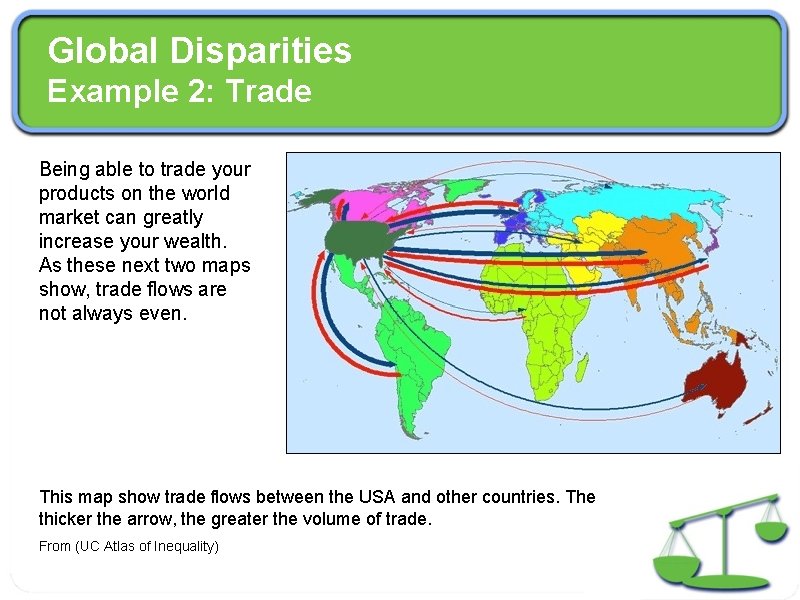
Global Disparities Example 2: Trade Being able to trade your products on the world market can greatly increase your wealth. As these next two maps show, trade flows are not always even. This map show trade flows between the USA and other countries. The thicker the arrow, the greater the volume of trade. From (UC Atlas of Inequality)
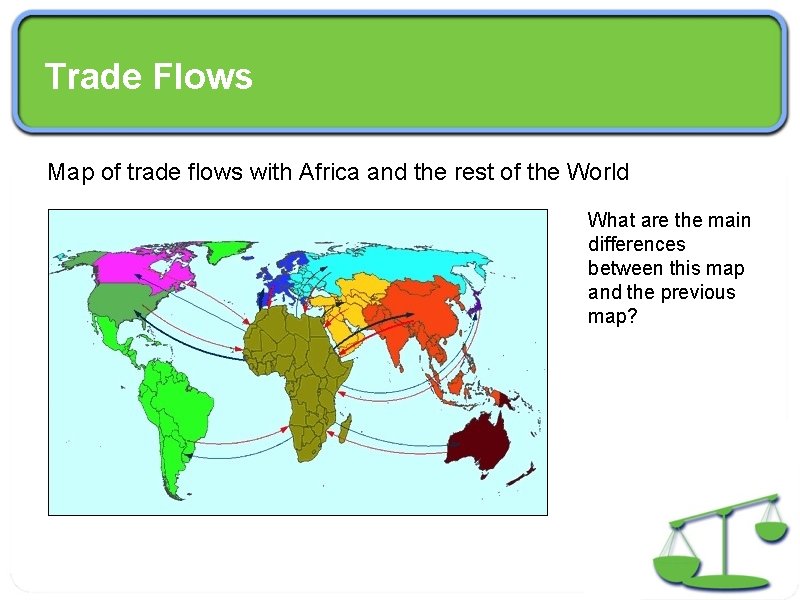
Trade Flows Map of trade flows with Africa and the rest of the World What are the main differences between this map and the previous map?
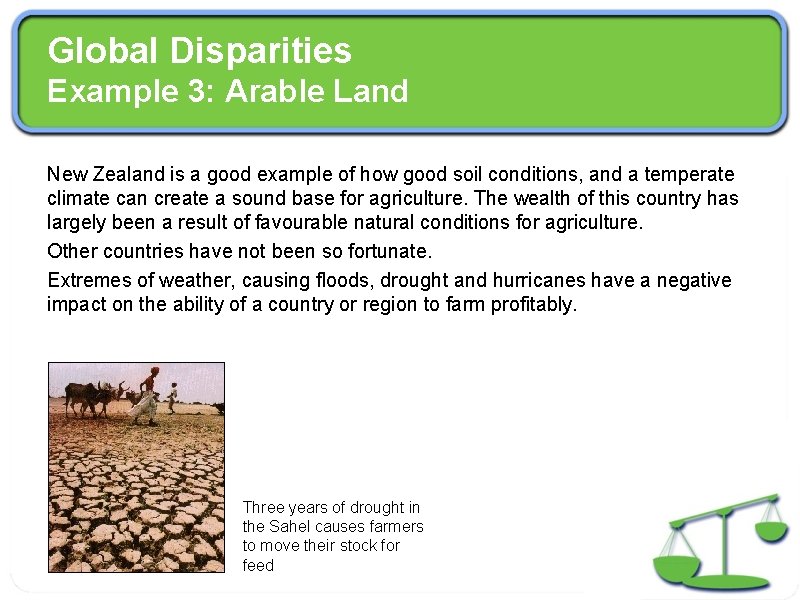
Global Disparities Example 3: Arable Land New Zealand is a good example of how good soil conditions, and a temperate climate can create a sound base for agriculture. The wealth of this country has largely been a result of favourable natural conditions for agriculture. Other countries have not been so fortunate. Extremes of weather, causing floods, drought and hurricanes have a negative impact on the ability of a country or region to farm profitably. Three years of drought in the Sahel causes farmers to move their stock for feed
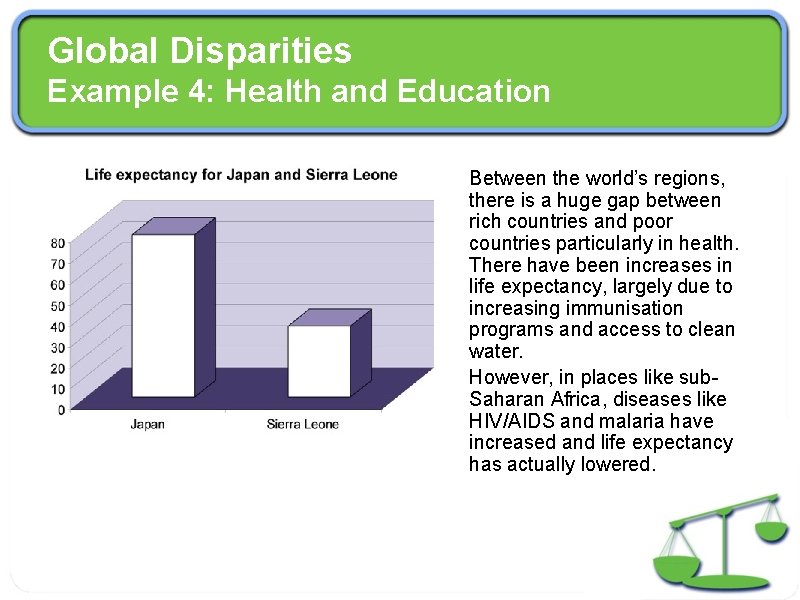
Global Disparities Example 4: Health and Education Between the world’s regions, there is a huge gap between rich countries and poor countries particularly in health. There have been increases in life expectancy, largely due to increasing immunisation programs and access to clean water. However, in places like sub. Saharan Africa, diseases like HIV/AIDS and malaria have increased and life expectancy has actually lowered.
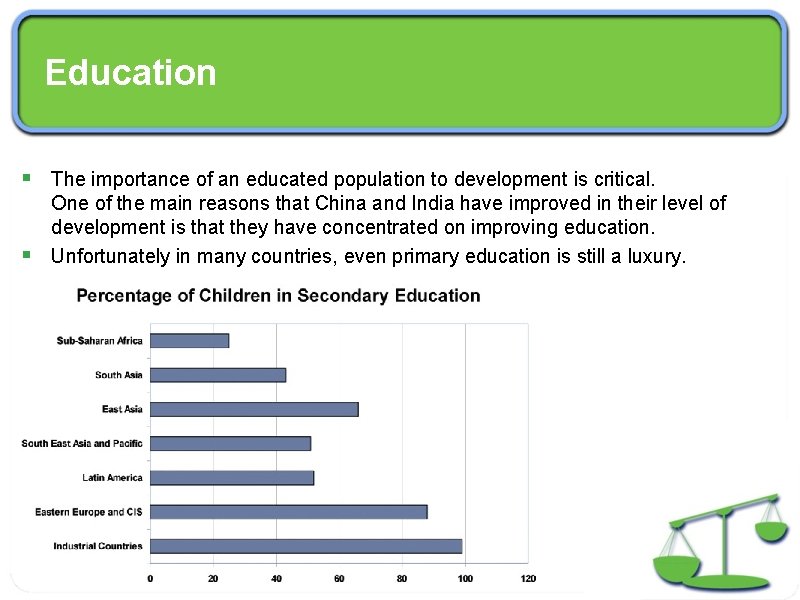
Education § The importance of an educated population to development is critical. § One of the main reasons that China and India have improved in their level of development is that they have concentrated on improving education. Unfortunately in many countries, even primary education is still a luxury.
Disparities Can Cause Trouble § There always going to be differences in the world, between the regions § and between people. If the world was all the same it would be a very boring place. Disparities can be caused by both cultural and natural factors. Some factors are caused or aggravated by people. The Chinese have a saying: "Inequality, rather than want, is the cause of trouble. " What do you think of this saying? Do you think conflicts are caused by envy?
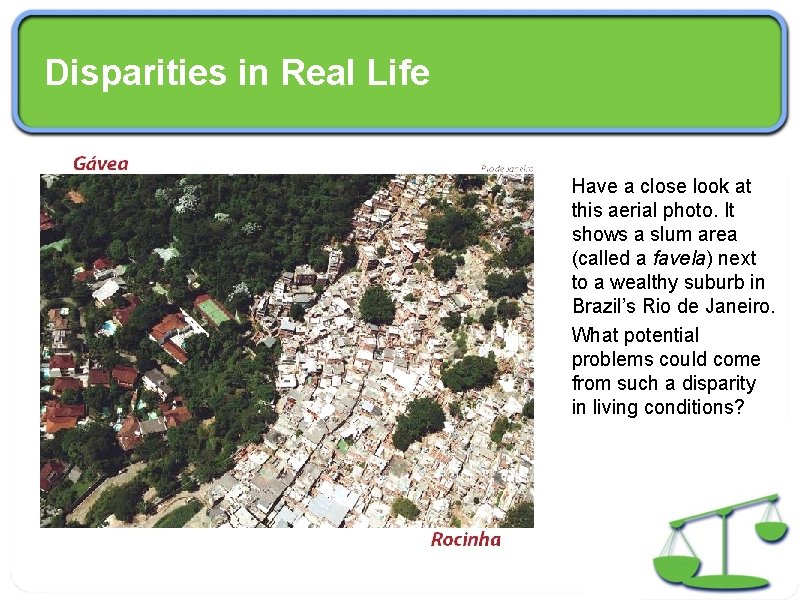
Disparities in Real Life Have a close look at this aerial photo. It shows a slum area (called a favela) next to a wealthy suburb in Brazil’s Rio de Janeiro. What potential problems could come from such a disparity in living conditions?
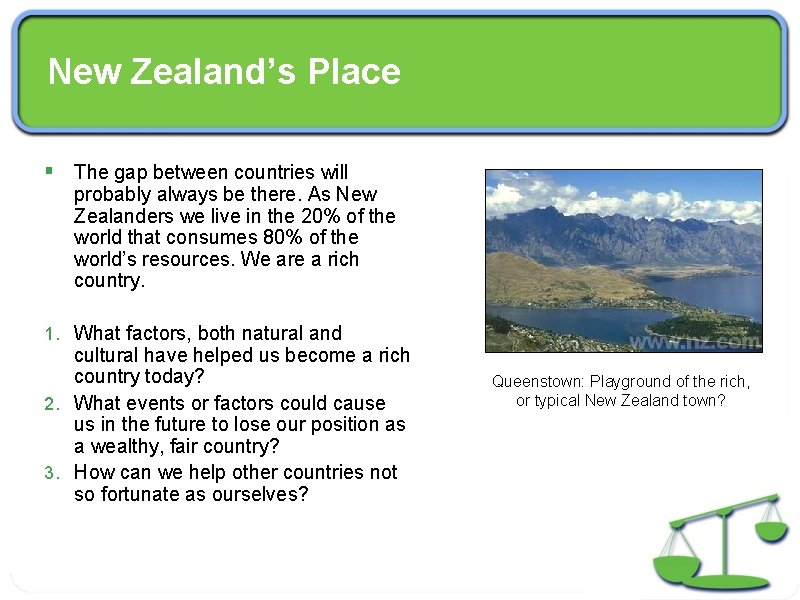
New Zealand’s Place § The gap between countries will probably always be there. As New Zealanders we live in the 20% of the world that consumes 80% of the world’s resources. We are a rich country. 1. What factors, both natural and cultural have helped us become a rich country today? 2. What events or factors could cause us in the future to lose our position as a wealthy, fair country? 3. How can we help other countries not so fortunate as ourselves? Queenstown: Playground of the rich, or typical New Zealand town?
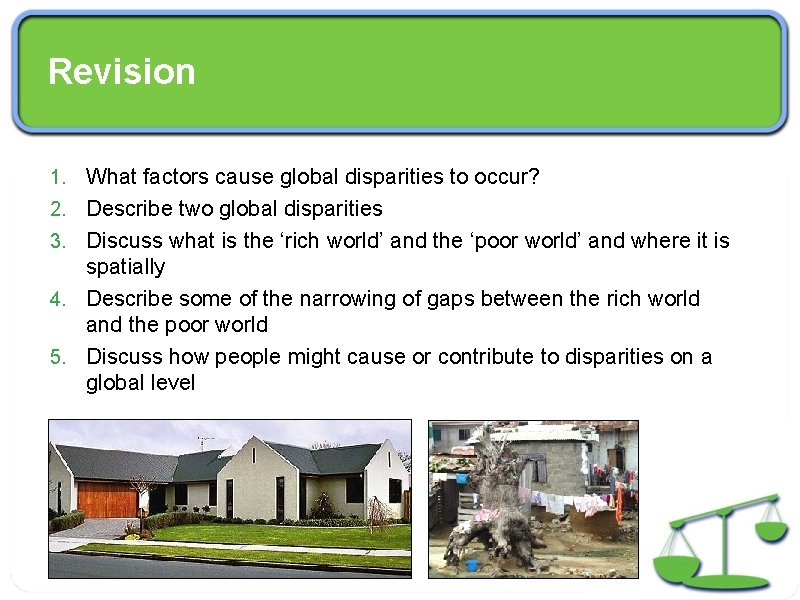
Revision 1. What factors cause global disparities to occur? 2. Describe two global disparities 3. Discuss what is the ‘rich world’ and the ‘poor world’ and where it is spatially 4. Describe some of the narrowing of gaps between the rich world and the poor world 5. Discuss how people might cause or contribute to disparities on a global level
- Slides: 21