
THE WAY THE MIND WORKS Thinking Directed Logical
- Slides: 23
THE WAY THE MIND WORKS
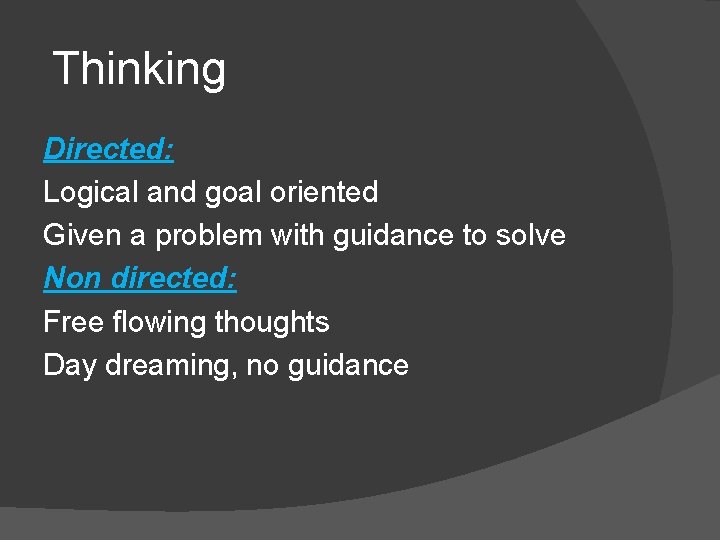
Thinking Directed: Logical and goal oriented Given a problem with guidance to solve Non directed: Free flowing thoughts Day dreaming, no guidance
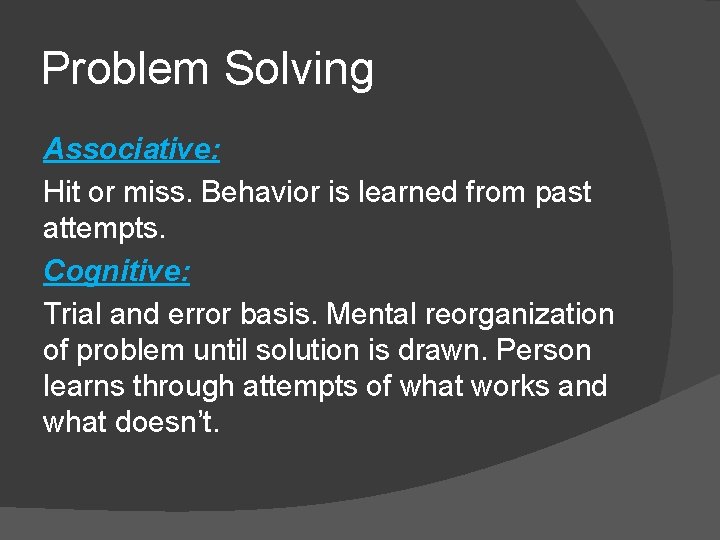
Problem Solving Associative: Hit or miss. Behavior is learned from past attempts. Cognitive: Trial and error basis. Mental reorganization of problem until solution is drawn. Person learns through attempts of what works and what doesn’t.
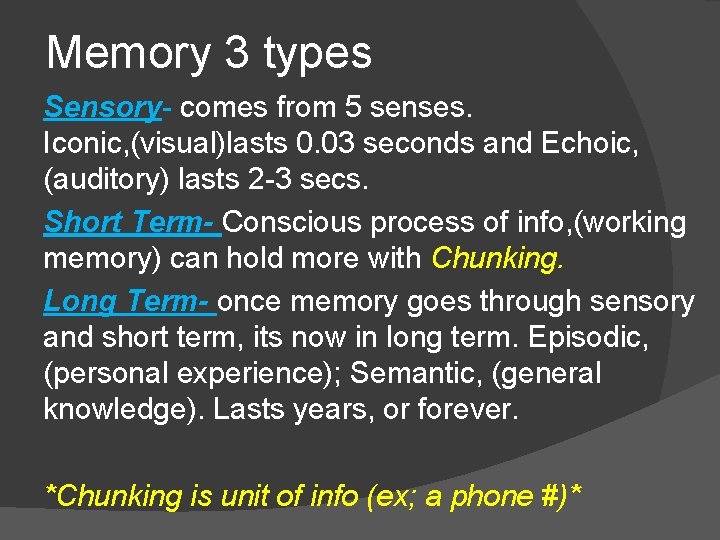
Memory 3 types Sensory- comes from 5 senses. Iconic, (visual)lasts 0. 03 seconds and Echoic, (auditory) lasts 2 -3 secs. Short Term- Conscious process of info, (working memory) can hold more with Chunking. Long Term- once memory goes through sensory and short term, its now in long term. Episodic, (personal experience); Semantic, (general knowledge). Lasts years, or forever. *Chunking is unit of info (ex; a phone #)*
3 R’s of Remembering: � Retrieval: How you get information stored in your brain, out. Requires complex organization • Recognition: retrieval in which items are presented to a person who must determine if they were previously encountered (is it familiar? ) � Recall: active reconstruction of information, reconstruct memory and use specific facts
Sensory Memory � Echoic memory �Sensory memory for auditory input that lasts only 2 to 3 seconds � Why do we need sensory memory?
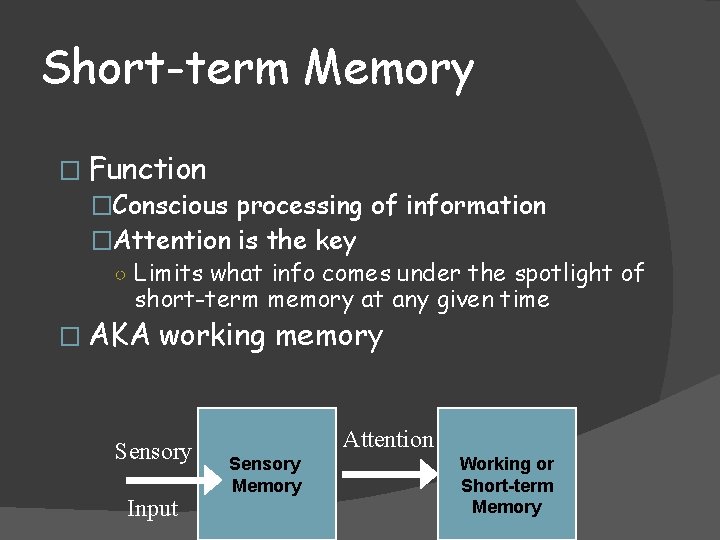
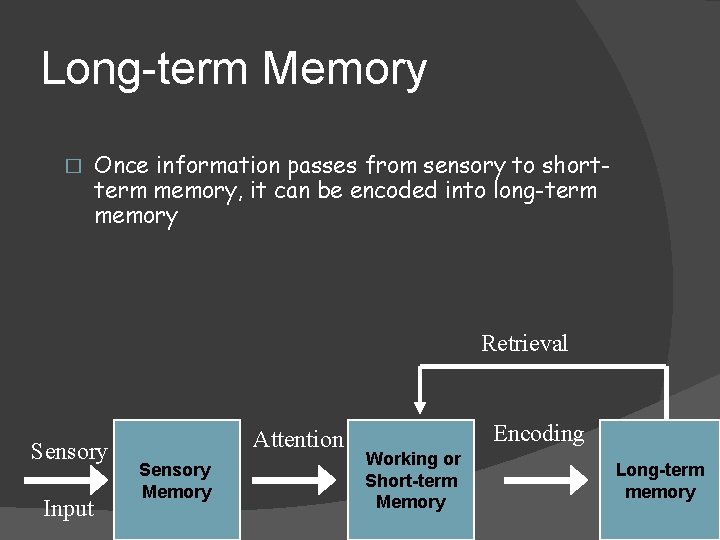
Short-term Memory � Function �Conscious processing of information �Attention is the key ○ Limits what info comes under the spotlight of short-term memory at any given time � AKA working memory Sensory Input Attention Sensory Memory Working or Short-term Memory
Short-term Memory � Limited capacity �Can hold 7 ± 2 items for about 20 seconds �Maintenance rehearsal ○ The use of repetition to keep info in short-term memory � CHUNK �Meaningful unit of information �Without rehearsal, we remember 4 ± 2 chunks �With rehearsal, we remember 7 ± 2 chunks �Ericsson & Chase (1982) 89319443492502157841668506120948888568772 731418610546297480129497496592280
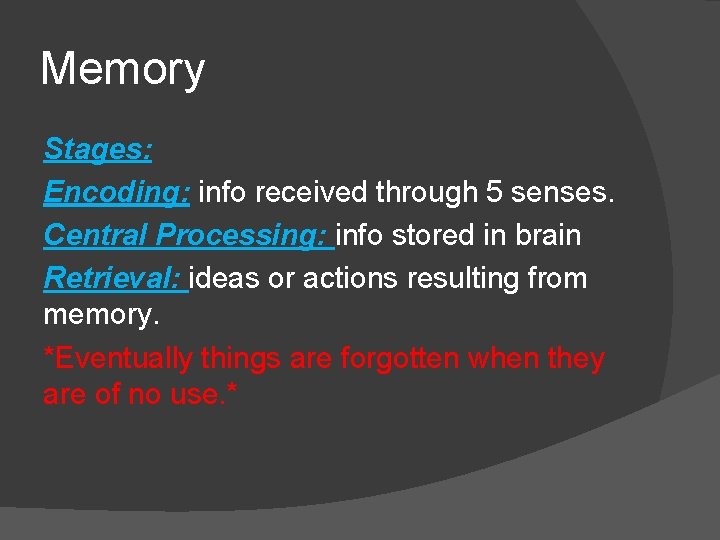
Memory Stages: Encoding: info received through 5 senses. Central Processing: info stored in brain Retrieval: ideas or actions resulting from memory. *Eventually things are forgotten when they are of no use. *
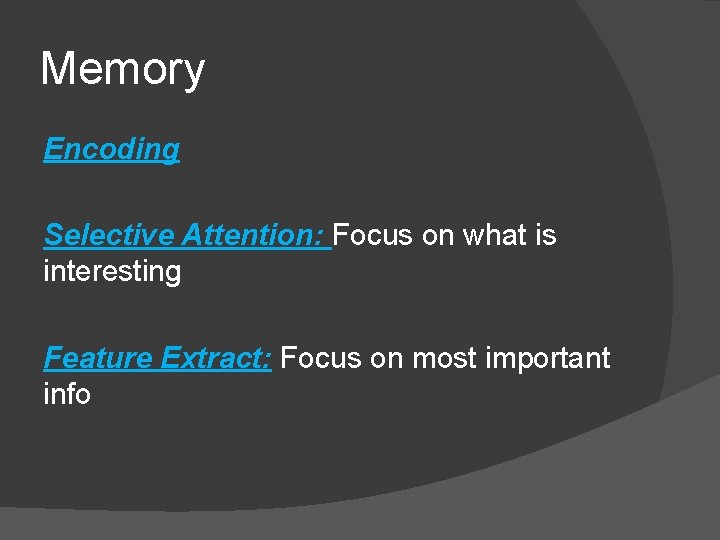
Memory Encoding Selective Attention: Focus on what is interesting Feature Extract: Focus on most important info
Long-term Memory � Once information passes from sensory to shortterm memory, it can be encoded into long-term memory Retrieval Sensory Input Attention Sensory Memory Encoding Working or Short-term Memory Long-term memory
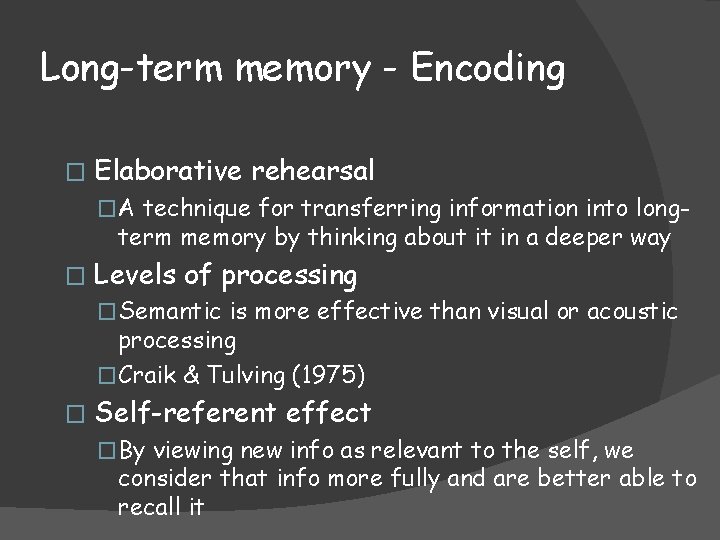
Long-term memory - Encoding � Elaborative rehearsal �A technique for transferring information into long- term memory by thinking about it in a deeper way � Levels of processing �Semantic is more effective than visual or acoustic processing �Craik & Tulving (1975) � Self-referent effect �By viewing new info as relevant to the self, we consider that info more fully and are better able to recall it
3 R’s of Remembering Retrieval: how info gets stored in the brain Recognition: brain process to see if it is familiar Recall: active reconstruction of info
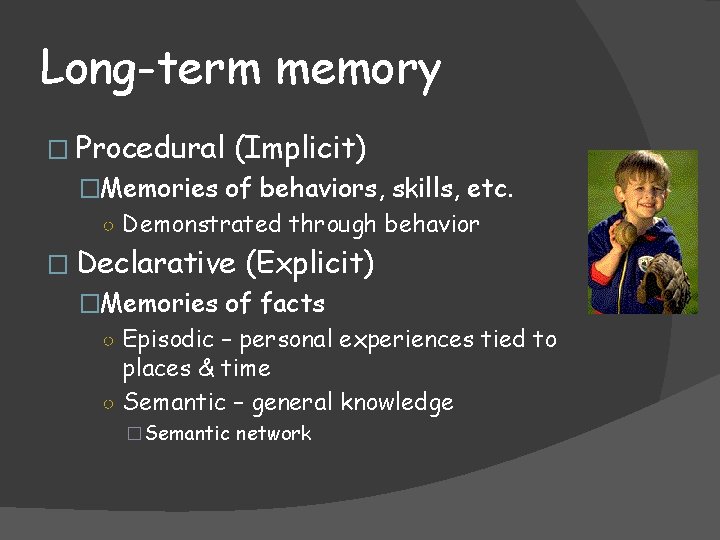
Long-term memory � Procedural (Implicit) �Memories of behaviors, skills, etc. ○ Demonstrated through behavior � Declarative (Explicit) �Memories of facts ○ Episodic – personal experiences tied to places & time ○ Semantic – general knowledge �Semantic network
Retrieval �Process that controls flow of information from long-term to working memory store � Explicit memory �The types of memory elicited through the conscious retrieval of recollections in response to direct questions � Implicit memory �A nonconscious recollection of a prior experience that is revealed indirectly, by its effects on performance
Retrieval – Explicit Memory � Context-Dependent Memory �We are more successful at retrieving memories if we are in the same environment in which we stored them � State-Dependent Memory �We are more successful at retrieving memories if we are in the same mood as when we stored them
Retrieval – Implicit Memory Showing knowledge of something without recognizing that we know it � Research with amnesics � Déjà vu � �The illusion that a new situation is familiar � Eyewitness testimony �Eyewitness transference � Unintentional plagiarism
Memory Loss Disorders Amnesia- loss of memory due to trauma or injury. Alzheimer’s- brain deteriorates due to age and progression of disease.
QUESTION � How Many of you feel these notes are familiar? � What is the definition of the retrieval method of Recognition?
Memory failure � Confabulation: filling in the gaps in memory, sometimes remembering information that was never there � Relearning: having to rehearse already learned information, (implicit memory) � Amnesia: inability to recall information often from brain trama � Déjà vu: illusion that a new situation is familiar. In a way, déjà vu is the opposite of amnesia. Whereas amnesics have memories without awareness or familiarity, the person with déjà vu has a sense of familiarity but no real memory. Estimates vary, but between 30 and 96% of people report having had such an episode.
Interference theory � Forgetting is a result of some memories interfering with others �Proactive interference ○ Old memories interfere with ability to remember new memories �Retroactive interference ○ New memories interfere with ability to remember old memories �Interference is stronger when material is similar
Memory Construction � Schema theory �Preconceptions about persons, objects, or events that bias the way new information is interpreted and recalled � Misinformation effect �The tendency to incorporate false postevent information into one’s memory of the event itself � Illusory memories �People sometimes create memories that are completely false
Improving Memory � Practice time �Distribute your studying over time � Depth of processing �Spend ‘quality’ time studying � Verbal mnemonics �Use rhyming or acronyms to reduce the amount of info to be stored