
The Wave Particle Duality OR Light Waves Until
- Slides: 14
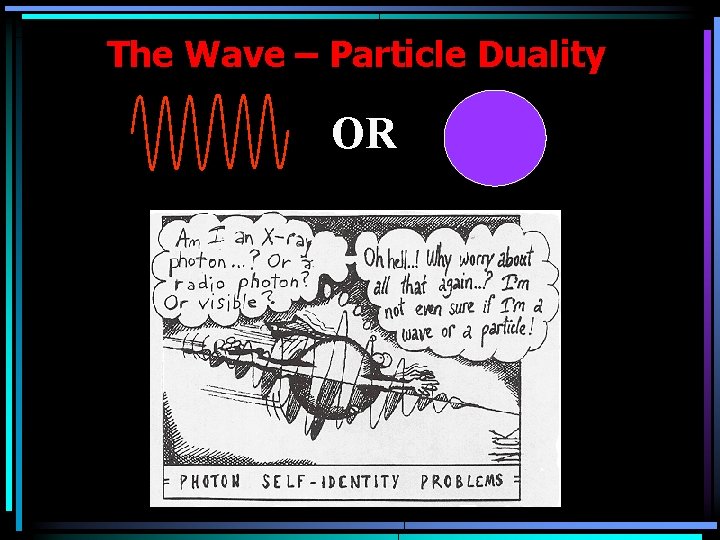
The Wave – Particle Duality OR
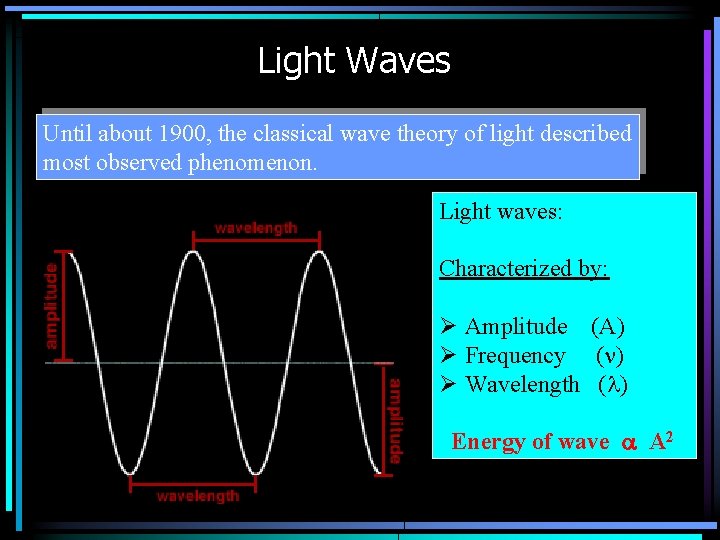
Light Waves Until about 1900, the classical wave theory of light described most observed phenomenon. Light waves: Characterized by: Ø Amplitude (A) Ø Frequency (n) Ø Wavelength (l) Energy of wave a A 2
And then there was a problem… the photoelectric effect In the early 20 th century, was observed which could not be understood using the wave theory of light.
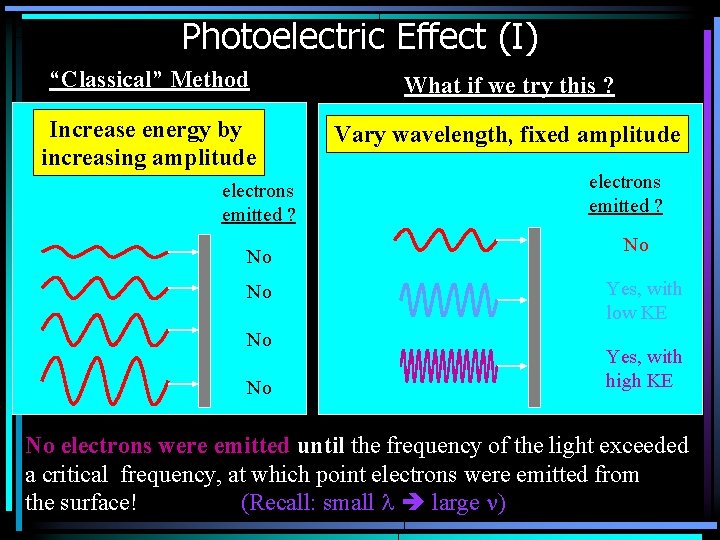
Photoelectric Effect (I) “Classical” Method What if we try this ? Increase energy by increasing amplitude Vary wavelength, fixed amplitude electrons emitted ? No No electrons emitted ? No Yes, with low KE Yes, with high KE No electrons were emitted until the frequency of the light exceeded a critical frequency, at which point electrons were emitted from the surface! (Recall: small l large n)
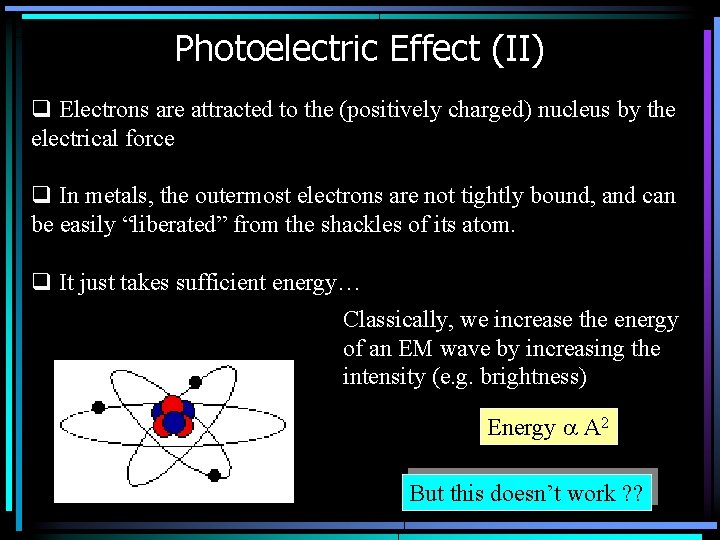
Photoelectric Effect (II) q Electrons are attracted to the (positively charged) nucleus by the electrical force q In metals, the outermost electrons are not tightly bound, and can be easily “liberated” from the shackles of its atom. q It just takes sufficient energy… Classically, we increase the energy of an EM wave by increasing the intensity (e. g. brightness) Energy a A 2 But this doesn’t work ? ?
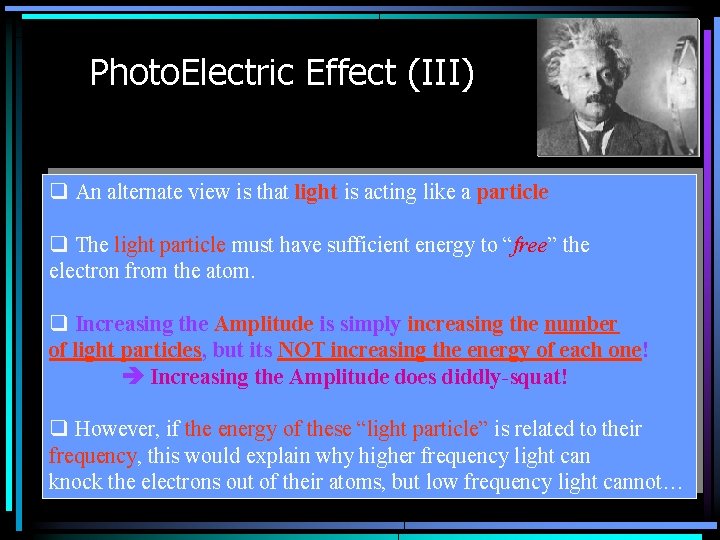
Photo. Electric Effect (III) q An alternate view is that light is acting like a particle q The light particle must have sufficient energy to “free” the electron from the atom. q Increasing the Amplitude is simply increasing the number of light particles, but its NOT increasing the energy of each one! Increasing the Amplitude does diddly-squat! q However, if the energy of these “light particle” is related to their frequency, this would explain why higher frequency light can knock the electrons out of their atoms, but low frequency light cannot…
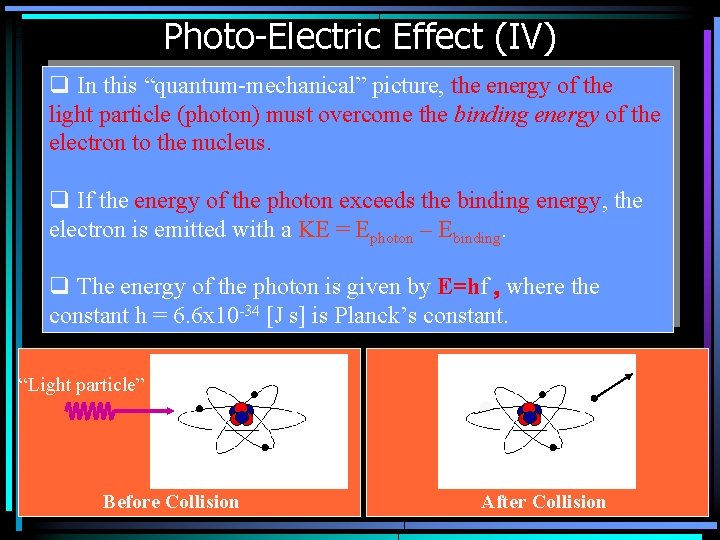
Photo-Electric Effect (IV) q In this “quantum-mechanical” picture, the energy of the light particle (photon) must overcome the binding energy of the electron to the nucleus. q If the energy of the photon exceeds the binding energy, the electron is emitted with a KE = Ephoton – Ebinding. q The energy of the photon is given by E=hf , where the constant h = 6. 6 x 10 -34 [J s] is Planck’s constant. “Light particle” Before Collision After Collision
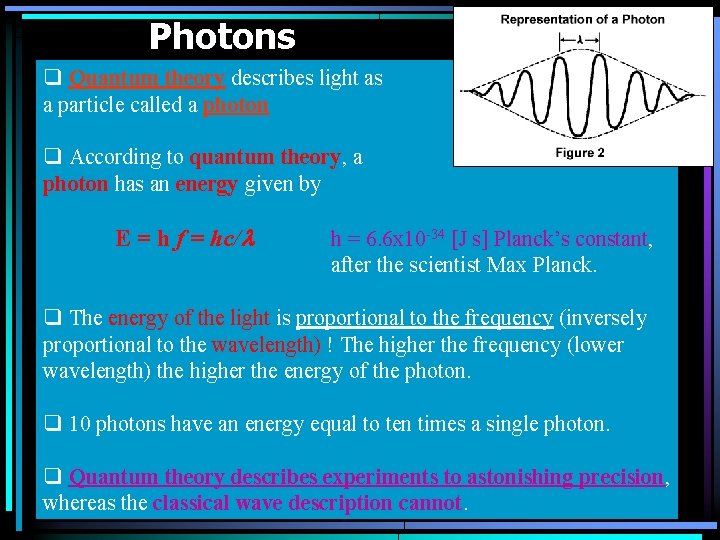
Photons q Quantum theory describes light as a particle called a photon q According to quantum theory, a photon has an energy given by E = h f = hc/l h = 6. 6 x 10 -34 [J s] Planck’s constant, after the scientist Max Planck. q The energy of the light is proportional to the frequency (inversely proportional to the wavelength) ! The higher the frequency (lower wavelength) the higher the energy of the photon. q 10 photons have an energy equal to ten times a single photon. q Quantum theory describes experiments to astonishing precision, whereas the classical wave description cannot.
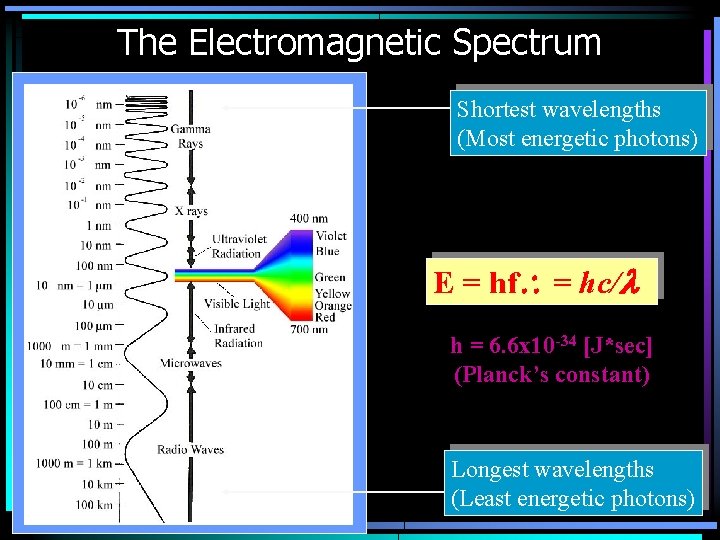
The Electromagnetic Spectrum Shortest wavelengths (Most energetic photons) E = hf = hc/l h = 6. 6 x 10 -34 [J*sec] (Planck’s constant) Longest wavelengths (Least energetic photons)
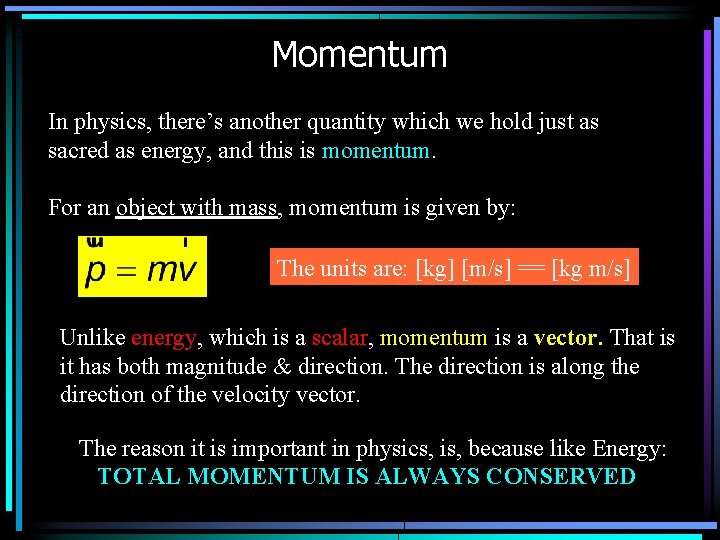
Momentum In physics, there’s another quantity which we hold just as sacred as energy, and this is momentum. For an object with mass, momentum is given by: The units are: [kg] [m/s] == [kg m/s] Unlike energy, which is a scalar, momentum is a vector. That is it has both magnitude & direction. The direction is along the direction of the velocity vector. The reason it is important in physics, is, because like Energy: TOTAL MOMENTUM IS ALWAYS CONSERVED
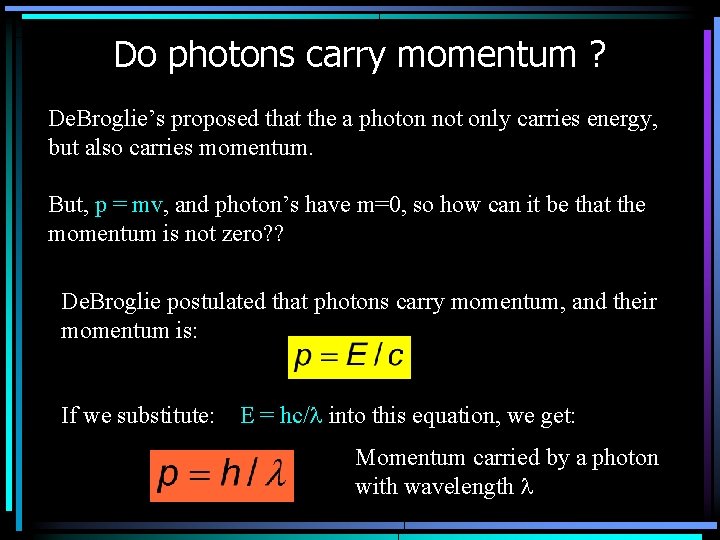
Do photons carry momentum ? De. Broglie’s proposed that the a photon not only carries energy, but also carries momentum. But, p = mv, and photon’s have m=0, so how can it be that the momentum is not zero? ? De. Broglie postulated that photons carry momentum, and their momentum is: If we substitute: E = hc/l into this equation, we get: Momentum carried by a photon with wavelength l
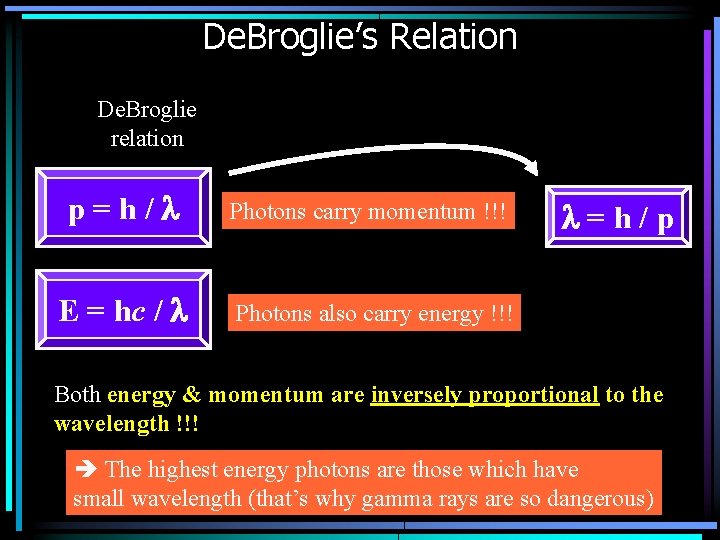
De. Broglie’s Relation De. Broglie relation p=h/l Photons carry momentum !!! E = hc / l Photons also carry energy !!! l=h/p Both energy & momentum are inversely proportional to the wavelength !!! The highest energy photons are those which have small wavelength (that’s why gamma rays are so dangerous)
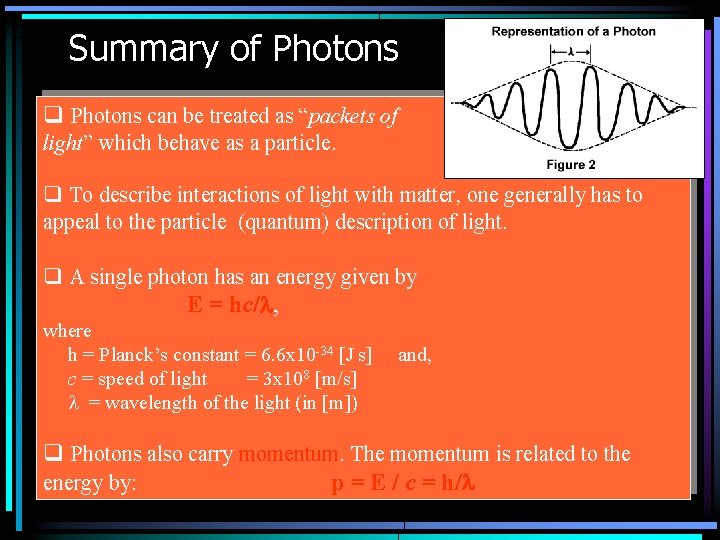
Summary of Photons q Photons can be treated as “packets of light” which behave as a particle. q To describe interactions of light with matter, one generally has to appeal to the particle (quantum) description of light. q A single photon has an energy given by E = hc/l, where h = Planck’s constant = 6. 6 x 10 -34 [J s] c = speed of light = 3 x 10⁸ [m/s] l = wavelength of the light (in [m]) and, q Photons also carry momentum. The momentum is related to the energy by: p = E / c = h/l
So is light a wave or a particle ? On macroscopic scales, we can treat a large number of photons as a wave. When dealing with subatomic phenomenon, we are often dealing with a single photon, or a few. In this case, you cannot use the wave description of light. It doesn’t work !