
The Water Table A colloquium presentation by Derrick
The Water Table A colloquium presentation by: Derrick Hwang
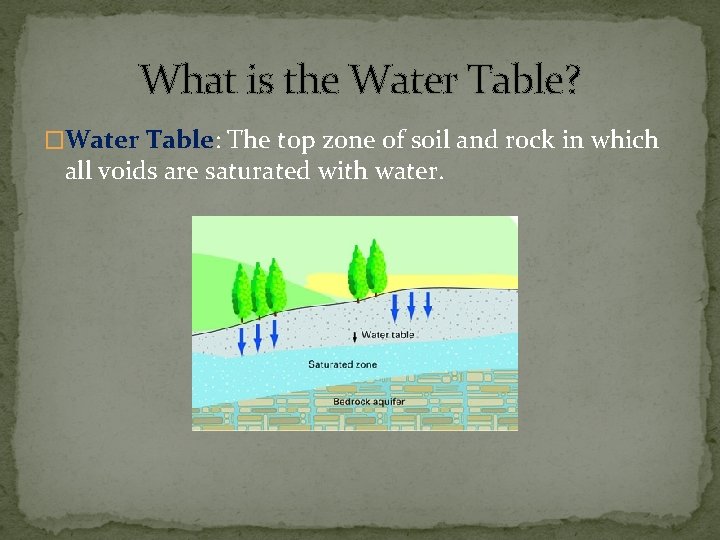
What is the Water Table? �Water Table: The top zone of soil and rock in which all voids are saturated with water.
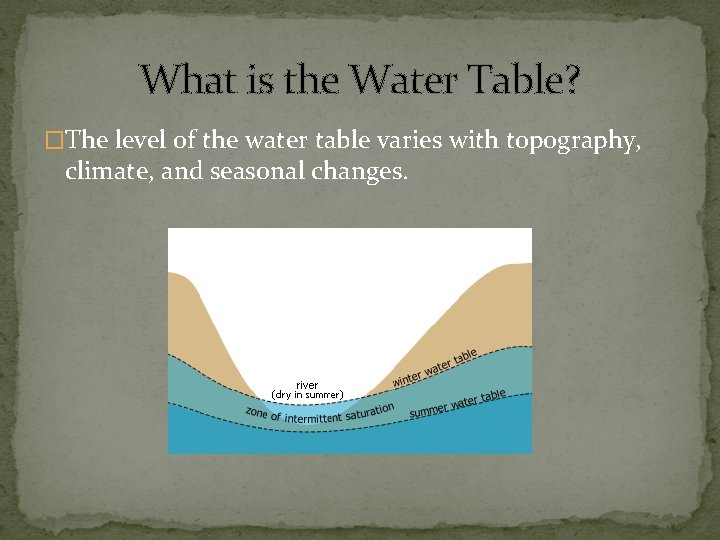
What is the Water Table? �The level of the water table varies with topography, climate, and seasonal changes.
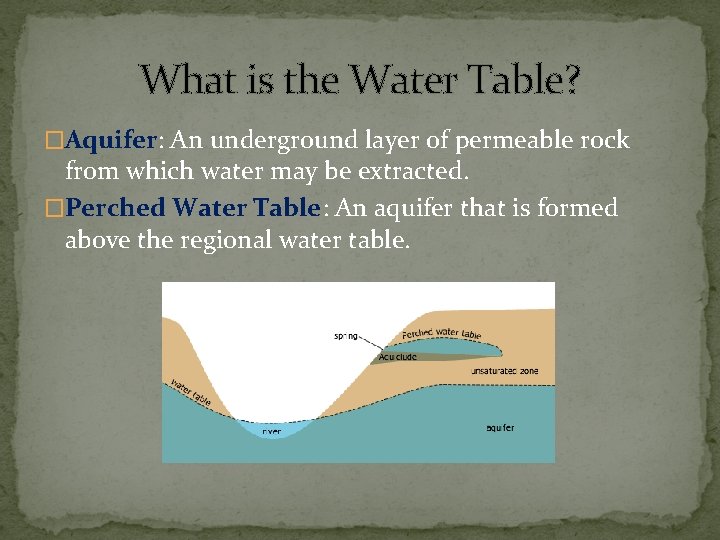
What is the Water Table? �Aquifer: An underground layer of permeable rock from which water may be extracted. �Perched Water Table: An aquifer that is formed above the regional water table.
How Does the Water Table Affect Us? �Without water, livestock cannot be grown and land cannot be cultivated. �Only 3% of Earth’s water is fresh water; however, humankind has access to only 1% of this fresh water. �The rise and fall of the water table has a very large impact on how and where fresh water can be distributed to the population.
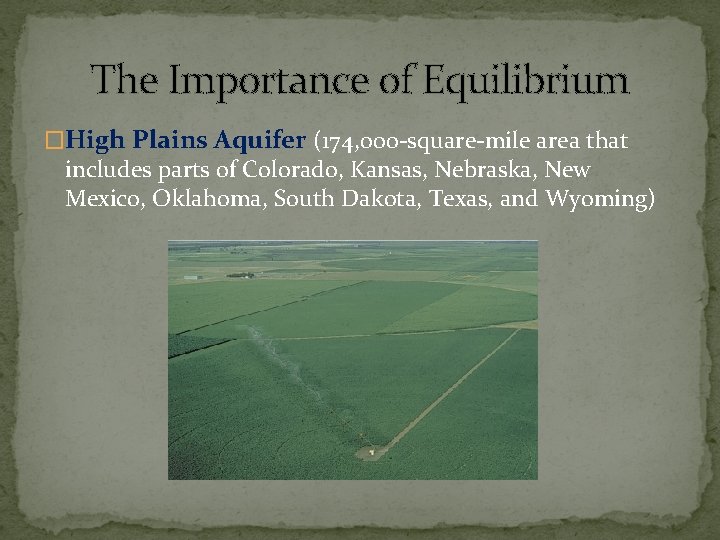
The Importance of Equilibrium �High Plains Aquifer (174, 000 -square-mile area that includes parts of Colorado, Kansas, Nebraska, New Mexico, Oklahoma, South Dakota, Texas, and Wyoming)
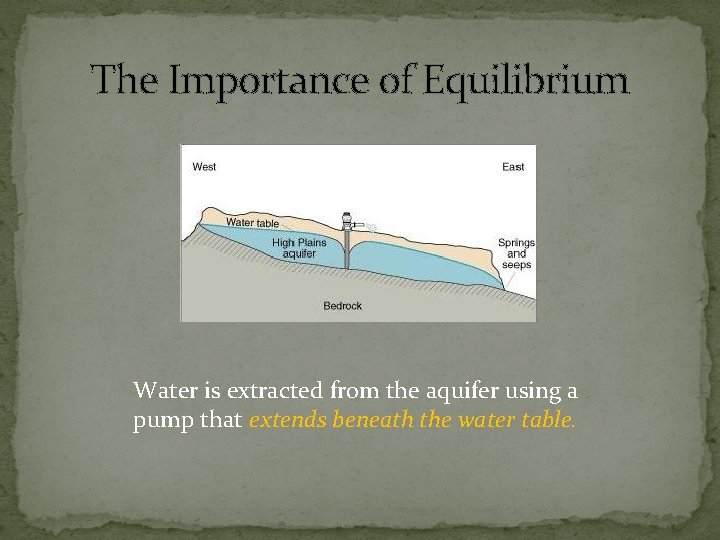
The Importance of Equilibrium Water is extracted from the aquifer using a pump that extends beneath the water table.
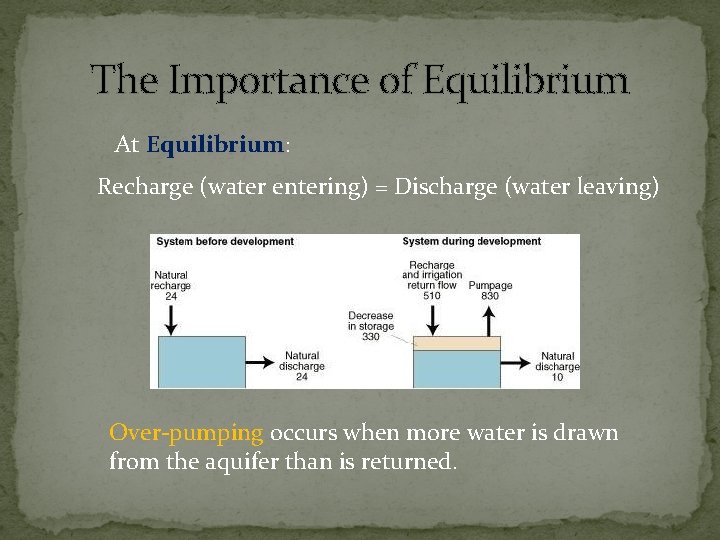
The Importance of Equilibrium At Equilibrium: Recharge (water entering) = Discharge (water leaving) Over-pumping occurs when more water is drawn from the aquifer than is returned.
Equilibrium Lost �What happens when the water table drops below the level of the pump? �To obtain water, we will have to wait until the aquifer naturally recharges itself. �If the pump is near a sea coast, over-pumping will allow saline water to seep into the aquifer – mixing with and replacing the original fresh water.
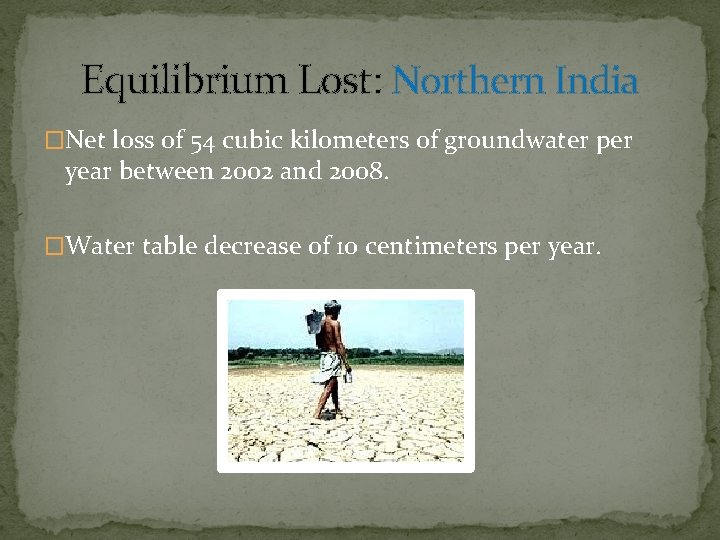
Equilibrium Lost: Northern India �Net loss of 54 cubic kilometers of groundwater per year between 2002 and 2008. �Water table decrease of 10 centimeters per year.
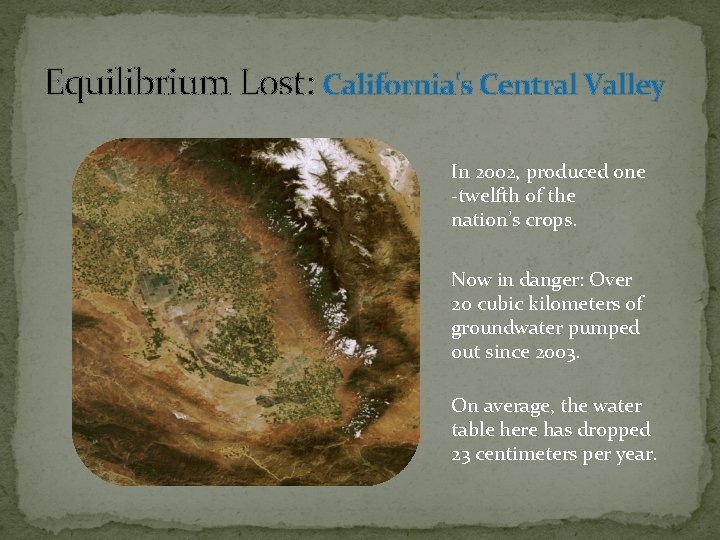
Equilibrium Lost: California's Central Valley In 2002, produced one -twelfth of the nation’s crops. Now in danger: Over 20 cubic kilometers of groundwater pumped out since 2003. On average, the water table here has dropped 23 centimeters per year.
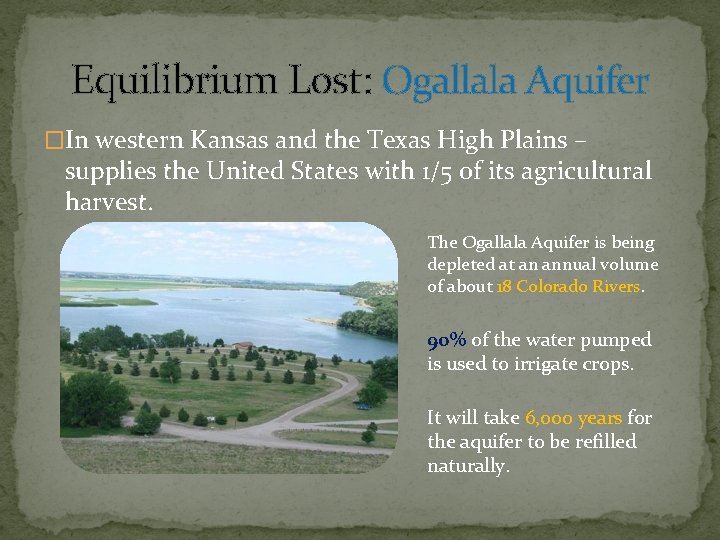
Equilibrium Lost: Ogallala Aquifer �In western Kansas and the Texas High Plains – supplies the United States with 1/5 of its agricultural harvest. The Ogallala Aquifer is being depleted at an annual volume of about 18 Colorado Rivers. 90% of the water pumped is used to irrigate crops. It will take 6, 000 years for the aquifer to be refilled naturally.
Sustainable Solutions for Ogallala � It takes 1, 000 gallons of water to produce 1 ton of grain. � Grow crops without groundwater: Eliminate wells and plant crops in harvest residue. � Develop less-thirsty crops: Drought-resistant corn could reduce amount of necessary water by 10 percent. Wheat does not require as much water as corn. � Evapotranspiration Measurement: Determine the minimal amount of water required to keep crops alive.
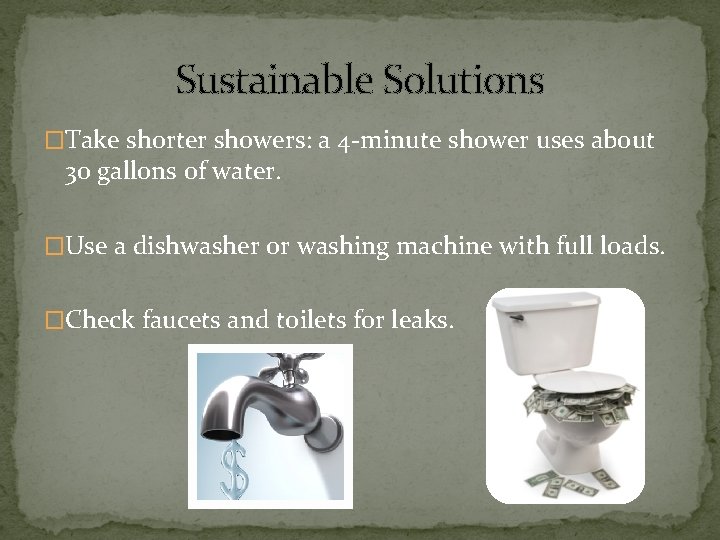
Sustainable Solutions �Take shorter showers: a 4 -minute shower uses about 30 gallons of water. �Use a dishwasher or washing machine with full loads. �Check faucets and toilets for leaks.
Sustainable Solutions �Xeriscaping – replacing thirsty plants with less thirsty ones will save 750 -1, 000 gallons of water per month. �Fuel-efficiency: 1, 700 gallons of water are needed to produce 1 gallon of ethanol. �Education: Producing a typical American Thanksgiving dinner for six people requires over 30, 000 gallons of water.
Sustainable Solutions �Should the price of water be raised in order to promote water conservation? � The average price of water in the United States is about $1. 50 for 1, 000 gallons – or about a penny for one gallon of water. Is this a bargain we can keep? �Would eating lower on the food chain have any effect on water usage? � For 300 million Americans, a small reduction in meat, milk, and egg consumption would cut grain use by 30 million tons and water used for irrigation by 300 billion tons.
Bibliography � (2009). Water table. Columbia Electronic Encyclopedia, 6 th Edition, 1. Retrieved from Academic Search Premier database. � Agricultural Water Table Management Systems, AEX 321 -97. (n. d. ). Ohioline. Retrieved March 8, 2010, from http: //ohioline. osu. edu/aex-fact/0321. html � Ground Water Development, Sustaninability, and Water Budgets. (n. d. ). USGS Publications Warehouse. Retrieved March 8, 2010, from http: //pubs. usgs. gov/circ 1186/html/gw_dev. html � Is Your Garden Soil Too Salty? : Salinity Levels Can Affect Plants. (n. d. ). Desert/Water-wise Gardens. Retrieved March 8, 2010, from http: //desertwaterwisegardens. suite 101. com/article. cfm/is_your_garden_soil_t oo_salty
Bibliography � Little, J. (2009). Saving the Ogallala Aquifer. Scientific American Earth 3. 0, 19(1), 32 -39. Retrieved from Academic Search Premier database. � OECD Glossary of Statistical Terms - Overpumping Definition. (n. d. ). OECD Statistics (GDP, unemployment, income, population, labour, education, trade, finance, prices. . . ). Retrieved March 8, 2010, from http: //stats. oecd. org/glossary/detail. asp? ID=1979 � Perkins, S. (2010). California hit by irrigation drain. Science News, 177(2), 14. Retrieved from Academic Search Premier database. � Perkins, S. (2009). New data show quickening loss of groundwater beneath India. Science News, 176(6), 5 -6. Retrieved from Academic Search Premier database.
Bibliography � Water Crisis: How Does it Affect Us? - A precious resource - Softpedia. (n. d. ). Latest news - Softpedia. Retrieved March 8, 2010, from http: //news. softpedia. com/news/Water-Crisis-How-it-Does-Affect-Us 71148. shtml � Water Conservation: 25 ways to conserve water in the home and yard. (n. d. ). Eartheasy - Sustainable Living. Retrieved March 8, 2010, from http: //www. eartheasy. com/live_water_saving. htm � Water Conservation. (n. d. ). Mono Lake. Retrieved March 8, 2010, from http: //www. monolake. org/about/waterconservation
- Slides: 19