
The Water Cycle An Overview Learning Objective To
The Water Cycle An Overview
Learning Objective To understand the water cycle. Success Criteria • To use key words to accurately label a diagram of the water cycle. • To explain how rain is formed using key words. • To describe, using key words, at least three routes around the water cycle.
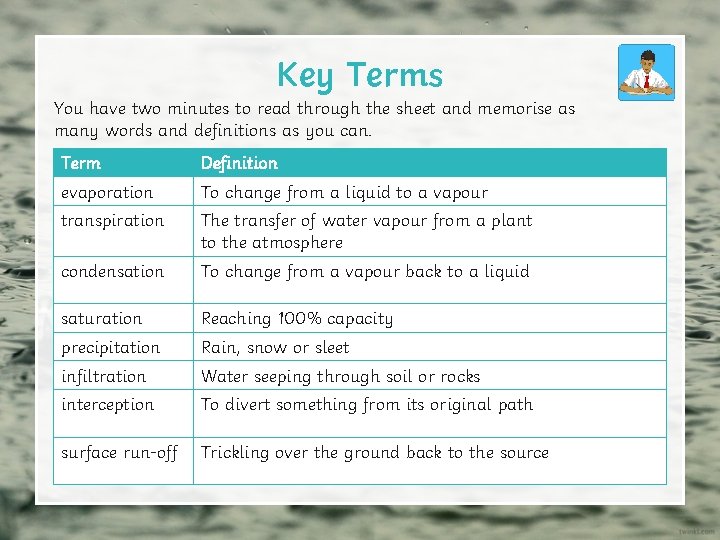
Key Terms You have two minutes to read through the sheet and memorise as many words and definitions as you can. Term Definition evaporation To change from a liquid to a vapour transpiration The transfer of water vapour from a plant to the atmosphere condensation To change from a vapour back to a liquid saturation Reaching 100% capacity precipitation Rain, snow or sleet infiltration Water seeping through soil or rocks interception To divert something from its original path surface run-off Trickling over the ground back to the source
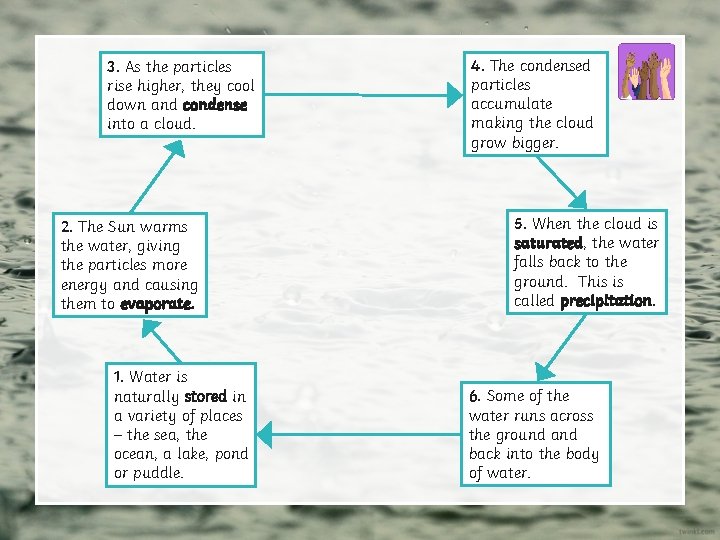
3. As the particles rise higher, they cool down and condense into a cloud. 2. The Sun warms the water, giving the particles more energy and causing them to evaporate. 1. Water is naturally stored in a variety of places – the sea, the ocean, a lake, pond or puddle. 4. The condensed particles accumulate making the cloud grow bigger. 5. When the cloud is saturated, the water falls back to the ground. This is called precipitation. 6. Some of the water runs across the ground and back into the body of water.
Describe the Water Cycle Only some of the water returns to the water source through surface run-off. Some of the water soaks into the ground and makes its way back to the water source underground.
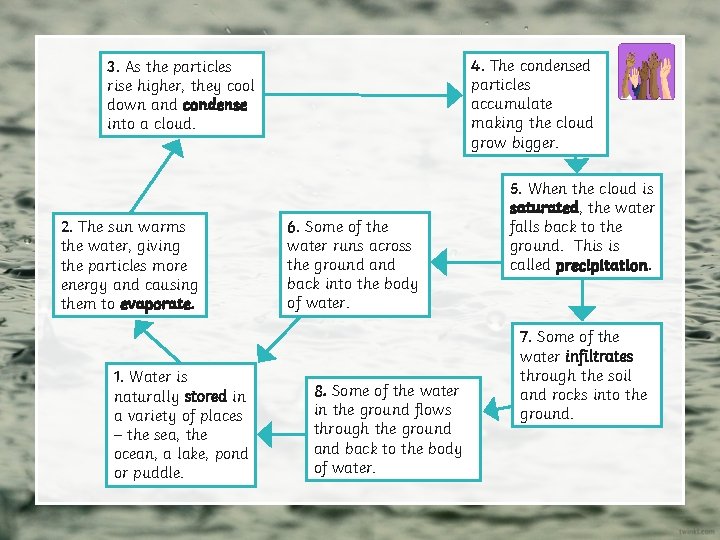
4. The condensed particles accumulate making the cloud grow bigger. 3. As the particles rise higher, they cool down and condense into a cloud. 2. The sun warms the water, giving the particles more energy and causing them to evaporate. 1. Water is naturally stored in a variety of places – the sea, the ocean, a lake, pond or puddle. 6. Some of the water runs across the ground and back into the body of water. 8. Some of the water in the ground flows through the ground and back to the body of water. 5. When the cloud is saturated, the water falls back to the ground. This is called precipitation. 7. Some of the water infiltrates through the soil and rocks into the ground.
Describe the Water Cycle Some of the water underground gets soaked up by tree and plant roots.
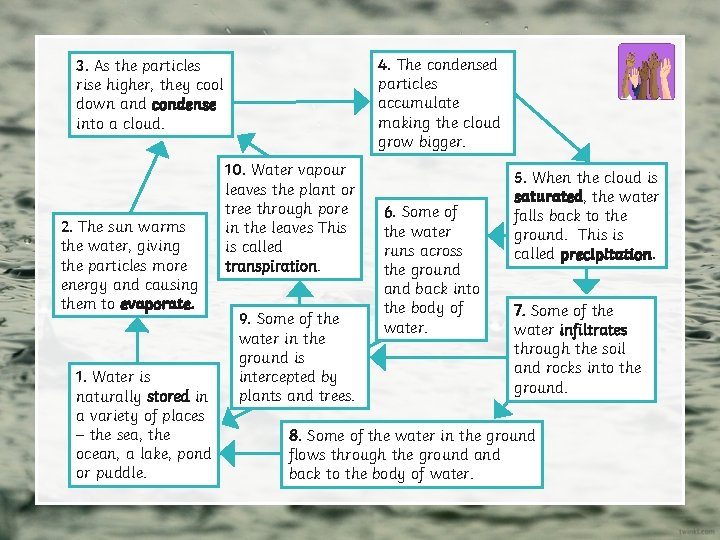
4. The condensed particles accumulate making the cloud grow bigger. 3. As the particles rise higher, they cool down and condense into a cloud. 2. The sun warms the water, giving the particles more energy and causing them to evaporate. 1. Water is naturally stored in a variety of places – the sea, the ocean, a lake, pond or puddle. 10. Water vapour leaves the plant or tree through pore in the leaves This is called transpiration. 9. Some of the water in the ground is intercepted by plants and trees. 6. Some of the water runs across the ground and back into the body of water. 5. When the cloud is saturated, the water falls back to the ground. This is called precipitation. 7. Some of the water infiltrates through the soil and rocks into the ground. 8. Some of the water in the ground flows through the ground and back to the body of water.
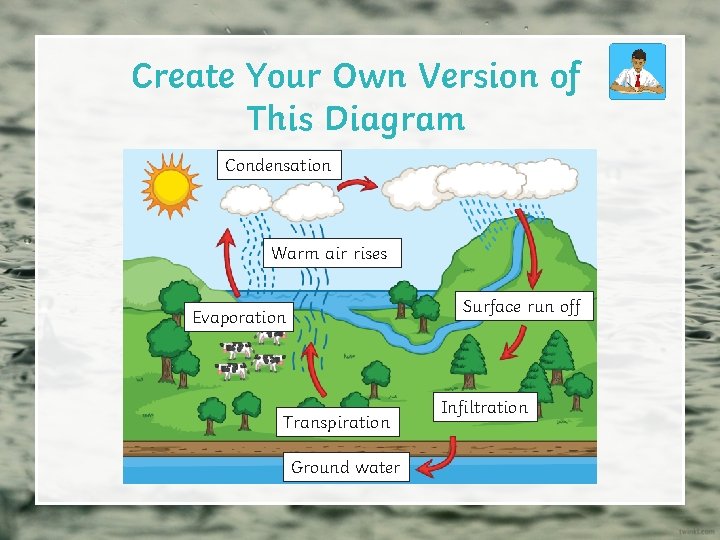
Create Your Own Version of This Diagram Condensation Warm air rises Surface run off Evaporation Transpiration Ground water Infiltration
Explain the Formation of Rain Copy and complete the following sentences: 1) Water evaporates because. . . • it heats up. • The Sun heats water particles, giving it more energy and causing it to rise. 2) Water condenses because. . . • It cools down. • As water vapour rises, the atmosphere cools down. It has less energy and cannot carry water vapour, so the water condenses and clumps together to form clouds. 3) Precipitation occurs because. . . • clouds become saturated and water droplets fall to the ground under the force of gravity. • If the water gets colder in the cloud before it falls, it may fall as hail or snow.
Alternative Routes Around the Water Cycle If you imagine the ocean is the starting point for the water cycle, evaporation, condensation and precipitation are the first three stages of the cycle. After precipitation, there are several routes the water can take to get back to the ocean. For example: ocean > evaporation > condensation > precipitation > surface run off > river > ocean In your groups, how many alternative routes back to the sea can you think of? Possible routes back to the ocean (you may have some more ideas of your own): • surface run off > river flows > ocean • infiltration into the soil and ground water supply > ocean • interception by vegetation > transpiration > condensation > precipitation >. . . • interception by animals > waste water > infiltration > ground through flow > river > ocean • interception by humans > used in many ways > drains > ocean • interception by humans > sweat/ spill/ leak > evaporation > condensation > precipitation. . .
Report It! Choose one of the routes back to the ocean that we have discussed. Draw a diagram of your route around the water cycle. Describe the route of the water around your chosen cycle – remember to include key terms and explanations wherever you can. For example: ‘The water was in the ocean, then it rose into the sky and turned into a cloud’ isn’t as good as. . . ‘The water was in the ocean, then it evaporated, then it condensed’ which isn’t as good as. . . ‘The water was in the ocean. As the particles were warmed by the Sun, they evaporated and rose into the sky. At higher altitudes, the particles cooled down and condensed into clouds. ’
Challenge! In pairs, stand facing each other, one with their back to the board. The person facing the board has one minute to describe as many of the words in the list to their partner as possible. The person with their back to the board has to guess the word being described. Count how many you get right. Then you will swap places. • • The Rules: You cannot say the word. You cannot say 'sounds like‘. You cannot spell the word. You can describe the words in an order.
Challenge! water cycle evaporation run off infiltration vapour interception condensation ground through flow sea river Start • • The Rules: You cannot say the word. You cannot say 'sounds like‘. You cannot spell the word. You can describe the words in an order. End
Challenge! mountain atmosphere precipitation low pressure saturation transpiration cloud water sunlight ground water Start • • The Rules: You cannot say the word. You cannot say 'sounds like‘. You cannot spell the word. You can describe the words in an order. End
- Slides: 16