
The Wasp Factory Iain Banks Expectations You should
The Wasp Factory Iain Banks
Expectations • You should be actively engaged with the text. I will teach and guide the class as we read the novel but you need to be actively reading and making notes. • Make notes on any aspects of the text that you think might be significant as you read it. • Think for yourself!
Organising your notes • Characterisation: how characters are portrayed and develop. Think especially about conflict between and within characters • Setting: how place and time are textualised and how setting contributes to the atmosphere • Plot: main developments in the story (also pay attention to subplots) • Language: word choice; imagery; structural techniques (punctuation, paragraphing, sentence structure); symbolism etc • Themes: all of the above contribute to thematic concerns of the novel
Genre • ‘The Wasp Factory’ is a darkly humorous gothic horror • When reading you should also make notes on Banks’s use of gothic ideas/motifs and black humour • Motif: a recurring image, object or idea or symbol that defines and develops a central theme. • Theme: the central idea or concern at the heart of a text • Brainstorm all you know about the gothic genre
Aspects of the gothic • • Darkness and light (juxtaposed) The supernatural Repressed desires Guilt Death and decay Madness The grotesque Romance
So, let’s jump in. . . • So, let’s jump in. . .
The Sacrifice Poles • What is a sacrifice and why might this be significant in the title? • What do you notice about the Narrative Point of View (NPOV)? • What do we learn about characters, plot and setting? • Do you notice any aspects of the gothic genre? Make notes on how effective they are • How effective is the opening chapter? • Make notes based upon these questions and anything else that strikes you as significant or important
Notes • Sacrifice: act of slaughtering an animal or person or surrendering a possession as an offering to a deity • This sets the tone for the novel and introduces a key motif • It is a 1 st person narrative from the point of view of the protagonist, Frank Cauldhame, who appears to be a psychopath. • The first paragraph is stark and introduces two key aspects: Frank has a brother who has escaped from somewhere (plot) and “the Factory told me” (element of supernatural or madness)
Notes • • Character: Frank is 17 and is very clever despite never going to school. He is isolated and has only one friend, Jamie the dwarf. He has a kind of shamanistic understanding of the world around him and is very superstitious: “It was a good omen”(p 8)and “I’d been pissing on the Poles during the day, infecting them with my scent and power. ” (p 16). He hints that he is disabled or impaired in some way: “my body was a forlorn hope for any improvement, so only my mind was left” (p 14). He is clever His father is unconventional, unreliable, eccentric, bizarre and secretive: “If I was lucky, my father might tell me something and, if I was luckier still, it might even be the truth. ”; “Keep Out—Private Property 2 (p 8); “lecture on cancer of the colon or tapeworms”. (p 11) Lots of humour! Eric is insane and has committed horrific acts: “I don’t go giving people presents of burning dogs”. (p 13) Frank calls him a “poor twisted bugger” (p 16) which mat be ironic as Frank seems quite twisted Setting: a desolate island in Scotland – “the tumbled remains of the slip where the handle of the rusty winch still creaks in an easterly wind“. Word choice sets the tone of the novel—element of foreshadowing
• Plot: • Frank lives with his father in a remote house on an island. • Eric, his brother, is insane but has escaped from hospital and Frank thinks he is heading home. • He was never officially registered and was home educated • Eric phones Frank and is clearly insane/deranged. • We learn that Frank is not happy with his own body • We learn that he “killed three people” • Language: many with negative connotations to create unease and develop the atmosphere: “kaw-calling and screaming”(p 7)Paradox: “seeing in my mind what those sightless eyes looked out to”; “ dead sentries”(p 20). • Loads of short sentences for dramatic emphasis • Gothic motifs: loads! Repression of aspects of true self; madness; horror; death and decay
Yet more notes • Frank and his father inhabit a bizarre and isolated world that has its own strange set of rules. His dad is obsessed by measurements (imperial) and Frank has constructed his own cosmology based around death (The Factory and Sacrifice Poles. They are a very odd couple yet the chapter, and the whole novel, is full of humour. There is a strange juxtaposition between Frank’s weird life and world view and the mundane conversations they have. • However, there is a chilling sense of horror at the end of the chapter when Frank calmly admits to murder and enjoying torturing wasps: “so I got to watch”. (p 21)
Chapter 2: The Snake Park • Read p 22 -23 and make notes on what we learn about characters, setting and plot. Think about how this information and the language contributes to the tone of the novel. • Characters: family relationships were/are difficult and strained: “morose”, “bored”, “smiling” (think about word choice and how contrasts illustrate differing personalities). Sense of Frank being disturbed is reinforced (see below). He has an affinity with Eric who “has killed somebody too. ” • Setting: typical Scottish weather: “mist”, “fog” contributes to the gloomy tone • Plot: idea of Frank being superstitious is reinforced--attaching an unhealthy importance to objects and dead creatures, carrying out bizarre rituals: “bag of heads and bodies”; “nicked my left thumb carefully”. Eric’s mother died in childbirth and Frank thinks this contributed to “What Happened To Eric” (note capitalisation) and he is described as a “Poor unlucky soul”.
Task • Read the rest of the chapter and develop your own notes as we have done in class. • Make notes under the subheadings: characterisation, setting, plot, language, gothic motifs and themes • You should do this individually then work in a group to develop a presentation for the rest of the class. • Any groups will be chosen so make sure you are prepared!
Chapter 2 • Plot: • Bizarre incident with the rabbit attacking Frank confirms that this is a very strange world: “This wasn’t Africa! It was a rabbit, not a lion! What the hell was happening here? ” (32)series of short dramatic sentences emphasise the strangely dark gothic tone of the novel. • More backstory about the family and their strange relationship with death. Lots of dark humour: “My God, the buggers’ve learned to fly…”(29) • We learn that his first murder was of Blythe, his older cousin. It is a very inventive murder where he puts an adder in the cavity of his false leg which then bites him. The reason he did this was because Blythe had incinerated his and Eric’s rabbits: “Incinerating all our beauties”(38) • He gets away with this murder and admits to also murdering his younger brother, Paul and another cousin, Esmeralda. He shows no remorse and claims “It was just a stage I was going through” (42)
• Setting: we learn more about the island: it is remote and isolated. Frank has given strange names to different parts of the island: Rabbit Grounds (renamed Black Destroyer Hill after his favourite catapult is broken during his battle with the rabbit), Snake Park, Skull Grounds etc (note capitalisation again) • Characterisation: Frank’s psychotic tendencies are reinforced and developed: “The catapult was avenged, the buck—or what it meant, it’s spirit maybe—soiled and degraded, taught a hard lesson, and I felt good” (36). This is a key quotation that shows Frank’s strange fetish with objects of violence and power. Also shows his he has a belief in the mystical and metaphysical nature of creatures too. Italics emphasise his happy feelings. But we also learn that he has a very strong and loving relationship with his brother: “Eric in particular was very upset” “I wanted to kill Blyth there and then” “my brother” (38)
• Motifs: • Fire : “might just have something to do with the fire that the Factory had predicted” “fiery death” (37)is repeated • Animals (sometimes with unpleasant connotations)dying in horrendous ways • Themes: • revenge “judgement from God…all because of the rabbits” Eric says “God wasn’t like that. I said the one I believed in was. ” Key quote(41) • Relationships and dysfunctional families (lots of evidence) • Truth and lies and how they impact on the individual • Critique of superstition and irrational belief systems (see above quotations) • Other themes to follow. . .
Chapter 3: In the Bunker • Read the chapter and make notes as we have done for the previous chapters. • Also, think about the opening sentences and why it is so striking. How do they develop the character of Frank? Do they introduce any new themes that we have not mentioned yet?
• “MY GREATEST ENEMIES are Women and the Sea. These things I hate. Women because they are weak and stupid” • Use of capitalisation for emphasis, inversion and unsubstantiated generalisations serve to underline Frank’s unpleasant personality. Introduces theme of misogyny (the irrational hatred of females) and gender that are important to the novel.
Characterisation • • • Frank’s strange fetishisation of mundane, everyday objects continues to build a picture of a deeply irrational and superstitious person: “precious substances such as toenail or belly button fluff” (44). He is a slave to his own rituals and there is a a possible suggestion of Obsessive Compulsive Disorder and Narcissism: “the shave follows a definite and predetermined pattern; I take the same number of strokes” “rising tingle of excitement as I contemplated the meticulously shorn surfaces of my face” The 1 st person narrative voice is very matter-of-fact and down to earth which jars with the sometimes brutal subject matter that Frank talks about He has visions of “what might have been” and the description of the “fetid light blazed from Old Saul’s sockets” helps to build the claustrophobic atmosphere and mood of the Bunker (48) Motif of fire (burning animals) and animal torture further devloped: “ as a wasp prison”, “newly lit candle, blood red”(47) connotations of red (pain, danger and anger). Use of list : “The severed heads of gulls, rabbits, crows, mice, owls, moles and small lizards looked down at me” (48) All contribute to the tone of the novel and Frank’s characterisation
Setting • The wider setting is gloomy and dreich: “hidden by cloud and the sea was rough” (45) while the Bunker is claustrophobic and darkly gothic in Banks’s description: “on plinths of wood or stone. . . my collection of skulls watched me. ” (48)
Plot • • • He goes to The Bunker and tries to induce visions through his bizarre rituals Goes to town We learn he has only one real friend: Jamie. We learn he does not “officially exist” and they pretend his father is his uncle He is largely ostracised by the villagers because of what Eric did: “Frank’ll get you” His father stores lots of highly explosive cordite in the cellar which is very dangerous His father has a weird theory about farts and claims to know what Frank drank at the pub by the type of farts he does Frank has lots of weapons to defend the island (his world) from attack Eric phones and the conversation is confused and full of irony. Eric states: “Are you crazy? ” While at the end Frank says “. . . Like a ship, indeed. What a loony”. Insanity clearly permeates the entire family. Eric also appears to be killing and eating dogs. There is lots of dark humour here in the way the conversation is very matter-of-fact when they discuss such disturbing subjects. Theme of dysfunctional relationships: “I never know exactly how much he really feels for me” (51) “These are dogs, you brainless little shitbag” (60)
Some questions to consider… • How do you feel about Frank now? • You might want to think about contrast between the murders of Blythe and Paul. • What aspects of his character are reinforced by the way he talks about women in the pub and his mother?
Chapter 4: The Bomb Circle • Characterisation: Frank admits to having a conscience (to an extent)“part of me which has felt guilty about killing Blyth, Paul and Esmeralda". He compares himself to “a state” and talks of his need for revenge, he is brutally honest about why he acts as he does and Banks uses the character to make a critical comment about governmental hypocrisy: “At least I admit that it’s all to boost my ego, restore my pride and give me pleasure, not to save the country or uphold justice or honour the dead. ” (63) • Connected to the setting: Frank is elemental and is very much a part of this Scottish island. “baring my neck to the wind like a lover, to the rain like an offering. ” Use of imagery creates a sense of his being in a symbiotic relationship with his surroundings, raw primordial power and a suggestion of sacrifice (another gothic motif in the novel)
• • Back story is developed: “all the fault of Agnes, my father’s second wife and my mother”(66). Frank claims that she is the reason for his delinquency. He is blunt in his opinions on her: “I hate her name, the idea of her” and “I killed her other son, and I hoped that she was dead, too”. Clearly this seriously dysfunctional relationship has contributed to Frank’s messed up psyche. Frank’s misogynistic attitude is further developed when he talks about being in proximity to females with Jamie “I don’t mind dancing with girls when it’s for Jamie. . . (but)the thoughts of her tits pressed up against my face nearly made me throw up. ” (76) We learn what happened to Frank’s brother, Paul and he claims he “was certainly humane that time” (67). He also states in a short and dramatic sentence: “I always got on well with Paul” which is ironic as he goes on to murder him. He feels compelled to kill him because “I’d never be free of the dog until he was gone” (67) Whereas we felt some sympathy when he murdered Blyth, there is none whatsoever for the killing of the innocent Paul. Banks want us to feel disgust at Frank’s actions and the actual explosion is described as a “climbing column of sand steam” (alliteration) and “halo-pool” (word choice, symbolism)reinforces the idea of Paul’s angelic innocence. Frank does show some uneasiness at his own actions: “wanting and not wanting to see bloody meat or tattered clothing”
• More hints about Frank having a disability that will not allow him to urinate like an ordinary man. He needs to squat down and this embarrasses him so he runs away, drunk, from Jamie. • We also learn that he has a strong friendship with Jamie and it appears to be the only ‘normal’ relationship in the novel (although it is also quite bizarre. “No! He’s my friend! Frank” (83) • Setting: “The house stared out to sea, out to night, and I walked into it” (86) personification contributes to feeling of uneasiness with negative connotations of night (and the sea for Frank). Closing line of the chapter created tension and sense of expectation.
Group task • Teaching the rest of the class. • You will be allocated one of the chapters that you read for homework and which you made notes on • Share your notes with other members of the group and add anything you missed to your existing notes • Design a detailed and informative presentation to teach the class what you have learned. • You should include: character development, thematic concerns, gothic motifs, language use, development of setting, NPOV etc. • Remember to include key quotations with analysis and evaluation
Chapter 8: The Wasp Factory • • The significance of the title is revealed in this chapter as Banks has Frank describe the actual factory. We see that he has created a very complex machine that he uses to conduct bizarre rituals that only make sense to himself. We see further evidence of his own cosmology and Banks further critiques religion and superstition. We see Frank believes in the power of the factory to make predictions and he has an overwhelming belief in fate: “If the factory so chooses” (121). The motifs of death and sacrifice are further explored in this chapter as the wasps are ultimately killed in highly inventive and bloody ways devised by Frank (confirms his characterisation as someone who enjoys torture). Grisly and humorous deaths include: “Boiling Pool”, “Spider’s Parlour”, “Gents (where the instrument of ending is my own urine”. The motif of fire recurs: “Fiery Lake” and “Death by fire has always been at Twelve. ” He uses the murders he has committed to name different types of deaths. Significantly the wasp choose twelve –death by fire- without hesitation: “straight for the big XII”“It went at a fast crawl down the corridor”. As he is asking the factory about Eric this can be seen as foreshadowing Its death is described in a vivid manner with strong word choice: “curled and licked about the open mesh” (123) The fire is described as active, having agency, and is almost personified by the word choice Sentence structure: long with multiple clauses reflecting the wasp’s efforts to escape its gruesome fate. “buzzing angrily above the silent flames, bumping against the glass, falling back”. A strong sense of it being able to escape perhaps symbolising the futile efforts of the characters in the story who are unable to evade their own gothic fates. Its final moments are described with particular attention to detail: active verbs elongated sentence structure and sibilance are particularly noteworthy: “ struggling, then curling, then staying still, smoking slightly”
• Sense of Frank being trapped within his own twisted imagined world is further developed in this pivotal key chapter: “my head in my hands” (actions suggest despair); “The Factory surrounded me” (all encompassing and all consuming: it is his cosmos). • More listing of objects that have ritualistic value for Frank: “Photographs of the living: Eric, my father, my mother” (124) “another matchbox with a couple of Eric’s first teeth”. There is a real sense of poignancy that he has surrounded himself with these mementos and relics of the people who are so important to him yet he is so distant from them and isolated within his own strange world. • Do we feel more sympathy, or empathise with, Frank more when he reveals these details of his fractured and dysfunctional existence? • Real; build up of tension here as we hurtle towards the climax: “the factory does not lie, and for once it had been comparatively specific. I was worried”. (125) short blunt sentence emphasises his real concern as previously he has been so self-assured.
• Banks uses contrast to show much Eric has fallen. He is described as a “clever, kind, excitable boy” who has turned into “a force of fire and disruption approaching the sands of the island like a mad angel” (125). • Frank uses the skull of Old Saul to try to get inside Eric’s mind: a kind of mystical joining of souls Some character development of the old Eric as Frank remembers him: “A young face, thin and intelligent and young. . during our summers together on the island "Clearly he has a strong bond with his brother which is bound up with the physical setting of the island. But now he appears to get inside Eric as he is now with “the remains of some awful meal lying dead in my stomach, taste burned meat and bone and fur on my tongue” “A blast of fire crashed out of me” (126) • Eric is getting closer and there is another phone call from him at the end of the chapter. Frank tries to talk to him about the mystical joining of their minds but Eric rejects this ever happening. • The conversation does not go well. Frank sticks up for his friend, Jamie, who Eric is very rude about. It is also very humorous: “ Maybe he’s really an alien!. . . a giant alien from a very small race of aliens? ” (131)
What Happened to Eric • Read the chapter and work on your individual notes. • Think about how Banks manages to create a real sense of horror in this chapter • By developing Eric’s backstory, does he create a more sympathetic character? Give specific quotations to justify your response
Textual analysis • This is a key skill in all aspects of English. You use this in RUAE, Scottish Text question and in your critical essay response in the exam. • You should be as specific as possible in your answers, use the formulas you have been taught to structure your answers and make sure you pay attention to the value of marks available to shape your answers
Activity • Read the rest of the novel • Work on individual notes as you do this. • Continue to organise notes under the headings that we have been using.
Chapter 10: The Running Dog • Read the chapter and work on individual notes. • Think especially about the relationship between Eric and Frank (characterisation) • How does our understanding of Eric change as we learn more about what happened to him? • What do you think the 1 st line of the chapter tells us about Frank and the way that he sees the world? • More gender issues and resentment of his family are strongly evident in this chapter. • Find evidence of this as you read and make notes of significant quotations
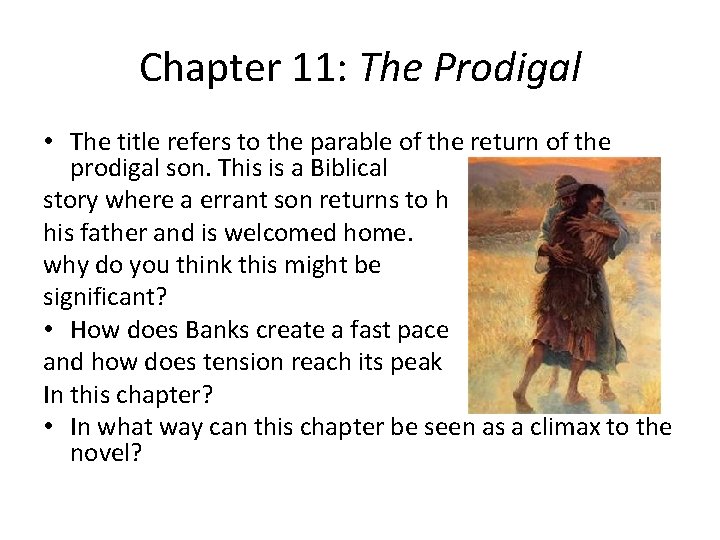
Chapter 11: The Prodigal • The title refers to the parable of the return of the prodigal son. This is a Biblical story where a errant son returns to h his father and is welcomed home. why do you think this might be significant? • How does Banks create a fast pace and how does tension reach its peak In this chapter? • In what way can this chapter be seen as a climax to the novel?
Chapter 12: What Happened to me • Do you think the twist is effective? Does it change the way you perceived Frank previously? • In what ways might we have more sympathy for the character? • What do you think the main themes are and why? • Give evidence.
• Characterisation: opening line shows a fixation on self and his own ego. “It always annoyed me that Eric went crazy. ” It is perhaps surprising that Frank only looks how his madness affected him and he does not empathise with his brother. Confirms that he is selfish with sociopathic tendencies. He claims to love his brother but this is through the filter of his own consciousness. • Gender: he has unrealistic conception of male and female characteristics. He is ashamed of his brother cause he shows: “weakness, a fundamental flaw that a real man should not have had” (147), which he attributes to women from the “thousands—of films” he has seen. • Relationships: both these utterances show that Frank’s relations with other human beings (especially his dysfunctional family) have coloured his judgement. They also suggest, as do many of the statements he has made in the 1 st person NPOV, that he is an unreliable narrator.
Extra notes • • • Setting: used to build tension as the novel moves towards its climax: “the heat built quickly, making the hose very stuffy”; “A warm breeze, hardly cooling at all”; “Everything shimmered in that heat, became uncertain and shifting” (this reflects the identity of the protagonist, Frank); “My scalp crawled with perspiration, and my crotch itched” (word choice: unpleasant connotations). (149) These quotations all serve to build up the mood of inevitability: something terrible is going to happen. When he is at the dump the word choice and imagery is particularly effective and builds the dark mood and embodies Frank’s psyche: “Papers picked themselves up and went round in a circle”; “savouring its rotten, slightly sweet smell”; “ [the dump] moved like something huge and alive, spreading like an immense amoeba as it absorbed the healthy land” (150) “the sheep moved slowly, like maggots, over the land, eating” similes link back to Eric’s experience and continues to build strong sense of unease and approaching horror. Horror: description of the dog is particularly graphic. Clearly this has been done by Eric and it continues to build a sense of anticipation and horror: “it was still alive. . . and the skin was underneath livid and seeping”. Interestingly, Frank appears to show empathy here and is gentle to the poor dying dog when he puts it out of its misery: “’Frank’ll get you, ’ I whispered. ” 153) Fire motif: prominent in this chapter: “ The blaze swept over the last bits of the dog’s fiery trail. ”
Chapter 11 • The title is ironic as Eric can be seen as a grotesque manifestation of the prodigal son but he is returning not to seek forgiveness but to exact vengeance upon his father • Structure: this is the climax of the novel where tension reaches its highest point in the narrative. We seem to have a denouement (solution to the plot and subplots that the narrative has comprised of) where we think Frank’s father is really his mother but it is a false ending. “You bitch, you bitch!”
Chapter 11 • • • Setting: the heat is almost tangible in the closing chapters and is an example of pathetic fallacy as it mirrors the tense and claustrophobic tone and the tension that is building up in the characters and their relationships with one another: “It was still overcast; the light seemed tired and the breeze tasted stale. ” (158) use of sensory language and personification helps to build the tense mood which breaks in spectacular fashion in this climax. “the afternoon was hotter than the morning. ” (161) Gothic motifs: “sheep made their ugly, broken noises”; “birds sat on barbed wire fences”(166); calling in their dark voices”; “An ear, covered in short white and black fur, still bleeding, was nailed to the wood. ” (167): animals portrayed as bleak markers of disharmony and madness. Nature is in flux. Fire, prominent throughout the novel and symbolising revenge and madness reaches its peak here: “burning sheep lay in pools of livid fire while others ran and jumped about, moaning and howling in their guttural, broken voices. ” Powerful, descriptive language (sensory) emphasises the horror and pain of the scene. Repetition of the fire motif and all it symbolises.
Chapter 11: Characterisation • Angus professes his love for his son, Frank, and tries to lure him away from the house: “Frang, you know ‘ve always loved you. . . ” (165) • The brothers finally meet in a frenzied and violent reconciliation: they almost kill each other admist the “crackling of fires on all sides and smell of roasted meat” (176) • “His face was bearded, dirty, like an animal mask. It was the boy, the man I had know, and it was another person entirely. ” (176). The entire novel has been leading up to this meeting where they both confront their shared past (love) and distorted terrifying present. In a rare note of hope, love wins out and signal the possibility of a better future for Frank and Eric. A climatic moment where the two brothers overcome the fractured and dysfunctional past (relationships)
Chapter 12: the resolution • This is the real denouement. We learn that Frank is Frances and his dad tried to turn her into a male by dosing her with male hormones as “a way of lessening—perhaps removing entirely—the influence of the female around him as I grew up” (181). Angus has lied to and manipulated his own children because of his own twisted views of gender and his poisonous relationships with his wives. • Frances’s life has been ruined by his family: “I’m a woman. . . capable of intercourse and giving birth (I shiver at the thought of either). ” (182) This revelation makes his previous misogynistic statements highly ironic and also shows how difficult their life will be in the future.
• Setting: the weather has broken and there is a sense of calm now after the intense heat/fire of previous chapter(s): “On the land in the distance there were some fields, set on a mildly sloping hillside”: positive connotations in word choice creates tranquil mood which leads into Frank’s reflections on his life. “Mountains marching into the glowing light of the north” This personification echoes previous phrase, w. c “glowing” creates warm and gentle tone. “sweeping all the cloud away out to sea, and the worst of the heat with it” sense of cleansing and wiping away the horrors of the past • Allegorical horse story and dream: this story has a deeper meaning. What do you think it might be and why does he remember and dream about the incident now?
Allegory • The horses could symbolise Frank and Eric and the separation they suffered when Eric left the island ultimately lost his mind. The dream indicates a sense of going full circle and closure.
• Re-read from “But I am still me. . . ”(p 182) to the end of the novel. Frank reflects on his/her life offers a variety of reasons and justifications for their actions. • Which reason do you think is the most valid? Or perhaps none of them are valid? Take a definite stance in relation to these questions and be prepared to argue your case to the rest of the class. Use evidence form the text. • Write a clear response to the task.
• • Frank suggests that because she believed that she had been emasculated and could never be a ‘normal man’ , then she was seeking revenge on all ‘normal’ people around her. She was trying to live up to the “small image of the ruthless soldier-killer” that society seems to place on a pedestal. This can be read as a critique of how society adheres to gendered stereotypes and that Frank was trying to aspire to but felt that he/she never could because he did not possess a penis. So, all the killings and torture were a vent for these feelings of frustration and inadequacy. Frank states, “the murders were my own conception, my sex” suggesting that the terrible actions were all driven by “penis envy” ( a kind of extreme manifestation of Freudian theory). To an extent, these are valid justifications (but obviously no sane person should indulge in such horrific actions) but there is no doubt that Frank was damaged by the bizarre experiment conducted by her reckless father in conjunction with the societal expectations of what it means to be a man or a woman. This is still relevant today where gender stereotyping is still rampant but perhaps even more so as more people identify as non-binary in their gender and choose to be characterised as ‘ze’.
Critical Reading • This is divided into two sections (both worth 20 marks): • Part one will be on a poem by Duffy where you answer questions focusing on poetic techniques used (textual analysis) • Part two will be from the prose fiction section where you will write a critical essay based upon The Wasp Factory. Make sure you choose a question that is suited to the text and that you respond to the demands of the specific question
2016 paper Answers to questions on Prose Fiction should refer to the text and to such relevant features as : characterisation, setting, language, key incidents(s), climax, turning point, plot, structure, narrative technique, theme, ideas, description. . . 4. Choose a novel or short story in which there is a central character to whom you react with mixed feelings. With reference to appropriate techniques, briefly explain why you react to the character in this way and discuss how this reaction adds to your understanding of the text as a whole. 5. Choose a novel or short story that deals with a theme of moral or social significance. With reference to appropriate techniques, explain how the writer develops this theme and discuss why its development adds to your appreciation of the text as a whole. 6. Choose a novel or short story in which the choice of setting is central to your appreciation of the text. Briefly explain how the writer effectively creates setting and, with reference to appropriate techniques, discuss how the writer’s presentation of the setting is central to your appreciation of the text as a whole.
Activity: Creating class revision notes • You will compile a collection of quotations that can be used in relation to different focuses for the Critical Reading paper. • Write down the quotation, main technique and a brief note on why it is relevant and brief analysis • Remember that quotations and analysis that you include in a critical essay must reflect the specific demands of the task.
Themes • A good critical essay will always link to a key theme(s) • Make a list of all themes you can identify in the novel
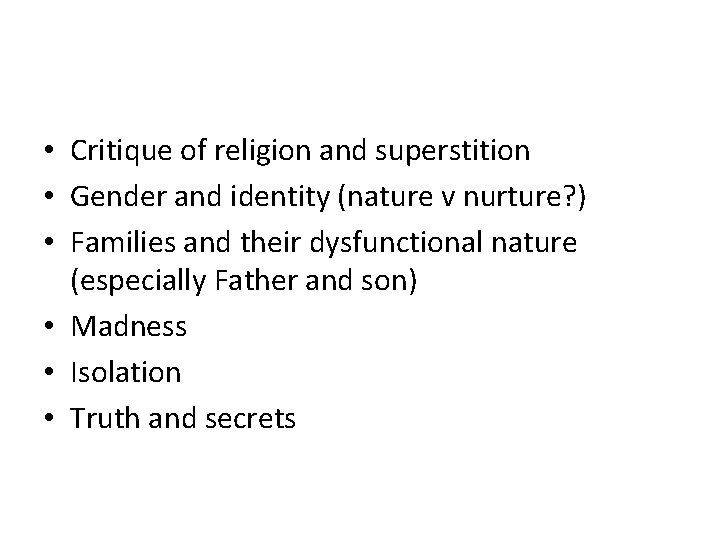
• Critique of religion and superstition • Gender and identity (nature v nurture? ) • Families and their dysfunctional nature (especially Father and son) • Madness • Isolation • Truth and secrets
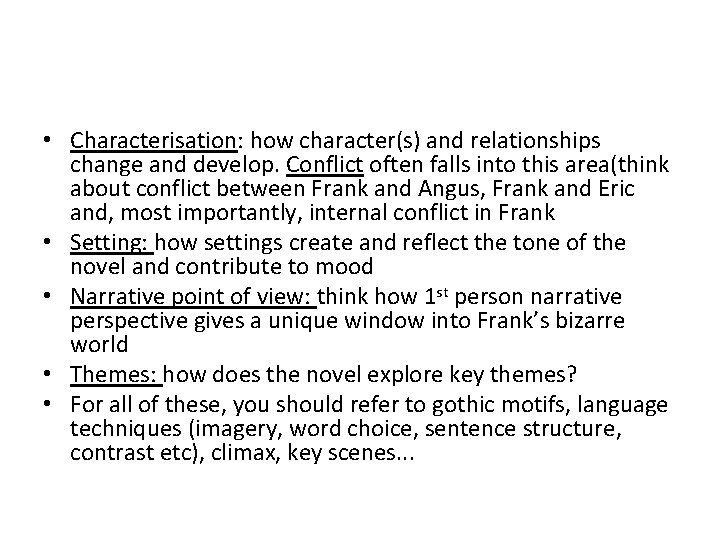
• Characterisation: how character(s) and relationships change and develop. Conflict often falls into this area(think about conflict between Frank and Angus, Frank and Eric and, most importantly, internal conflict in Frank • Setting: how settings create and reflect the tone of the novel and contribute to mood • Narrative point of view: think how 1 st person narrative perspective gives a unique window into Frank’s bizarre world • Themes: how does the novel explore key themes? • For all of these, you should refer to gothic motifs, language techniques (imagery, word choice, sentence structure, contrast etc), climax, key scenes. . .
Presentation • You are going to explain your spider-gram to the rest of the class • You should write key quotations down as groups identify them and explain why they selected them
- Slides: 53