
The War on Drugs The Mythology of Antibiotics
The War on Drugs The Mythology of Antibiotics Edward L. Goodman, MD August 17, 2009
An Epidemic of Drastic Proportions: demographics • Affects people of all ages – Disproportionately involves the very young and very old – Involves the more affluent and well insured • Costs in the billions – Producers reap huge profits – Pushers are among elite – Users are not addicted • Sometimes still demand a drug fix
Effects of the Epidemic • Direct toxicity of the drugs – Diarrhea from most – Deafness from a few – Renal failure from quite a few – Skin rash from all – Secondary infections from all – IV phlebitis from all
Indirect Effects: Secondary Infections • Pneumonia – Vent associated • Bacteremia/fungemia – Line associated • MDR Urinary tract infections – Catheter associated • Prolonged hospital stay • Excessive costs
Description of “Pushers” • Well educated • Well intentioned • Extremely Defensive – Fearful of lawyers – Use that as an excuse • Forgetful – Forgotten lessons of graduate school • Addicted to the culture of cultures
The Truth • • • Producers = PHARMA Pushers = physicians Victims = all of us Drugs = antimicrobials Root Causes = ignorance of microbiology, epidemiology, pharmacology • DRUGS OF FEAR
More of the Truth • Antibiotic use (appropriate or not) leads to microbial resistance • Resistance results in increased morbidity, mortality, and cost of healthcare • Antibiotics are used as “drugs of fear” (Kunin et al. Annals 1973; 79: 555) • Appropriate antimicrobial stewardship will prevent or slow the emergence of resistance among organisms (Clinical Infectious Diseases 1997; 25: 584 -99. )
Antibiotic Misuse • Published surveys reveal that: – 25 - 33% of hospitalized patients receive antibiotics (Arch Intern Med 1997; 157: 1689 -1694) – At PHD during 1999, 2000 and 2001, 50 -60% of patients received antibiotics – 22 - 65% of antibiotic use in hospitalized patients is inappropriate (Infection Control 1985; 6: 226 -230)
Consequences of Misuse of Antibiotics • Contagious RESISTANCE – Nothing comparable for overuse of procedures, surgery, other drugs • Morbidity - drug toxicity • Mortality - MDR bacteria harder to treat • Cost
Appropriate Use of Antibiotics • Need 8 -10 lectures • Many useful reference sources – Sanford Guide (hard copy or electronic) – Epocrates (epocrates. com) – Hopkins abx-guide (hopkins-abx. guide. org) – ID Society – practice guidelines (idsociety. org)
Inappropriate Use of Antibiotics • Asymptomatic UTI in non pregnant patients • “Acute sinusitis” before trial of 7 -10 days of symptomatic treatment (NEJM 8/26/04) • Respiratory cultures when there is no clinical evidence of pneumonia • Positive catheter tip cultures when no bacteremia • Coagulase negative staph in single blood cultures • FUO with no clinical site of infection • Prophylaxis for surgery beyond 24 hours
More Inappropriate Uses • Aseptic meningitis when already pretreated – Watch for six hours and retap, versus – Treat for 10 -14 days empirically • Abnormal CXR when no clinical symptoms for pneumonia • Swabs of open wounds growing potential pathogens • THE LIST COULD GO ON FOREVER!
Antibiotic Myths • • • More is better IV is better than po Longer duration is better Multiple drugs are better Vancomcyin mythology Miscellaneous
Is More Better? • What does “more” (higher doses) accomplish? – Higher serum levels, and thus – Higher tissue levels • But when are higher levels needed? – Privileged sanctuary where drugs penetrate poorly • CSF/vitreous • Heart valve vegetations • Implants/prostheses/biofilms – Defenseless host
Parameters of Killing • Concentration dependent pharmacodynamics – Quinolones – Aminoglycosides – Lipopeptide = Daptomycin • Non concentration dependent – All the others – Various parameters of efficacy • Area under curve dependent (stay tuned)
Concentration Dependent • Need peak level/MIC of 10 -12 – Easily achieved with most enteric pathogens with FQ – Less easily achieved for FQ with Pseudomonas – Easily achieved with “once daily aminoglycoside” • Can’t push levels much higher – Narrow therapeutic index
Non Concentration Dependent: Time Dependent Killing • Beta lactams, glycopeptides, macrolides and most others • Parameters of efficacy – For beta lactams, time above MIC >50% of dosing interval • Unless significant post antibiotic effect (PAE) – AUC/MIC (AUIC) above a certain threshold
“More is Better” continued • If beta lactams don’t kill any better at higher concentrations – Why give them IV? – Why increase dose? – Just give often enough • Confounding factor – Higher dose gives higher serum levels which may exceed MIC for longer perior of time
When is IV better than enteral? • Patient unable to take enteral meds/food • Patient unable to absorb enterally – Short bowel syndrome – Malabsorption – Vascular collapse – Ileus
“Completely” Bioavailable IV and enteral essentially identical GIVE ENTERALLY IF POSSIBLE • • Respiratory quinolones (90 -98%) Fluconazole (90%) Trimethoprim sulfa (85%) Metronidazole Doxycycline/minocycline Clindamycin (90%) Linezolid (100%)
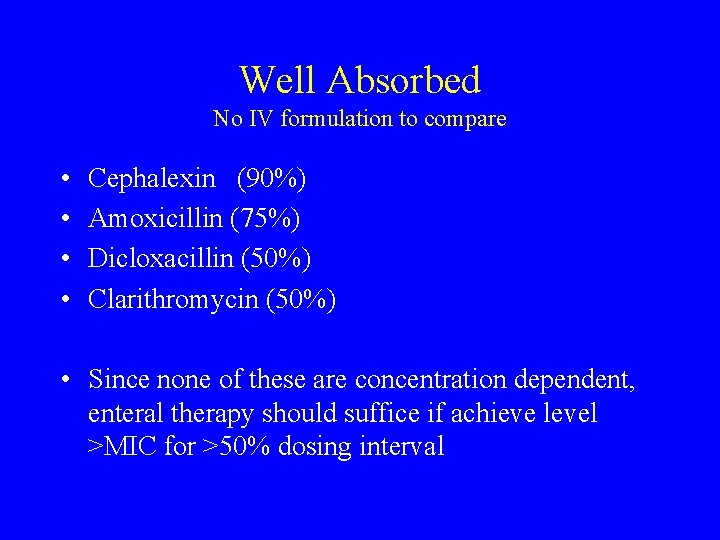
Well Absorbed No IV formulation to compare • • Cephalexin (90%) Amoxicillin (75%) Dicloxacillin (50%) Clarithromycin (50%) • Since none of these are concentration dependent, enteral therapy should suffice if achieve level >MIC for >50% dosing interval
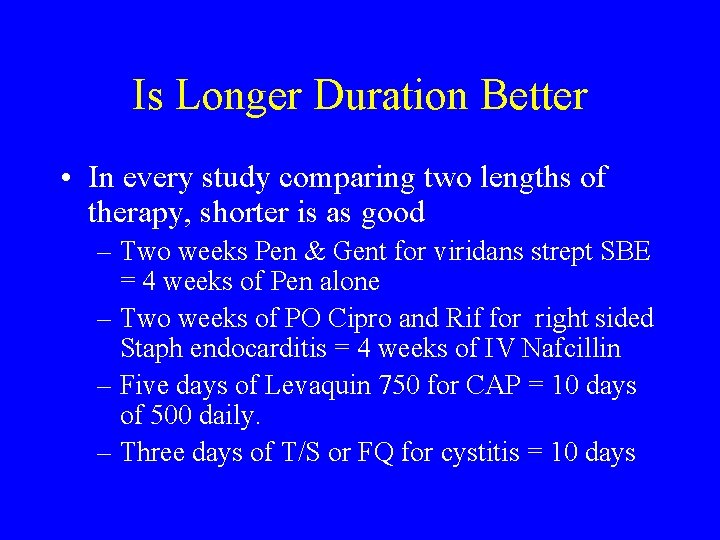
Is Longer Duration Better • In every study comparing two lengths of therapy, shorter is as good – Two weeks Pen & Gent for viridans strept SBE = 4 weeks of Pen alone – Two weeks of PO Cipro and Rif for right sided Staph endocarditis = 4 weeks of IV Nafcillin – Five days of Levaquin 750 for CAP = 10 days of 500 daily. – Three days of T/S or FQ for cystitis = 10 days
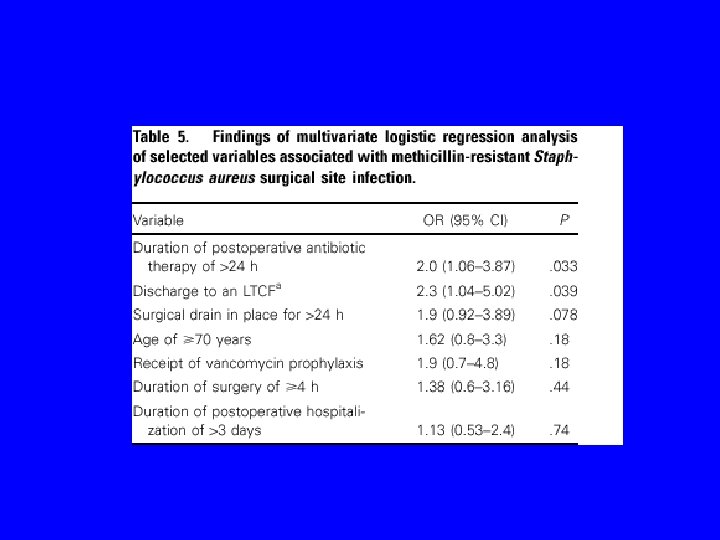
Is Longer Worse? • • Increases antibiotic resistance Exposes patient to more toxicity Increases cost May actually increase the risk of some infections
When are Multiple Antibiotics Indicated • Empiric therapy when organism(s) not known • For mixed infections when one drug won’t cover • For synergy • To retard or prevent the development of resistance
When is Synergy Needed? • If it allows reduction in dosage of toxic components of a combination – Flucytosince with AMB can shorten the course and lower the dose of AMB for Crypto meningitis – No other good example
Synergy Needed • When monotherapy is not bactericidal – Enterococcal endocarditis – Neither penicillin nor aminoglycoside are ‘cidal by themselves – When combined ‘cidal activity produced
When is Cidal Therapy Needed • Bacterial Endocarditis • Bacterial Meningitis • Maybe neutropenic or immunocompetent host • Maybe for osteomyelitis • Not for almost all other bacterial infections
When are Multiple Drugs Needed to Prevent/Retard Development of Resistance? • HIV therapy • Chemotherapy of active TB • ? ? Pseudomonas pneumonia
Vancomycin Myths • Vancomycin is the “Ultimate drug for gram positive” – Clearly inferior to Nafcillin for sensitive staph – Slowly bactericidal – High failure rate in MRSA infections • Vancomycin is a highly toxic drug – No clear evidence of renal or otic toxicity at standard doses - e. g, 1 gm Q 12 h – Evidence of toxicity as doses are pushed higher
More Myths • Keflex is still a appropriate for outpatient SSI, respiratory infections – 50% of staph aureus are MRSA – Poor activity vs. PRSP, Hemophilus • Fluoroquinolones are superior for UTI, sinusitis, bronchitis, pneumonia – Not unless resistant organisms – May allow short therapy for CAP – Once daily dosing is convenient
The Solution • • • Vaccinate against preventable infections Reduction in promiscuous culturing Antimicrobial stewardship Education Restriction of drugs – Payors – Hospitals
- Slides: 32