
The voltaic pile was the first electrical battery
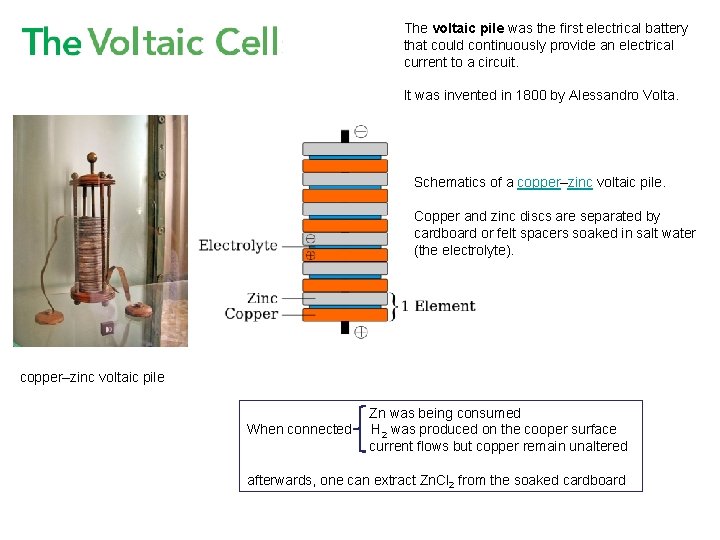
The voltaic pile was the first electrical battery that could continuously provide an electrical current to a circuit. It was invented in 1800 by Alessandro Volta. Schematics of a copper–zinc voltaic pile. Copper and zinc discs are separated by cardboard or felt spacers soaked in salt water (the electrolyte). copper–zinc voltaic pile When connected Zn was being consumed H 2 was produced on the cooper surface current flows but copper remain unaltered afterwards, one can extract Zn. Cl 2 from the soaked cardboard
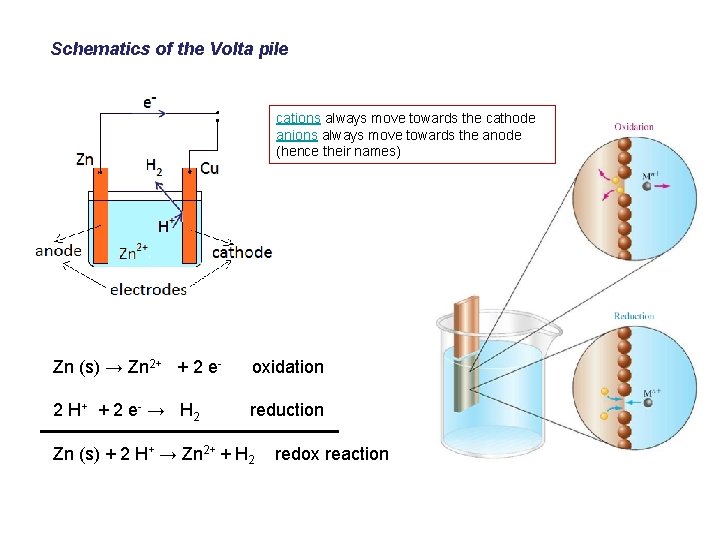
Schematics of the Volta pile cations always move towards the cathode anions always move towards the anode (hence their names) Zn (s) → Zn 2+ + 2 e- oxidation 2 H+ + 2 e - → H 2 reduction Zn (s) + 2 H+ → Zn 2+ + H 2 redox reaction
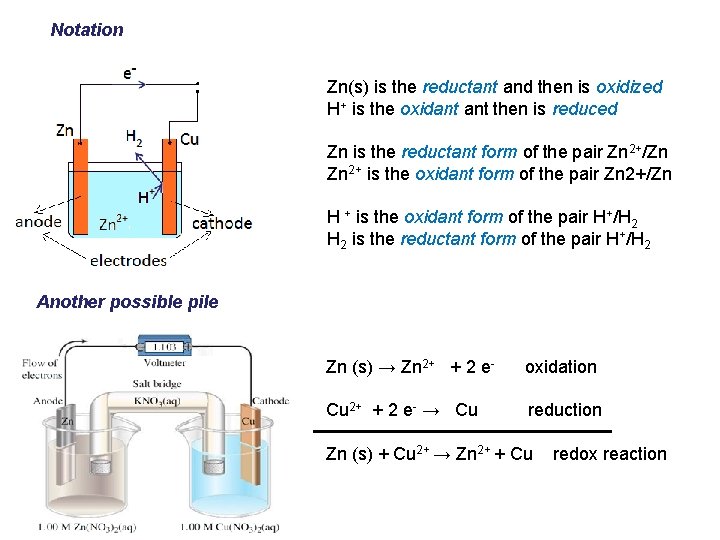
Notation Zn(s) is the reductant and then is oxidized H+ is the oxidant then is reduced Zn is the reductant form of the pair Zn 2+/Zn Zn 2+ is the oxidant form of the pair Zn 2+/Zn H + is the oxidant form of the pair H+/H 2 is the reductant form of the pair H+/H 2 Another possible pile Zn (s) → Zn 2+ + 2 e- oxidation Cu 2+ + 2 e- → Cu reduction Zn (s) + Cu 2+ → Zn 2+ + Cu redox reaction
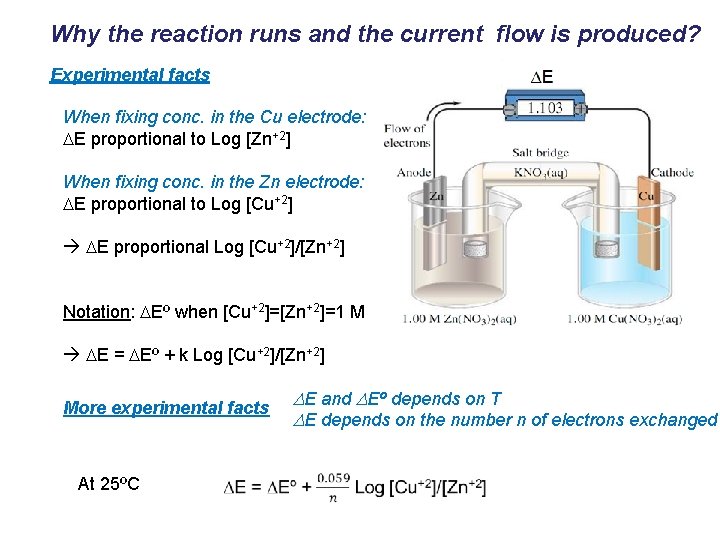
Why the reaction runs and the current flow is produced? Experimental facts When fixing conc. in the Cu electrode: E proportional to Log [Zn+2] When fixing conc. in the Zn electrode: E proportional to Log [Cu+2] E proportional Log [Cu+2]/[Zn+2] Notation: Eº when [Cu+2]=[Zn+2]=1 M E = Eº + k Log [Cu+2]/[Zn+2] More experimental facts At 25ºC E and Eº depends on T E depends on the number n of electrons exchanged
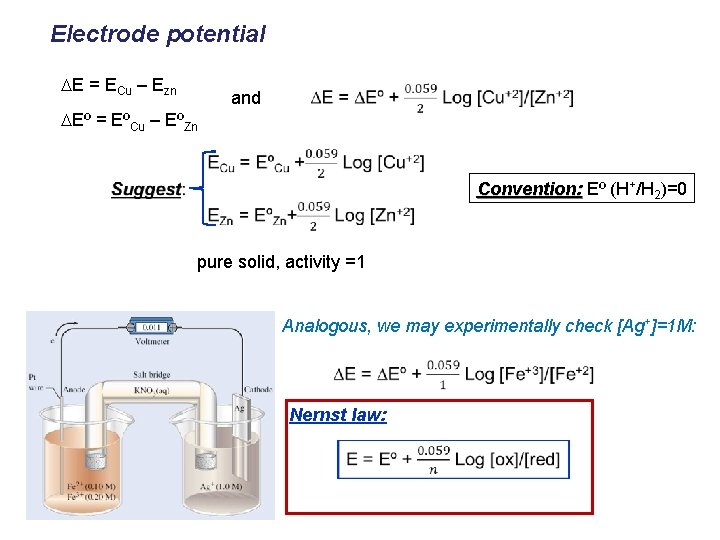
Electrode potential E = ECu – Ezn and Eº = EºCu – EºZn Convention: Eº (H+/H 2)=0 pure solid, activity =1 Analogous, we may experimentally check [Ag+]=1 M: Nernst law:
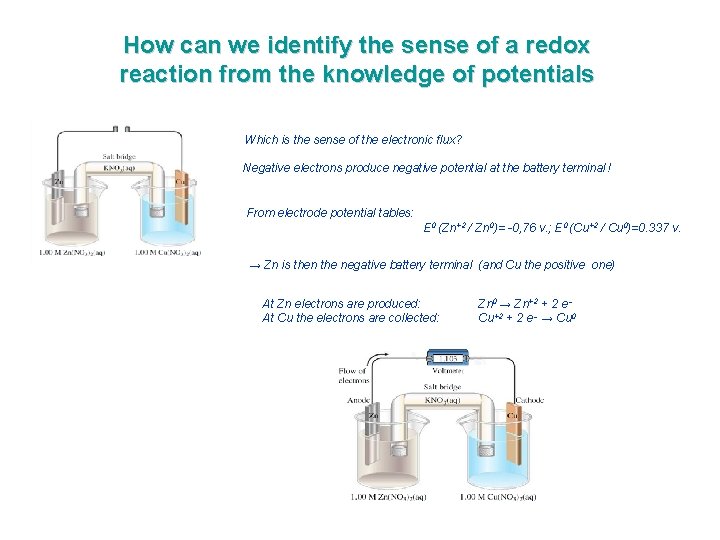
How can we identify the sense of a redox reaction from the knowledge of potentials Which is the sense of the electronic flux? Negative electrons produce negative potential at the battery terminal ! From electrode potential tables: E 0 (Zn+2 / Zn 0)= -0, 76 v. ; E 0 (Cu+2 / Cu 0)=0. 337 v. → Zn is then the negative battery terminal (and Cu the positive one) At Zn electrons are produced: At Cu the electrons are collected: Zn 0 → Zn+2 + 2 e. Cu+2 + 2 e- → Cu 0
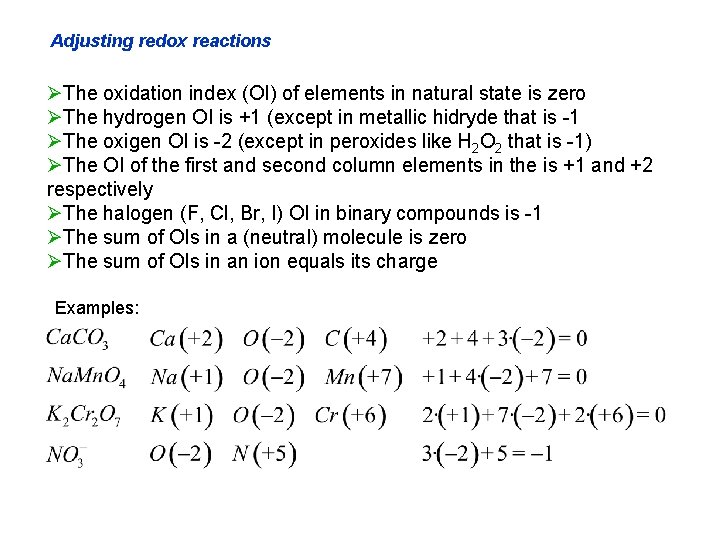
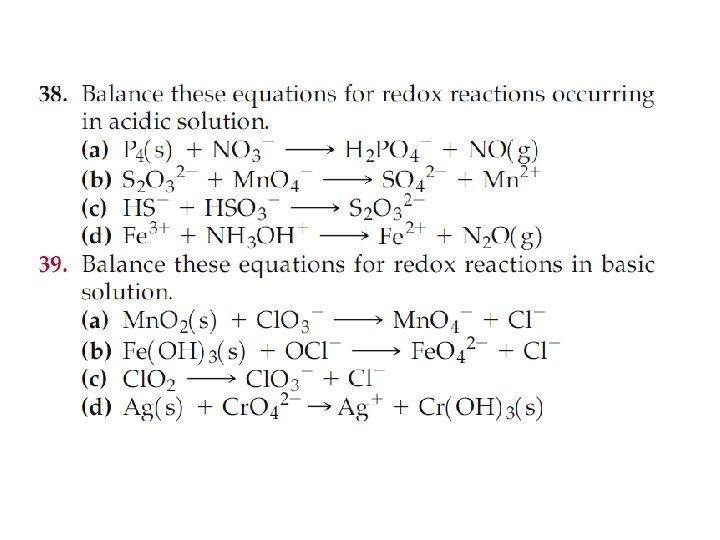
Adjusting redox reactions ØThe oxidation index (OI) of elements in natural state is zero ØThe hydrogen OI is +1 (except in metallic hidryde that is -1 ØThe oxigen OI is -2 (except in peroxides like H 2 O 2 that is -1) ØThe OI of the first and second column elements in the is +1 and +2 respectively ØThe halogen (F, Cl, Br, I) OI in binary compounds is -1 ØThe sum of OIs in a (neutral) molecule is zero ØThe sum of OIs in an ion equals its charge Examples:
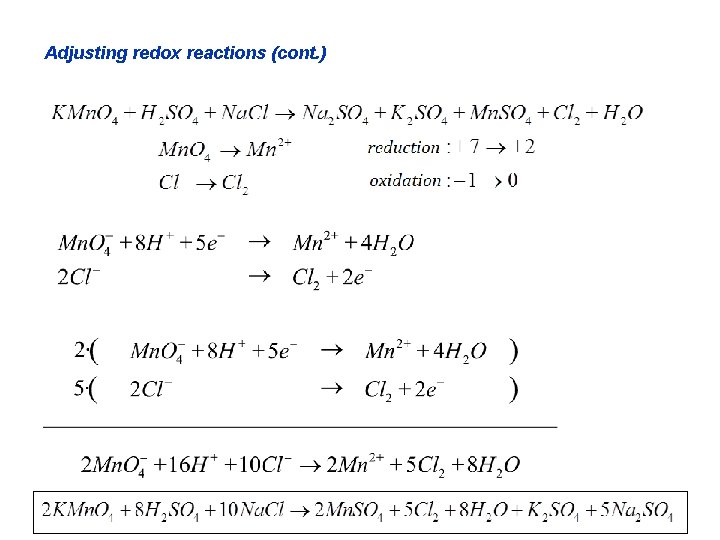
Adjusting redox reactions (cont. )
Applications: pile types and corrossion See Petrucci sections:
- Slides: 10