
The Vocabulary Mapping Framework matrix background and application

The Vocabulary Mapping Framework matrix: background. . . and application Gordon Dunsire Presented to the Vocabulary Mapping Framework seminar 9 Nov 2009, British Library, London
Vocabulary Mapping Framework ² Funded by UK’s Joint Information Systems Committee (JISC) ²Only first stage funded ² Major expansion of the RDA/ONIX framework ²To create a tool to support the automated mapping of vocabularies from metadata standards of use to the JISC community ² Research, teaching, learning ² Project conducted during second half of 2009
A starting point: RDA outreach ² RDA outreach to other communities ²RDA/ONIX framework ²DCMI (Dublin Core Metadata Initiative) RDA Task Group ²Members from Dublin Core, IEEE-Learning Object Metadata, RDA, and W 3 C communities ²Expressing RDA element set and value vocabularies in Resource Description Framework (RDF)
RDA alignment ² RDA alignment with recent metadata models developed by IFLA (International Federation of Library Associations and Institutions) ²Functional Requirements for Bibliographic Records (FRBR) ²Functional Requirements for Authority Data (FRAD) ²Statement of International Cataloguing Principles ² Stimulated IFLA project to develop RDF representation of FRBR ²Expected end of 2009
IFLA 2009 ² Further discussion at IFLA’s World Library and Information Congress 2009 (Milan, Italy) ²Study group to consider RDF/XML representation of International Standard Bibliographic Description (ISBD) ²Model underpinning many national cataloguing schema, including MARC 21 ²Task group to consider general support for RDF/XML namespaces for IFLA “standards” ²Consolidation of “FR” family of models, including Functional Requirements for Subject Authority Data (FRSAD) when finalised (2010+)
Linked data (2009, mostly) ² Increasing presence of “expert” metadata in the linked data pool ² Library of Congress Subject Headings (LCSH) ²With relators to Rameau (French subject heading scheme) terms ² Top-level Dewey Decimal Classification (DDC) notations and captions (1000+) ²In 9 languages ² Top-level Universal Decimal Classification (UDC) notations and captions real soon now
Opportunities and possibilities ² If metadata schema (MARC 21, UNIMARC, RDA, ISBD) in RDF ²Then easier to parse instance data (catalogue records) into RDF ² If very large quantities of legacy instance data available in RDF ²Then latent associations (relationships) can be identified using statistical inferencing ²E. g. Mapping of DDC notations to LCSH (Web. Dewey) ² If critical mass of rich (diverse) RDF triples ²Then utility of Semantic Web increases
Threats and vulnerabilities ² Redundancy ²Same relationship/property expressed multiple times in multiple ways makes inferencing more complex ² Gaps ²Relationship/property not expressed at all so classes/entities remain isolated ² Authority and authenticity ²Who says this? Professional expert, end-user, machine? ² Currency and version ²When was this said? Is it deprecated?
VMF requirements ² Scalable and extensible to accommodate new and changing vocabularies ² Flexible to allow engagement by different communities in various stages of vocabulary development and mapping ² Non-prescriptive to encourage uptake ²And allow use beyond VMF (and RDF) environment ². . . Goto: How the VMF matrix works / Godfrey Rust
Applications ² Metadata cross-walks ²Between different vocabularies ²E. g. Publisher metadata (ONIX) and library metadata (RDA) ² Mapping of local, bespoke metadata schemes ²From local scheme to global framework ²Local metadata often specialised, specific, and unique
Application: Complex term mapping ² Different domains may have very different views on resource categorization and identification ²E. g. Institutional repositories may distinguish draft versions of scholarly articles while publishers need only “see” the final version ²Conversely, publishers may distinguish the components of a monograph for rights assignment (text, illustrations, binding, etc. ), while libraries want to treat it as a single resource ²Good relator mappings can improve metadata exchange across differing granularities
Translations ² Translation of the VMF matrix is unnecessary ²Intended for machine use only ² Several ways of handling translations of mapped vocabularies ²Declare translations within the term (@en, @de, etc. ) ²Same term URI already mapped to VMF ²Declare translations as a separate vocabulary ²Then map term URIs to original vocabulary ² Original URIs already mapped to VMF ²Or map term URIs directly to VMF
Modes of use ² RDF properties/relators vs Roles ²Role (contextual): writer ²Property/Relator pair: writes; is. Written. By ² Formal vs Remote vs Informal ²Term mapping contained within “official” version of the VMF ²Time Authenticity Reliability Utility ²Term mapped to term within official version ²Time Authenticity ? Reliability ? Utility ²Copy of VMF ²Time Authenticity ? Reliability Utility ?
Concept family ² Accommodates terms for roles, bi-directional relator pairs, uni-directional relators (properties), classes and attributes ² FRBR class “Choreography” ²vmf: Choreographed. Dance ² RDA role “choreographer” ²vmf: Choreographed. Dance_Dance. Choreographer ² RDA/ONIX attribute “language” ²vmf: Lexical. Work ² DDEX role “Author” ²Vmf: Lexical. Work_Writer
Roles vs relators ² Vocabularies of role terms are popular ²DDEX, MARC, ONIX, RDA. . . ² Role definitions can be extracted from VMF ²Hub (vmf) and spoke (mapped) ²From a local copy ² May aid development of role vocabularies by other communities ²With possible subsequent incorporation in VMF ² (VMF as guidance on good (shared) practice)
Identification ² VMF namespace URI for every mapped vocabulary term ²Linked to published (scheme) URI for term ²Scheme URI to be used as external referent ²VMF is a black box ² If term not mapped within VMF ²Add to VMF ²Forces review of internal VMF mappings ²If no scheme URI, use VMF URI as referent? ²Map to term already mapped within VMF ²owl: equivalent. Class; owl: equivalent. Property ²Nature of equivalence?
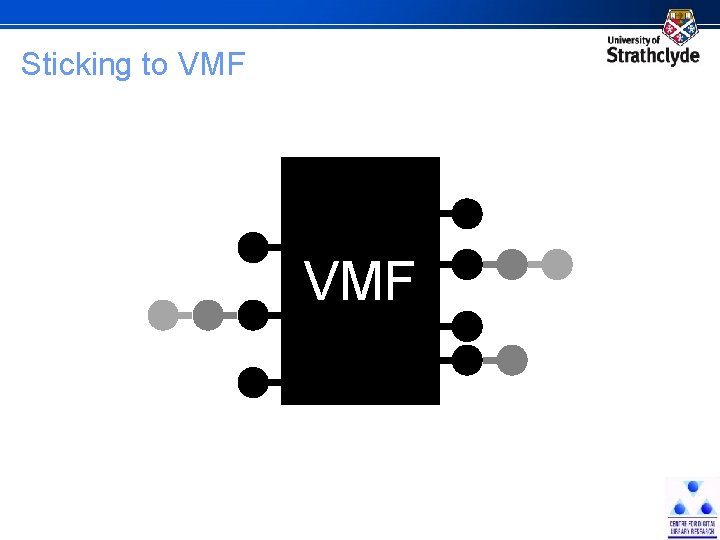
Sticking to VMF
Semantic (fractal) soup?
Thank you ² Questions?
- Slides: 19