
The VLA Survey of the Chandra Deep Field

- Slides: 15
The VLA Survey of the Chandra Deep Field South X-ray Properties of Radio Sources Shaji Vattakunnel - University of Trieste Paolo Tozzi - Francesca Matteucci AGN 9 – Ferrara 25 th May 2010
Outline - Deep Radio and X-ray Surveys of the Chandra Deep Field South - X-ray properties of Radio Sources - The sub-m. Jy radio source population
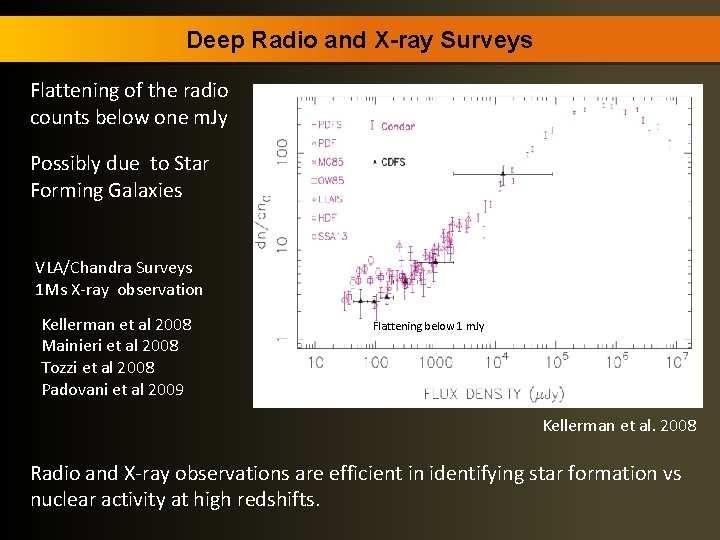
Deep Radio and X-ray Surveys Flattening of the radio counts below one m. Jy Possibly due to Star Forming Galaxies VLA/Chandra Surveys 1 Ms X-ray observation Kellerman et al 2008 Mainieri et al 2008 Tozzi et al 2008 Padovani et al 2009 Flattening below 1 m. Jy Kellerman et al. 2008 Radio and X-ray observations are efficient in identifying star formation vs nuclear activity at high redshifts.
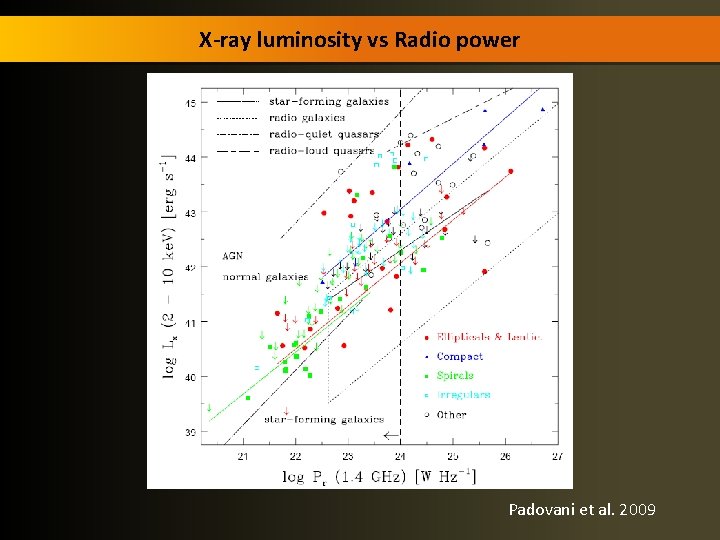
X-ray luminosity vs Radio power Padovani et al. 2009
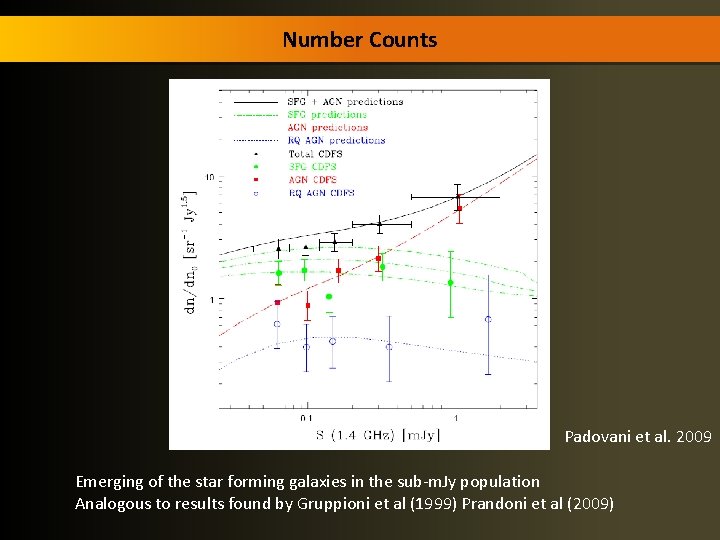
Number Counts Padovani et al. 2009 Emerging of the star forming galaxies in the sub-m. Jy population Analogous to results found by Gruppioni et al (1999) Prandoni et al (2009)
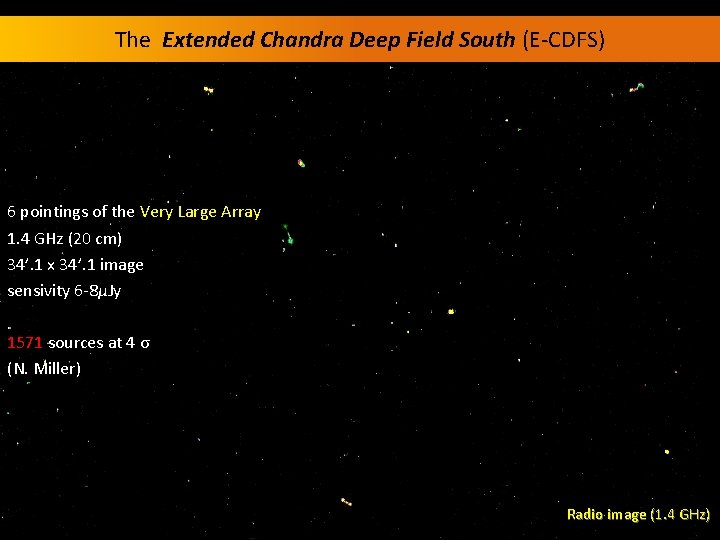
The Extended Chandra Deep Field South (E-CDFS) 6 pointings of the Very Large Array 1. 4 GHz (20 cm) 34’. 1 x 34’. 1 image sensivity 6 -8μJy 1571 sources at 4 σ (N. Miller) Radio image (1. 4 GHz)
The Chandra Deep Field South (CDFS) 0. 3 – 1 ke. V 1 – 2 ke. V 2 – 7 ke. V 23 observations (8 years) for a total of 2 Ms - 16’ x 16’ image Sensitivity: ~10 -17 erg cm-2 s-1 448 sources [0. 3 -7 ke. V] X-ray color image of the 2 Ms (441 with redshifts) derived from Luo et al. 2008
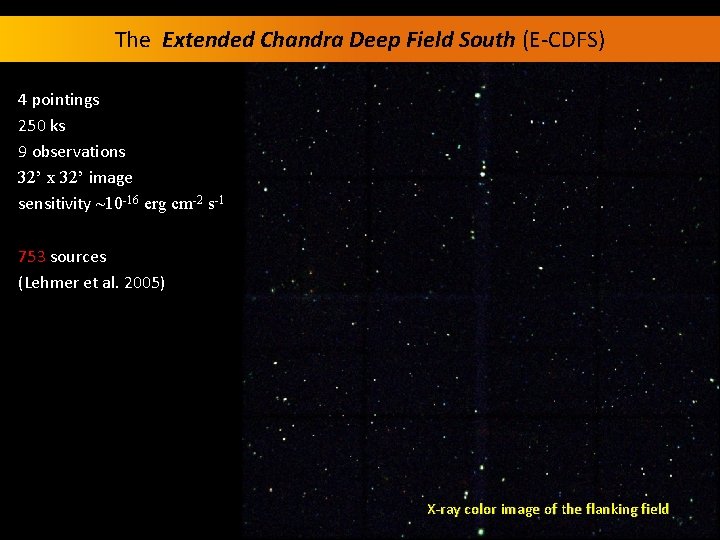
The Extended Chandra Deep Field South (E-CDFS) 4 pointings 250 ks 9 observations 32’ x 32’ image sensitivity ~10 -16 erg cm-2 s-1 753 sources (Lehmer et al. 2005) X-ray color image of the flanking field
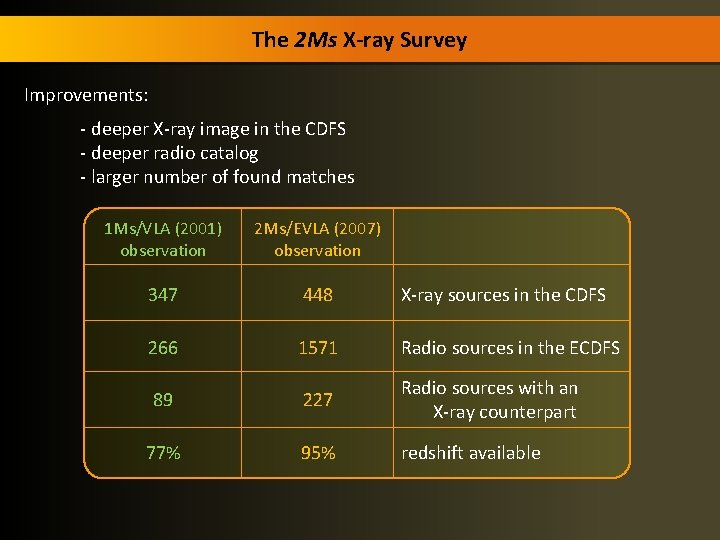
The 2 Ms X-ray Survey Improvements: - deeper X-ray image in the CDFS - deeper radio catalog - larger number of found matches 1 Ms/VLA (2001) observation 2 Ms/EVLA (2007) observation 347 448 X-ray sources in the CDFS 266 1571 Radio sources in the ECDFS 89 227 Radio sources with an X-ray counterpart 77% 95% redshift available
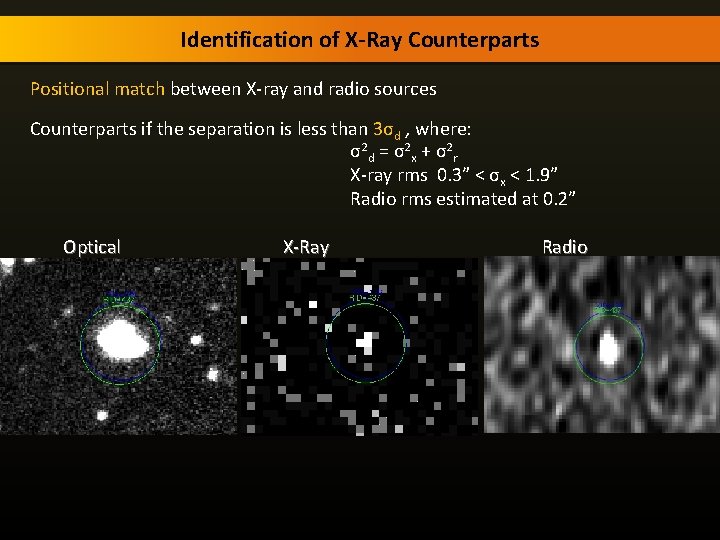
Identification of X-Ray Counterparts Positional match between X-ray and radio sources Counterparts if the separation is less than 3σd , where: σ2 d = σ2 x + σ2 r X-ray rms 0. 3” < σx < 1. 9” Radio rms estimated at 0. 2” Optical X-Ray Radio
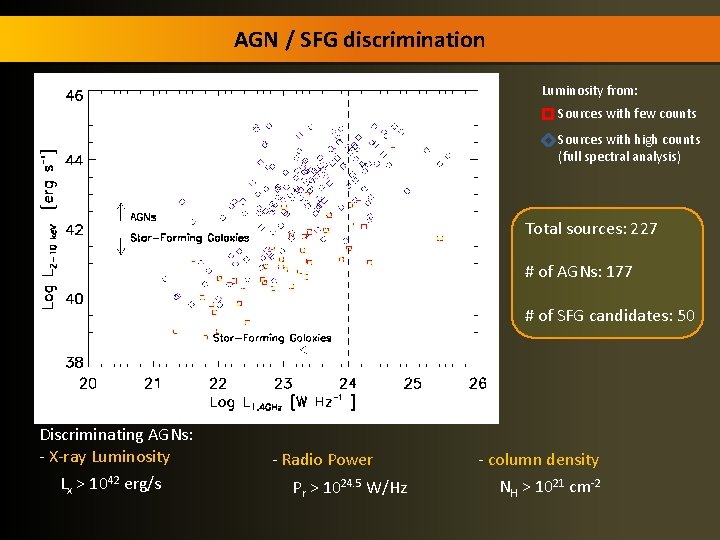
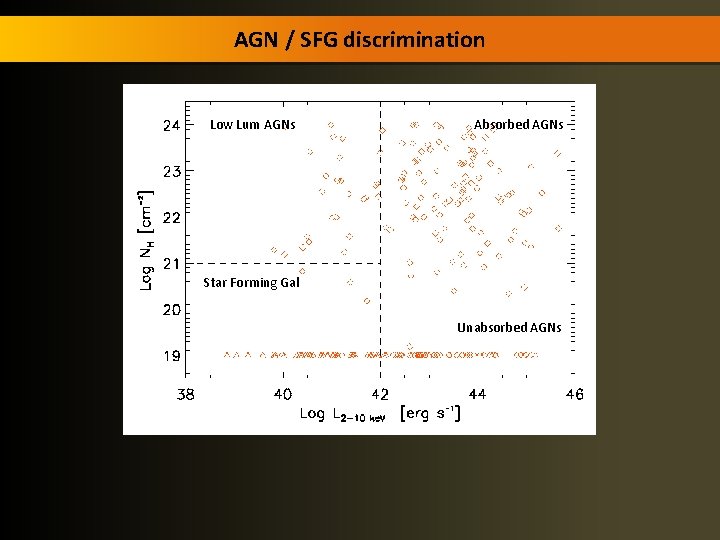
AGN / SFG discrimination Luminosity from: Sources with few counts Sources with high counts (full spectral analysis) Total sources: 227 # of AGNs: 177 # of SFG candidates: 50 Discriminating AGNs: - X-ray Luminosity Lx > 1042 erg/s - Radio Power Pr > 1024. 5 W/Hz - column density NH > 1021 cm-2
AGN / SFG discrimination Low Lum AGNs Absorbed AGNs Star Forming Gal Unabsorbed AGNs
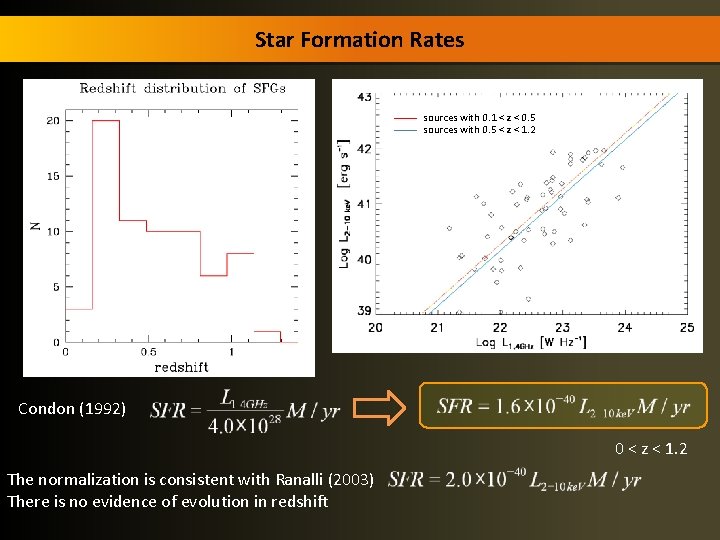
Star Formation Rates sources with 0. 1 < z < 0. 5 sources with 0. 5 < z < 1. 2 Condon (1992) 0 < z < 1. 2 The normalization is consistent with Ranalli (2003) There is no evidence of evolution in redshift
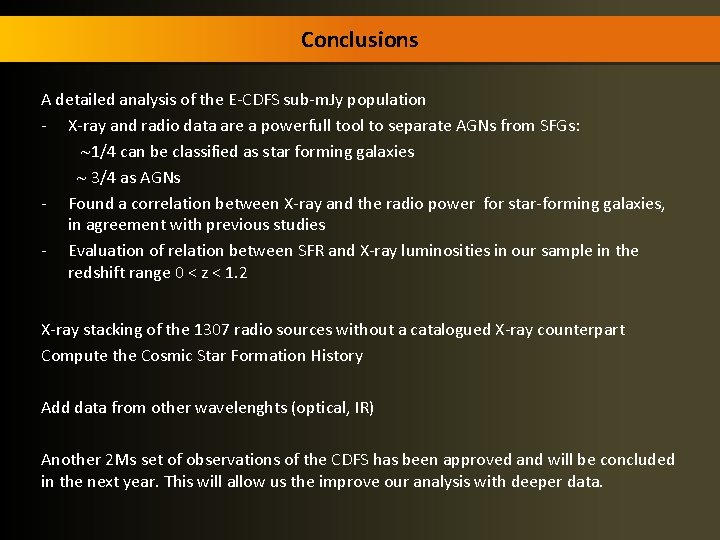
Conclusions A detailed analysis of the E-CDFS sub-m. Jy population - X-ray and radio data are a powerfull tool to separate AGNs from SFGs: ~1/4 can be classified as star forming galaxies ~ 3/4 as AGNs - Found a correlation between X-ray and the radio power for star-forming galaxies, in agreement with previous studies - Evaluation of relation between SFR and X-ray luminosities in our sample in the redshift range 0 < z < 1. 2 X-ray stacking of the 1307 radio sources without a catalogued X-ray counterpart Compute the Cosmic Star Formation History Add data from other wavelenghts (optical, IR) Another 2 Ms set of observations of the CDFS has been approved and will be concluded in the next year. This will allow us the improve our analysis with deeper data.
Thanks for your attention