
The VIVO Ontology Project Technology Jon CorsonRikert Brian
The VIVO Ontology Project Technology: Jon Corson-Rikert, Brian Caruso, Brian Lowe, Nick Cappadona Project Coordination: Medha Devare, Elaine Guidero, Jaron Turner Content Editors: Medha Devare, Nan Hyland, Jim Morris-Knower, Jill Powell, Deb Schmidle, Gail Steinhart, Kornelia Tancheva, Susanne Whitaker September 21, 2007
What is VIVO? A Web resource • Single point of access for information on scholarly activity at Cornell • Independent of Cornell’s administrative structure • Search or browse directly or syndicate via web services An ontology-based application • Represents common university relationships • Patterned on AKT 1 and SWRC 2 A framework for ontology-based applications (Vitro) • Jena 3 model + ontology editor + simple CMS • Real-time inferencing for a production environment
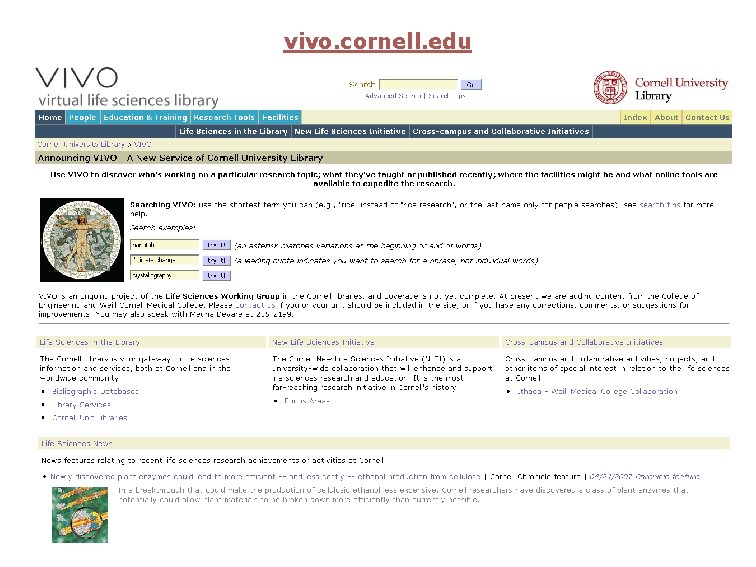
vivo. cornell. edu
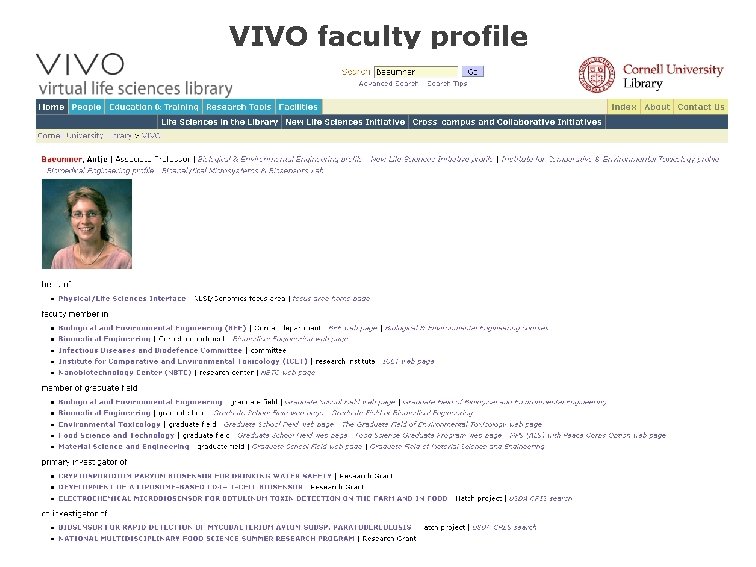
VIVO faculty profile
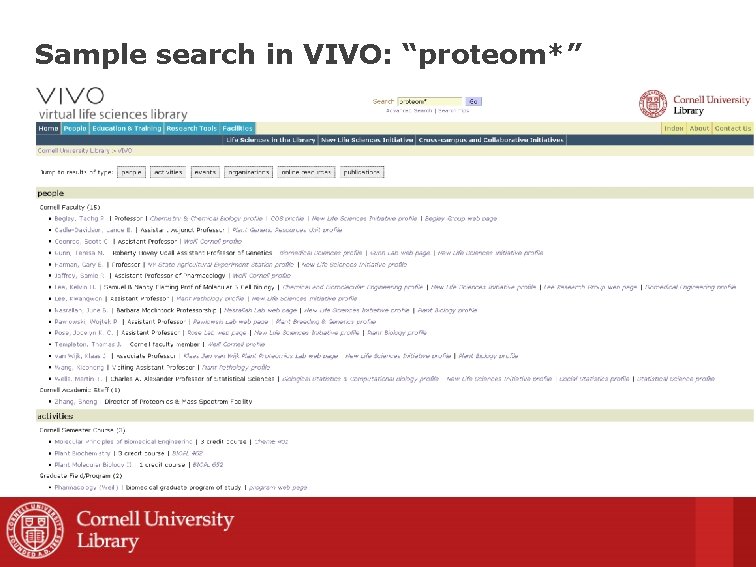
Sample search in VIVO: “proteom*”
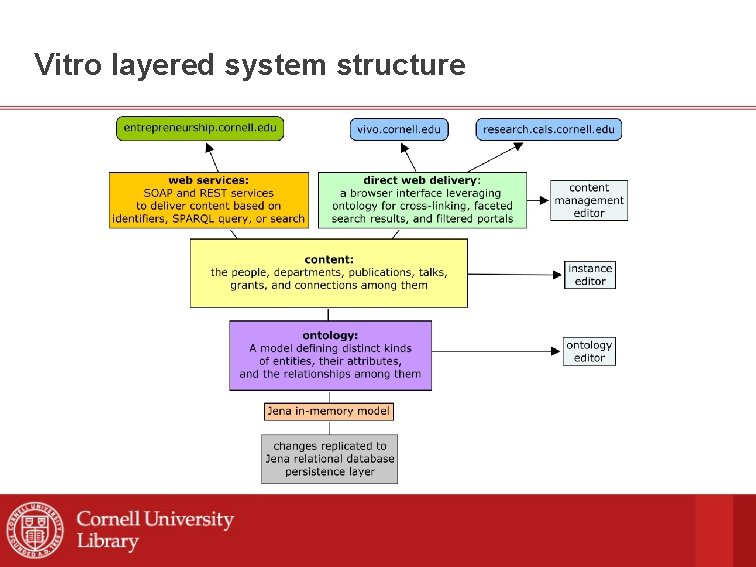
Vitro layered system structure
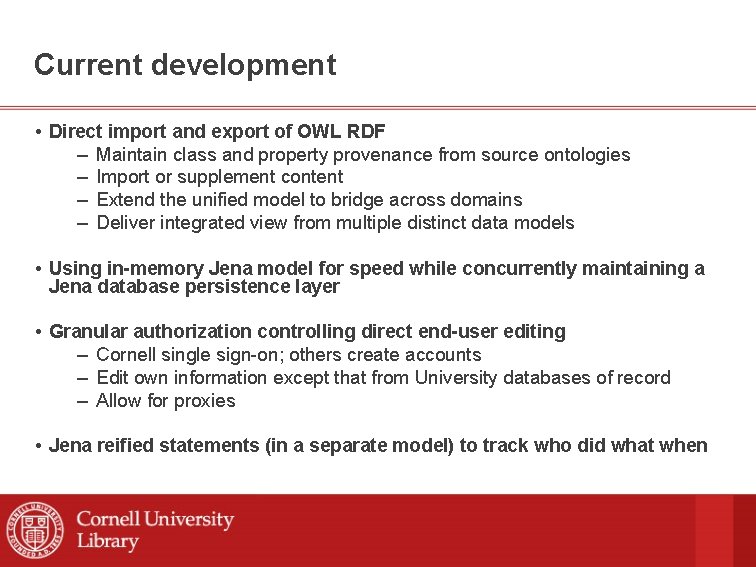
Current development • Direct import and export of OWL RDF – Maintain class and property provenance from source ontologies – Import or supplement content – Extend the unified model to bridge across domains – Deliver integrated view from multiple distinct data models • Using in-memory Jena model for speed while concurrently maintaining a Jena database persistence layer • Granular authorization controlling direct end-user editing – Cornell single sign-on; others create accounts – Edit own information except that from University databases of record – Allow for proxies • Jena reified statements (in a separate model) to track who did what when
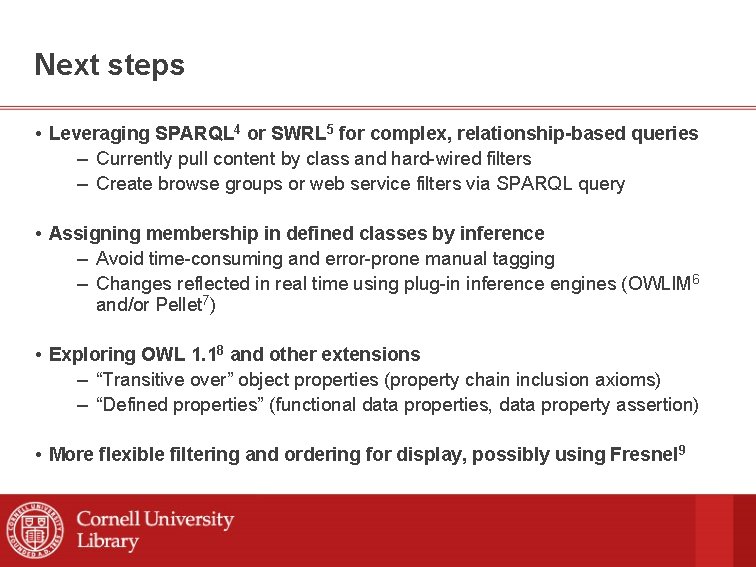
Next steps • Leveraging SPARQL 4 or SWRL 5 for complex, relationship-based queries – Currently pull content by class and hard-wired filters – Create browse groups or web service filters via SPARQL query • Assigning membership in defined classes by inference – Avoid time-consuming and error-prone manual tagging – Changes reflected in real time using plug-in inference engines (OWLIM 6 and/or Pellet 7) • Exploring OWL 1. 18 and other extensions – “Transitive over” object properties (property chain inclusion axioms) – “Defined properties” (functional data properties, data property assertion) • More flexible filtering and ordering for display, possibly using Fresnel 9
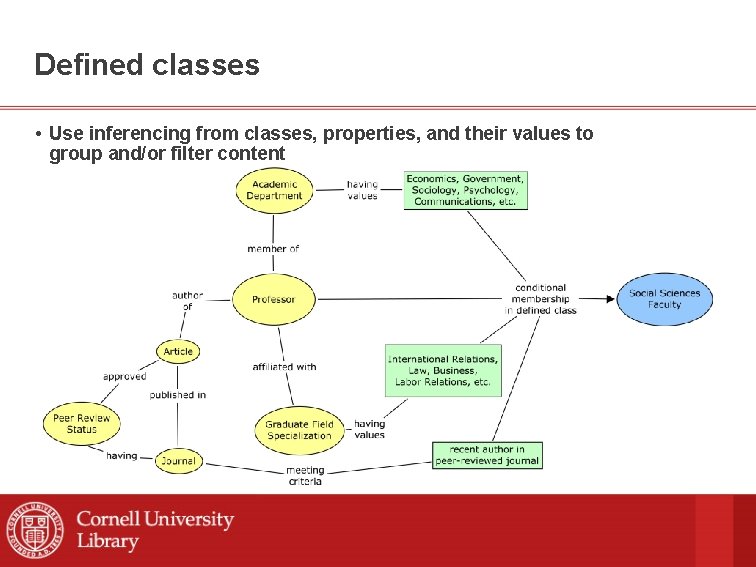
Defined classes • Use inferencing from classes, properties, and their values to group and/or filter content
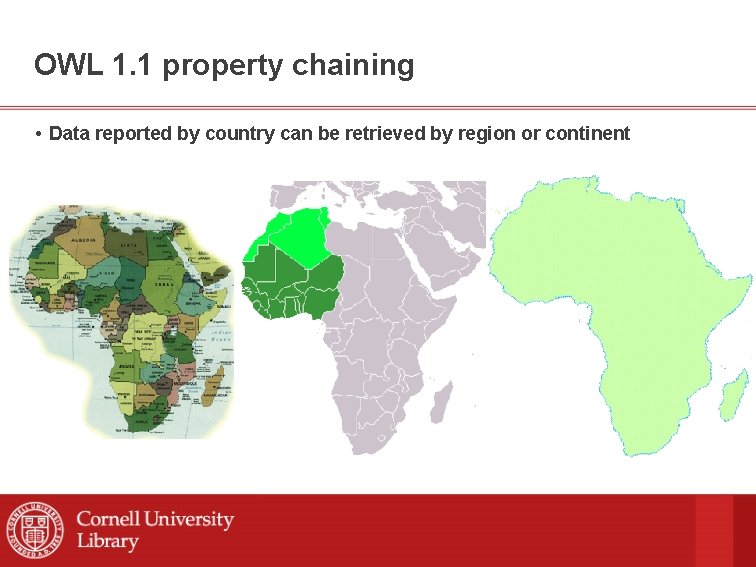
OWL 1. 1 property chaining • Data reported by country can be retrieved by region or continent
Future opportunities • Selective and dynamic content integration – Import and manage multiple ontologies or portions thereof, retaining original class and property relationships – Pull in only enough metadata from remote data sources to allow discovery and the desired level of integration, without replicating all content – Build higher-level defined classes and properties to bridge across ontologies within Vitro – Link out to or query remote sources for updated content, statistics, and/or data • e. Science, e. Humanities – Use Vitro as a front end to Fedora 9 and other repository platforms – Create and manage terminology and cross-disciplinary relationships for distributed collections while retaining original metadata schemas – Facilitate blending distributed data resources into scholarly publishing and other academic exchanges
References 1. 2. 3. 4. 5. 6. 7. 8. 9. AKT http: //kmi. open. ac. uk/projects/akt/ref-onto/ SWRC http: //www. aifb. uni-karlsruhe. de/WBS/ysu/publications/2005_swrc_baosw. pdf Jena http: //jena. sourceforge. net SPARQL http: //www. w 3. org/TR/rdf-sparql-query/ SWRL http: //www. w 3. org/Submission/SWRL/ OWLIM http: //www. ontotext. com/owlim/ Pellet http: //pellet. owldl. com/ Fresnel http: //simile. mit. edu/wiki/Fresnel Fedora http: //www. fedora-commons. org/
- Slides: 12