
The Visual Causality Analyst An Interactive Interface for
![Causality • “Any relationship that cannot be defined from the distribution alone” [Pearl, 2010]](https://slidetodoc.com/presentation_image_h/9ddff671e47ce38ee072e7b24d4b2ae2/image-2.jpg "Causality • “Any relationship that cannot be defined from the distribution alone” [Pearl, 2010]")
![TC Algorithm [Pellet & Elisseeff, 2008] Start from an empty graph, 1. For each](https://slidetodoc.com/presentation_image_h/9ddff671e47ce38ee072e7b24d4b2ae2/image-8.jpg "TC Algorithm [Pellet & Elisseeff, 2008] Start from an empty graph, 1. For each")
![The Visual Causality Analyst Running on auto mpg dataset [UCI Machine Learning Repository, 2013]](https://slidetodoc.com/presentation_image_h/9ddff671e47ce38ee072e7b24d4b2ae2/image-13.jpg "The Visual Causality Analyst Running on auto mpg dataset [UCI Machine Learning Repository, 2013]")
![Case 1: Auto MPG dataset [UCI Machine Learning Repository, 2013] 8 variables, 392 observations](https://slidetodoc.com/presentation_image_h/9ddff671e47ce38ee072e7b24d4b2ae2/image-17.jpg "Case 1: Auto MPG dataset [UCI Machine Learning Repository, 2013] 8 variables, 392 observations")
![Case 1: Auto MPG dataset [UCI Machine Learning Repository, 2013] The added causal relation](https://slidetodoc.com/presentation_image_h/9ddff671e47ce38ee072e7b24d4b2ae2/image-18.jpg "Case 1: Auto MPG dataset [UCI Machine Learning Repository, 2013] The added causal relation")

- Slides: 23
The Visual Causality Analyst: An Interactive Interface for Causal Reasoning Jun Wang, Stony Brook University Klaus Mueller, Stony Brook University, SUNY Korea 10/28/2015 Jun Wang and Klaus Mueller, Stony Brook University
Causality • “Any relationship that cannot be defined from the distribution alone” [Pearl, 2010] • Counterfactuals • A causes B means: If A didn’t happen (change), B would not happen (change) • All relations between variables in a system form a Causal Network 10/28/2015 Jun Wang and Klaus Mueller, Stony Brook University
Causal Networks • Causal networks can be represented as Bayesian belief networks • • Directed Acyclic Graphs (DAGs) Augmented with conditional probability distributions CPT, CPD, Linear Regression, Logistic Regression, etc. Probabilistic Dependency and Causal Dependency • Thus causal networks can be learned as Bayesian networks • But with added constraints and assumptions 10/28/2015 Jun Wang and Klaus Mueller, Stony Brook University
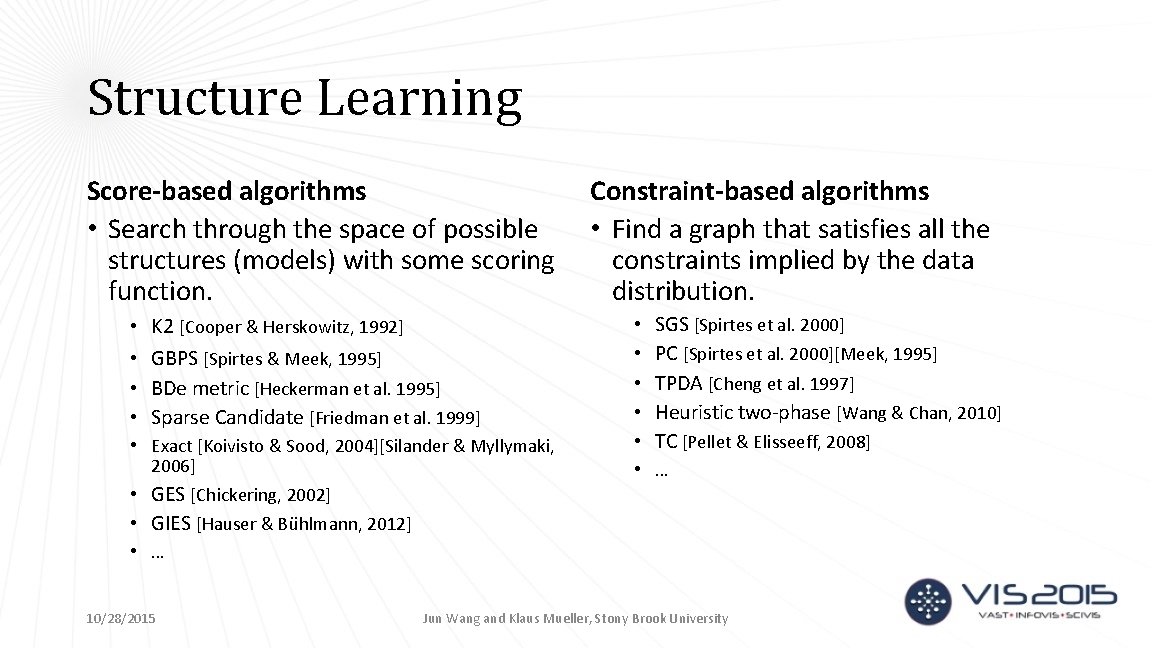
Structure Learning Score-based algorithms Constraint-based algorithms • Search through the space of possible • Find a graph that satisfies all the structures (models) with some scoring constraints implied by the data function. distribution. • • K 2 [Cooper & Herskowitz, 1992] GBPS [Spirtes & Meek, 1995] BDe metric [Heckerman et al. 1995] Sparse Candidate [Friedman et al. 1999] • Exact [Koivisto & Sood, 2004][Silander & Myllymaki, 2006] • GES [Chickering, 2002] • GIES [Hauser & Bühlmann, 2012] • … 10/28/2015 • • • SGS [Spirtes et al. 2000] PC [Spirtes et al. 2000][Meek, 1995] TPDA [Cheng et al. 1997] Heuristic two-phase [Wang & Chan, 2010] TC [Pellet & Elisseeff, 2008] • … Jun Wang and Klaus Mueller, Stony Brook University
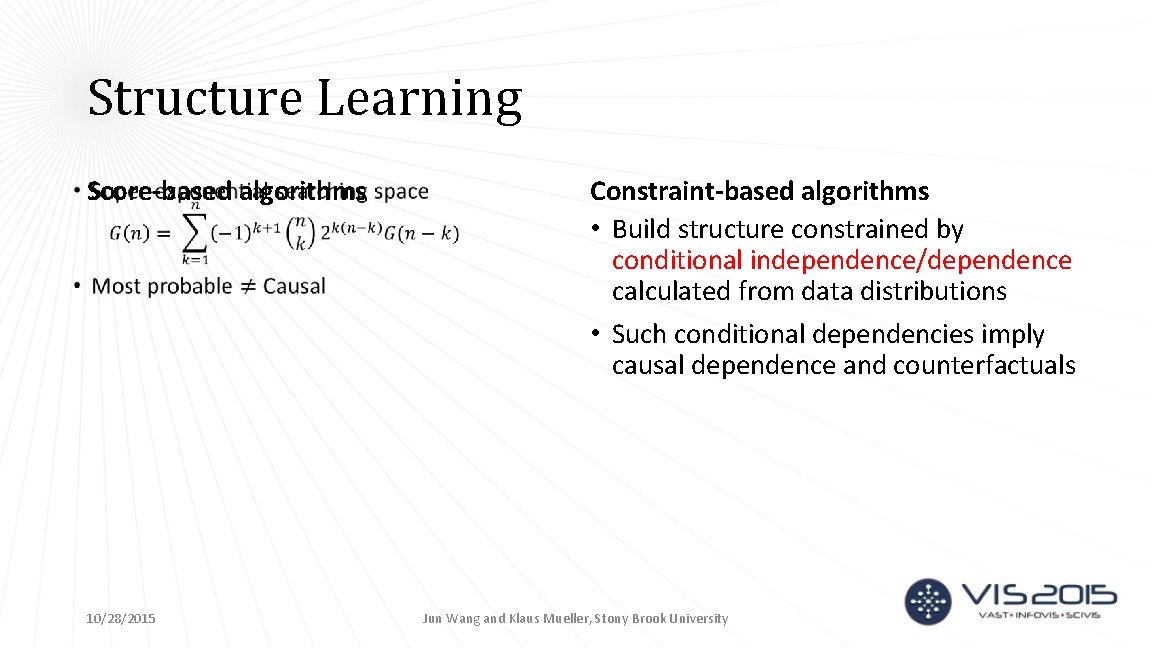
Structure Learning algorithms • Score-based 10/28/2015 Constraint-based algorithms • Build structure constrained by conditional independence/dependence calculated from data distributions • Such conditional dependencies imply causal dependence and counterfactuals Jun Wang and Klaus Mueller, Stony Brook University
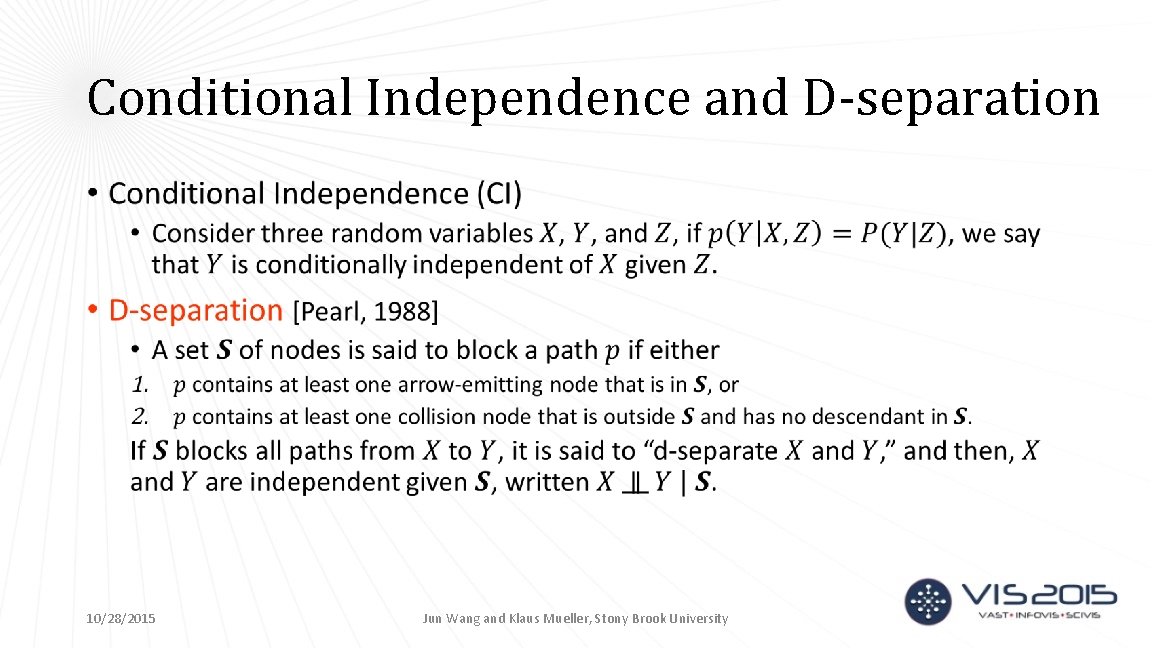
Conditional Independence and D-separation • 10/28/2015 Jun Wang and Klaus Mueller, Stony Brook University
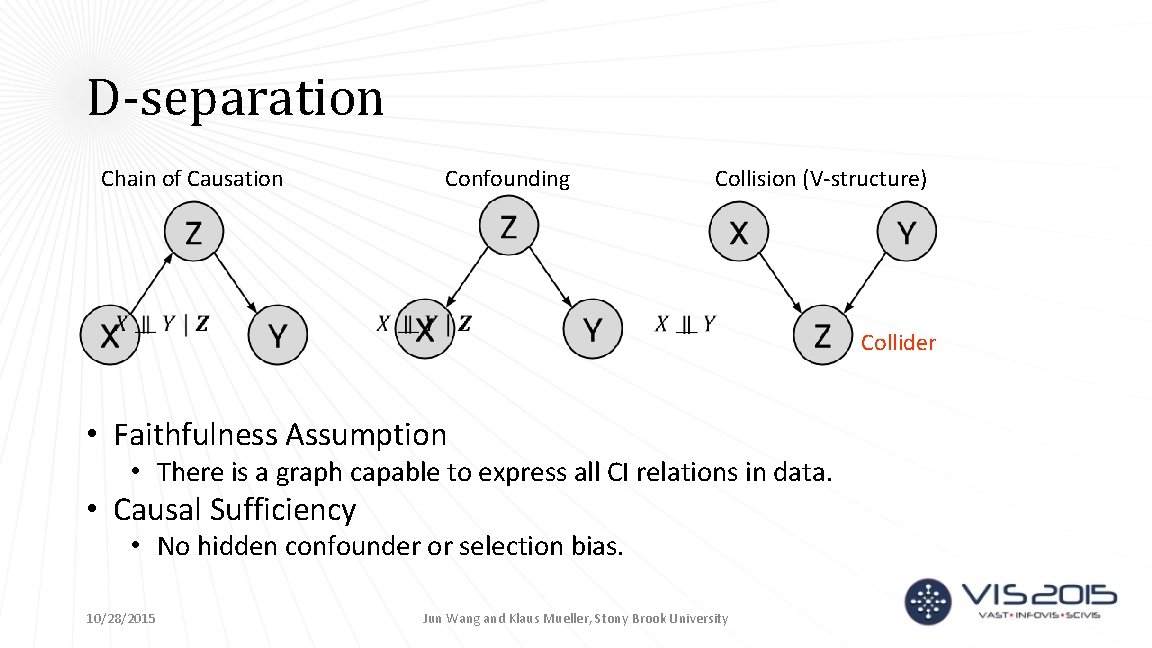
D-separation Chain of Causation Collision (V-structure) Confounding • Faithfulness Assumption • There is a graph capable to express all CI relations in data. • Causal Sufficiency • No hidden confounder or selection bias. 10/28/2015 Jun Wang and Klaus Mueller, Stony Brook University Collider
TC Algorithm [Pellet & Elisseeff, 2008] Start from an empty graph, 1. For each pair of variables in dataset, test for CI conditioning on all other variables. Connect the pair if they are dependent. Output: Moral Graph 2. For each pair of connected variables, search for colliders in variables forming triangles with them. Require a number of CI test exponential to the number of potential colliders 3. Orient V-structures and propagate. Output: Partial DAG 10/28/2015 Jun Wang and Klaus Mueller, Stony Brook University
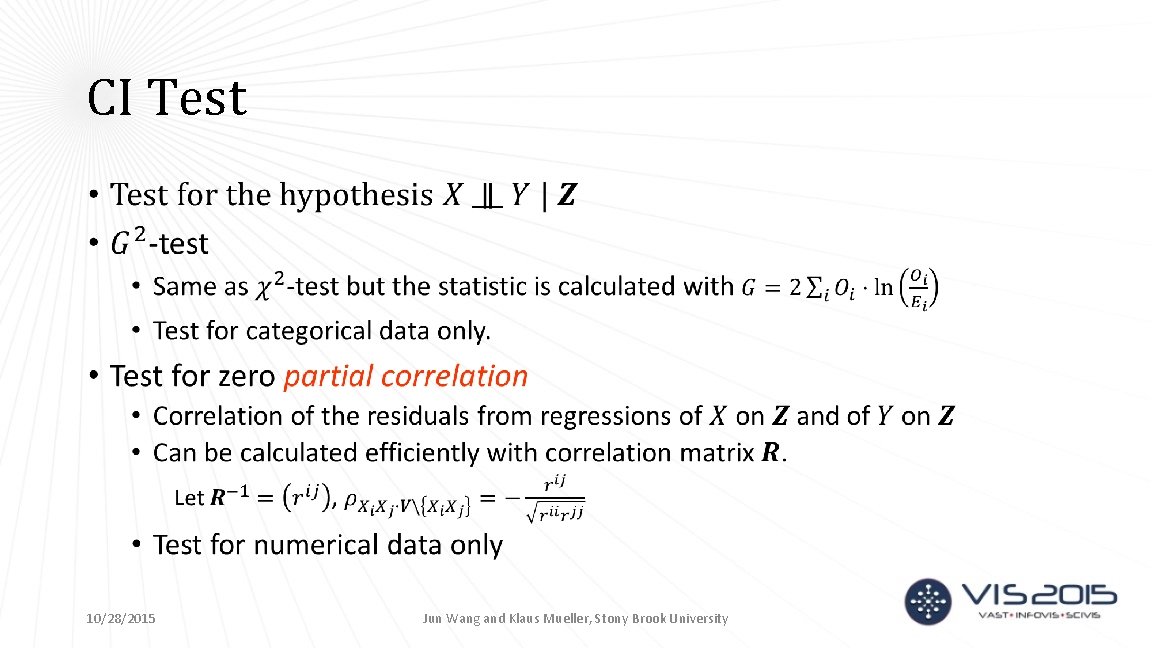
CI Test • 10/28/2015 Jun Wang and Klaus Mueller, Stony Brook University
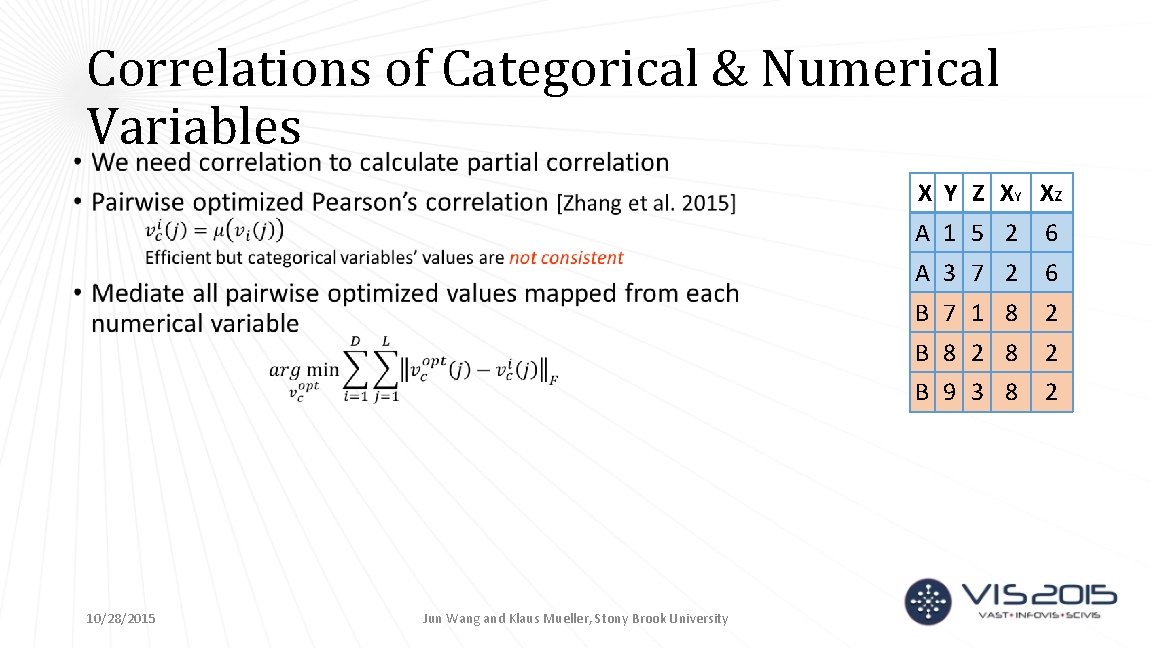
Correlations of Categorical & Numerical Variables • 10/28/2015 X Y Z XY Xz Jun Wang and Klaus Mueller, Stony Brook University A 1 5 2 6 A 3 7 2 6 B 7 1 8 2 B 9 3 8 2
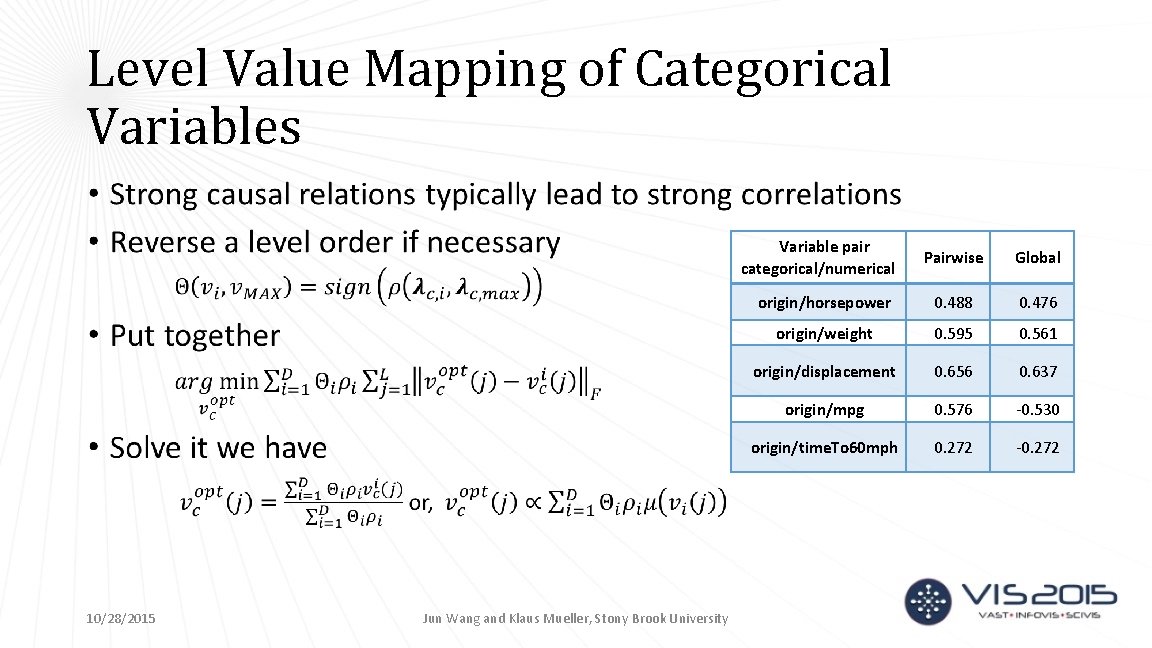
Level Value Mapping of Categorical Variables • Variable pair categorical/numerical 10/28/2015 Jun Wang and Klaus Mueller, Stony Brook University Pairwise Global origin/horsepower 0. 488 0. 476 origin/weight 0. 595 0. 561 origin/displacement 0. 656 0. 637 origin/mpg 0. 576 -0. 530 origin/time. To 60 mph 0. 272 -0. 272
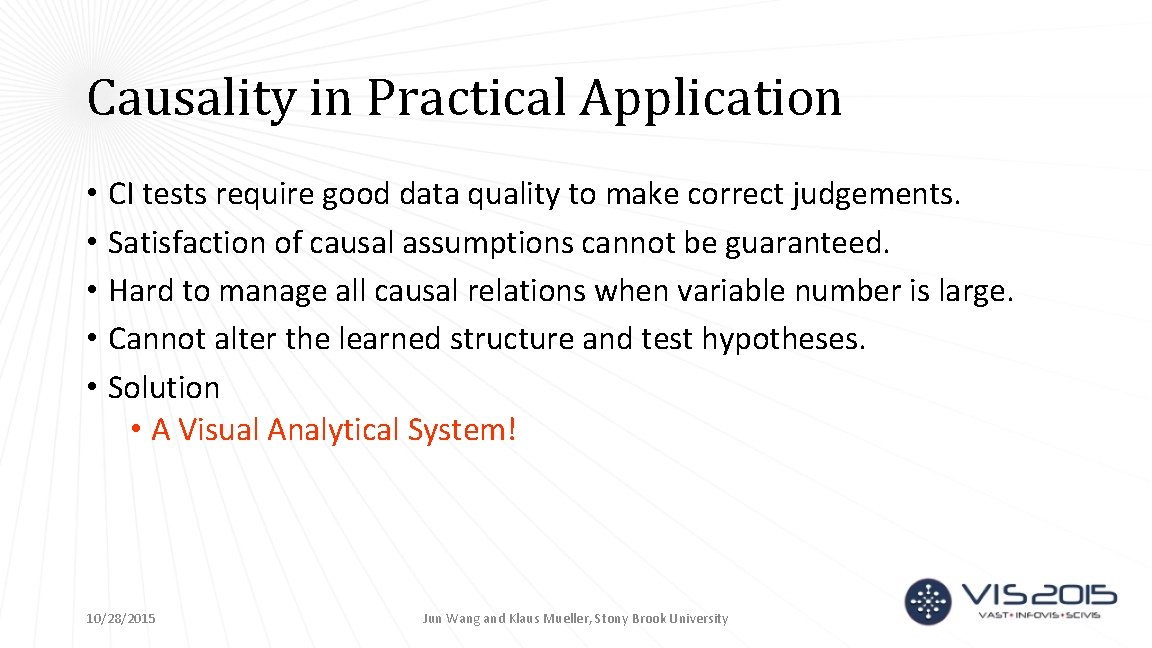
Causality in Practical Application • CI tests require good data quality to make correct judgements. • Satisfaction of causal assumptions cannot be guaranteed. • Hard to manage all causal relations when variable number is large. • Cannot alter the learned structure and test hypotheses. • Solution • A Visual Analytical System! 10/28/2015 Jun Wang and Klaus Mueller, Stony Brook University
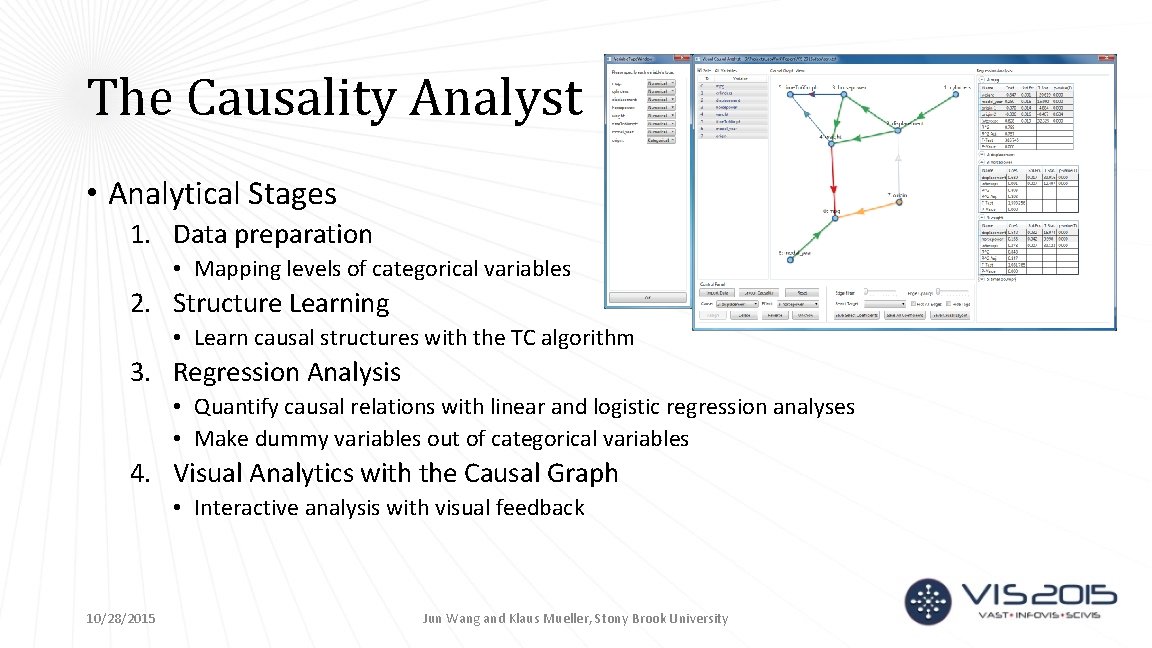
The Visual Causality Analyst Running on auto mpg dataset [UCI Machine Learning Repository, 2013] 10/28/2015 Jun Wang and Klaus Mueller, Stony Brook University
The Causality Analyst • Analytical Stages 1. Data preparation • Mapping levels of categorical variables 2. Structure Learning • Learn causal structures with the TC algorithm 3. Regression Analysis • Quantify causal relations with linear and logistic regression analyses • Make dummy variables out of categorical variables 4. Visual Analytics with the Causal Graph • Interactive analysis with visual feedback 10/28/2015 Jun Wang and Klaus Mueller, Stony Brook University
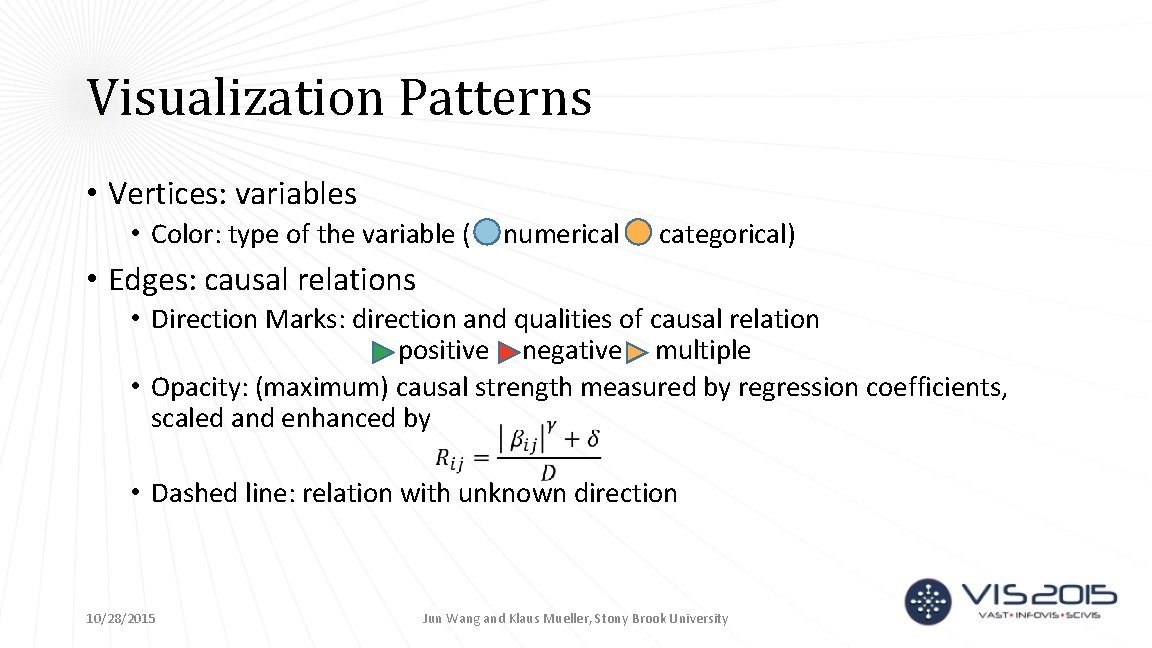
Visualization Patterns • Vertices: variables • Color: type of the variable ( numerical categorical) • Edges: causal relations • Direction Marks: direction and qualities of causal relation positive negative multiple • Opacity: (maximum) causal strength measured by regression coefficients, scaled and enhanced by • Dashed line: relation with unknown direction 10/28/2015 Jun Wang and Klaus Mueller, Stony Brook University
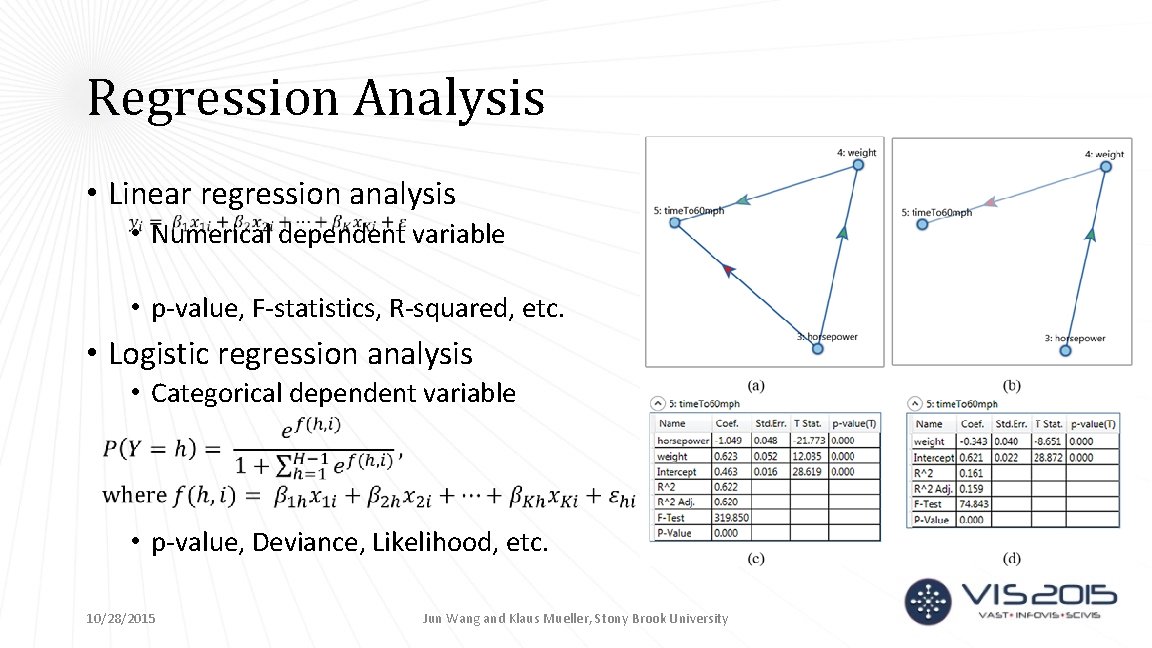
Regression Analysis • Linear regression analysis • Numerical dependent variable • p-value, F-statistics, R-squared, etc. • Logistic regression analysis • Categorical dependent variable • p-value, Deviance, Likelihood, etc. 10/28/2015 Jun Wang and Klaus Mueller, Stony Brook University
Case 1: Auto MPG dataset [UCI Machine Learning Repository, 2013] 8 variables, 392 observations The complete causal graph 10/28/2015 Filter edges with 0. 4 coefficient threshold Jun Wang and Klaus Mueller, Stony Brook University The causal chain related to mpg
Case 1: Auto MPG dataset [UCI Machine Learning Repository, 2013] The added causal relation 10/28/2015 Regression view of mpg before adding the edge Jun Wang and Klaus Mueller, Stony Brook University Regression view of mpg after adding the edge
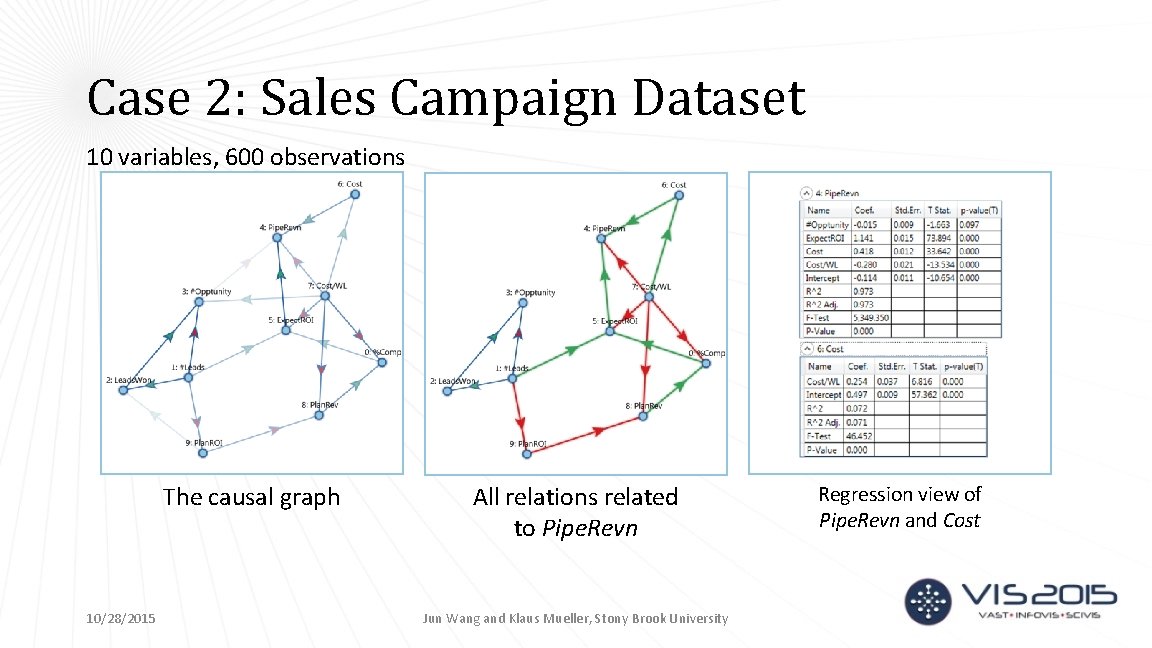
Case 2: Sales Campaign Dataset 10 variables, 600 observations The causal graph 10/28/2015 All relations related to Pipe. Revn Jun Wang and Klaus Mueller, Stony Brook University Regression view of Pipe. Revn and Cost
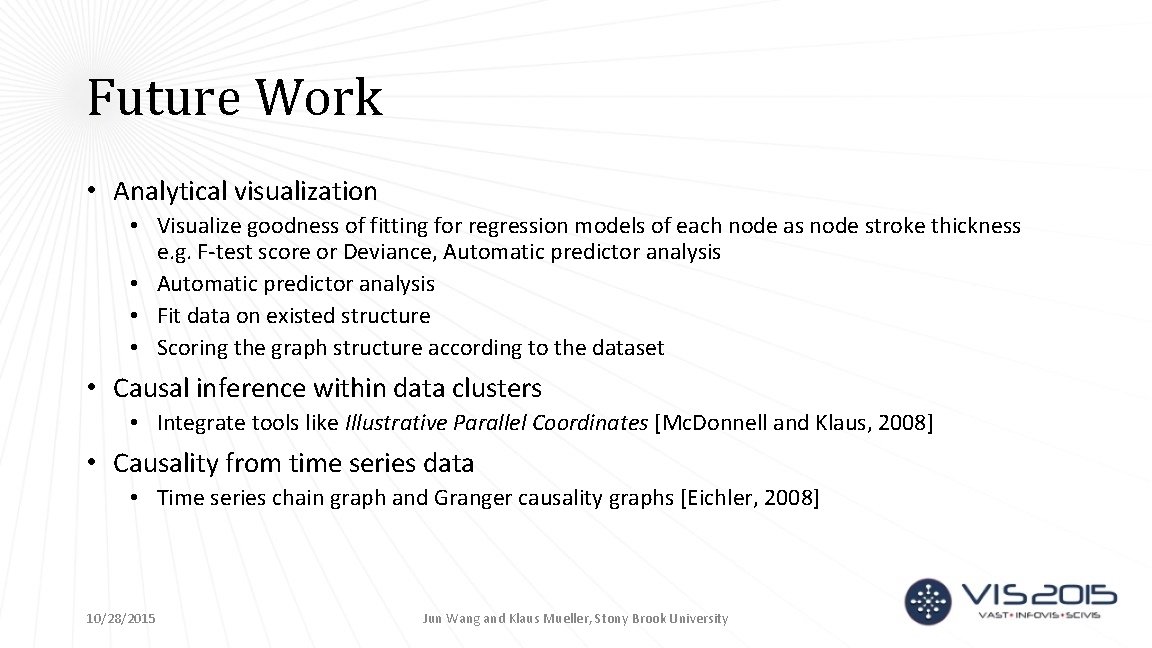
Future Work • Analytical visualization • Visualize goodness of fitting for regression models of each node as node stroke thickness e. g. F-test score or Deviance, Automatic predictor analysis • Fit data on existed structure • Scoring the graph structure according to the dataset • Causal inference within data clusters • Integrate tools like Illustrative Parallel Coordinates [Mc. Donnell and Klaus, 2008] • Causality from time series data • Time series chain graph and Granger causality graphs [Eichler, 2008] 10/28/2015 Jun Wang and Klaus Mueller, Stony Brook University
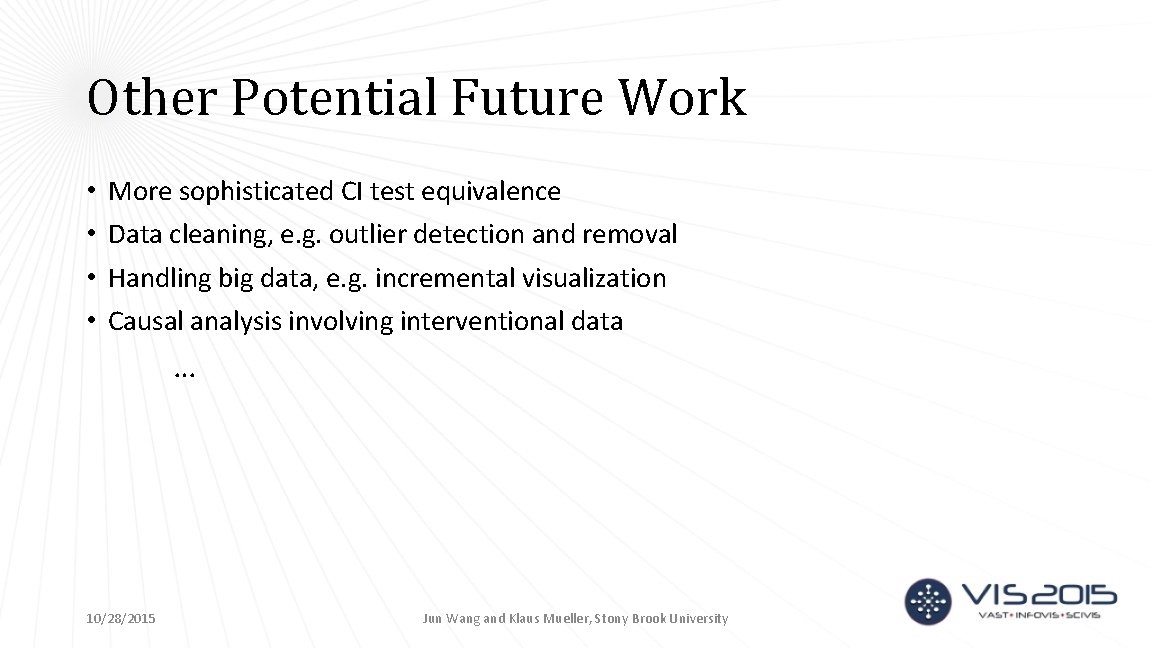
Other Potential Future Work • • More sophisticated CI test equivalence Data cleaning, e. g. outlier detection and removal Handling big data, e. g. incremental visualization Causal analysis involving interventional data … 10/28/2015 Jun Wang and Klaus Mueller, Stony Brook University
Summary • Causality and Causal Network • Constraint-based Structural Learning • Value Mapping of Categorical Variables • The Visual Causal Analyst • • Analytical Stages Visualization of Causal Graph with Statistical Assessment Interactive Analysis with Visual Feedback Prototype with Many Potential Future Work 10/28/2015 Jun Wang and Klaus Mueller, Stony Brook University
Thanks for attending my talk! 10/28/2015 Jun Wang and Klaus Mueller, Stony Brook University