
The Virtual Free Radical School Cell Signaling by
The Virtual Free Radical School Cell Signaling by Oxidants: Mitogen-Activated Protein Kinases (MAPK) and Activator Protein – 1 (AP-1) Brooke T. Mossman* and Maria Stern Environmental Pathology Program Department of Pathology College of Medicine University of Vermont Burlington, VT 05405 Tel: 802. 656. 0382 Brooke. Mossman@uvm. edu Cell Signaling by Oxidants Society For Free Radical Biology and Medicine Mossman & Stern 1
Overview Oxidants can modulate cell signaling events by modifying cell surface receptors, phosphatases and protein phosphorylation, etc. These phenomena are important in transactivation of transcription factors and activation/inactivation of gene transcription that may regulate steps in the development of disease. At least two classical signaling pathways, the Mitogen-Activated Protein Kinases (MAPK) and signaling leading to activation of NF- B, are activated by oxidants. Physiological oxidant stresses, such as asbestos, induce primarily the extracellular signalregulated kinases (ERKs) whereas H 2 O 2 causes activation of all three MAPK cascades. A consequence of MAPK activation is formation of Activator Protein– 1 (AP-1), which binds to the promoter regions of intermediate response genes governing cell proliferation, differentiation, etc. Mossman & Stern 2
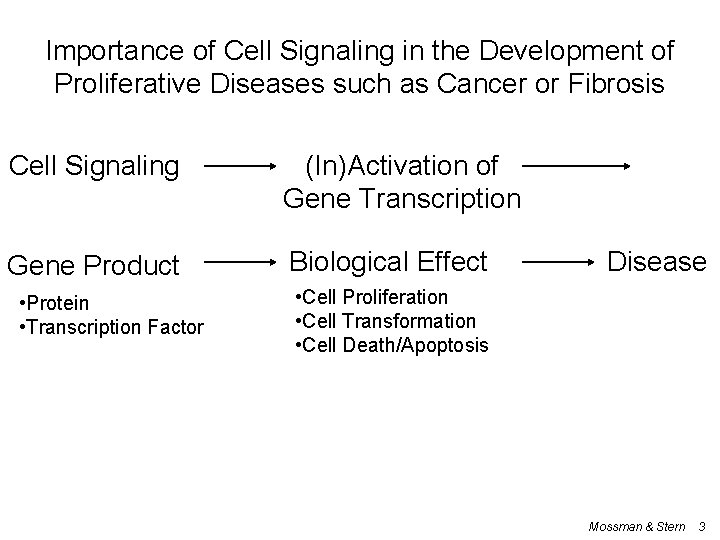
Importance of Cell Signaling in the Development of Proliferative Diseases such as Cancer or Fibrosis Cell Signaling (In)Activation of Gene Transcription Gene Product Biological Effect • Protein • Transcription Factor Disease • Cell Proliferation • Cell Transformation • Cell Death/Apoptosis Mossman & Stern 3
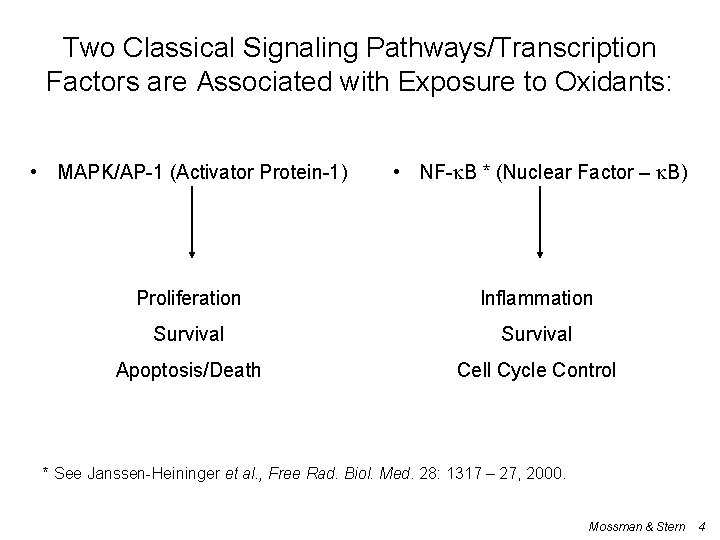
Two Classical Signaling Pathways/Transcription Factors are Associated with Exposure to Oxidants: • MAPK/AP-1 (Activator Protein-1) • NF- B * (Nuclear Factor – B) Proliferation Inflammation Survival Apoptosis/Death Cell Cycle Control * See Janssen-Heininger et al. , Free Rad. Biol. Med. 28: 1317 – 27, 2000. Mossman & Stern 4
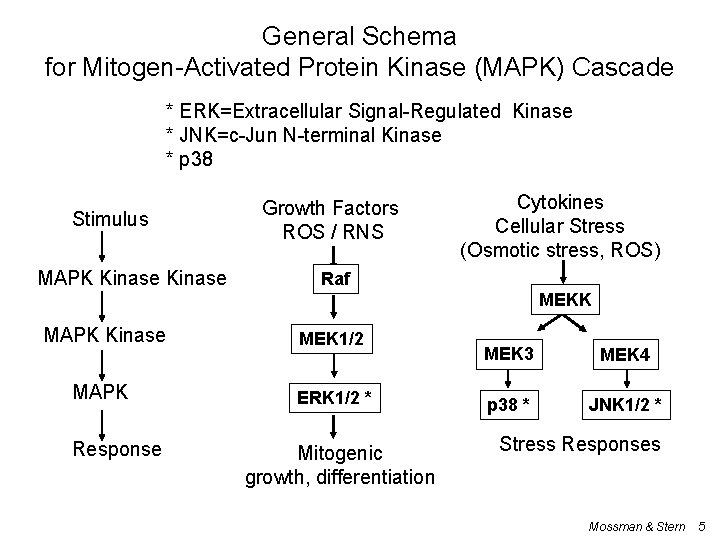
General Schema for Mitogen-Activated Protein Kinase (MAPK) Cascade * ERK=Extracellular Signal-Regulated Kinase * JNK=c-Jun N-terminal Kinase * p 38 Stimulus MAPK Kinase Growth Factors ROS / RNS Raf MEKK MAPK Kinase MEK 1/2 MAPK ERK 1/2 * Response Cytokines Cellular Stress (Osmotic stress, ROS) Mitogenic growth, differentiation MEK 3 MEK 4 p 38 * JNK 1/2 * Stress Responses Mossman & Stern 5
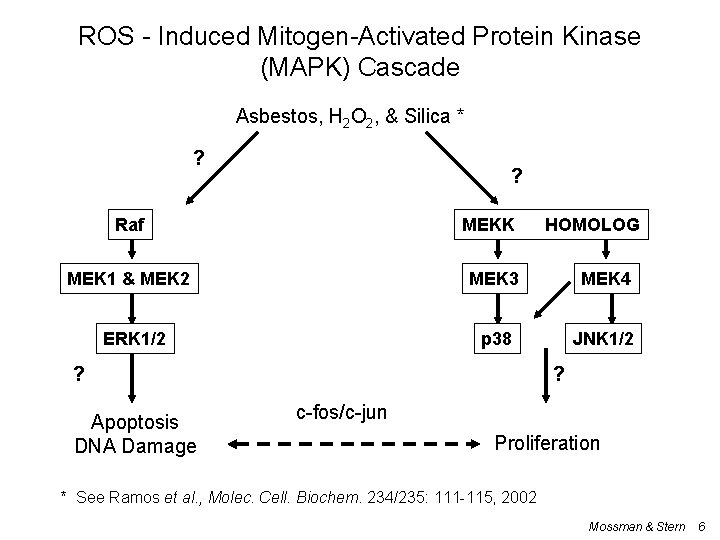
ROS - Induced Mitogen-Activated Protein Kinase (MAPK) Cascade Asbestos, H 2 O 2, & Silica * ? ? Raf MEKK MEK 1 & MEK 2 ERK 1/2 MEK 3 MEK 4 p 38 JNK 1/2 ? Apoptosis DNA Damage HOMOLOG ? c-fos/c-jun Proliferation * See Ramos et al. , Molec. Cell. Biochem. 234/235: 111 -115, 2002 Mossman & Stern 6
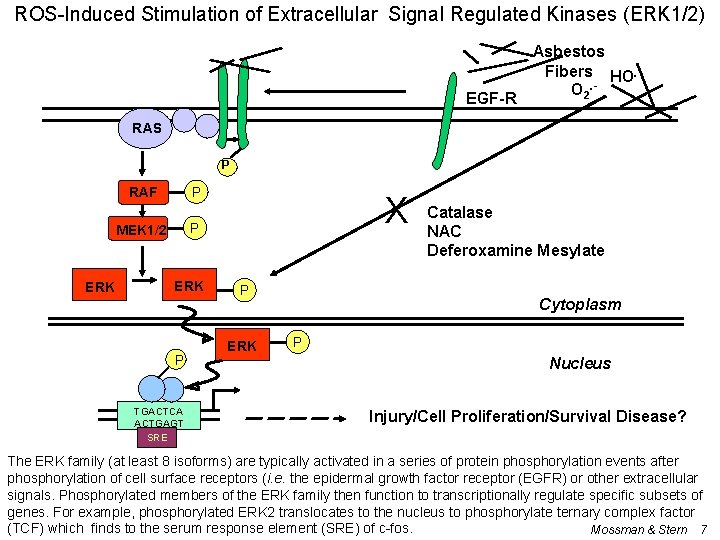
ROS-Induced Stimulation of Extracellular Signal Regulated Kinases (ERK 1/2) EGF-R Asbestos Fibers HO. O 2. - RAS P P RAF P MEK 1/2 ERK X ERK P TGACTCA ACTGAGT SRE P ERK Catalase NAC Deferoxamine Mesylate Cytoplasm P Nucleus Injury/Cell Proliferation/Survival Disease? The ERK family (at least 8 isoforms) are typically activated in a series of protein phosphorylation events after phosphorylation of cell surface receptors (i. e. the epidermal growth factor receptor (EGFR) or other extracellular signals. Phosphorylated members of the ERK family then function to transcriptionally regulate specific subsets of genes. For example, phosphorylated ERK 2 translocates to the nucleus to phosphorylate ternary complex factor (TCF) which finds to the serum response element (SRE) of c-fos. Mossman & Stern 7
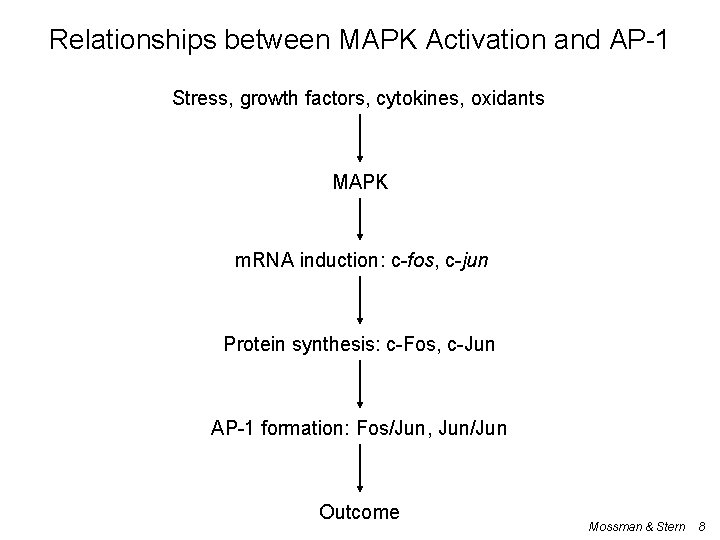
Relationships between MAPK Activation and AP-1 Stress, growth factors, cytokines, oxidants MAPK m. RNA induction: c-fos, c-jun Protein synthesis: c-Fos, c-Jun AP-1 formation: Fos/Jun, Jun/Jun Outcome Mossman & Stern 8
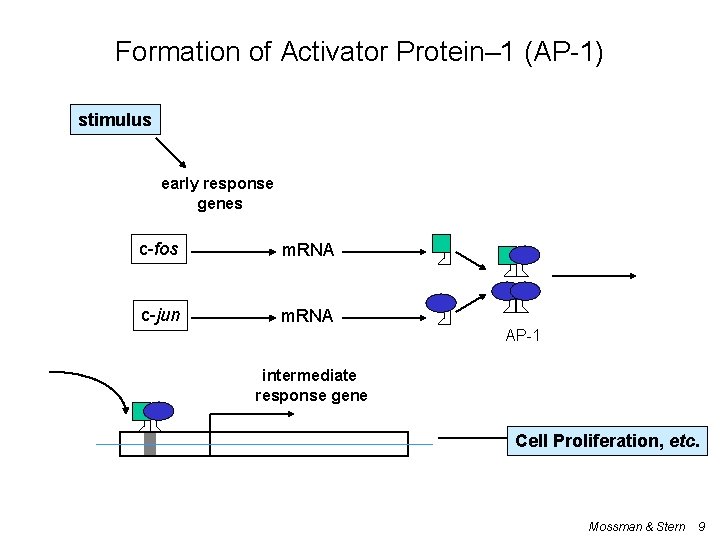
Formation of Activator Protein– 1 (AP-1) stimulus early response genes c-fos m. RNA c-jun m. RNA AP-1 intermediate response gene Cell Proliferation, etc. Mossman & Stern 9
Summary • Oxidants can induce MAPK. • The MAPKs family includes extracellular signal-regulated kinases (ERKs), which are generally activated by mitogens, and c-Jun NH 2 – terminal kinase (JNKs) and p 38 MAPKs, both activated by cytokines and cellular stresses. • Upon activation, JNKs and ERKs phosphorylate Jun and Fos proteins, i. e. AP-1 family members. Although p 38 MAPKs do not activate AP-1 proteins directly, they can regulate jun and fos transcription by phosphorylating enhancer binding proteins (C/EBPs) binding to their promoter elements. • By selective dimerization of AP-1 family members (Jun/Jun or Fos/Jun partners) and diverse binding specificities with the promoter regions of genes, the AP-1 transcription factor regulates gene expression important in cell injury, repair, proliferation, and differentiation. Mossman & Stern 10
- Slides: 10