
The Virtual Free Radical School Biological Protein Nitration
The Virtual Free Radical School Biological Protein Nitration: Mechanisms and Significance Harry Ischiropoulos Stokes Research Institute, Children’s Hospital of Philadelphia, Department of Biochemistry and Biophysics, The University of Pennsylvania 416 D Abramson Center, 34 th Street and Civic Center Blvd. Philadelphia, PA 19104 -4318 Tel: (215) 590 -5320, Fax: (215) 590 -4267 email: ischirop@mail. med. upenn. edu Protein Nitration Society For Free Radical Biology and Medicine Ischiropoulos 1
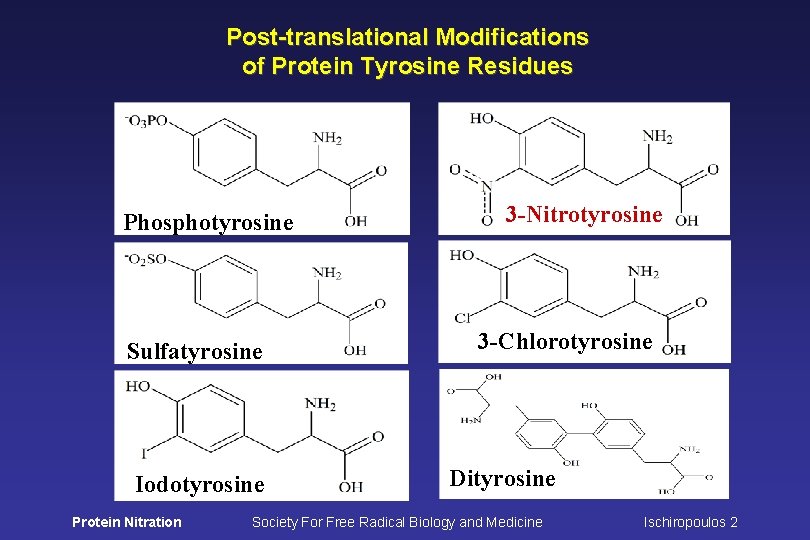
Post-translational Modifications of Protein Tyrosine Residues Phosphotyrosine Sulfatyrosine Iodotyrosine Protein Nitration 3 -Nitrotyrosine 3 -Chlorotyrosine Dityrosine Society For Free Radical Biology and Medicine Ischiropoulos 2
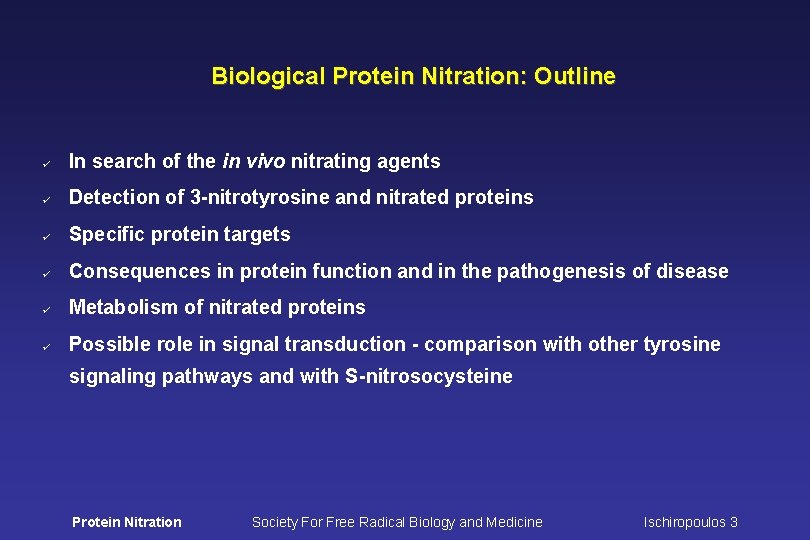
Biological Protein Nitration: Outline ü In search of the in vivo nitrating agents ü Detection of 3 -nitrotyrosine and nitrated proteins ü Specific protein targets ü Consequences in protein function and in the pathogenesis of disease ü Metabolism of nitrated proteins ü Possible role in signal transduction - comparison with other tyrosine signaling pathways and with S-nitrosocysteine Protein Nitration Society For Free Radical Biology and Medicine Ischiropoulos 3
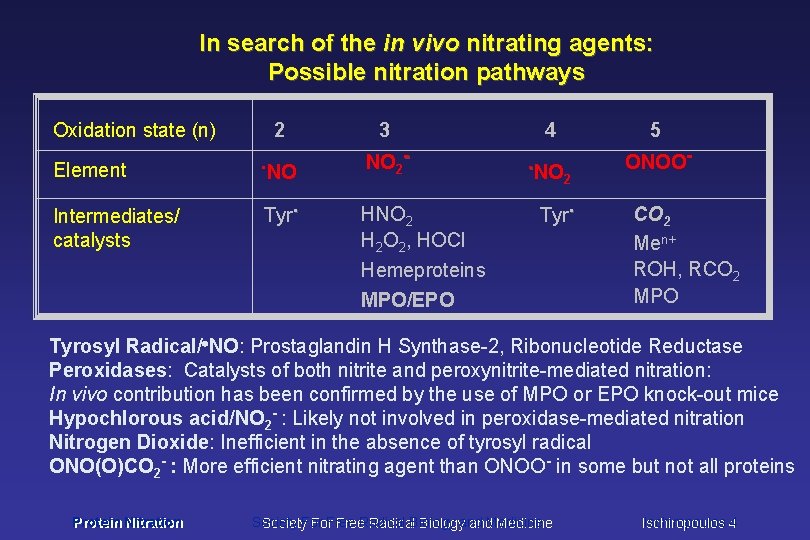
In search of the in vivo nitrating agents: Possible nitration pathways Oxidation state (n) Element Intermediates/ catalysts 2 3 4 5 . NO NO 2 - . NO ONOO- Tyr. HNO 2 H 2 O 2, HOCl Hemeproteins MPO/EPO 2 Tyr. CO 2 Men+ ROH, RCO 2 MPO Tyrosyl Radical/ NO: Prostaglandin H Synthase-2, Ribonucleotide Reductase Peroxidases: Catalysts of both nitrite and peroxynitrite-mediated nitration: In vivo contribution has been confirmed by the use of MPO or EPO knock-out mice Hypochlorous acid/NO 2 - : Likely not involved in peroxidase-mediated nitration Nitrogen Dioxide: Inefficient in the absence of tyrosyl radical ONO(O)CO 2 - : More efficient nitrating agent than ONOO- in some but not all proteins Protein Nitration Society. For. Free. Radical. Biologyand and. Medicine Ischiropoulos 44 Ischiropoulos
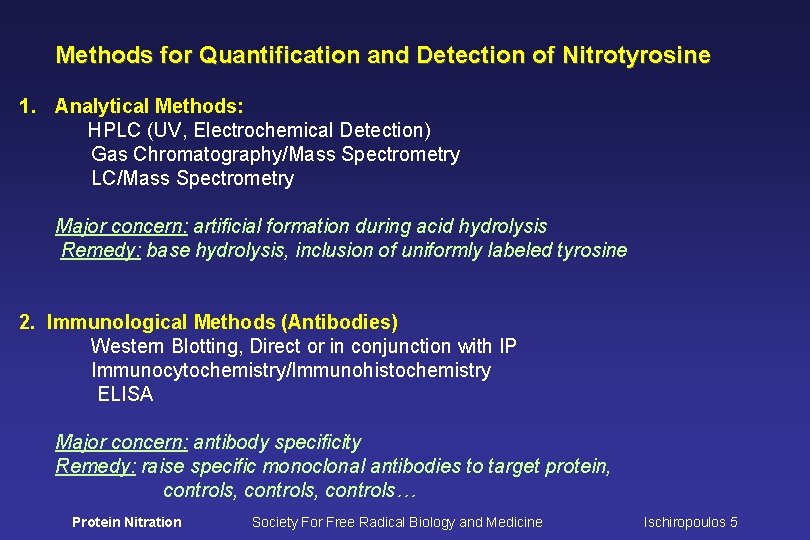
Methods for Quantification and Detection of Nitrotyrosine 1. Analytical Methods: HPLC (UV, Electrochemical Detection) Gas Chromatography/Mass Spectrometry LC/Mass Spectrometry Major concern: artificial formation during acid hydrolysis Remedy: base hydrolysis, inclusion of uniformly labeled tyrosine 2. Immunological Methods (Antibodies) Western Blotting, Direct or in conjunction with IP Immunocytochemistry/Immunohistochemistry ELISA Major concern: antibody specificity Remedy: raise specific monoclonal antibodies to target protein, controls, controls… Protein Nitration Society For Free Radical Biology and Medicine Ischiropoulos 5
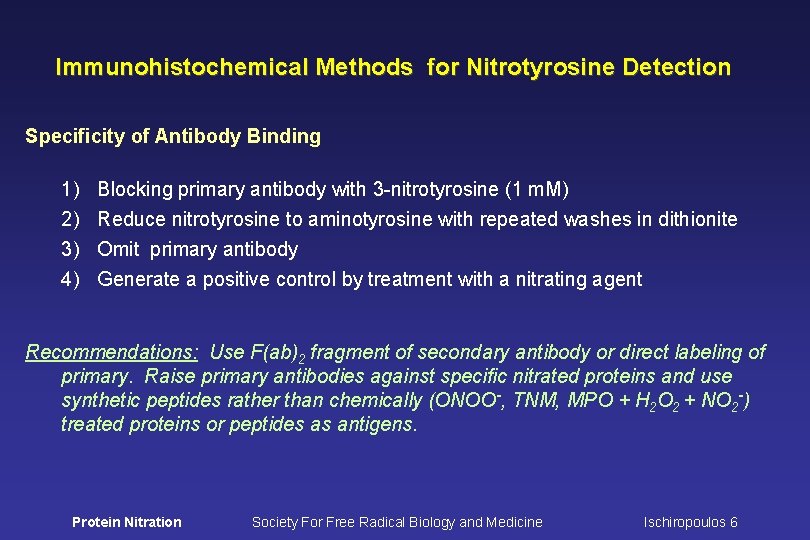
Immunohistochemical Methods for Nitrotyrosine Detection Specificity of Antibody Binding 1) 2) 3) 4) Blocking primary antibody with 3 -nitrotyrosine (1 m. M) Reduce nitrotyrosine to aminotyrosine with repeated washes in dithionite Omit primary antibody Generate a positive control by treatment with a nitrating agent Recommendations: Use F(ab)2 fragment of secondary antibody or direct labeling of primary. Raise primary antibodies against specific nitrated proteins and use synthetic peptides rather than chemically (ONOO-, TNM, MPO + H 2 O 2 + NO 2 -) treated proteins or peptides as antigens. Protein Nitration Society For Free Radical Biology and Medicine Ischiropoulos 6

Protein Tyrosine Nitration ØSpecific proteins modified by nitration have been detected in more than 50 human disorders ØAssociated with oxidative stress, most of the nitrating agents require the formation of reactive nitrogen and oxygen species ØLocalized at site(s) of injury and in selective cell types ØOnly a selective number of proteins are modified by nitration in vivo ØOnly specific tyrosine residues in proteins are targets for nitration: Selectivity is derived from protein structure and folding Protein Nitration Society For Free Radical Biology and Medicine Ischiropoulos 7
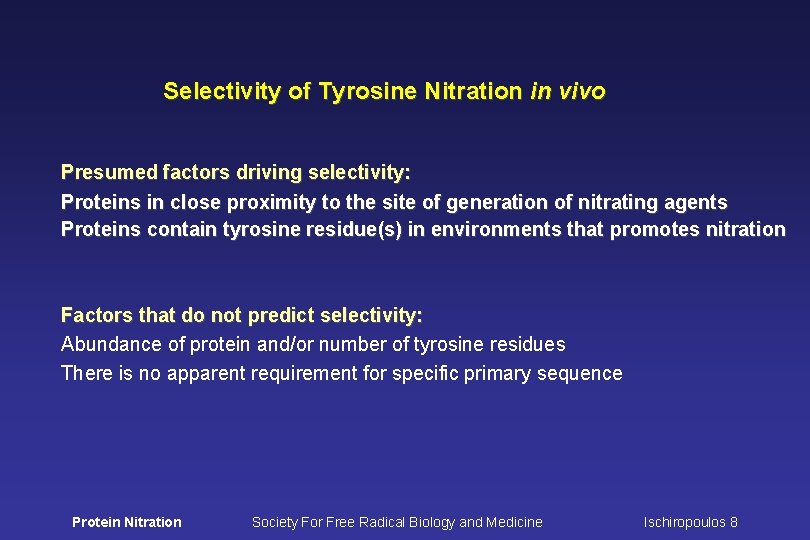
Selectivity of Tyrosine Nitration in vivo Presumed factors driving selectivity: Proteins in close proximity to the site of generation of nitrating agents Proteins contain tyrosine residue(s) in environments that promotes nitration Factors that do not predict selectivity: Abundance of protein and/or number of tyrosine residues There is no apparent requirement for specific primary sequence Protein Nitration Society For Free Radical Biology and Medicine Ischiropoulos 8
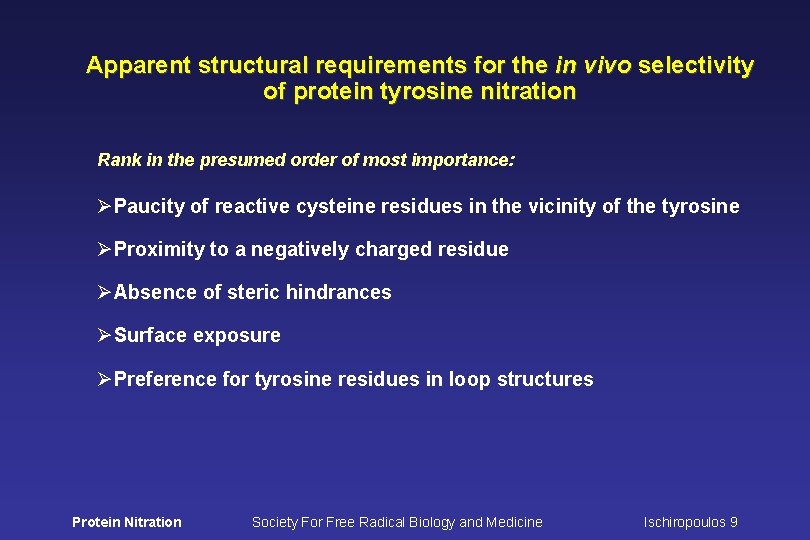
Apparent structural requirements for the in vivo selectivity of protein tyrosine nitration Rank in the presumed order of most importance: ØPaucity of reactive cysteine residues in the vicinity of the tyrosine ØProximity to a negatively charged residue ØAbsence of steric hindrances ØSurface exposure ØPreference for tyrosine residues in loop structures Protein Nitration Society For Free Radical Biology and Medicine Ischiropoulos 9
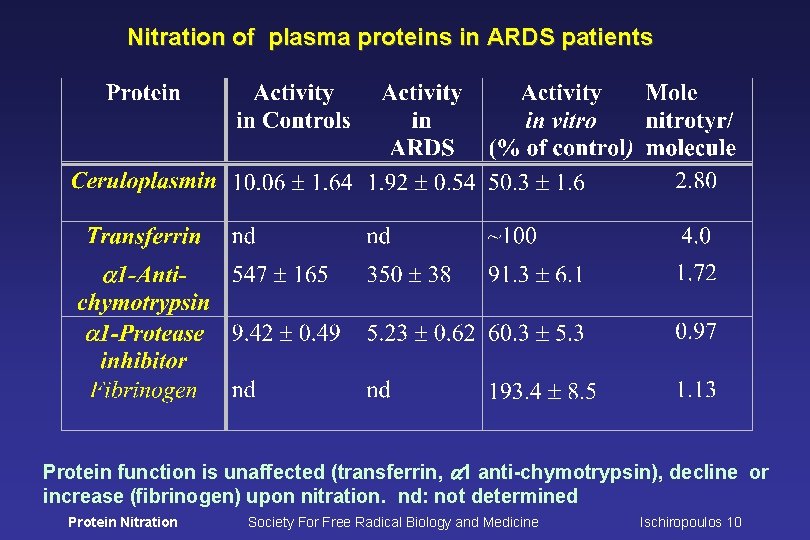
Nitration of plasma proteins in ARDS patients Protein function is unaffected (transferrin, a 1 anti-chymotrypsin), decline or increase (fibrinogen) upon nitration. nd: not determined Protein Nitration Society For Free Radical Biology and Medicine Ischiropoulos 10
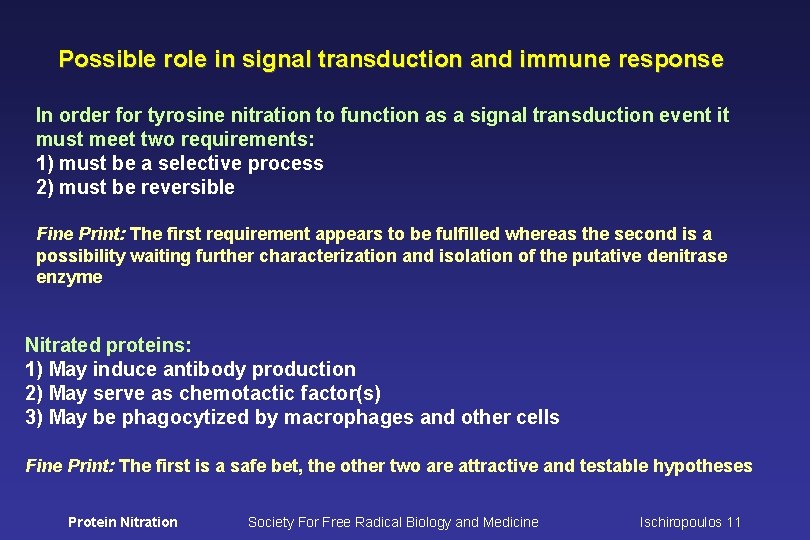
Possible role in signal transduction and immune response In order for tyrosine nitration to function as a signal transduction event it must meet two requirements: 1) must be a selective process 2) must be reversible Fine Print: The first requirement appears to be fulfilled whereas the second is a possibility waiting further characterization and isolation of the putative denitrase enzyme Nitrated proteins: 1) May induce antibody production 2) May serve as chemotactic factor(s) 3) May be phagocytized by macrophages and other cells Fine Print: The first is a safe bet, the other two are attractive and testable hypotheses Protein Nitration Society For Free Radical Biology and Medicine Ischiropoulos 11
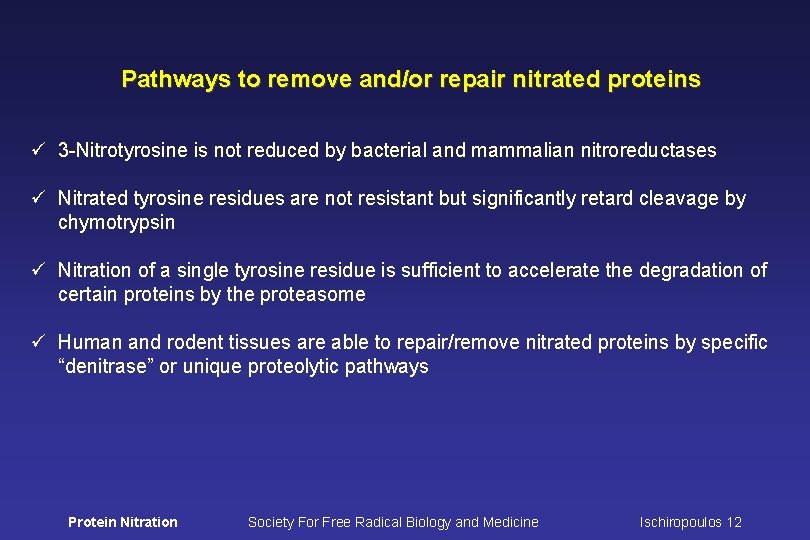
Pathways to remove and/or repair nitrated proteins ü 3 -Nitrotyrosine is not reduced by bacterial and mammalian nitroreductases ü Nitrated tyrosine residues are not resistant but significantly retard cleavage by chymotrypsin ü Nitration of a single tyrosine residue is sufficient to accelerate the degradation of certain proteins by the proteasome ü Human and rodent tissues are able to repair/remove nitrated proteins by specific “denitrase” or unique proteolytic pathways Protein Nitration Society For Free Radical Biology and Medicine Ischiropoulos 12
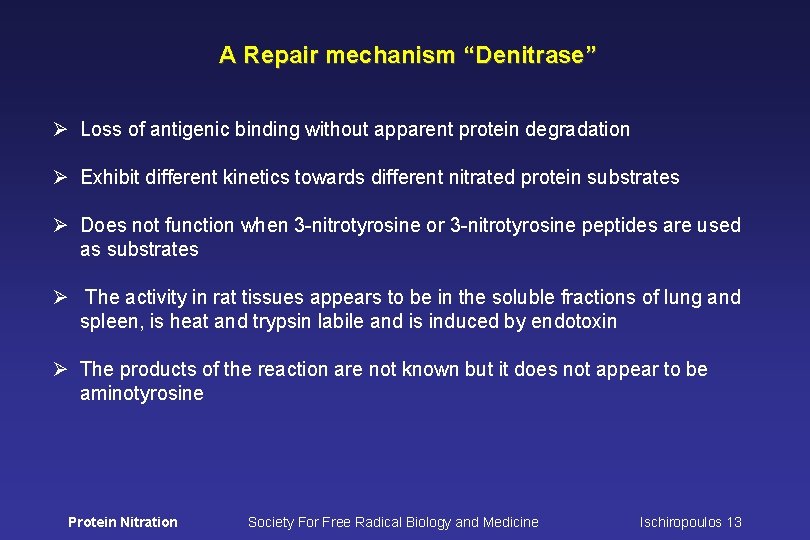
A Repair mechanism “Denitrase” Ø Loss of antigenic binding without apparent protein degradation Ø Exhibit different kinetics towards different nitrated protein substrates Ø Does not function when 3 -nitrotyrosine or 3 -nitrotyrosine peptides are used as substrates Ø The activity in rat tissues appears to be in the soluble fractions of lung and spleen, is heat and trypsin labile and is induced by endotoxin Ø The products of the reaction are not known but it does not appear to be aminotyrosine Protein Nitration Society For Free Radical Biology and Medicine Ischiropoulos 13
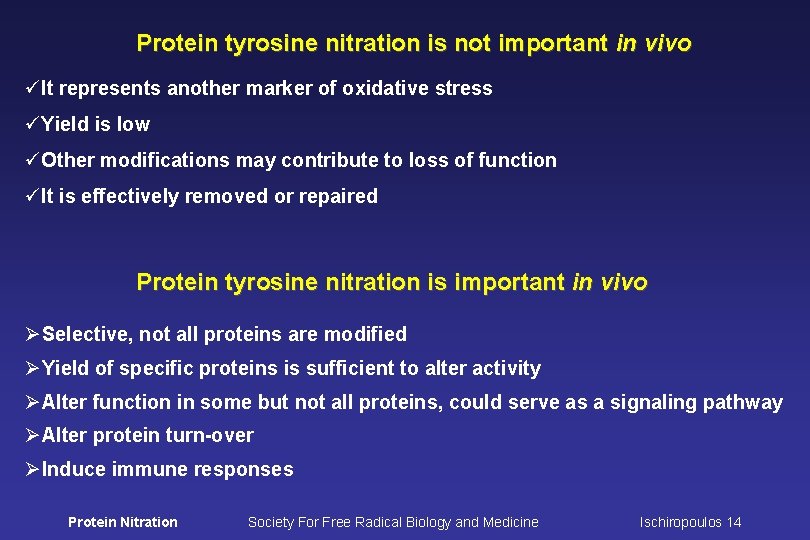
Protein tyrosine nitration is not important in vivo üIt represents another marker of oxidative stress üYield is low üOther modifications may contribute to loss of function üIt is effectively removed or repaired Protein tyrosine nitration is important in vivo ØSelective, not all proteins are modified ØYield of specific proteins is sufficient to alter activity ØAlter function in some but not all proteins, could serve as a signaling pathway ØAlter protein turn-over ØInduce immune responses Protein Nitration Society For Free Radical Biology and Medicine Ischiropoulos 14
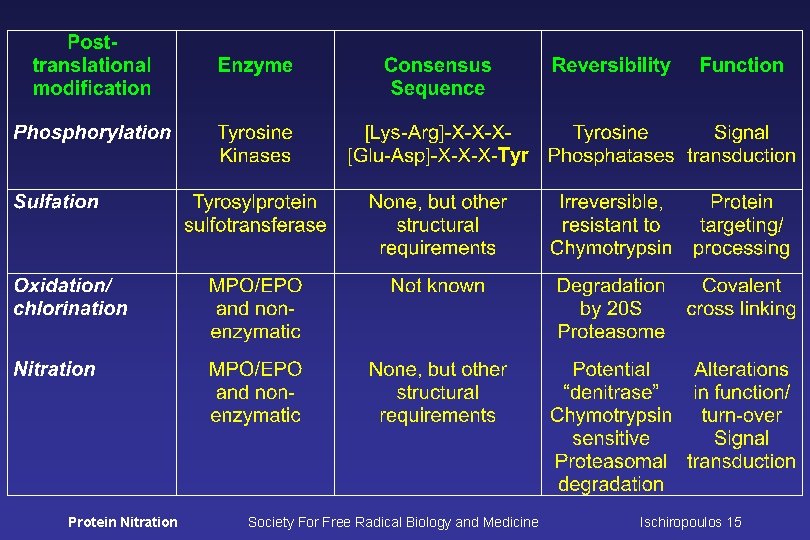
Protein Nitration Society For Free Radical Biology and Medicine Ischiropoulos 15
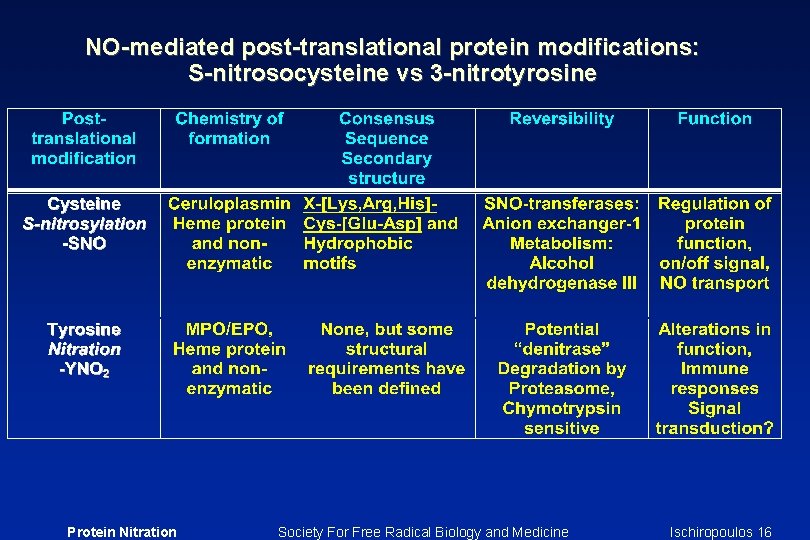
NO-mediated post-translational protein modifications: S-nitrosocysteine vs 3 -nitrotyrosine Protein Nitration Society For Free Radical Biology and Medicine Ischiropoulos 16
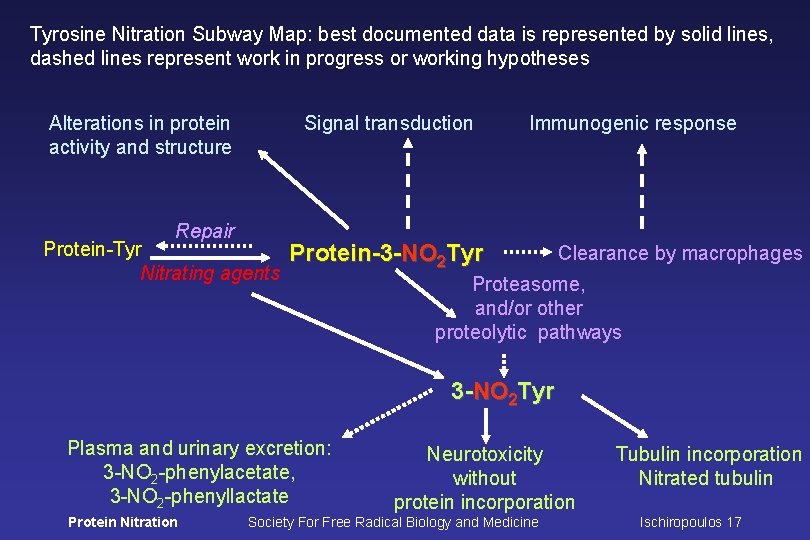
Tyrosine Nitration Subway Map: best documented data is represented by solid lines, dashed lines represent work in progress or working hypotheses Alterations in protein activity and structure Repair Signal transduction Protein-Tyr Nitrating agents Immunogenic response Protein-3 -NO 2 Tyr Clearance by macrophages Proteasome, and/or other proteolytic pathways 3 -NO 2 Tyr Plasma and urinary excretion: 3 -NO 2 -phenylacetate, 3 -NO 2 -phenyllactate Protein Nitration Neurotoxicity without protein incorporation Society For Free Radical Biology and Medicine Tubulin incorporation Nitrated tubulin Ischiropoulos 17
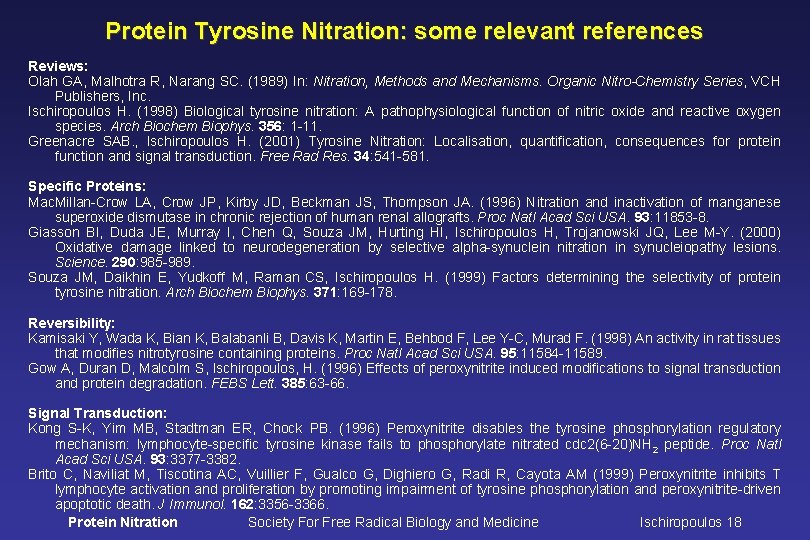
Protein Tyrosine Nitration: some relevant references Reviews: Olah GA, Malhotra R, Narang SC. (1989) In: Nitration, Methods and Mechanisms. Organic Nitro-Chemistry Series, VCH Publishers, Inc. Ischiropoulos H. (1998) Biological tyrosine nitration: A pathophysiological function of nitric oxide and reactive oxygen species. Arch Biochem Biophys. 356: 1 -11. Greenacre SAB. , Ischiropoulos H. (2001) Tyrosine Nitration: Localisation, quantification, consequences for protein function and signal transduction. Free Rad Res. 34: 541 -581. Specific Proteins: Mac. Millan-Crow LA, Crow JP, Kirby JD, Beckman JS, Thompson JA. (1996) Nitration and inactivation of manganese superoxide dismutase in chronic rejection of human renal allografts. Proc Natl Acad Sci USA. 93: 11853 -8. Giasson BI, Duda JE, Murray I, Chen Q, Souza JM, Hurting HI, Ischiropoulos H, Trojanowski JQ, Lee M-Y. (2000) Oxidative damage linked to neurodegeneration by selective alpha-synuclein nitration in synucleiopathy lesions. Science. 290: 985 -989. Souza JM, Daikhin E, Yudkoff M, Raman CS, Ischiropoulos H. (1999) Factors determining the selectivity of protein tyrosine nitration. Arch Biochem Biophys. 371: 169 -178. Reversibility: Kamisaki Y, Wada K, Bian K, Balabanli B, Davis K, Martin E, Behbod F, Lee Y-C, Murad F. (1998) An activity in rat tissues that modifies nitrotyrosine containing proteins. Proc Natl Acad Sci USA. 95: 11584 -11589. Gow A, Duran D, Malcolm S, Ischiropoulos, H. (1996) Effects of peroxynitrite induced modifications to signal transduction and protein degradation. FEBS Lett. 385: 63 -66. Signal Transduction: Kong S-K, Yim MB, Stadtman ER, Chock PB. (1996) Peroxynitrite disables the tyrosine phosphorylation regulatory mechanism: lymphocyte-specific tyrosine kinase fails to phosphorylate nitrated cdc 2(6 -20)NH 2 peptide. Proc Natl Acad Sci USA. 93: 3377 -3382. Brito C, Naviliat M, Tiscotina AC, Vuillier F, Gualco G, Dighiero G, Radi R, Cayota AM (1999) Peroxynitrite inhibits T lymphocyte activation and proliferation by promoting impairment of tyrosine phosphorylation and peroxynitrite-driven apoptotic death. J Immunol. 162: 3356 -3366. Protein Nitration Society For Free Radical Biology and Medicine Ischiropoulos 18
- Slides: 18